
Ask a vendor "how much does a people counter cost" and you get a price per door. Ask "what will it cost me over five years" and the answer looks different, because the sticker price is only the first line in a longer bill. A people counting system carries hardware, an install, a recurring subscription, support, and the slow-burn cost of keeping it accurate as doors get repainted and ceilings re-fitted. Two systems quoted at the same headline number can diverge widely once all of that is added up. This post breaks the total cost of ownership into its parts, shows which are one-time and which recur, and points to what moves each line, so you can compare quotes on the number that matters rather than the one on the front page.
Before the model, a word on price ranges. Public list prices for people counters are scarce and inconsistent, because most vendors quote against a site survey rather than a catalogue. Where a figure is not attributable to a dated public source, this post describes the cost driver instead of inventing a number, because a made-up range only anchors a buyer to a figure that does not hold at their own doors.
What is the total cost of ownership of a people counting system?
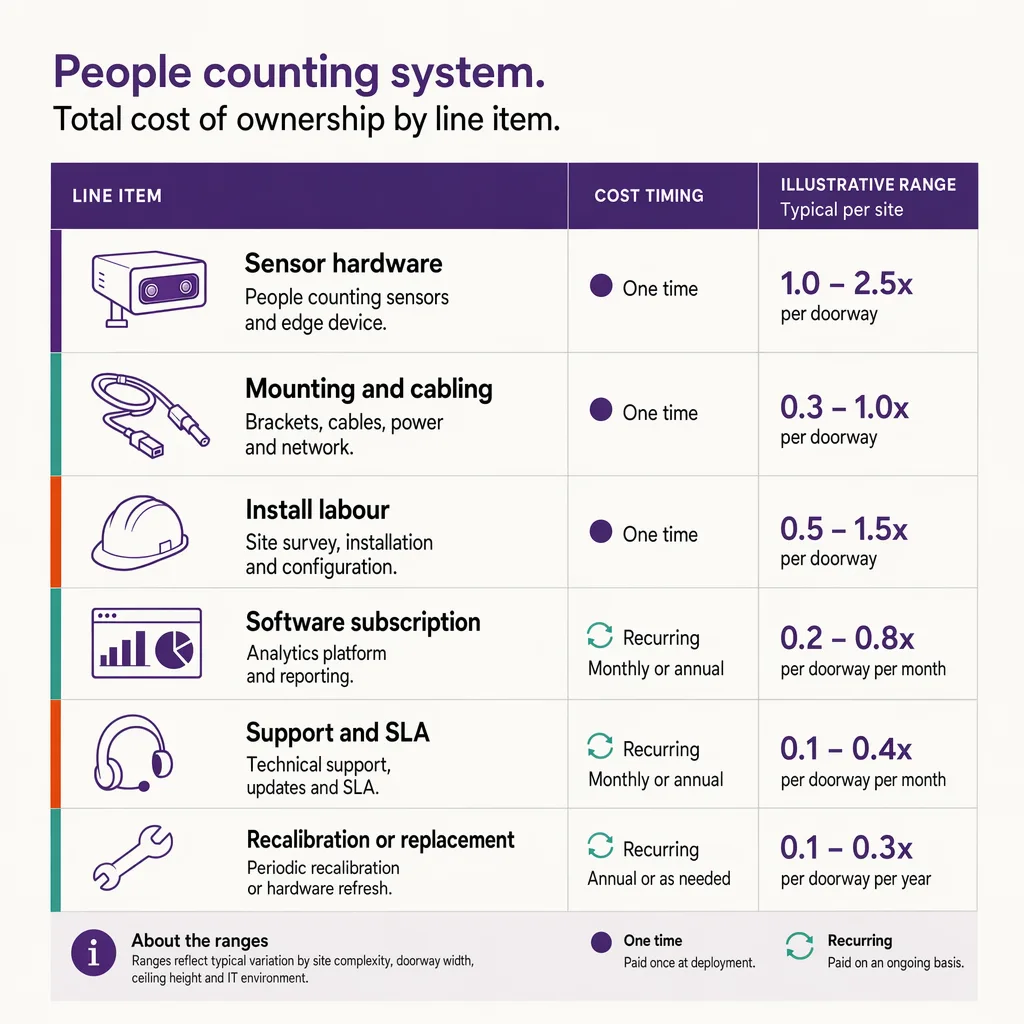
Total cost of ownership for a people counting system is the full five-year cost, not the purchase price: sensor hardware, mounting and cabling, install labour, the software subscription, support and SLA, and the cost of recalibration or replacement over the period. Two systems with the same sticker price can differ sharply once you add cabling for camera-based units, battery replacement cycles, or per-door subscription tiers. The honest comparison scopes every line to the doors you actually have and runs it across five years, because a per-door price that looks cheap can carry a subscription that overtakes the hardware saving inside the first two years.
The rest of this guide walks each line item, separates the one-time spend from the recurring spend, and flags the costs buyers most often miss when they compare on the headline figure alone.
What a people counter costs, and what drives the price
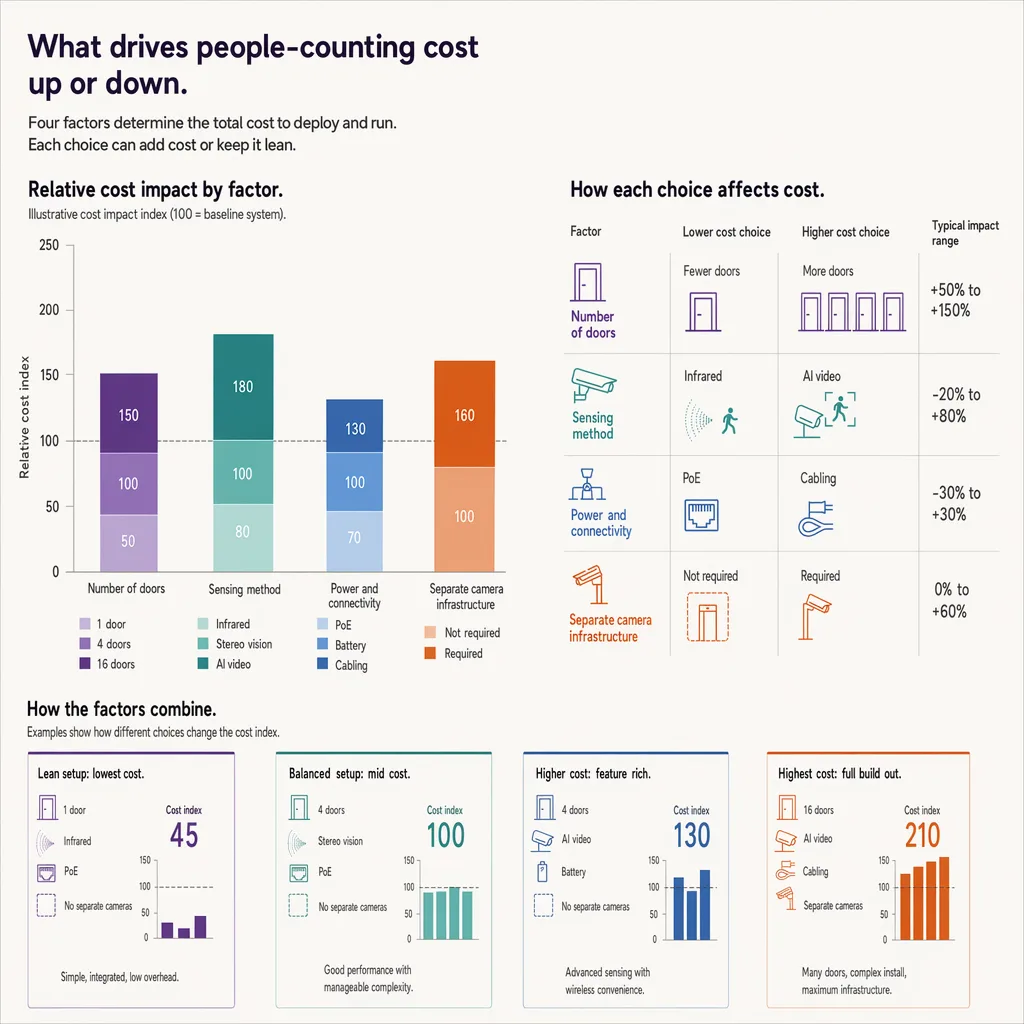
Most buyers arrive at the total cost question through a simpler one: what does a people counter cost at all. The honest short answer is that it depends on four things, and any range you see quoted is really a proxy for where a site sits on these four axes.
The first driver is the number of entrances. Counting is priced per counted opening, so a single-door boutique and a mall with twenty entrances are not in the same conversation, and a quote that sounds high for one is low for the other. The second is the sensing method. A beam counter, a depth sensor, a stereo-vision unit, and a fused system sit at different hardware price points, and the cheaper sensor often costs more over five years because it needs more units or more correction to hold the same accuracy. The third is the install. A sensor that runs on Power over Ethernet needs a cable pulled to each mounting point; a battery unit skips the cabling but adds a replacement cycle; a camera-based counter may piggyback on existing CCTV cabling or may need its own. The fourth is the software. Turning raw counts into reporting is a subscription, and the tier usually scales with the number of doors, the data retention you need, and the integrations you connect.
Because those four move independently, a single price tag tells you very little. The useful figure is the five-year total for the doors you actually have, which is why the model below matters more than any list price. If you want the components in isolation before the five-year view, PoE versus battery and ceiling mount versus door frame cover the install economics that feed the largest one-time line.
The TCO line items, at a glance
The table below is the five-year model in outline. It names each line, marks whether it is a one-time or a recurring cost, gives the main thing that drives it up or down, and flags the lines buyers most often leave out of a comparison. It carries no dollar figures on purpose: the point is the structure, so you can drop your own quoted numbers into it and compare quotes like for like.
| TCO line item | One-time or recurring | Typical driver | Easy to miss? |
|---|---|---|---|
| Sensor hardware | One-time | Number of counted openings and sensing method (beam, depth, stereo, fusion) | No, it is the headline |
| Mounting and cabling | One-time | PoE cable runs, mounting height, ceiling type, whether existing cabling can be reused | Yes, often folded into "install" and under-scoped |
| Install labour | One-time | Number of units, access difficulty, whether work is out of trading hours | Sometimes, especially after-hours premiums |
| Software subscription | Recurring | Number of doors, data retention, integrations, reporting tier | No, but the multi-year total is underestimated |
| Support and SLA | Recurring | Response-time guarantees, monitoring, firmware maintenance | Yes, sometimes bundled, sometimes a separate line |
| Recalibration and replacement | Recurring / periodic | Sensor drift, battery cycles, door or ceiling changes, hardware refresh at end of life | Yes, the most commonly omitted line |
Hidden costs that break a budget
The lines a buyer misses are almost always the ones that recur or that hide inside another line. Four break budgets most often.
Cabling for camera-based or wired units is the first. A quote that lists the sensor and a flat install fee can be hiding a run of cable to every mounting point, and if the site has no accessible cable route, that one-time cost climbs fast. It is the single line where "the same sensor" can cost very different amounts at two different sites.
Battery replacement cycles are the second, and they run the opposite way. A battery-powered counter saves the cabling cost up front, but the batteries are a recurring line, and across five years the swap-out visits and the batteries themselves add up. Whether wired or battery works out cheaper depends entirely on the site, which is exactly the trade-off PoE versus battery exists to work through.
Per-door subscription tiers are the third. Software priced per counted door scales with the estate, so a system that is cheap on one entrance can become the dominant cost line across a portfolio. This is the line that most often overtakes the hardware saving: a cheaper sensor on a pricier per-door subscription can cost more by year two than a dearer sensor on a flatter plan.
Integration and data work is the fourth. Counts only earn their keep once they reach the systems that use them, a BI dashboard, a workforce scheduler, a leasing report. If that connection is bespoke, it is a one-time cost at setup and sometimes a recurring one to maintain, and it rarely appears on the sensor quote at all.
One-time versus recurring, and how to model five years
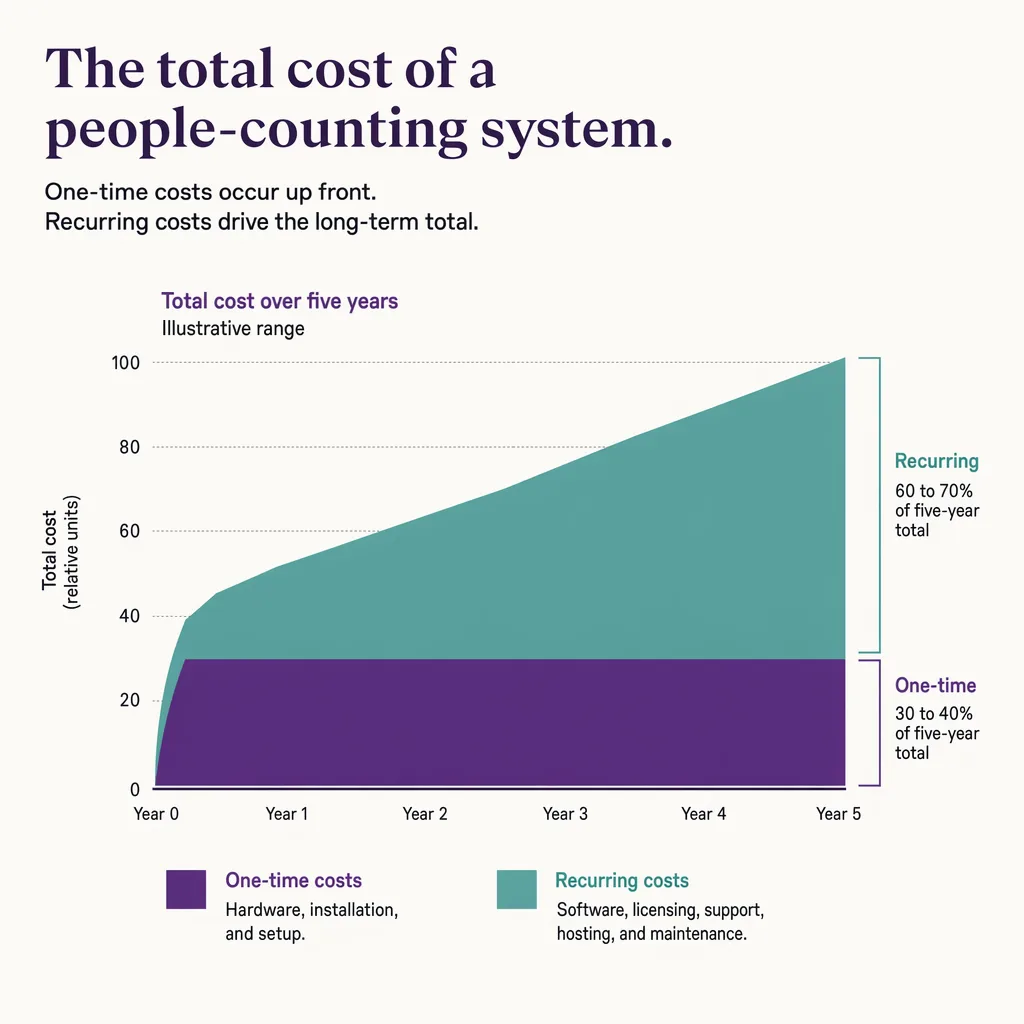
The clean way to model this is to split every line into a one-time bucket and a recurring bucket, then run the recurring bucket out across the full period. The one-time bucket is hardware, mounting and cabling, install labour, and any bespoke integration at setup: you pay it once, at the start. The recurring bucket is the software subscription, support and SLA, battery cycles where they apply, and the periodic recalibration or refresh that keeps the system accurate. You pay it every year, and it is the bucket that decides which of two systems is actually cheaper.
Five years is the right window, rather than one, because it is long enough for the recurring costs to overtake a hardware difference and short enough to sit inside a realistic hardware lifespan. A system that is a little more expensive to buy and a little cheaper to run wins over five years; a system that is cheap to buy and expensive to run loses. You cannot see that from a purchase price, which is why a serious comparison always runs the recurring bucket forward. The counterpart to this, the return that justifies the spend, is covered in the people counting ROI case: TCO tells you what it costs, ROI tells you what it returns.
How sensing method and install model move the total
The two structural choices that move TCO most are the sensing method and how the sensor installs, and they interact.
A camera-based counter can be cheaper on hardware in some configurations, but it tends to carry a heavier install where new cabling is needed and a heavier compliance line, because a camera capturing images pulls in CCTV signage, retention policy, and in many workplaces a works-council conversation. Those are real costs of ownership even when they never appear on the sensor invoice, and a depth or fused method that captures no image removes that line, which can matter more to the total than the hardware difference does. The install model then swings the one-time bucket: Power over Ethernet concentrates cost in the cable pull but removes the recurring battery line, while a battery unit inverts that. Neither is universally cheaper, which is the whole reason the choice belongs in a TCO model rather than a spec sheet.
Where Ariadne fits on total cost of ownership
Ariadne is one camera-free option to run through this model, and the reason it belongs here is what its hardware does to the compliance and install lines rather than any headline price.
Ariadne measures this with Hybrid Fusion, its patented camera-free method. Time-of-Flight depth sensing counts every visitor at the entrances, capturing geometry rather than images, while patented phone signal sensing follows movement through the interior, detecting the signals a phone emits even in airplane mode, and tracks that movement to about one-metre precision. The sensor streams both feeds to Ariadne, where Hybrid Fusion combines them into one trajectory per visit and computes counts, dwell, and paths. The streams carry no identifier: no MAC address, no device ID, no biometric data, and no camera is involved. Identifiers are stored only when a visitor explicitly opts in, which keeps the method GDPR-friendly and outside biometric territory.
Read against the TCO model, the camera-free method removes the CCTV-driven documentation line entirely, because there is no image, no face, and no biometric data to retain or govern. The hardware is a single unit per counted area doing both the entrance count and the interior movement, which affects how many devices a site needs. What Ariadne costs at a given site still comes from the same four drivers as any vendor, the number of doors, the sensing units required, the install, and the subscription, so the right way to price it is a site-scoped quote, not a list figure. That is true of every serious vendor on this page, which is why the closing advice is the same for all of them: get a quote scoped to your actual doors and run it across five years. To make several vendors comparable on exactly those lines, scope a comparable quote with an RFP, and see Ariadne's people counting for what the camera-free method covers.
Related reading
FAQ
What is total cost of ownership for a people counting system?
It is the full five-year cost rather than the purchase price: sensor hardware, mounting and cabling, install labour, the software subscription, support and SLA, and periodic recalibration or replacement. The recurring lines, subscription and support especially, usually decide which of two similarly priced systems is actually cheaper.
Why is the headline price per door misleading?
Because it captures only the one-time hardware line and ignores the recurring subscription, support, and maintenance that accrue every year. A cheaper sensor on a higher per-door subscription can cost more by year two than a pricier sensor on a flatter plan.
Which cost line do buyers forget most often?
Recalibration and replacement, followed by battery cycles on battery-powered units and per-door subscription scaling across a larger estate. All three are recurring, so they compound across the five-year window in a way a purchase price never shows.
Does a camera-free system change the total cost of ownership?
It can, mainly through the compliance and install lines rather than the sensor price. A method that captures no image removes CCTV signage, retention policy, and the associated documentation from the running cost, which for some organisations outweighs any difference in hardware price.
How should I compare vendors on cost fairly?
Ask each vendor for a quote scoped to your actual number of doors, split every line into one-time and recurring, then run the recurring lines across five years. An RFP that fixes those line items makes quotes comparable instead of leaving each vendor free to hide costs in a different place.
---


