
The procurement question behind the buzzwords
Most counter brochures bury the power question in a spec sheet. In practice it is the decision that shapes everything else: the install bill, the maintenance routine, the uptime you can promise an operations team, and how the project looks five years in. The choice splits cleanly into two camps. A PoE (Power over Ethernet) counter draws power and pushes data down a single network cable. A battery counter runs on internal cells, often paired with a wireless radio for backhaul, with no cable on the wall at all.
Vendors talk about both as if they were interchangeable, with the wireless option framed as the easy retrofit and the cabled option framed as the serious deployment. The truth is more boring and more useful: each has a real place. The right answer depends on how many doors you are counting, how the building is wired, who maintains it, and how long the system has to keep running before the next refresh. This is a buyer's guide to that decision over a five-year horizon, with a worked example at the end. Every cost figure below is illustrative and should be replaced with your own quotes. The structure of the comparison is what matters, not the numbers themselves.
What PoE actually buys you
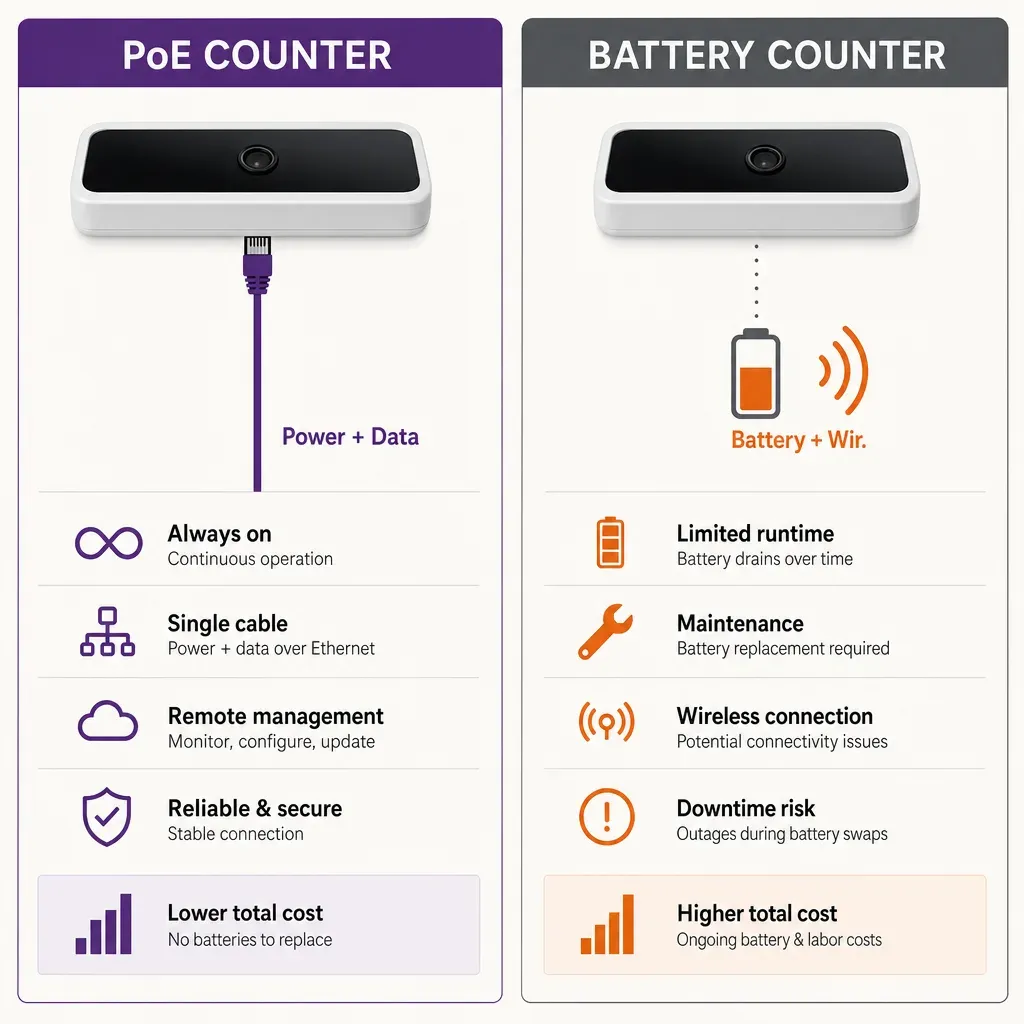
A PoE counter is wired with a single Cat6 (or Cat5e) cable from a network switch to the sensor. The switch port supplies low-voltage DC power and carries the data stream at the same time. Mechanically, this is the same wiring practice the building probably already uses for ceiling Wi-Fi access points, IP intercoms, and access control readers. Once a building has a structured cabling backbone and a couple of PoE switches in the rack, adding another counter is a cable pull and a port assignment.
The practical properties that matter:
- Always-on power. The sensor runs continuously and reports continuously. There is no duty cycle to manage and no battery to die overnight on a busy weekend.
- Wired backhaul. Data goes over the building LAN, not a radio link. Wi-Fi outages or interference do not break counting.
- Centralised management. Firmware updates, health monitoring, and time sync go through the same network the rest of the building IT already monitors.
- Lifecycle defined by the sensor, not the cell. There is no battery wear curve to plan around. The replacement clock is the sensor's own service life, typically several years.
The cost is in the cable. Pulling Cat6 across a finished ceiling, through fire-rated walls, or to a remote entrance can cost more than the counter itself. PoE is cheapest when the cable run is short or the building is already partly wired.
What battery actually buys you
A battery counter ships with internal cells and a wireless radio (usually a low-power cellular or LPWAN link, sometimes Wi-Fi). It mounts to a ceiling, doorframe, or pole with nothing more than fixings and a brief commissioning step. There is no cable to run, no switch port to assign, and no electrician on site.
The practical properties that matter:
- Install is hours, not days. The fitter brings a ladder and a drill. For a heritage facade, a glass shopfront, or a pedestrian zone column where chasing a cable is unacceptable, that is decisive.
- No dependency on building IT. Useful when the landlord or anchor tenant controls the network and a project cannot wait for VLAN approval.
- Movable. If a pop-up store closes, a temporary exhibition ends, or a pilot needs to relocate, the sensor comes off the wall and goes onto another.
- Lifecycle defined by the cell. A useful cell life of two to five years is typical depending on the sensor design and reporting cadence. The replacement task is recurring and has to be planned, scheduled, and budgeted.
The cost is in the visit. Every battery swap is a truck roll: a fitter on a ladder, a quick reconfiguration, a return to service. For a single entrance that nobody can reach without scaffolding, that visit can dwarf the hardware cost.
Five cost lines that drive a five-year TCO
Total cost of ownership over a typical procurement horizon (five years is the common refresh window for sensor hardware) breaks down into five lines. Read them in the order they actually hit your budget.
- Unit cost. Sticker price of the sensor itself. PoE units are often slightly cheaper because the power and connectivity are commoditised. Battery units carry the cost of the cell pack and the radio module.
- Install cost. Cabling and labour for PoE. Mounting and commissioning for battery. This is the line where the two options diverge most sharply, and the line where building age, ceiling height, and aesthetics matter most.
- Connectivity cost. Zero recurring cost for PoE (the LAN is already there). For battery, a small monthly SIM or LPWAN fee per sensor, plus whatever the platform charges for data ingest.
- Maintenance cost. For PoE, sensor cleaning and occasional firmware checks. For battery, a scheduled cell replacement per sensor plus the truck roll behind it. This line compounds with the number of doors and the access difficulty.
- Downtime cost. Hours the counter is offline. PoE downtime is usually tied to network or power events at the building scale. Battery downtime is more often a flat cell or a wireless dropout, both per-sensor and harder to spot remotely without a strong health-monitoring system on the platform side.
A worked illustrative example: 10 doors, 5 years
All numbers below are illustrative. Use them to understand the SHAPE of the comparison, not as a quote. Your own vendor quotes, electrician day rates, and SIM tariffs will replace each line. Assume a single chain of ten ground-floor entrances across a city centre, three of which are in heritage premises where a cable pull is expensive.
PoE deployment, illustrative five-year TCO:
- Unit cost: 10 sensors at an illustrative 800 EUR each = 8,000 EUR.
- Install: 7 standard entrances at an illustrative 250 EUR cable + labour = 1,750 EUR. 3 heritage entrances at an illustrative 900 EUR each (chasing, conduit, reinstatement) = 2,700 EUR. Total install: 4,450 EUR.
- Connectivity (5 years): 0 EUR (existing LAN).
- Maintenance (5 years): one cleaning visit per sensor per year at an illustrative 40 EUR per sensor visit = 2,000 EUR.
- Downtime budget: nominal, absorbed by IT operations.
- Illustrative five-year total: ~14,450 EUR.
Battery deployment, illustrative five-year TCO:
- Unit cost: 10 sensors at an illustrative 950 EUR each (cell pack plus radio) = 9,500 EUR.
- Install: 10 entrances at an illustrative 120 EUR mount and commissioning = 1,200 EUR.
- Connectivity: 10 SIMs or LPWAN subscriptions at an illustrative 4 EUR per sensor per month over 60 months = 2,400 EUR.
- Maintenance: one battery swap per sensor at year three at an illustrative 90 EUR per visit (cell pack + truck roll), plus the same cleaning cadence at 40 EUR per visit over the period = 900 EUR + 2,000 EUR = 2,900 EUR.
- Downtime budget: small allowance for an occasional dropout, varies by site.
- Illustrative five-year total: ~16,000 EUR.
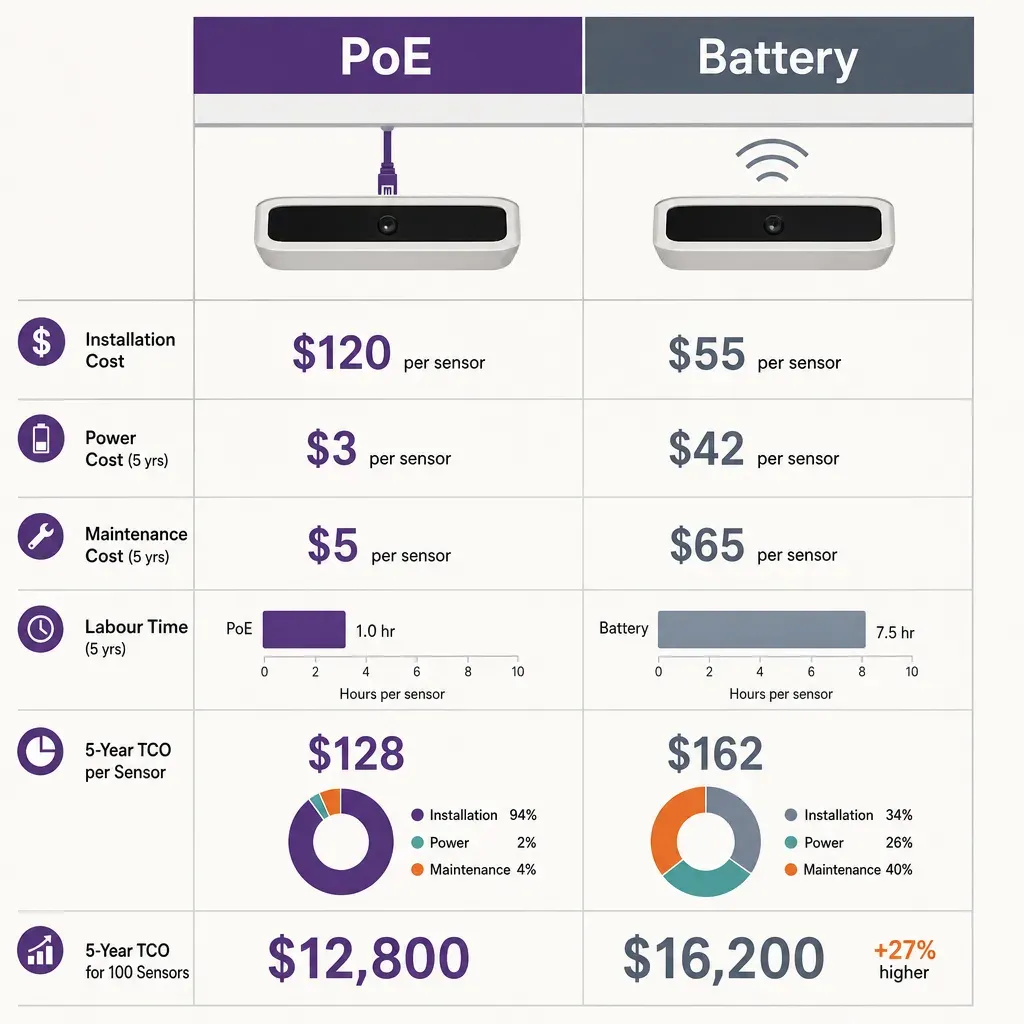
In this illustrative scenario the two are within roughly 10 percent of each other over five years, even though the install bill on day one is much smaller for the battery deployment. That is the pattern worth internalising. The wireless option moves cost from CAPEX to OPEX. The PoE option front-loads spend into the install and then runs flat. Change one assumption (say, two of the ten doors actually need scaffolding for the cable pull, or the chain expands from ten doors to forty over the period) and the ranking flips. That is the value of building your own version of this table before you sign.
When PoE wins the argument
- Large estates with structured cabling already in place. Marginal cost of one more port is small.
- Entrances with high traffic where any downtime is expensive (transport hubs, large stores at peak season).
- Long deployments. The longer the system runs, the more battery replacement cycles you avoid by going wired.
- Sites with strict IT policy. Building IT prefers managing a known network device on a known port over a fleet of cellular endpoints.
When battery wins the argument
- Heritage facades, glass storefronts, listed buildings, and any wall where chasing a cable is refused.
- Outdoor poles, pedestrian zones, and street furniture without a nearby switch.
- Pilot deployments and pop-up retail where the sensor may need to move within a year.
- Tenants in a multi-occupancy building who do not control the LAN and cannot wait for a landlord ticket.
- Sites where speed of install matters more than five-year economics, for example to capture a seasonal pattern that starts next month.
Hybrid is usually the honest answer
Almost every multi-site rollout we see ends up mixed. The chain wires PoE at the main entrances of its larger stores where the LAN is already there and the doors will be open for a decade. It uses battery sensors at the awkward third entrance, the heritage storefront, and the temporary pop-up. The reporting platform does not care which power source sits behind a count: it ingests data from both, joins it to the same store, and produces one footfall figure per location.
The procurement discipline is to make the choice per door, not per chain. A blanket PoE-everywhere mandate burns money at the three heritage sites. A blanket battery-everywhere mandate pays the OPEX premium and the maintenance overhead at sites that already had a switch on the wall.
How Ariadne fits
Ariadne ships counting hardware in both power topologies and treats the choice as a per-site decision. The sensor lineup includes PoE-powered Time-of-Flight devices for cabled doors and battery options for retrofit and outdoor use. The platform side is independent of the power choice: the same dashboard, the same per-store reporting, the same people counting outputs.
Ariadne measures this with Hybrid Fusion, its patented camera-free method. Time-of-Flight depth sensing counts every visitor at the entrances, capturing geometry rather than images, while patented phone signal sensing follows movement through the interior, detecting the signals a phone emits even in airplane mode. The sensor streams both feeds to Ariadne, where Hybrid Fusion combines them into one trajectory per visit and computes counts, dwell, and paths. The streams carry no identifier: no MAC address, no device ID, no biometric data, and no camera is involved. Identifiers are stored only when a visitor explicitly opts in, which keeps the method GDPR-friendly and outside biometric territory.
The practical consequence for procurement is that the privacy posture does not change with the power source. PoE or battery, the count is produced without cameras, without face capture, and without device identifiers by default, so the same data protection answer covers the whole estate. The technical detail sits on the how it works page. For a site-by-site quote, the team is at contact.
FAQ
How long does a typical battery counter run before a swap?
Depends on the cell pack, the reporting cadence, and the radio. Two to five years is the typical range you will see on a vendor spec sheet for a counter that reports once or twice an hour. Reporting in real time, or transmitting over a longer cellular link, shortens that. Plan one swap inside a five-year horizon and budget accordingly.
Does PoE need a special switch?
It needs a switch port that supplies PoE. Most modern managed switches do, and a small unmanaged PoE injector can power a single sensor on a network that does not. The wattage requirement of a Time-of-Flight counter is modest and well within standard PoE budgets.
Is battery counting less accurate than PoE?
Accuracy is a property of the sensor, not the power source. A PoE and a battery counter using the same Time-of-Flight depth method count the same way. What changes with battery is the reporting cadence: a wired sensor can stream continuously, while a battery sensor often batches reports to save energy. For dashboards and weekly reporting that gap is invisible. For live occupancy dashboards it matters, and PoE is the better fit.
Does the system use cameras?
No. Ariadne counts with Hybrid Fusion: Time-of-Flight depth sensing plus patented phone signal sensing, never cameras. Time-of-Flight captures geometry rather than images, and signal sensing captures no MAC address by default, so the measurement involves no video, no faces, and no biometric data.


