
Search for a people counting system comparison and most results jump straight to a list of brand names. That is useful once you know what you are looking at, but it skips the more important layer underneath: the sensing method. Two products from different vendors can share a method and behave almost identically, while two products that look similar on a feature list can record completely different things about your visitors. Compare the methods first, then the brands.
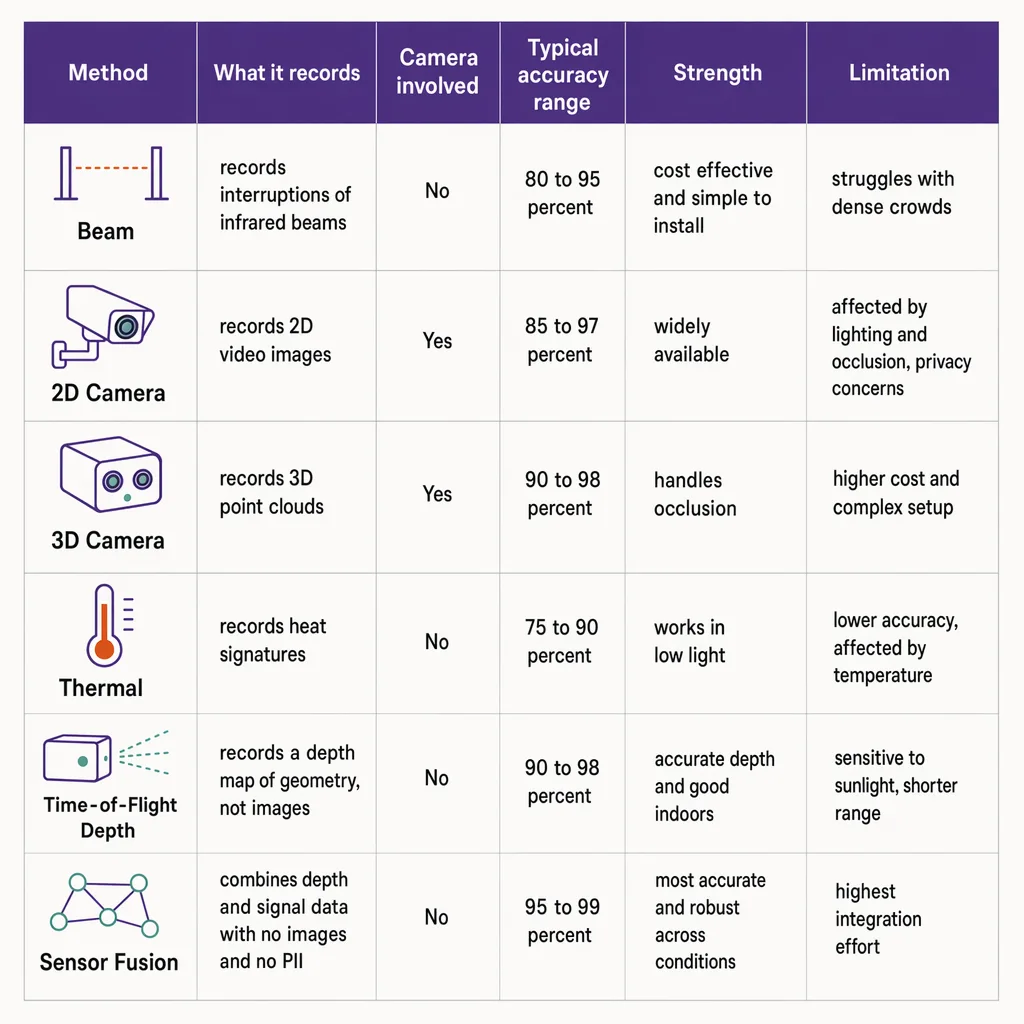
This post compares the six sensing methods on the market, beam counters, 2D cameras, 3D cameras, thermal sensors, Time-of-Flight depth sensors, and sensor fusion, on the four things that actually decide a purchase: what each records, whether a camera is involved, how each holds up on accuracy, and where each sits on privacy. It stays at the method level on purpose, because that keeps the comparison honest and lets you carry the framework to any vendor. For the named-brand field, see the best people counting systems compared.
How do people counting systems compare?
There are five sensing methods in common use for people counting, and choosing between them is mostly a question of what you are willing to record. Infrared beams are cheapest and cannot separate people walking together. Mono cameras see appearance and inherit every obligation that comes with it. Thermal sensors read heat rather than images. Time-of-Flight measures distance, so it resolves individuals from geometry without capturing anything that looks like a person. Sensor fusion combines two independent streams so they can cross-validate. This page compares those five on what each records, how each behaves on the hard cases, the law that follows from each, and what each costs to install and run.
Sensing methods compared at a glance
The table below is the core of the comparison. Read down the privacy column first if your organisation has a constraint there, because it removes methods from the shortlist faster than any other factor.
| Sensing method | What it records | Camera involved | Strength | Limitation | Privacy posture |
|---|---|---|---|---|---|
| Beam (infrared break-beam) | A break in a beam across a doorway, counted as one crossing | No | Cheap, simple, easy to install | Cannot separate people in a group or tell direction reliably; miscounts busy or wide doors | No images, but counts events not people, so low information and low privacy risk |
| 2D camera | Video images of the entrance, with people detected in the frame | Yes | Rich data; can support other analytics from the same feed | Struggles with occlusion, groups, and low light; the feed is video | Captures images; CCTV obligations, retention, and DPIA typically apply |
| 3D camera (stereo vision) | Stereo image pairs used to build a depth map and detect people | Yes | Strong accuracy on groups and height; separates adults from children | Still an image-based sensor with a camera in the ceiling | Captures images; camera and CCTV considerations apply as with 2D |
| Thermal sensor | A heat map of bodies passing under the sensor | No (thermal, not video) | Works in darkness; no recognisable images of faces | Lower spatial detail; can be confused by heat sources and close-packed groups | No recognisable images; generally lighter than video but confirm the specific product |
| Time-of-Flight (ToF) depth | Distance measurements that form a depth map, geometry not images | No | High accuracy at the door; separates groups; light-independent | Measures at the point it is mounted; a single door sensor sees the door, not the interior | Captures geometry, not images; no faces, no biometric data |
| Sensor fusion | Multiple feeds combined into one trajectory (e.g. ToF depth plus signal sensing) | No (in Ariadne's camera-free case) | Covers both the door count and the interior journey; resilient because feeds cross-check | More moving parts to specify and verify; implementation varies by vendor | Depends on the feeds fused; Ariadne's fusion records no MAC address by default and no biometric data |
A note on reading the table: no single method wins every column. A beam counter is the cheapest and simplest and also the least able to hold a count at a busy or wide door. A 3D camera is strong on accuracy and separates groups well, and it is still a camera in the ceiling. The right method is the one whose strengths line up with your decision and whose limitations you can live with on your specific doors, which is why the accuracy section below insists on verifying rather than trusting.
What each method records, and the law that follows
The privacy column in the table is not a soft preference. What a method records decides what the law then requires of you, and in a European deployment that can be the difference between a straightforward install and a procurement that stalls in legal review.
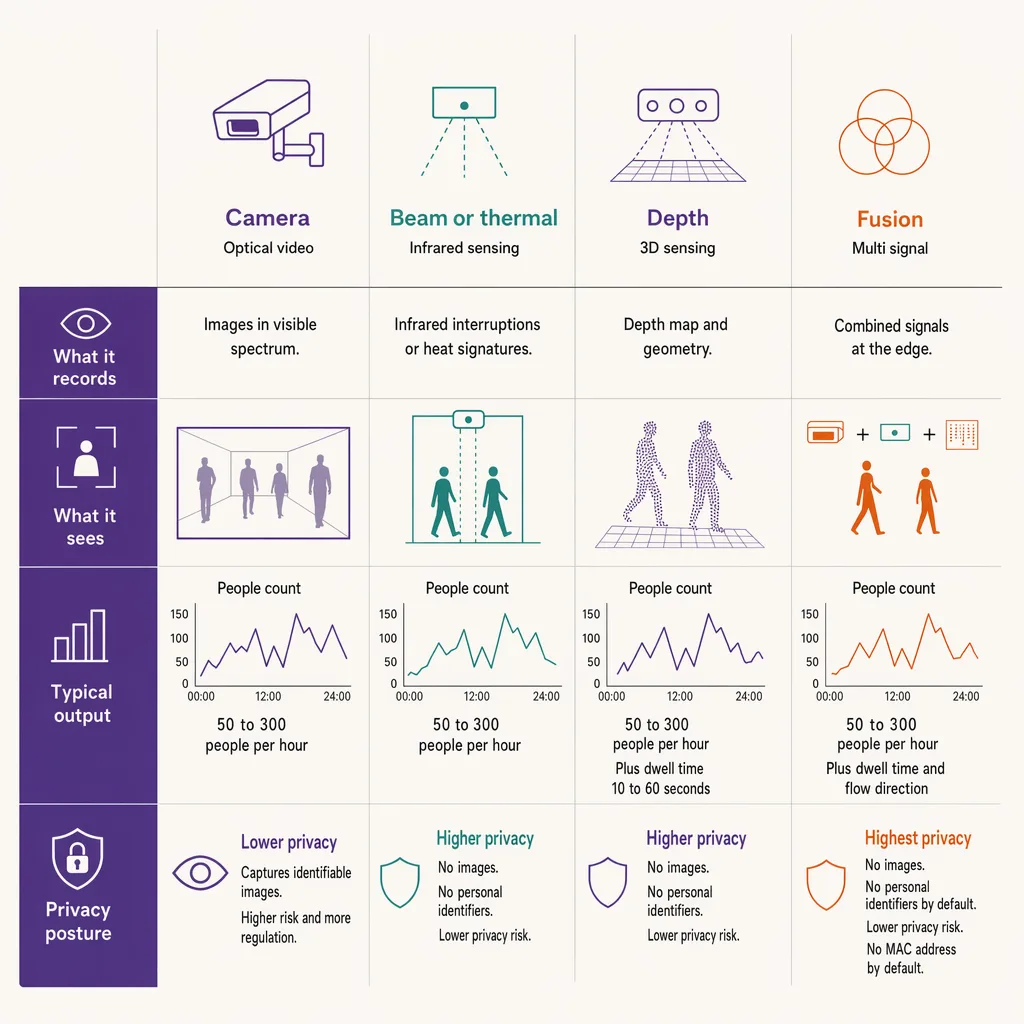
The clearest split is camera versus camera-free. A 2D or 3D camera captures video images of everyone who passes. That makes the system CCTV, which brings signage, a defined retention period, access controls on the footage, and, in most European deployments, a data protection impact assessment, often alongside a works-council conversation. None of that is a reason to rule out cameras, but it is a cost and a timeline that belongs in the comparison from the start.
Camera-free methods change what you have to document because there is no footage. A thermal sensor produces a heat map with no recognisable faces. A Time-of-Flight sensor records distance and geometry, not images. Fusion of camera-free feeds, in Ariadne's case Time-of-Flight depth plus phone-signal sensing, records geometry and signal data with no MAC address by default and no biometric data, so there is no video to retain and nothing to categorise. The distinction between what these methods do and do not capture is set out in full in what each method records about visitors. Whichever method you choose, decide the capture question deliberately, because it is easier to remove camera-based products from a shortlist at the start than to discover the constraint mid-procurement.
Accuracy on the hard cases
Every method advertises an accuracy figure, and every figure is measured under conditions chosen to flatter it: a controlled test door, moderate traffic, no groups, good light. Your accuracy is decided on the hard cases the datasheet leaves out.
Three hard cases separate the methods. Groups, where several people cross together, break a beam counter and challenge a 2D camera, while depth and stereo methods that read height and geometry hold up better. Low light, a dark foyer or an evening entrance, degrades 2D camera performance, while thermal, Time-of-Flight, and signal-based methods are largely indifferent to it. Wide doors, a broad sliding entrance where people cross at any point and in any direction, stress every method and are where a cheap beam counter fails most visibly.
Because the hard cases are specific to your site, the only figure worth trusting is the one you measure on your own doors. Do not accept the advertised number. Run a defined on-site test: count a busy period manually, compare that manual ground-truth count to the system's count for the same window, and repeat it in a quiet period. The full procedure, including how long to run it and what a passing result looks like, is in the people counter accuracy test methodology. For a deeper technical comparison of the depth and thermal methods specifically, see stereo vs ToF vs thermal in depth.
Cost and install model compared
Method also drives cost, and not only through the price of the sensor. The install model and the ongoing subscription usually matter more over five years than the hardware line does on day one.
A beam counter is cheap to buy and simple to install, which is its main appeal. Camera-based systems carry the cost of cabling and the documentation overhead that CCTV brings. Powering the sensor is its own line: a wired sensor over Power over Ethernet needs cabling to each location, while a battery sensor avoids cabling but adds a replacement cycle, a trade-off worked through in PoE vs battery people counters. Across every method, the number that decides the purchase is the five-year total cost of ownership for the doors you actually have, not the price per door on the quote, and the full model is in people counting total cost of ownership. This post keeps cost structural on purpose: the components and what drives them are stable, while the specific figures depend on your site and belong in a scoped quote.
Where Ariadne sits in the comparison
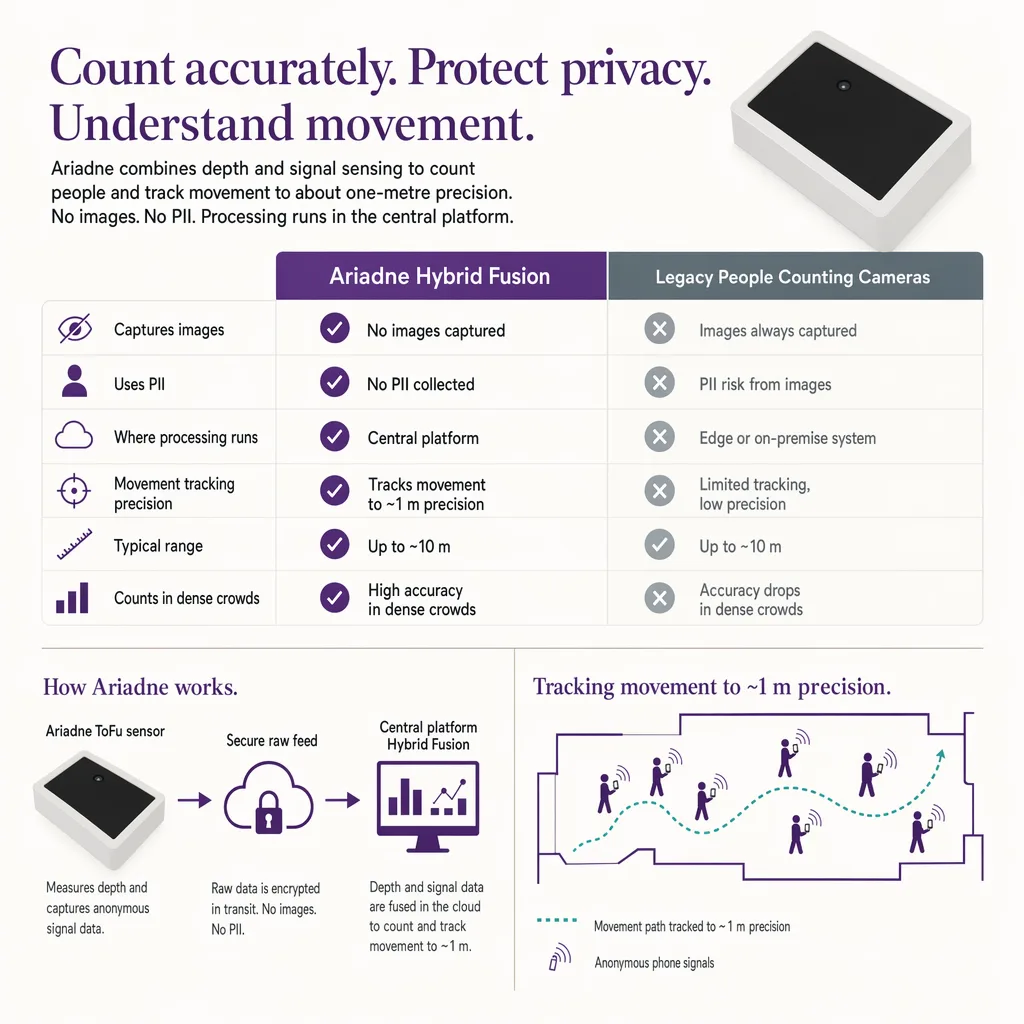
In the method table, Ariadne sits in the sensor-fusion row, on the camera-free side. It is not a single-method counter: it combines a door count with an interior journey, which a single door-mounted sensor of any kind cannot do on its own. Ariadne measures this with Hybrid Fusion, its patented camera-free method. Time-of-Flight depth sensing counts every visitor at the entrances, capturing geometry rather than images, while patented phone signal sensing follows movement through the interior, detecting the signals a phone emits even in airplane mode, and tracks that movement to about one-metre precision. The sensor streams both feeds to Ariadne, where Hybrid Fusion combines them into one trajectory per visit and computes counts, dwell, and paths. The streams carry no identifier: no MAC address, no device ID, no biometric data, and no camera is involved. Identifiers are stored only when a visitor explicitly opts in, which keeps the method GDPR-friendly and outside biometric territory.
That places Ariadne in the fusion row for a reason that matters to the comparison: a single Time-of-Flight sensor sees the door it is mounted on, and a single beam or camera sees its own choke point, whereas fusing a depth count at the entrance with signal-based movement through the interior covers both the count and the path in one system. On the privacy column it sits with the camera-free methods, recording geometry and signal data rather than images. It does not exempt itself from the accuracy rule: verify it on your own doors like any other method, using the on-site test above. For the product itself, see Ariadne's camera-free counting, and to see how to choose between the methods once you have compared them, work through the people counting buyer's guide.
Related reading
FAQ
What is the most accurate people counting method?
There is no single most accurate method for every site; accuracy depends on your doors. Depth-based methods such as Time-of-Flight and 3D stereo vision generally handle the hard cases, groups and low light, better than a beam counter or a 2D camera, and fusion adds resilience by cross-checking feeds. The only figure worth acting on is the one you measure on your own busiest door against a manual count, because a datasheet number rarely survives a busy entrance.
Which people counting methods use a camera?
2D cameras and 3D stereo-vision cameras capture video images and are camera-based, with the CCTV obligations that follow. Beam counters, thermal sensors, and Time-of-Flight depth sensors do not capture video images. Ariadne's Hybrid Fusion is camera-free: it records geometry from Time-of-Flight depth sensing and signal data from phone-signal sensing, with no MAC address by default and no biometric data.
How do I compare people counting systems without trusting the datasheet?
Compare the sensing methods first on what they record, whether a camera is involved, and how each handles your hard cases, then verify the shortlisted systems on your own doors. Run a manual ground-truth count over a busy and a quiet window and compare it to each system's count for the same period. A datasheet accuracy figure is measured under controlled conditions and rarely matches a busy door.
Is a camera-free people counter less accurate than a camera one?
Not inherently. Accuracy is set by the method and the site, not by whether a camera is involved. Camera-free depth and fusion methods handle groups and low light well, and some camera-based methods struggle in exactly those conditions. Verify any system, camera-based or camera-free, on your own doors rather than assuming one class is more accurate than the other.
Which people counting method is cheapest?
A beam counter is usually the cheapest to buy and install, which is why it persists for simple, low-traffic doors. It is also the least able to hold a count at a busy or wide entrance or to separate people in a group. The cost that decides a purchase is the five-year total for the doors you actually have, not the sticker price, so a cheaper sensor that miscounts your busiest door can cost more than an accurate one once the data is used for a real decision.


