
Most people counting purchases go wrong in the same place: the buyer starts by comparing products before deciding what the count is for. A counter chosen to keep a venue under an occupancy limit is a different specification from one chosen to prove retail conversion, and one chosen to feed a leasing argument is different again. Pick the product first and you end up bending the business question to fit the datasheet you happened to like.
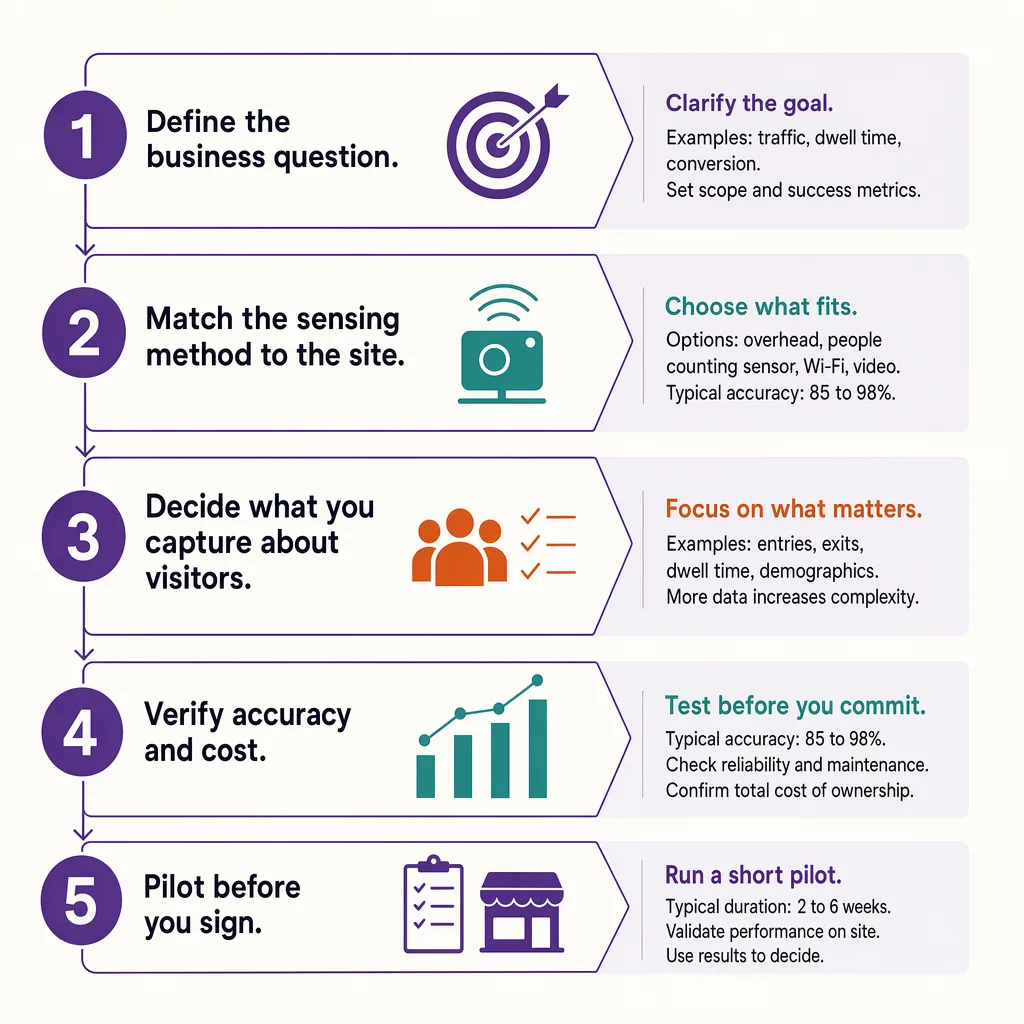
This guide runs the purchase in the order that actually works: decide the business question, match the sensing method to your site, decide what you will and will not capture about visitors, verify accuracy and scope the real cost, then run a pilot and compare vendors on your own doors. It is deliberately vendor-neutral. It folds in the selection criteria a shortlist needs, so you can work through it end to end without a separate checklist, and it points you to the two live tools that do the heavy lifting at the end: the RFP questions that make vendors comparable, and the on-site method for verifying an accuracy claim.
What should a people counting buyer's guide cover?
A people counting buyer's guide should walk a buyer from problem to purchase: what question the data has to answer, which sensing method fits the site, what the system records about visitors, how to verify accuracy before signing, and what the five-year cost will be. The order matters. Decide the business question first, because a counter chosen for occupancy safety is specified differently from one chosen for retail conversion. Only then compare vendors, and always on a like-for-like trial at your own doors rather than on datasheet numbers.
The five steps below are the whole journey. Each one closes off a decision that, left open, comes back to bite you at renewal or at the first audit of the data. Work them in sequence.
Step 1: define the business question
Before any product enters the conversation, write down the single decision the count has to support. This is not a formality. The decision sets the entire specification, and the four common decisions pull in different directions.
If the count exists for occupancy safety, then real-time accuracy and a reliable live occupancy number matter more than historic trend analysis, and the system has to hold its count during the busy periods when a limit is most likely to be breached. If it exists for retail conversion, then the count has to be trustworthy enough to divide sales by visits and defend the resulting rate, which puts the weight on consistent accuracy over comparable periods rather than on a live figure. If it exists for staff scheduling, then hourly and day-of-week patterns matter most, and the system has to produce clean historic data at the granularity a rota is built on. If it exists for leasing or asset management, then the count is evidence in a commercial argument, so it has to be defensible, comparable across sites, and auditable by a party who did not install it.
Naming the decision also tells you where the counter goes. Occupancy safety wants counts at every entrance and exit that feeds the controlled space. Conversion wants the shop entrance and, ideally, the ability to separate passers-by from enterers. Leasing wants the whole-center view, mall entrances plus the flow reaching individual units. Skip this step and you buy a counter that measures something adjacent to the decision but not the decision itself, which is the most expensive mistake in the whole process because it is invisible until someone asks the count to settle an argument it was never scoped to settle.
Step 2: match the sensing method to the site
Once the decision is fixed, the site decides which sensing methods are even viable. The methods differ, and a fuller side-by-side lives in the people counting system comparison, but for a buyer the site-level questions are concrete.
Entrances. Count the doors, and count the ones people actually use, not just the ones on the plan. A wide sliding entrance, a revolving door, and a fire exit that gets propped open on hot days each behave differently. The number of entrances drives both the hardware count and, later, the cost.
Ceiling height and mounting. Some methods want an overhead mount at a specific height range; others fit a door frame. If your ceilings are very high, very low, or glass, that constrains the shortlist before privacy or price does. Mounting also decides install labour, which is a real line in the five-year cost. The trade-offs are set out in ceiling mount vs door frame people counter.
Light and environment. Bright sunlight through a glass frontage, dark cinema foyers, and outdoor thresholds each break some methods and not others. Ask the vendor which of your specific conditions its method holds up in, and treat a vague answer as a red flag.
Privacy posture. This is a site-and-organisation question as much as a technical one. A venue with a works council, a hospital, a school, or any site where a camera on the ceiling would trigger objections narrows the field toward camera-free methods before anything else is decided. Getting this in the frame early avoids specifying a system that legal or the works council later refuses.
Step 3: decide what you will and will not capture about visitors
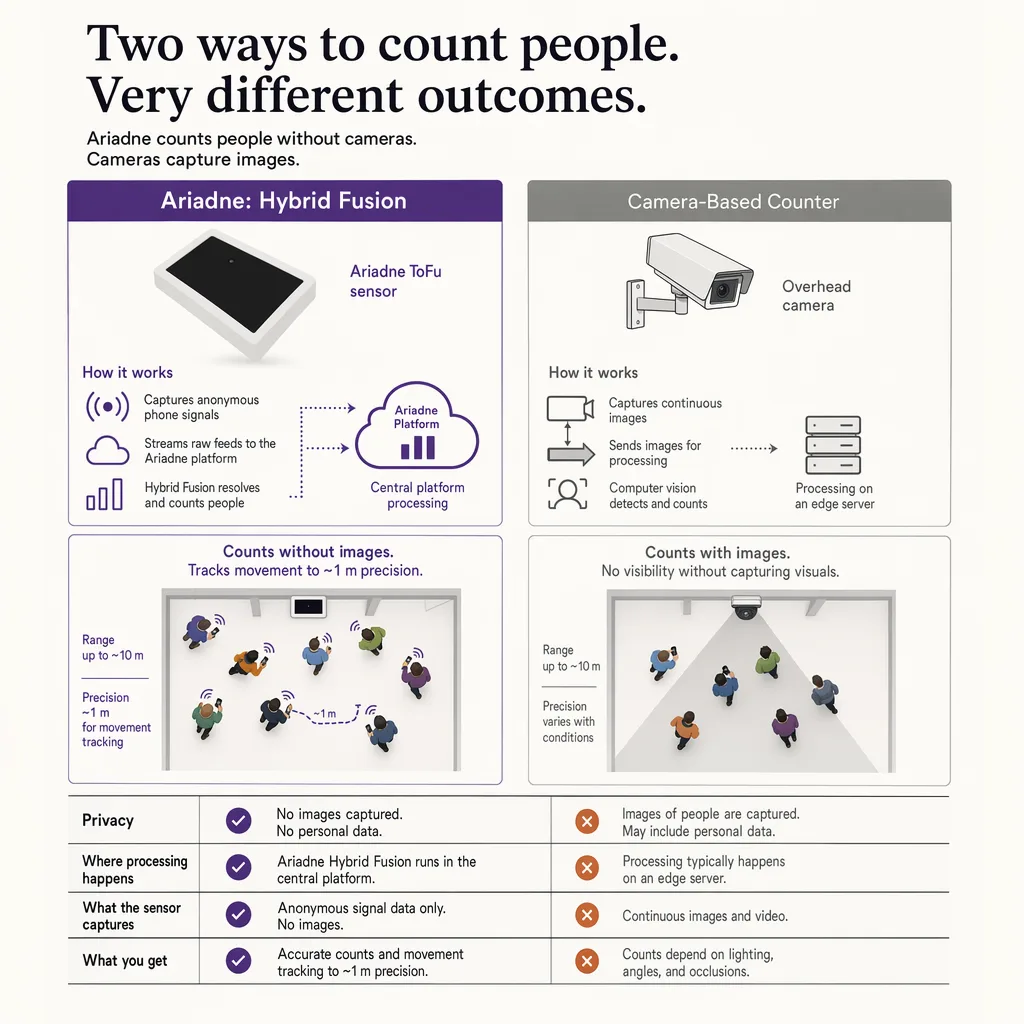
This is the step buyers most often skip, and it is the one that carries the most risk after signing. Two counters can produce the same number and record entirely different things to get there. One captures images of everyone who passes and infers age and gender; another records only geometry and signal data and knows nothing about who the visitor is. The count looks identical on the dashboard. The obligations behind it do not.
Decide explicitly what the system is allowed to capture, because that decision drives what the law then requires of you. A camera-based counter is CCTV, with the signage, retention policy, and access-control obligations that follow, plus a data protection impact assessment in most European deployments and, frequently, a works-council conversation. A method that captures no images and no biometric data changes what you have to document, because there is no footage to retain, no faces to protect, and nothing to categorise. The distinction between the two is the subject of biometric vs non-biometric counting, and where either sits under the 2026 rules is covered in the EU AI Act and people counting.
Write the capture decision down before you compare products, not after. If the organisation has decided it will not deploy cameras or will not process biometric data, that decision removes whole categories of product from the shortlist, and it is far cheaper to remove them now than to discover the constraint during procurement.
Step 4: verify accuracy and scope the cost
Steps one to three narrow the field to a shortlist. Step four is where you stop trusting anyone's datasheet.
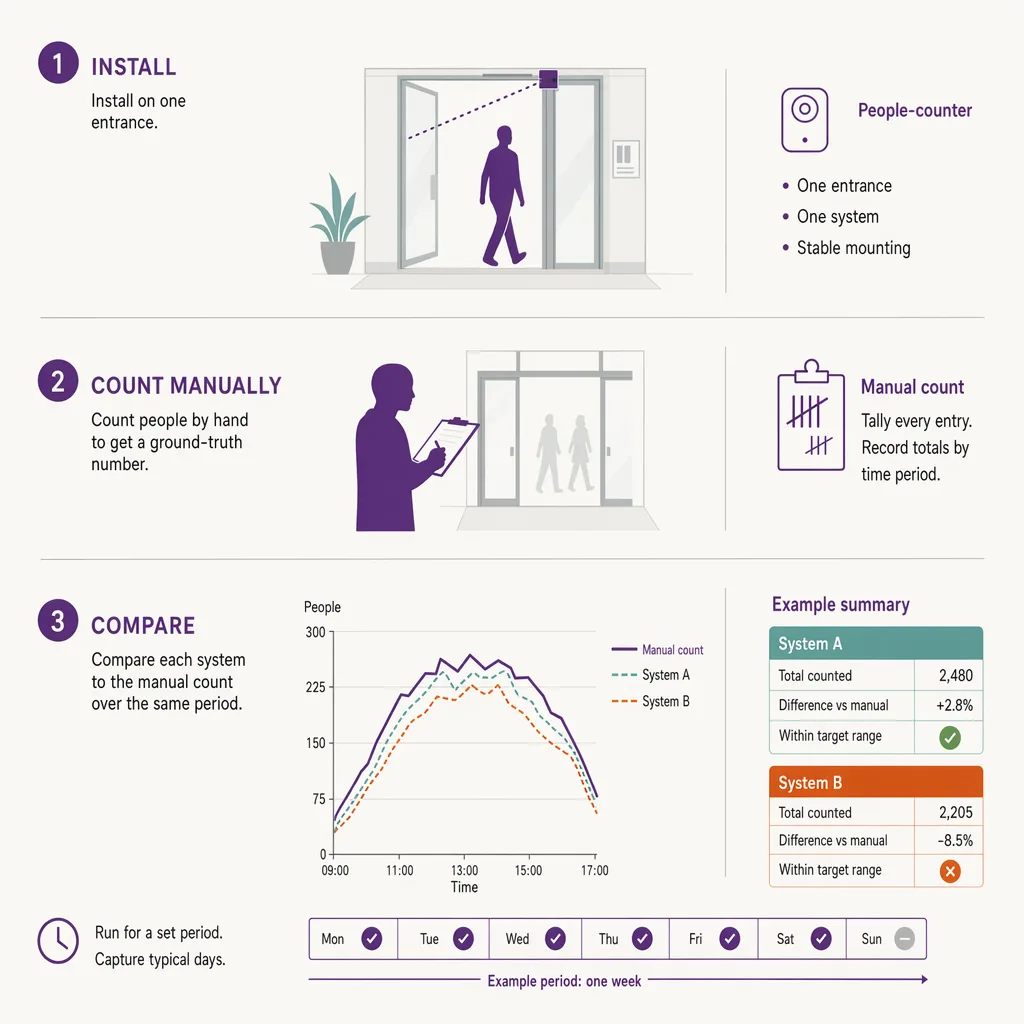
Verify accuracy on your own doors. A headline accuracy figure is measured under conditions that are not your conditions: a controlled test door, moderate traffic, no groups, good light. Your busy Saturday with families arriving four abreast is the case that matters, and it is precisely the case a datasheet does not describe. Never accept an advertised accuracy number as the accuracy you will get. Instead, run a defined on-site test: count a set period manually, compare the manual ground-truth count to the system's count for the same period, and repeat it across a busy and a quiet window. The full method is set out in the people counter accuracy test methodology, and it is the single most useful thing you can do before signing.
Scope the real cost. The number that decides the purchase is not the price per door on the quote. It is the five-year total cost of ownership for the doors you actually have: sensor hardware, mounting and cabling, install labour, the software subscription, support, and any recalibration or replacement across the period. Two systems with the same sticker can diverge sharply once you add cabling, battery cycles, or per-door subscription tiers. The full model is in people counting total cost of ownership. Ask every vendor for a quote scoped to a site survey, not a list price, so the numbers are comparable.
The five buying steps at a glance
| Buying step | What to check | How to verify it | Common mistake |
|---|---|---|---|
| 1. Define the business question | The single decision the count must support (safety, conversion, scheduling, leasing) | Write the decision down before any product is discussed; confirm the counter's placement serves it | Comparing products before naming the decision, so the count measures the wrong thing |
| 2. Match the method to the site | Entrances, ceiling height, mounting, light, privacy posture | Site survey with the vendor; ask which of your specific conditions the method holds in | Specifying from a plan, not the doors people actually use |
| 3. Decide what you capture | Images vs no images, biometric vs non-biometric, what the law then requires | Document the capture decision; check DPIA, CCTV, and works-council obligations against it | Skipping the capture decision, then hitting a legal or works-council block during procurement |
| 4. Verify accuracy and scope cost | Accuracy on your own doors; five-year TCO for your doors | Manual ground-truth count vs the system's count, busy and quiet windows; site-scoped quote | Trusting the datasheet accuracy figure and the price per door on the quote |
| 5. Pilot and compare like-for-like | The top two shortlisted systems, on one representative entrance | Run both against the same manual count over the same period; use one RFP so answers are comparable | Choosing on a demo at the vendor's site instead of a trial at yours |
Step 5: run a pilot and compare vendors like-for-like
The final step turns a shortlist into a decision. Take the top two systems that survived steps one to four and pilot them on one representative entrance, ideally the busiest, because that is where the methods separate. Run both across the same period, against the same manual ground-truth count, and read the results on your data, not the vendor's slides. The method for a clean trial is in the people counting pilot project guide.
To make the vendor answers comparable, put the same questions to each in writing. That is what an RFP is for, and a ready set of questions covering capture, accuracy, install, cost, and support is in the people counting RFP template. Without a common question set, one vendor answers on accuracy, another on price, a third on features, and you cannot line them up. If you want the named-vendor field as a starting shortlist rather than a method for building your own, the best people counting systems compared post lists them.
Where Ariadne fits in this framework is as one camera-free answer to the capture decision in step three. If the organisation has decided it will not deploy cameras or process biometric data, Ariadne is a system that meets that constraint without giving up interior journey data. Ariadne measures this with Hybrid Fusion, its patented camera-free method. Time-of-Flight depth sensing counts every visitor at the entrances, capturing geometry rather than images, while patented phone signal sensing follows movement through the interior, detecting the signals a phone emits even in airplane mode, and tracks that movement to about one-metre precision. The sensor streams both feeds to Ariadne, where Hybrid Fusion combines them into one trajectory per visit and computes counts, dwell, and paths. The streams carry no identifier: no MAC address, no device ID, no biometric data, and no camera is involved. Identifiers are stored only when a visitor explicitly opts in, which keeps the method GDPR-friendly and outside biometric territory.
Read against this guide, that puts Ariadne firmly on the camera-free side of the step-three decision, with a documentation footprint that reflects the absence of footage and biometric data. It does not exempt Ariadne from steps one, two, four, and five: you should still name your decision, confirm the method fits your site, verify accuracy on your own doors, and pilot it against your shortlist before signing. The point of a buyer's guide is that the framework outlives any single vendor, Ariadne's people counting included.
FAQ
What is the first step in buying a people counting system?
Define the business question before comparing any products. Write down the single decision the count has to support, whether that is occupancy safety, retail conversion, staff scheduling, or a leasing argument. The decision sets the whole specification, including where the counters go, so naming it first stops you buying a counter that measures something adjacent to the decision rather than the decision itself.
How do I compare people counting vendors fairly?
Put the same questions to every vendor in writing using an RFP, so their answers line up on capture, accuracy, install, cost, and support rather than each vendor answering on its own strong point. Then run a like-for-like pilot: trial the top two on one representative entrance over the same period against the same manual count, and read the results on your own data.
Should I trust the accuracy figure on the datasheet?
No. A datasheet accuracy figure is measured under controlled conditions that are unlikely to match your busiest door, with groups, low light, or a wide entrance. Verify accuracy on your own site by comparing the system's count to a manual ground-truth count over a busy and a quiet window before you sign, rather than accepting the advertised number.
Do I need cameras to count people accurately?
No. Ariadne counts with Hybrid Fusion: Time-of-Flight depth sensing plus patented phone signal sensing, never cameras. Time-of-Flight captures geometry rather than images, and signal sensing captures no MAC address by default, so the measurement involves no video, no faces, and no biometric data.
What is the most expensive mistake in a people counting purchase?
Buying before you have named the decision the count supports. A counter scoped for the wrong question, or placed to measure the wrong flow, produces numbers that look fine on the dashboard but cannot settle the argument they were bought for. The error stays invisible until someone asks the data to defend a staffing, leasing, or safety decision, which is the point at which it is expensive to fix.
How long should a people counting pilot run?
Long enough to capture the range of conditions the system will work in, which means at minimum a full week to cover weekday and weekend patterns, and ideally across both a busy and a quiet period. Run the shortlisted systems over the same window against the same manual count so the comparison is like-for-like rather than a snapshot of one favourable afternoon.
---


