
The renewal data pack, in one paragraph
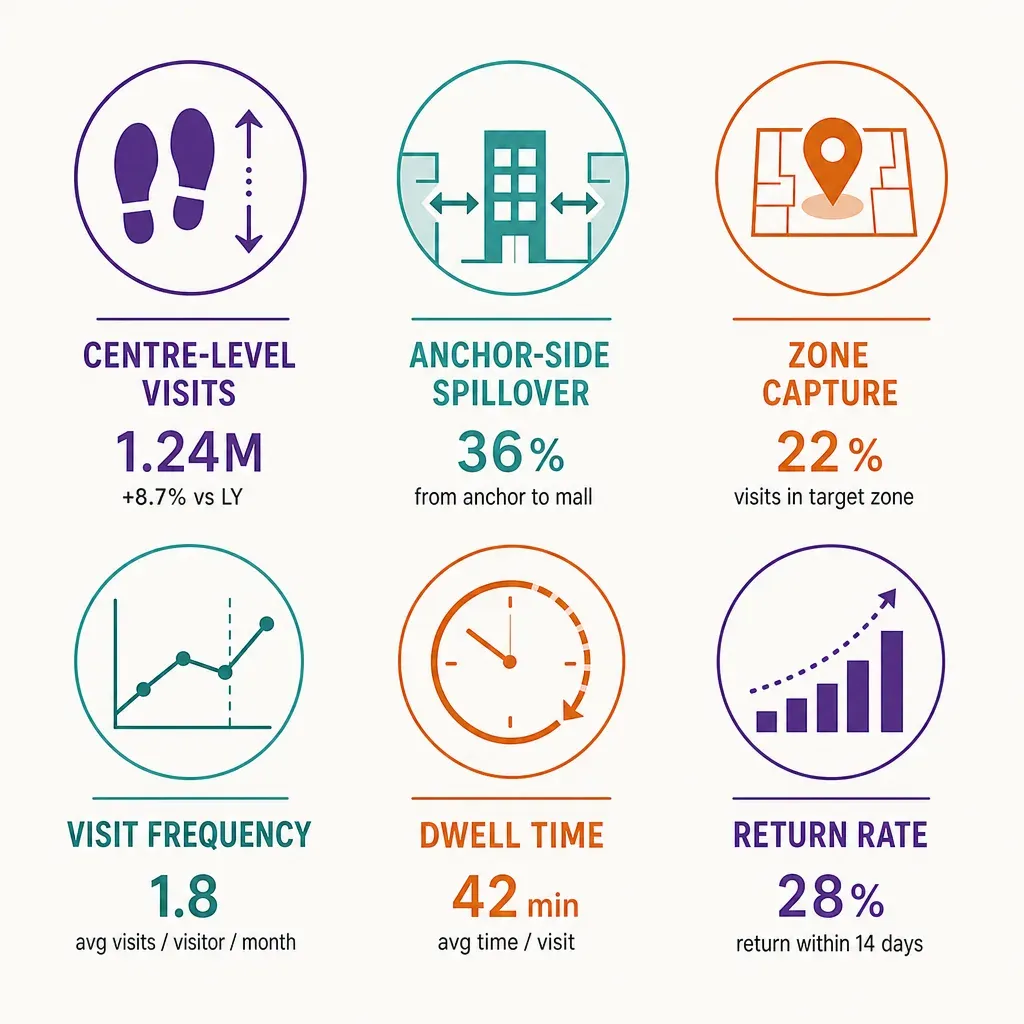
Lease renewal is the moment when a year of footfall data has to defend a rent. A retailer asking for a reduction, or pushing back on a step-up, will arrive with a story about soft trade. The landlord's counter has to be specific, comparable, and honest about what the building delivered. The six metrics in this guide are the set that does that work for a shopping centre, arranged in the order they typically come up at the renewal meeting: centre-level visits with year-over-year, anchor-side spillover, zone capture, dwell time, day-part mix, and weekday-weekend split. This is the BOFU companion to a wider piece on tenant performance reporting; the monthly report is the relationship work, this pack is the renewal conversation. The figures below are illustrative examples chosen to show the mechanics. They are not market averages or measured outcomes from any specific centre.
Why six metrics, not twenty
A renewal pack with twenty charts is a pack the retailer's commercial team will skim and dismiss. A pack with six numbers, each of which answers a question the retailer is about to ask, is the one that earns the conversation. Each of the six below has a job: it either defends the headline (the centre was a draw), or it explains a softness without ceding rent, or it gives the asset manager a credible offer (a relocation, a marketing push, a step structure) when the data really does say something has moved.
The reverse is also true. If the data says the centre underperformed the lease assumption, this is the set that surfaces it before the renewal meeting, not during it. A landlord who walks in already knowing the soft number is a landlord who keeps the tenant. A landlord who is surprised in the meeting is already losing the renewal.
1. Centre-level visits with year-over-year
The first number is the headline. Total visits to the centre over the lease year, compared with the same period the year before. Everything else in the pack supports this one figure or sets it in context. Anchored on year-over-year, it answers the only question a retailer will care about on page one: did the building bring the people the lease assumed it would?
Anchor it on calendar-aligned periods, not raw rolling twelves. A centre comparing November-to-November against a year that included an extra trading weekend will get an apparently soft number that has nothing to do with the centre's draw. Adjust for trading days where possible, and call out any obvious calendar shifts (Easter, school holidays, public holidays) in a short caption rather than letting the retailer read them into the gap.
Pair the headline with two supporting reads. A 12-month rolling chart that smooths week-to-week noise, and a quarter-by-quarter table that shows whether any softness is recent or long-standing. A centre whose year-over-year is flat but whose last quarter is up is in a fundamentally different renewal conversation than one whose last quarter is the softest of the four.
2. Anchor-side spillover
The second number is the most underused. Anchor-side spillover is the share of visitors who, after entering the centre through an anchor (a department store, a cinema, a grocer), pass through the wing or level where the tenant sits. It is the closest a centre can get to answering the retailer's most common implicit complaint: the anchor moved and now nobody comes down our wing.
The mechanic is simple. Sensors at the anchor entry and at the entries to the connecting concourse let the centre count, for any chosen period, what share of anchor visitors crossed into the wing in question. As an illustrative example, a centre whose anchor entry sees 200,000 visits a month and whose connecting wing entry sees 110,000 of the same visitors has a 55% spillover. If that number is steady year-over-year, the retailer's complaint about anchor change is not borne out by the traffic data. If it has fallen from 70% to 40%, the landlord has a real problem and the renewal conversation needs to be about a relocation or a marketing intervention, not about defending the rent.
Spillover is also the metric that lets a landlord credibly argue against a rent cut on flat traffic. A retailer pointing at a slow store on a Tuesday lunchtime is harder to maintain that position when the spillover number is the same as it was when they signed the lease.
3. Zone capture for the tenant's wing
The third number is the tenant's own context. Zone capture is the share of total centre visitors who entered the wing, level, or zone the tenant occupies. It is one step closer to the storefront than spillover (which is anchor-conditional) and one step further from the storefront than the tenant's own capture (which the centre does not own).
Zone capture matters because it is the trading environment the retailer actually rented. A tenant on a quiet wing whose zone captures 30% of centre visits is in a different business than a tenant on a primary concourse whose zone captures 75% of centre visits, even at the same centre and the same headline footfall. The renewal conversation is properly anchored on whichever number applies to this tenant.
Report it monthly across the lease year, with year-over-year. A tenant who can see that their zone's capture has been stable through twelve months has very little ground to argue the centre's traffic abandoned them. A tenant whose zone capture has fallen has a real grievance and the landlord should already be preparing a response (a leasing change in the wing, a marketing push, a relocation offer) rather than fighting on rent.
4. Average dwell time
Dwell time is how long, on average, a visitor stayed in the centre. It is the cleanest single signal of whether the centre's experience is working. A centre whose visits are flat but whose dwell has climbed is becoming a stronger trading environment regardless of what the headline says. A centre whose visits are flat and whose dwell has fallen is in early-warning territory.
At renewal, dwell is the metric that separates the centre as a destination from the centre as a transit point. A tenant whose category trades on browse-and-buy (apparel, home, gifts) is meaningfully exposed to dwell. A tenant whose category trades on planned visits (pharmacy, services) is less so. Use that to calibrate which retailers are being given dwell context and how. As an illustrative example, a centre reporting average dwell of 78 minutes year-on-year against 74 a year earlier has a number that an apparel tenant should care about and a pharmacy tenant probably does not.
Dwell is also a more credible centre-level metric than zone-level dwell at the renewal table. The centre as a whole is what the lease describes. Per-zone dwell can be informative internally for the asset team, but it is a number that invites the retailer to argue about measurement boundaries rather than about the business question.
5. Day-part mix
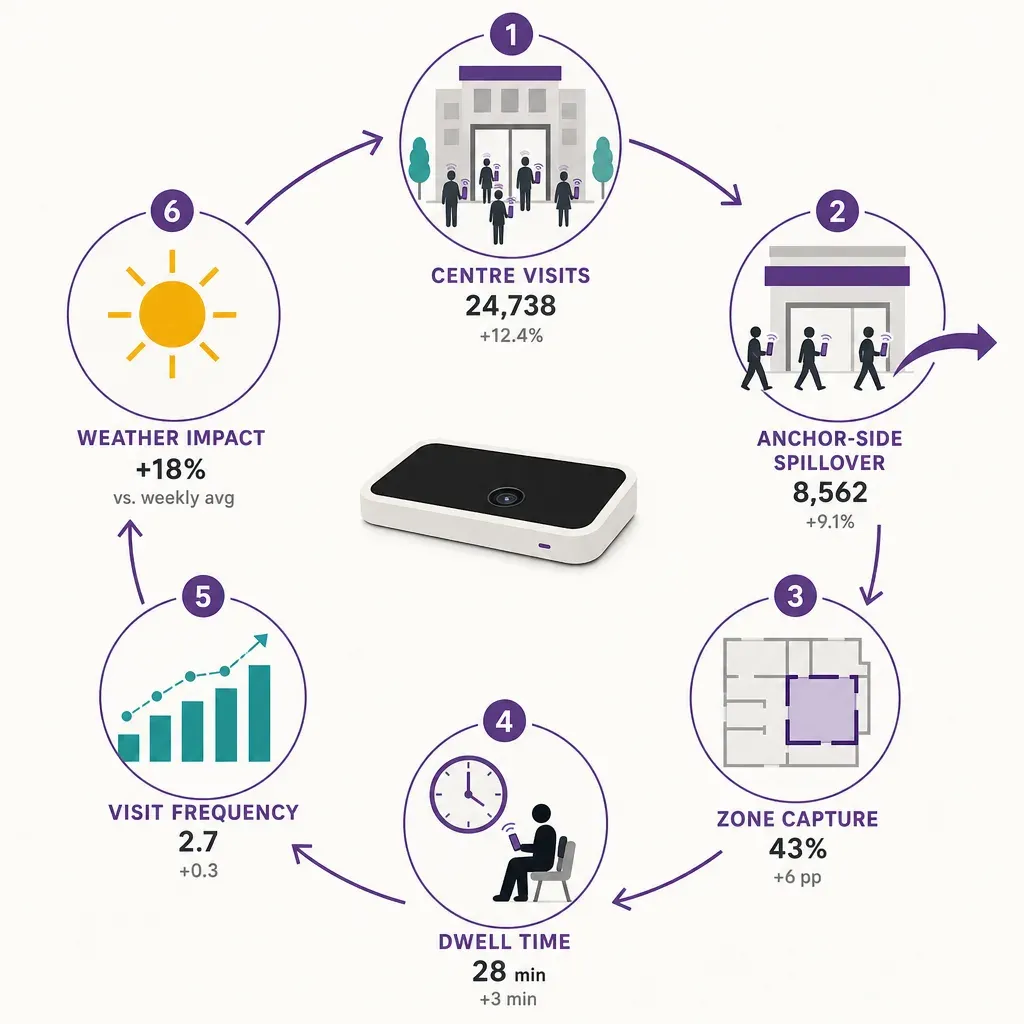
The fifth number is the day-part mix: the share of monthly visits that fell across morning, midday, afternoon, and evening blocks. It is the metric that translates a retailer's complaint about a specific shift into a centre-wide context they can read against.
A retailer running an apparel store, telling the landlord that weekday mornings are dead, is making a different argument when the centre's day-part data shows that 7% of all monthly visits happen between opening and 11am. The conversation moves from "the centre is empty in the morning" to "morning is a small share of total trade across the building, and that has been steady year-over-year." The tenant's category may not fit a morning shift; that is a category decision, not a landlord failure.
The same data also identifies real opportunities. A centre whose evening share has grown 4 percentage points year-over-year because a cinema has reopened or an F&B cluster has matured is a centre whose evening-leaning tenants have a defensible case for an evening-extended trading hour, not a rent reduction. The data does the case; the asset manager does not have to make it anecdotally.
6. Weekday and weekend split
The sixth number is the simplest, and one of the most useful. The share of monthly visits that fell on weekends versus weekdays. It is the metric that directly informs staffing, stock, and trading hours, and the one a store manager will read first in any pack.
At renewal, it is the metric that catches a hidden shift in the centre's mix. A retailer whose store is struggling on weekdays may not have noticed that the centre's weekend share has climbed from 38% to 45% over two years. That is a centre becoming a destination rather than a routine errand venue. For a category that trades better on weekends (entertainment-adjacent F&B, leisure retail), the renewal supports a higher rent. For a category that depends on weekday lunch traffic (services, convenience), the renewal needs a different conversation: an extension of operating hours into the weekend, a fit-out adjustment, or a relocation to a higher-weekday wing.
Pair this metric with day-part mix and the asset manager has a clear picture of how the centre is trading across the week, which is exactly what a category-aware renewal conversation needs.
How the six work together at the table
Each metric has a job, but their value at the renewal meeting is in the order they are read. A short worked example, using illustrative figures rather than measured outcomes from any specific centre, makes the sequence concrete.
- Headline (Metric 1). The centre delivered 4.6 million visits over the lease year, down 1.5% year-over-year. The decline is recent: the last quarter is roughly flat against the prior quarter. The centre is not collapsing.
- Anchor spillover (Metric 2). Spillover from the south anchor into the tenant's wing held at 58%, unchanged year-over-year. The anchor refresh did not draw traffic away from this wing.
- Zone capture (Metric 3). The tenant's wing captured 47% of centre visits, against 48% a year earlier. Effectively flat.
- Dwell (Metric 4). Average dwell across the centre rose from 74 to 78 minutes year-on-year. The experience is strengthening.
- Day-part (Metric 5). Morning share dropped from 9% to 7%; evening rose from 24% to 27%. The day is shifting later.
- Weekday-weekend (Metric 6). Weekend share climbed from 41% to 45%. The centre is leaning into weekend trading.
Read together, this is a renewal in which the landlord has a defensible position on rent (headline is essentially flat, dwell is up, the building is becoming a destination) and a constructive offer to make to a tenant whose category needs weekday morning trade (a relocation conversation, an evening-hour proposal, a category-specific marketing line). The retailer arrives expecting to argue about a soft store; the landlord arrives with the trading environment in context. That is the renewal conversation the data pack is for.
How Ariadne fits
The six metrics above all sit on the same underlying measurement: an accurate count of visits to the centre, broken down by zone, by hour, and by group size. The counting system has to read the building correctly enough to stand up in front of a tenant who will challenge it, and it has to read it in a way that does not create a privacy problem the landlord then has to defend at every renewal.
Ariadne measures this with Hybrid Fusion, its patented camera-free method. Time-of-Flight depth sensing counts every visitor at the entrances, capturing geometry rather than images, while patented phone signal sensing follows movement through the interior, detecting the signals a phone emits even in airplane mode. The sensor streams both feeds to Ariadne, where Hybrid Fusion combines them into one trajectory per visit and computes counts, dwell, and paths. The streams carry no identifier: no MAC address, no device ID, no biometric data, and no camera is involved. Identifiers are stored only when a visitor explicitly opts in, which keeps the method GDPR-friendly and outside biometric territory.
For a centre putting the six metrics in front of tenants, the practical consequences are direct. The people counting feeds give centre-level and zone-level visits accurate enough for a renewal conversation, including the anchor-side spillover and day-part splits that drive the harder readings. Group sizing comes from the patented signal sensing layer, which matters for centres whose tenant mix trades against family visits versus individual walk-ups. Dwell time is measured across the building, not estimated from a single door count. The data lands in Ariadne Analytics, where the asset team builds the renewal pack from the same source the monthly tenant report draws on, and the privacy policy covers what is captured and what is not. There are no cameras to point at tenants, no biometric data to argue about, and no MAC addresses to disclose or refuse to disclose. The renewal pack is exactly what it says it is: a count of visits and the time those visits spent in the building.
FAQ
How many months of footfall data do I need before a renewal meeting?
A minimum of twelve months of comparable data, ideally twenty-four. The first twelve give the year-over-year reading on each of the six metrics; the second twelve give the trend that turns a one-off shift into a story. Renewals are usually telegraphed twelve to eighteen months out, which is the natural window to ensure the data is in place.
Which of the six matters most?
Centre-level visits with year-over-year is the headline, and at most renewal tables it is the number a retailer will challenge first. Zone capture is the most relevant to the individual tenant, because it describes the trading environment they actually rented. The other four (anchor spillover, dwell, day-part mix, weekday-weekend split) are the context that explains what the headline really means for this retailer's category.
Should we share the full data pack with the retailer?
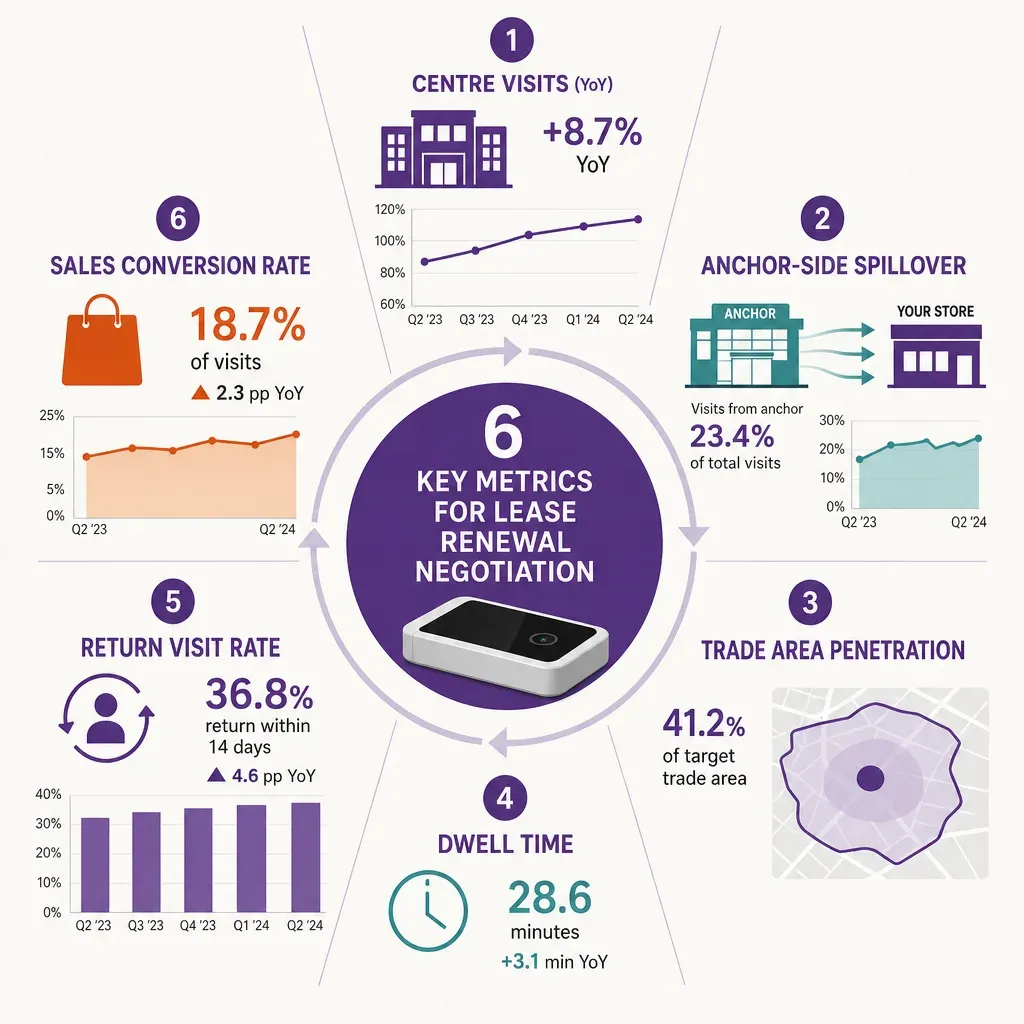
Yes, with one caveat. The six metrics in this guide are all centre-level or zone-level numbers that describe the trading environment, and they are appropriate to share with a tenant at renewal. What does not go in the pack is intra-tenant comparisons or named-neighbour data, which belong inside the asset management team. The principle is the same as in monthly tenant reporting: the landlord reports on the centre as a draw, not on one tenant against another.


