
A screen on a store wall is easy to buy and hard to justify. The invoice is concrete: hardware, mounting, a content management subscription, the design time to keep the loop fresh. The return is usually a wave of the hand toward "impressions" or "brand presence." That gap is why in-store screen budgets get cut first when a merchandising team is asked to defend spend, and it is entirely avoidable. The screen changes behavior in a small patch of floor around it, and that behavior is measurable. This post walks the ROI case for a single in-store screen: what to measure, how to turn it into a payback figure, and how to capture the signal without cameras or personal data.
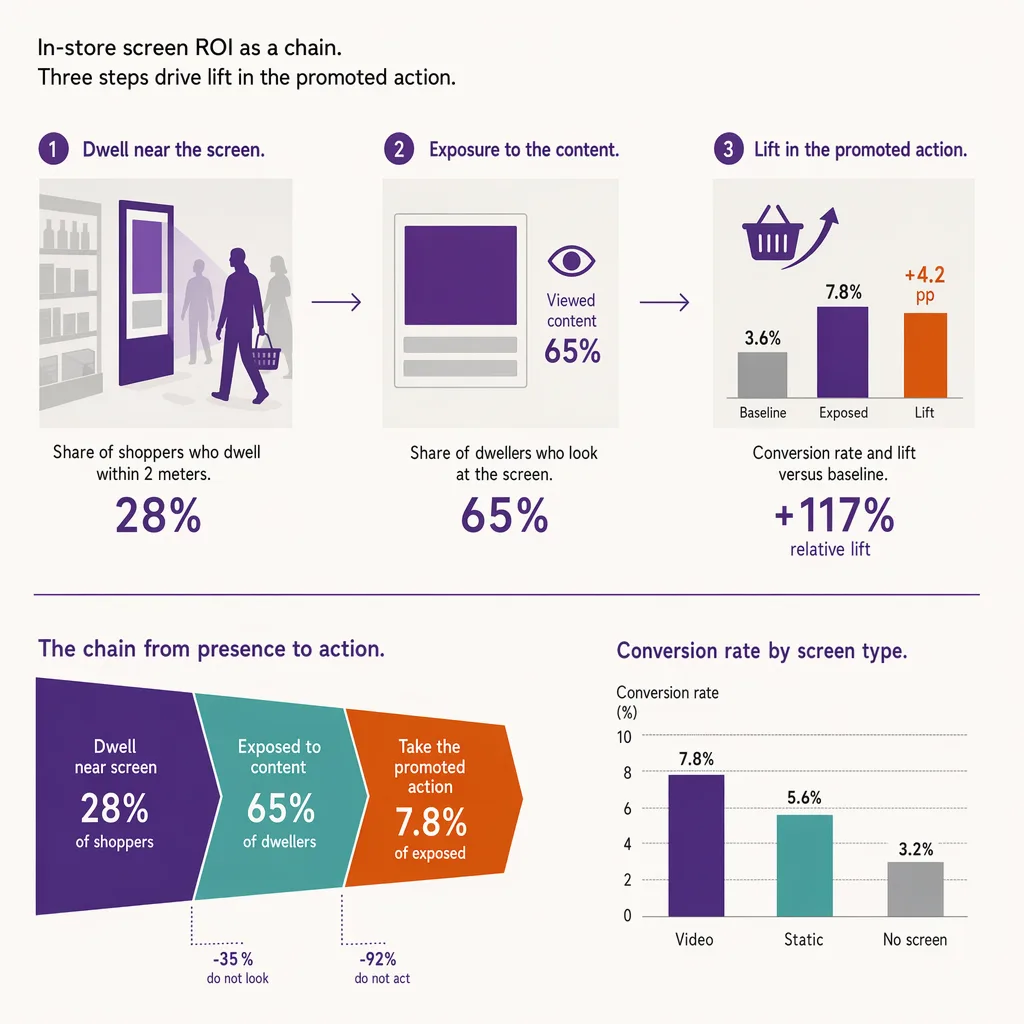
How do you measure the ROI of an in-store screen?
You measure in-store screen ROI by pairing what the screen costs with what it demonstrably changes in shopper behavior near it. The behavior signal is dwell: how many people stop in front of the screen and for how long, and whether traffic to the promoted zone or product rises while content runs. Ariadne captures that dwell and count camera-free, with no personal data, so the ROI case rests on measured engagement rather than assumed views. Pair the dwell signal with the conversion or sales change in that zone and you have a payback story a merchandising or media team can defend.
The rest of this post takes that outline apart: why impressions are the wrong starting point, what belongs in the ROI equation, how the dwell number is captured, and a worked template you can drop your own figures into.
Why "impressions" undersell a screen, and dwell is the honest engagement metric
An impression, in the way most signage vendors report it, is a modelled figure: total store traffic multiplied by an assumption about how many people faced the screen. It counts a shopper who walked past staring at their phone exactly the same as one who stopped, watched a fifteen-second spot, and turned toward the shelf it promoted. Those are not the same event, and a metric that cannot tell them apart cannot support a spending decision.
Dwell is the honest correction. It measures whether people actually stopped in front of the screen and for how long, which is the closest physical proxy for attention you can get without pretending to read minds. A placement that holds people for several seconds is doing work; one that everyone walks straight past is a lit rectangle. The distinction only shows up if you measure it. For the fuller treatment of dwell as an engagement metric, see dwell time as an engagement metric; for this post it is enough to say that dwell, not impressions, is the number the ROI case is built on.
There is a second reason dwell beats impressions for ROI work. Impressions scale with store traffic, so a busy store always looks like it has a great screen and a quiet store always looks like it has a poor one, regardless of the content. Dwell isolates the screen's own effect: it tells you whether this content, in this spot, earned a pause from the people who were there. That is the variable you actually control, which makes it the variable worth optimizing.
The ROI equation: screen and content cost vs. dwell, zone traffic, and zone conversion
The equation has two sides. On the cost side, total the real annual outlay: hardware amortized over its life, mounting and power, the content management platform, and the recurring design or agency time to produce and refresh content. Undercounting the content-refresh cost is the most common error here, because a screen running stale content for a year is a cost with no return.
On the return side, three measurements do the work, and they stack:
- Dwell in front of the screen. How many people stopped, and for how long. This is the engagement signal, and on its own it tells you whether the placement earns attention.
- Zone traffic. Whether footfall into the promoted product zone or aisle rises while the content runs, compared with a period when it does not. A screen that lifts dwell but moves nobody toward the product is entertaining, not commercial.
- Zone conversion or sales. Whether the people who reach that zone buy more than they did without the screen. This is where dwell turns into money.
The chain is dwell to zone traffic to zone conversion, and the ROI figure is the incremental margin from that conversion lift set against the annual screen cost. Conversion is the pivot: if you cannot connect the placement to a change in the conversion rate or the spend of shoppers in that zone, you have measured engagement but not value. The same logic underpins tying counted footfall to takings across the whole store, covered in footfall to revenue correlation; an in-store screen is that correlation narrowed to one patch of floor.
The cleanest way to isolate the effect is a before-and-after or an A/B window: run the promoted content for a defined period, measure dwell, zone traffic, and zone conversion, then compare against a matched period with the screen off or running neutral content. Matching the periods for day-of-week and seasonality matters, because a screen switched on the week before a holiday will take credit for a lift it did not cause.
Measuring dwell in front of a screen camera-free, with no PII
The measurement is only as trustworthy as the method behind it, and for a screen the instinct is often to reach for a camera. That instinct is worth resisting: a camera pointed at shoppers to gauge attention raises exactly the privacy and regulatory questions a retailer does not want attached to a marketing experiment, and it collects far more than a dwell figure needs. The dwell number does not require knowing who anyone is. It requires knowing how many people were present in front of the screen and how long they stayed.
Ariadne measures this with Hybrid Fusion, its patented camera-free method. Time-of-Flight depth sensing counts every visitor at the entrances, capturing geometry rather than images, while patented phone signal sensing follows movement through the interior, detecting the signals a phone emits even in airplane mode, and tracks that movement to about one-metre precision. The sensor streams both feeds to Ariadne, where Hybrid Fusion combines them into one trajectory per visit and computes counts, dwell, and paths. The streams carry no identifier: no MAC address, no device ID, no biometric data, and no camera is involved. Identifiers are stored only when a visitor explicitly opts in, which keeps the method GDPR-friendly and outside biometric territory.
Read against the screen, that gives you the dwell and zone-traffic numbers the ROI case needs, measured as verified presence rather than inferred views, and it does so without ever recording a face. For the reasons a screen audience can be measured properly without facial recognition, and why that is a defensible posture rather than a compromise, see measuring screens without cameras.
A worked, illustrative payback model
The figures below are illustrative sample data, not a customer result and not a benchmark. Their only job is to show the shape of the calculation so you can substitute your own numbers. The example compares two content treatments on the same screen over matched two-week windows, holding the store and the placement constant and changing only what plays.
| Measure (sample data) | Content A: generic brand loop | Content B: promoted-product spot |
|---|---|---|
| People passing the screen (2 weeks) | 12,000 | 12,000 |
| Stopped in front (dwell over 2s) | 900 | 1,700 |
| Median dwell | 3s | 7s |
| Traffic into promoted zone | 2,100 | 2,850 |
| Zone conversion | 18% | 22% |
| Incremental zone transactions | baseline | +510 |
In this illustration, the volume of passers is identical because the store's traffic did not change; the only variable is the content. Content B nearly doubles the number who stop and more than doubles median dwell, that dwell pulls more people into the promoted zone, and the higher zone conversion turns the extra traffic into roughly five hundred additional transactions over the fortnight. To finish the payback, you multiply those incremental transactions by average margin per transaction in that category and compare the result against the screen's cost for the same period. If the incremental margin clears the fortnight's share of the annual screen cost, the placement pays back, and the model tells you which content did the paying.
The point of laying it out this way is that every cell is a number you can measure rather than assume. Swap in your real passer count, your real dwell, your real zone conversion, and the same table produces a payback figure specific to your store and your content.
Content that earns its dwell: what to test next
An ROI model is not a one-off audit; it is a loop. Once you can measure which content earns dwell and which moves zone traffic, the screen becomes a testing surface rather than a fixed cost. The obvious next tests are content type (product spots versus brand loops versus price-led messages), rotation length (whether a shorter loop holds attention better than a long one), and placement timing (whether the same content earns more dwell at peak than in quiet hours).
Feed each test back through the same three measurements and the screen compounds in value: you are no longer paying for a display, you are running a small, continuous experiment in what makes shoppers stop and move. For the broader analytics that sit around a signage network and connect it to the rest of store performance, see analytics for digital signage, and for how Ariadne supports screen and audience measurement across a network, the digital signage analytics hub covers the deployment picture. The measurement itself rests on camera-free counting and dwell, which is what lets the whole ROI case stand up to scrutiny.
FAQ
Is in-store digital signage worth it?
It is worth it when you can measure that it changes behavior, and not before. A screen that lifts dwell, pulls more people into the promoted zone, and raises conversion in that zone earns its cost. A screen running stale content that everyone walks past is a lit rectangle. The difference is measurable, so the honest answer is to run the placement, measure dwell and zone conversion, and let the numbers decide rather than defending the spend on brand presence alone.
How do you measure dwell time in front of a screen?
By counting how many people are present in the screen's viewing area and how long they stay, then reporting the share who stopped beyond a threshold and their median dwell. Ariadne captures this camera-free, as verified presence and dwell, so the figure reflects people who actually paused rather than a modelled impression multiplied out of total store traffic.
Do I need cameras to measure in-store screen ROI?
No. Ariadne counts with Hybrid Fusion: Time-of-Flight depth sensing plus patented phone signal sensing, never cameras. Time-of-Flight captures geometry rather than images, and signal sensing captures no MAC address by default, so the measurement involves no video, no faces, and no biometric data.
What is the difference between impressions and dwell for signage ROI?
An impression is usually a modelled figure: total traffic multiplied by an assumption about who faced the screen, which counts a passer-by and an engaged viewer identically. Dwell measures whether people actually stopped and for how long, isolating the screen's own effect from raw store traffic. For an ROI case, dwell is the variable you control and therefore the one worth optimizing.
---


