
Why dwell beats reach at the screen
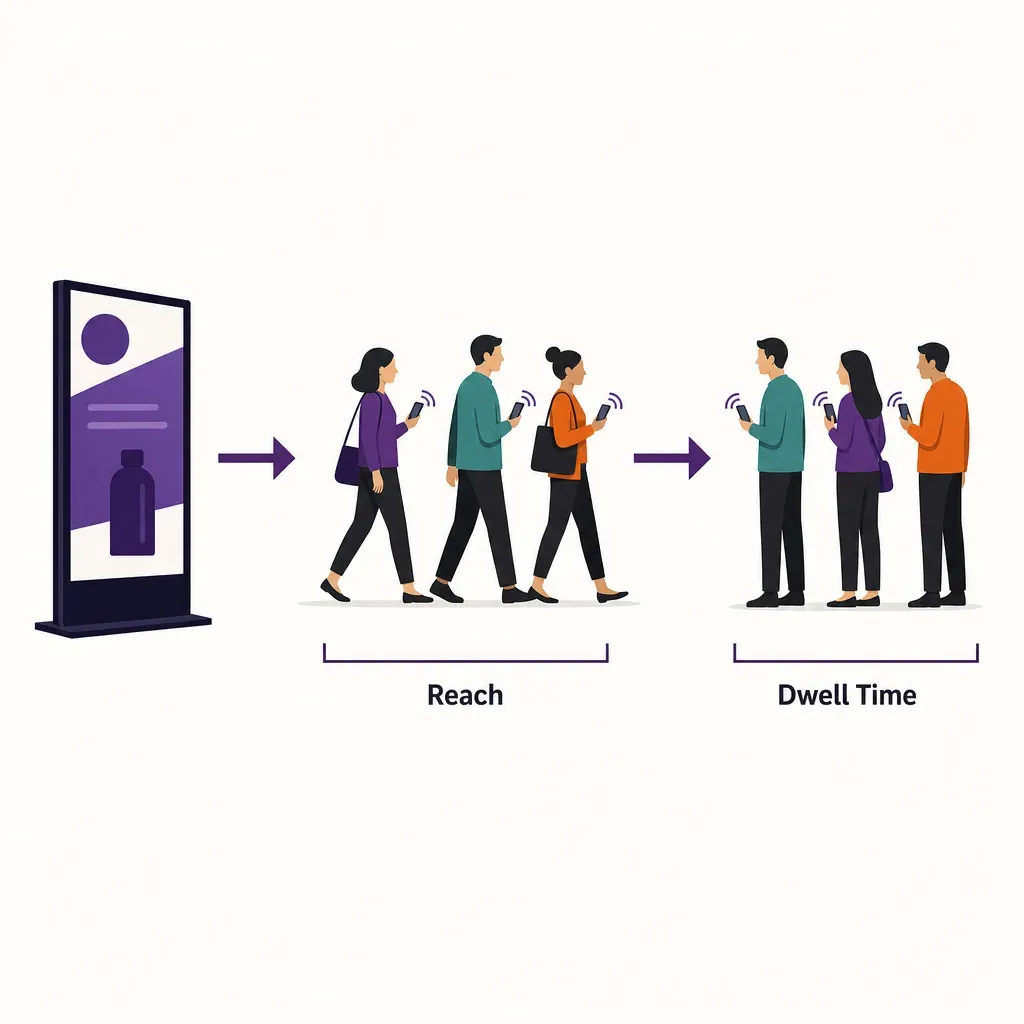
A digital screen in a public venue has the same problem every advertising medium has had since the first poster went up on a wall: someone has to look at it for it to matter. Reach answers half of that question. It tells you how many people walked past the screen during the hour, the day, or the campaign. It does not tell you whether any of them stopped, slowed down, or stayed long enough to take in the message. Dwell time at the screen tells you the rest.
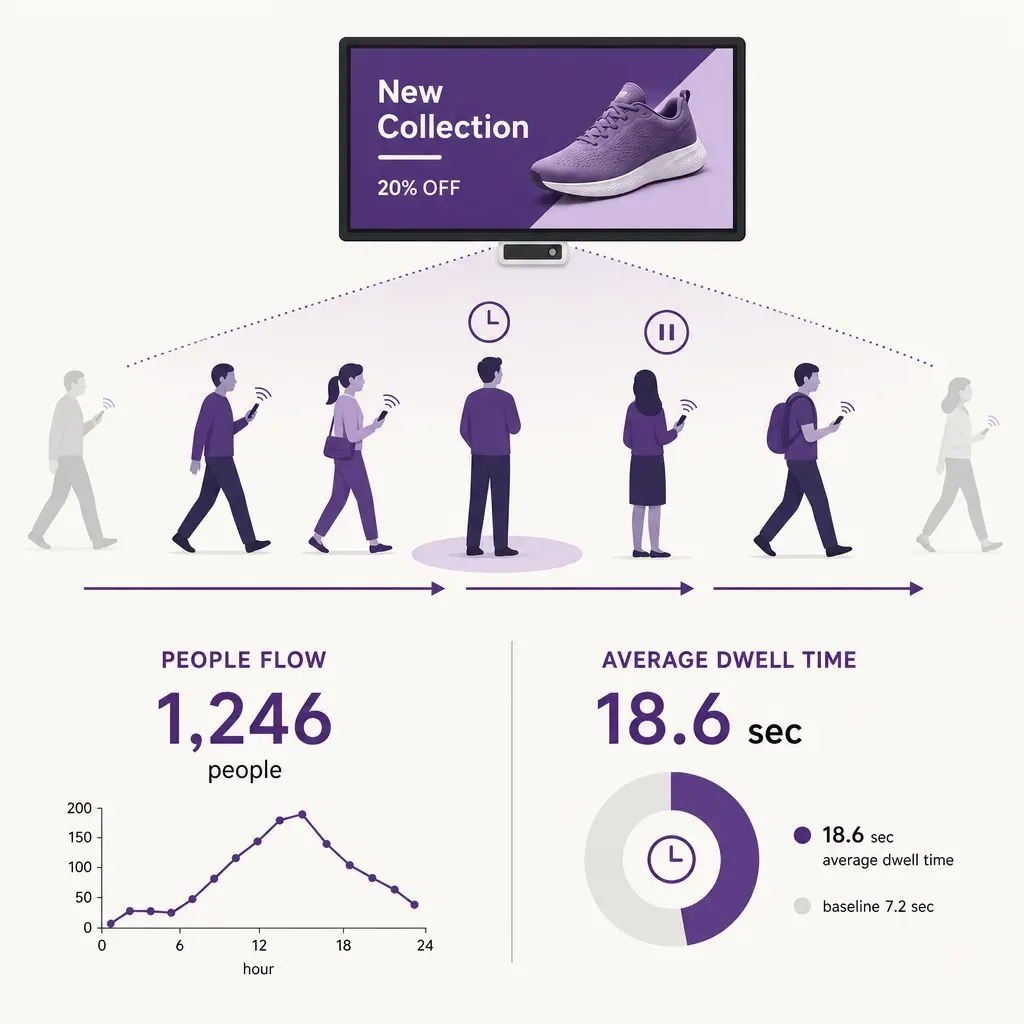
On a digital signage network, dwell is the closest thing to an attention proxy that holds up under audit and does not require a camera to produce. It is the average length of time a visitor spends inside the screen's coverage zone, weighted by how many of them are there and what they were doing when they passed. A 12-second dwell on a transit-platform screen is a different audience from a 1.5-second dwell on a doorway screen, and the creative has to know which one it is selling to. This post walks through what dwell actually is, how to measure it at a screen without a camera, what counts as a high-attention zone in practice, and what dwell tells the creative team about message length and pacing.
What dwell at a screen actually measures
Dwell time is one of those words that gets used loosely in DOOH conversations, so it helps to fix a definition before going further. Three things tend to get bundled under the same label, and they answer different questions.
- Pass-by dwell. The time a person spends inside the screen's coverage zone while moving past it. The audience is in motion. The dwell figure is typically a small number of seconds. This is the dominant pattern on circulation screens in transit stations, mall corridors, and airport concourses.
- Stop-and-look dwell. The time a person spends in the zone after slowing down or coming to rest. The audience has chosen to give the screen attention, even briefly. This is what happens at decision points, queues, waiting areas, and food-court seating zones.
- Captive dwell. The time a person spends in the zone because they cannot easily leave it. The audience is in a lift lobby, a waiting room, a queue corridor, a fitting-room area, or a gantry queue. The dwell figure is typically longer and more uniform.
A single average dwell number for a screen flattens those patterns into something that is not very useful for a planner or a creative team. A better report breaks dwell down by pattern, by daypart, and by group size, because the message that works against a 2-second pass-by audience is not the message that works against a 30-second captive one. The dwell figure is also only meaningful alongside the count: 12 seconds against 4 people in the zone is a different campaign reality from 12 seconds against 40.
Measuring dwell at a screen without a camera
The historical way to measure dwell at a screen was a camera on or near the screen, running face detection to track how long a face stayed in front of the panel. That approach has become hard to defend in 2026. Under the GDPR, processing images of identifiable people is processing personal data. Under the EU AI Act, real-time biometric categorisation in publicly accessible spaces is restricted. A camera looking at faces to measure dwell is exactly the kind of system both frameworks are designed to push back against.
What replaces it is a class of camera-free methods that count people and measure their time in a zone without forming an image of them or recognising who they are. Two sensing methods do this well, and a serious in-venue audience-measurement stack tends to combine them.
- Time-of-Flight depth sensing at the screen. A ceiling or top-mounted sensor fires infrared pulses and measures the return distance. It captures the height and shape of whatever passes below it, to roughly 30 centimetres, and reads geometry rather than images. It counts every person entering and leaving the screen's coverage zone, independent of whether they carry a phone, and produces the count side of the dwell equation cleanly.
- Patented signal sensing in the zone. A sensor detects the radio signals a phone emits, even in airplane mode, and triangulates position. It can measure how long a visitor stays in the screen's coverage zone, and it can size the group around the screen without recording who anyone is. By default, no MAC address is captured.
Run together, the two methods produce the inputs the creative and the buyer actually need: how many people were inside the screen's coverage zone, how long each visit lasted on average, and how those figures move across the day. There is no camera in the path, no image of a visitor anywhere, and nothing that a data protection officer would classify as biometric.
What counts as a high-attention zone
Not every screen sees the same audience behaviour, and not every position in a venue produces a dwell figure worth optimising creative for. A useful way to think about this is to separate the venue's screens into attention tiers based on the dwell patterns they actually produce, and then to plan the creative and the media schedule around those tiers rather than treating the network as one undifferentiated reach buy.
Across the venue types where camera-free dwell measurement is now common (transit, retail, mall, airport, place-based networks of various kinds), the high-attention zones tend to share a small number of structural traits.
- The visitor has stopped or is queuing. Decision points, ticket queues, ordering queues, security gantries, food-court seating, lift lobbies. The audience is not moving past the screen; they are waiting in proximity to it.
- The visitor's eye line is naturally directed at the screen. Screens positioned on the line of sight a queue is already producing (above a counter, at the far end of a corridor, opposite a waiting area) earn far more dwell than screens placed perpendicular to the flow.
- The visitor is between tasks. A passenger between security and the gate, a shopper between a transaction and an exit, a diner between ordering and a meal. These are the moments where attention is genuinely available, and the dwell figure reflects it.
- The group around the screen is small enough to give it weight. Group sizing matters. A screen surrounded by a crowd of 40 people is not earning 40 individual seconds of attention; it is competing with the crowd itself. Camera-free group sizing through signal sensing lets a venue report dwell against the actual audience, not against the headline footfall.
- The screen is not competing with another screen. Two adjacent screens running different creative produce divided attention. Dwell against either screen drops because the visitor's eye splits between them. The high-attention zones in a venue are usually the ones where a single screen owns the sight line.
Indicative ranges from venue-level camera-free measurement, useful as planning anchors rather than benchmark claims, tend to look something like this. Circulation screens in motion-dominated zones (transit concourses, mall corridors) report dwell in the low single digits of seconds, with a long tail of very short visits. Decision-point and queue screens report dwell in the high single digits to mid-teens, depending on queue length and time of day. Captive screens in waiting and lobby zones report dwell from the low tens of seconds upward, with a far tighter distribution. The exact numbers vary by venue, by screen geometry, and by the rest of the environment; the shape of the distribution is the more reliable signal.
What dwell tells the creative team
Once dwell is measured cleanly at each screen, the creative implications fall out of it directly. The single most useful question a creative team can ask is the simplest one: how long do we actually have? Everything else follows.
Message length tuned to dwell
The default DOOH creative duration is 10 to 15 seconds because that is the standard sold across most networks. Whether the creative inside that window earns its time is a different question. On a pass-by circulation screen with an average dwell of 2 to 3 seconds, the audience never sees the second half of a 15-second spot. The creative has to be readable in the first second, the brand has to be present in the first frame, and the call to action has to be the headline, not the resolution. On a captive screen with a 30-second dwell, the same creative wastes 25 seconds of available attention. A creative built for that screen can carry a longer narrative, a sequence of frames, a value proposition that unfolds.
The practical move is to maintain a small number of creative versions tuned to dwell bands (short pass-by, medium queue, long captive), and to traffic them against the zone tiers the dwell measurement produces. A network that sells inventory as one undifferentiated pool loses this. A network that sells dwell-tiered inventory, with the creative cut accordingly, gets meaningful lift out of the same media spend.
Pacing and frame economy
Pass-by creative has to behave like a billboard, not like a television spot. The frame economy is brutal. One headline, one image, one brand mark, one action. Motion is useful only where it draws the eye on the first glance; layered animation that resolves at the three-second mark resolves to no one. Captive creative can be paced like a short film, but even there the most-watched second is still the first one. The brand mark and the headline have to live in that second on every dwell band.
Daypart matching
Dwell varies by time of day in patterns that the camera-free measurement reports cleanly. A queue screen at a quick-service venue has a long dwell at peak meal times and almost no dwell off-peak. A transit screen has a long dwell when the platform is full and a service is delayed, and a short one when the service is on time. Matching creative to dwell daypart, not just to footfall daypart, lets a campaign run a longer message during the venues' high-dwell windows and a shorter one outside them.
Group-aware creative
When the camera-free measurement reports group size at the screen as well as dwell, the creative can be matched to that too. A screen with a group of three people in front of it for 15 seconds is selling differently from a screen with one person in front of it for 15 seconds. Family-oriented creative belongs against the group reading. Single-shopper or solo-commuter creative belongs against the individual reading. A network that can report group sizing without a camera (through the same signal-sensing measurement that produces the dwell figure) gives the creative team a lever that camera-based measurement could never deliver under European privacy law.
How Ariadne measures dwell at the screen
Ariadne builds the two sensing methods above into one system, designed so that nothing identifying is captured at any point.
Ariadne measures this with Hybrid Fusion, its patented camera-free method. Time-of-Flight depth sensing counts every visitor at the entrances, capturing geometry rather than images, while patented phone signal sensing follows movement through the interior, detecting the signals a phone emits even in airplane mode. The sensor streams both feeds to Ariadne, where Hybrid Fusion combines them into one trajectory per visit and computes counts, dwell, and paths. The streams carry no identifier: no MAC address, no device ID, no biometric data, and no camera is involved. Identifiers are stored only when a visitor explicitly opts in, which keeps the method GDPR-friendly and outside biometric territory.
Applied to a digital screen, the practical output is the data layer the creative team and the media buyer ask for: how many people entered the screen's coverage zone, how long each visit lasted on average, how the group around the screen was sized, and how those figures move across the day. The same measurement feeds the venue-level people counting layer, so dwell at a screen can be read against the venue's footfall context rather than in isolation. Visitor marketing reporting for the operator and the advertiser is produced under a no-personal-data design that holds up under GDPR, the EU AI Act, and the audit expectations a buyer is increasingly bringing to the channel. The data handling is described in the privacy policy.
A short checklist for putting dwell to work
If you are bringing dwell into a digital signage plan for the first time, a small number of questions tend to produce most of the value.
- How is dwell defined for each screen? Confirm whether the measurement is reporting pass-by, stop-and-look, or captive dwell, and ask for the breakdown by zone rather than a single network-wide average.
- How is dwell measured? The answer should not be a camera looking at faces. A method built on Time-of-Flight depth and signal sensing measures dwell without capturing images or biometric data.
- Is dwell paired with a count? A dwell figure without an audience count is not a campaign metric. Read dwell and count together for each screen and each daypart.
- Is group size measured? Group sizing through camera-free signal sensing lets the creative match the audience configuration, not just the audience volume.
- Are creative cuts dwell-tiered? If the network sells one cut against all screens, dwell is being wasted on captive zones and overrun on pass-by zones. Plan the creative against the dwell distribution, not against the network average.
- How is the privacy posture documented? Under the GDPR and the EU AI Act, the measurement stack should produce no images, no faces, no biometric inference, and no identifiable device traces by default. Get this in writing before the campaign starts.
Related reading
FAQ
Does dwell measurement at a screen require a camera?
No. Ariadne counts with Hybrid Fusion: Time-of-Flight depth sensing plus patented phone signal sensing, never cameras. Time-of-Flight captures geometry rather than images, and signal sensing captures no MAC address by default, so the measurement involves no video, no faces, and no biometric data.
Applied to a digital screen, Time-of-Flight depth sensing counts people entering and leaving the screen's coverage zone, and patented signal sensing measures how long they stay and sizes the group around the screen. Together they produce dwell, count, and group size without any image, face, or biometric input.
What is a good dwell figure for a digital signage screen?
There is no single good number, because dwell is a function of the screen's position in the venue. A circulation screen with a low single-digit dwell is performing as expected; a captive screen with the same figure is failing. The useful frame is to read each screen against the dwell band it sits in (pass-by, stop-and-look, captive) and to tune the creative to that band rather than chasing a single network-wide average.
How does dwell relate to attention?
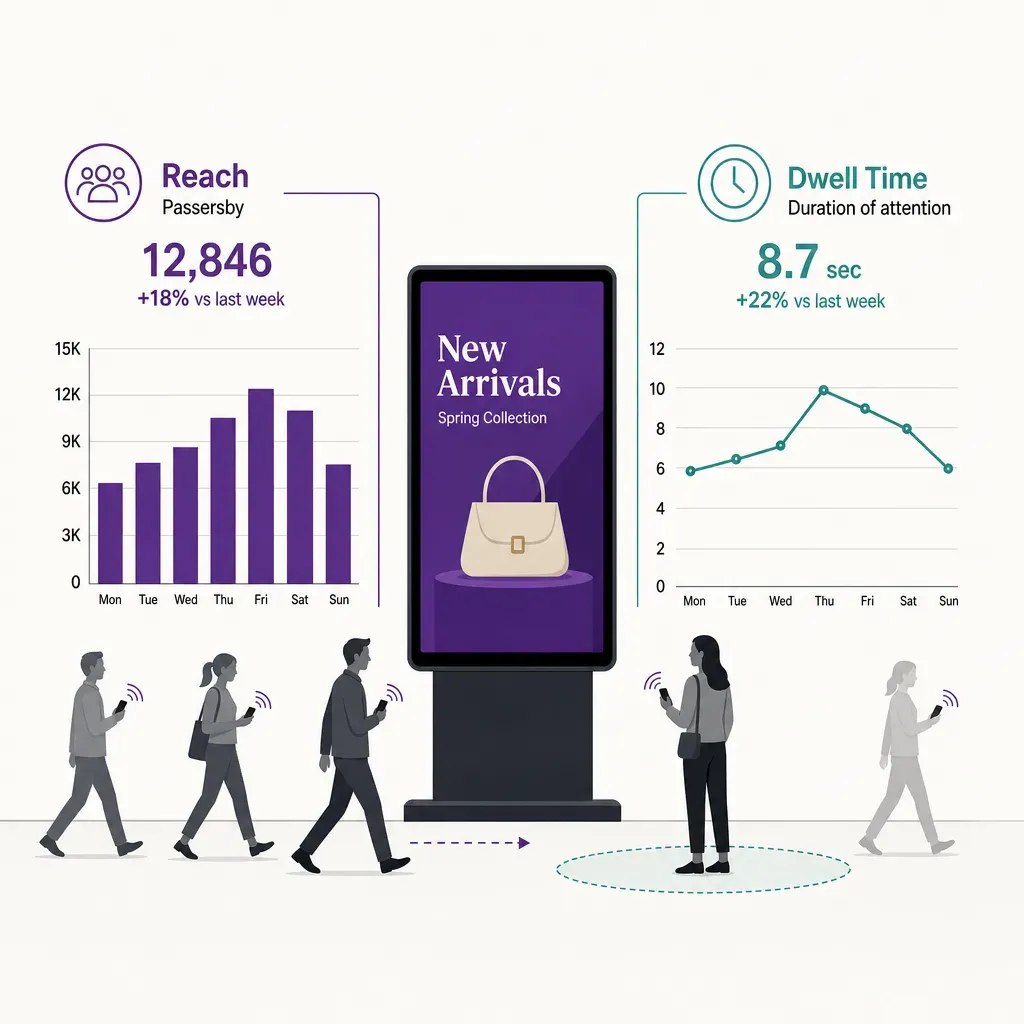
Dwell is a proxy for attention. It is not the same thing as a confirmed gaze on the screen, and the standards bodies have not yet accredited a single in-venue attention metric. As a planning input, dwell is the most defensible proxy that can be produced at scale today without cameras: it tells you the audience was present in the screen's coverage zone for a measurable length of time, which is the necessary precondition for attention without being a claim to having captured it.


