
A hotel measures itself by occupancy percentage, the share of rooms sold. It is the number on every report and the basis of every forecast. It is also blind to the one space that decides a guest's first and last impression: the lobby. Occupancy tells you a room sold. It does not tell you that fourteen guests tried to check in at the same eight minutes, that the bar filled with non-residents at 19:00, or that the meeting rooms drew a stream of visitors who never appear in the rooms ledger.
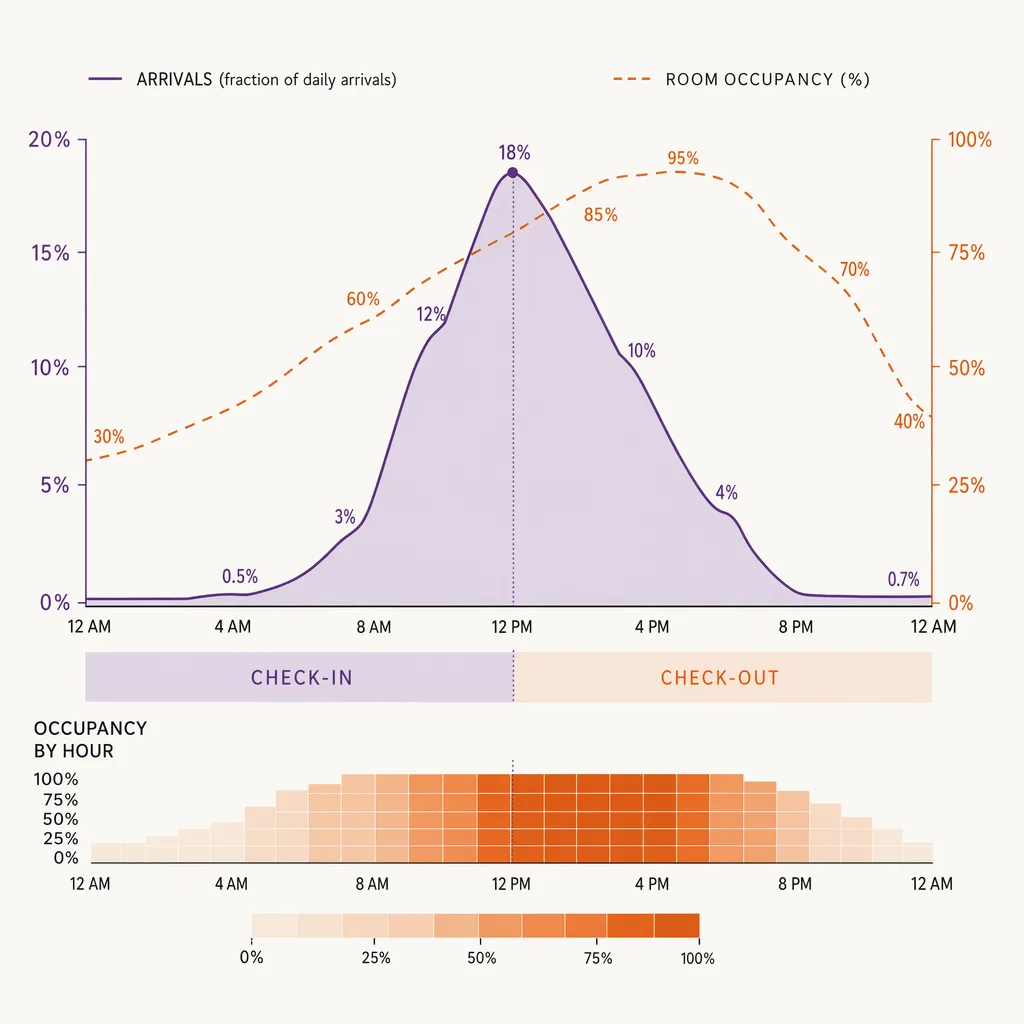
Lobby foot traffic measures the building as it is actually used. It shows the real arrival and departure peaks, so the front desk can be staffed for the genuine check-in rush rather than a flat shift pattern. It measures non-resident use of the bar, restaurant, and meeting spaces, which is revenue that occupancy data never sees. This guide covers why a lobby count matters, how to staff to the arrival curve, and how to do it in a public space without pointing a camera at guests.
Why measure foot traffic in a hotel lobby?
A hotel lobby is shared by arriving guests, departing guests, restaurant and bar visitors, and event attendees, and room nights tell you none of that. Lobby foot traffic shows the real arrival and departure peaks, so you can staff the front desk for the actual check-in rush rather than a flat schedule. It also measures non-resident use of the bar, restaurant, and meeting spaces, which is revenue that never appears in the rooms ledger.
The sections below work through the two highest-value uses, staffing the desk and measuring non-room revenue, and then the practical question of counting a public, guest-facing space without surveillance.
The hotel pain point: occupancy percentage hides the check-in and check-out crush
Eighty percent occupancy is a comfortable number on a report. It says nothing about how those guests arrive. A hotel near an airport may see a tight evening arrival wave as flights land; a city business hotel sees a check-out crush before the working day. A flat occupancy figure averages all of that into a single percentage that hides the very peaks that decide whether a guest's stay starts with a queue or a welcome.
The first and last few minutes carry disproportionate weight in how a guest rates a stay. A long check-in queue after a travel day, or a slow check-out when a guest has a train to catch, is what gets remembered and reviewed. Yet the front-desk rota is often set by shift convention rather than by the arrival curve, because nobody has measured the curve. An accurate live lobby count makes the peaks visible, and a public-facing one lets the desk see a wave building rather than discovering it when the queue is already out the door.
The peaks are also more predictable than most desks treat them, once measured. An airport hotel inherits the arrival banks of the airport it serves, so a delayed evening wave of flights becomes a delayed wave at the desk a known interval later. A conference hotel sees its arrivals bunch around the event it is hosting, which the front office knows is coming but rarely staffs precisely for. A city-centre business hotel sees a heavy check-out crush in the early morning as guests leave for meetings and trains, then a long quiet daytime, then an evening arrival spread. These are not random; they are repeatable shapes tied to transport and to the standard check-in and check-out times, and once a hotel has a few weeks of measured curve it can staff the desk to the pattern the building actually runs rather than to a flat three-shift convention.
Front-desk staffing to the arrival curve
Once the arrival and departure peaks are measured rather than assumed, the desk rota can follow them. This is the same staffing to the arrival curve discipline retailers use for their busy hours, adapted to a pattern that is often sharper in a hotel: arrivals cluster around transport schedules and standard check-in times, and departures cluster before check-out.
The payoff is not necessarily more staff. It is the right staff at the right minutes. Pulling a team member from a quiet mid-afternoon to cover a 16:00 to 18:00 arrival wave costs nothing extra and removes the queue that would otherwise define the guest's arrival. Counting also distinguishes a genuinely busy lobby from a slow one: a queue at the desk with low lobby traffic is a service-speed problem, while a queue with high traffic is a staffing one, and the two need different fixes.
In day-to-day operation a duty manager uses the live lobby count the way a retail manager uses a live store count, but with sharper consequences. Seeing the lobby fill ahead of a 16:00 check-in window is the cue to open a second desk position or to deploy a roaming team member with a tablet to start check-ins in the queue before guests reach the desk. The same number flags the opposite: a lobby that is full but moving slowly, which points at a system or a process problem (a slow property-management system, a key-card jam, a single guest with a complicated booking holding the desk) rather than a need for more bodies. A manager who can tell those apart in the moment stops throwing staff at a queue that more staff will not clear.
Measuring non-resident use of the bar, restaurant, and meeting spaces
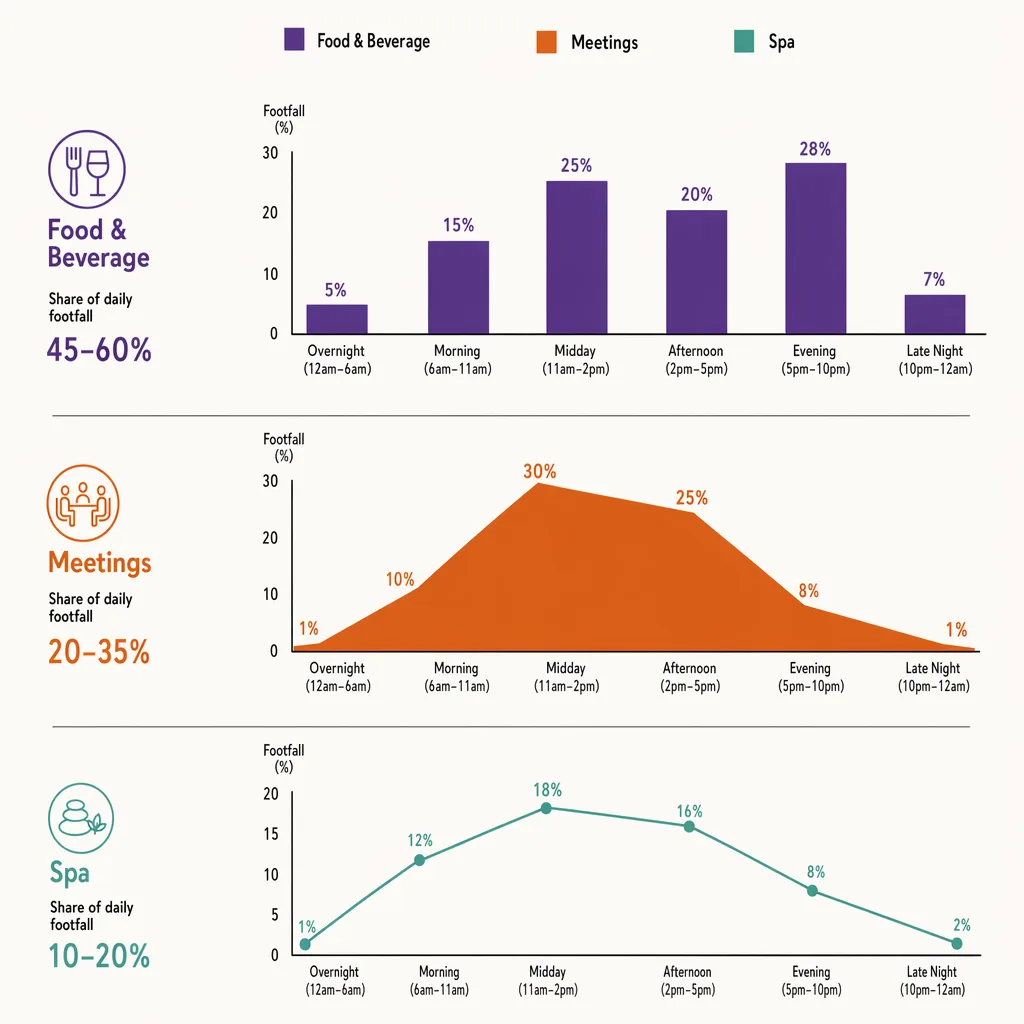
A modern hotel earns a growing share of its revenue from people who are not staying the night: the bar that draws a local after-work crowd, the restaurant open to the street, the meeting and event spaces booked by businesses with no room nights attached. None of this appears in occupancy data, and much of it is hard to attribute even from till data, because a drink sold at the bar does not say whether the buyer was a resident or a walk-in.
Lobby and zone counting begins to separate these streams. By counting entries to the building against the known resident base and counting the F&B and meeting areas separately, a hotel can estimate non-resident footfall and see how the bar or restaurant traffic moves through the evening. That turns a vague sense that "the bar does well on Thursdays" into a measured pattern that can inform opening hours, F&B staffing, and whether a space is worth promoting to non-residents at all. It is revenue the rooms ledger structurally cannot see, and counting is one of the few ways to put a number on it.
The numbers also reframe questions that hotels currently answer on instinct. Is the lobby bar worth keeping open until late on weeknights, or is the after-ten trade so thin that the staffing cost outruns the spend? Does the street-facing restaurant actually pull non-residents, or is it mostly serving the guests who would have eaten somewhere anyway? Should a function room sitting empty most weekdays be repositioned as bookable meeting space, co-working, or a daytime café? Each of these is a revenue or cost decision that the rooms ledger cannot inform, because the rooms ledger only knows about room nights. A footfall pattern for each space, read against the till takings for that space, gives a hotelier the missing denominator: not just what a space earned, but against how many people passing through, which is what separates an underperforming space from an under-trafficked one.
Attribution honesty
A note on what the count can and cannot claim. Counting entries against the known resident base gives an estimate of non-resident footfall, not a precise headcount of walk-ins, because residents also pass through the lobby and use the bar. The honest framing is a measured pattern and a defensible estimate, not an exact split, and it is most reliable where the F&B or meeting space has its own monitored entrance separate from the main lobby flow. Treated that way, the data is strong enough to inform opening hours and staffing without being oversold as a precise revenue attribution it cannot support.
Counting in a public lobby without cameras pointed at guests
A hotel lobby is a public, guest-facing space where people expect a degree of ease and discretion. It is also, increasingly, a space where guests are sensitive to being watched. A counting camera in a lobby is both a guest-experience problem and a data-protection one. The counting needs to measure flow, arrivals, departures, zone use, without recording the guests themselves. That is the argument for counting without cameras in hospitality specifically.
Ariadne measures this with Hybrid Fusion, its patented camera-free method. Time-of-Flight depth sensing counts every visitor at the entrances, capturing geometry rather than images, while patented phone signal sensing follows movement through the interior, detecting the signals a phone emits even in airplane mode, and tracks that movement to about one-metre precision. The sensor streams both feeds to Ariadne, where Hybrid Fusion combines them into one trajectory per visit and computes counts, dwell, and paths. The streams carry no identifier: no MAC address, no device ID, no biometric data, and no camera is involved. Identifiers are stored only when a visitor explicitly opts in, which keeps the method GDPR-friendly and outside biometric territory.
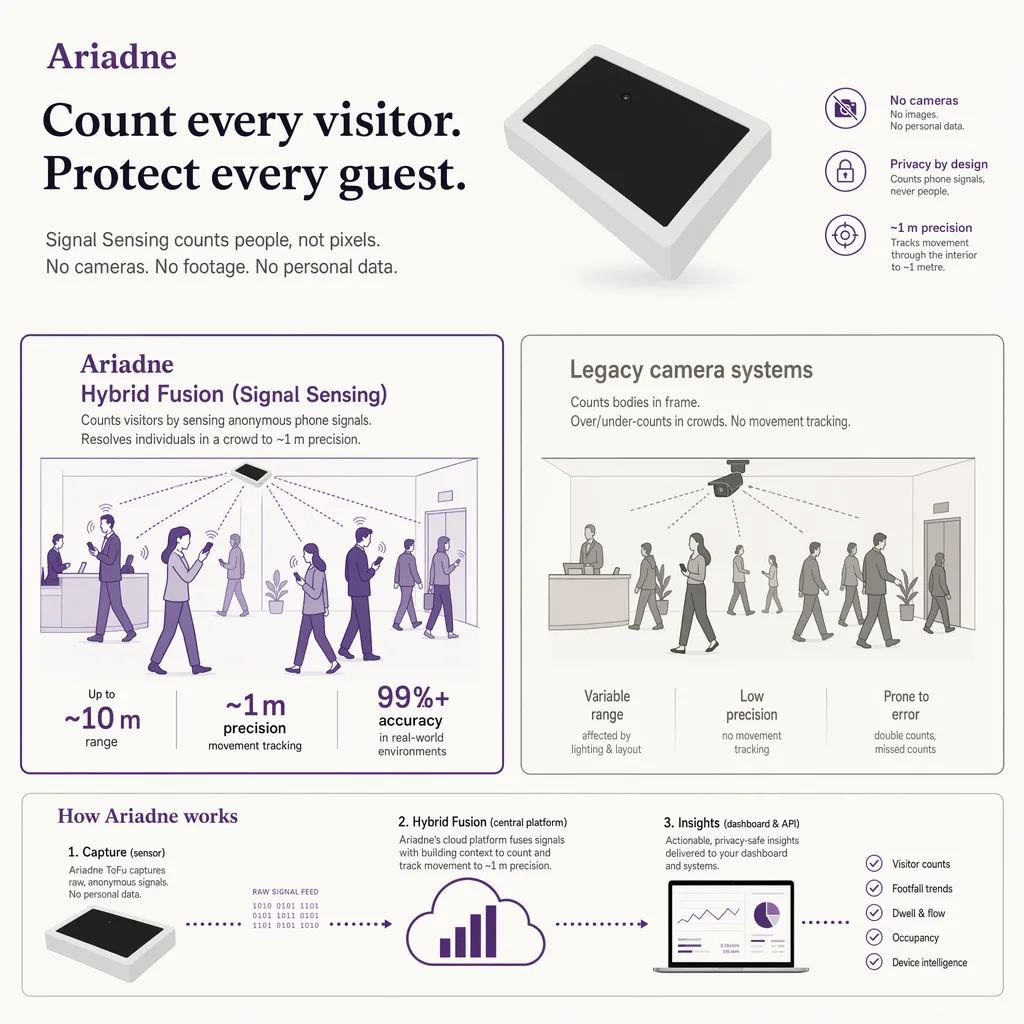
Because the method records geometry and signal rather than images, it gives the hotel the arrival curve and the zone counts without a single frame of a guest. There is no footage of the lobby, no record of who arrived when, and nothing personal to manage. The hotel gets the operational picture, and the guest gets a lobby that feels like a lobby rather than a monitored space.
From counts to action: cleaning, concierge cover, F&B prep timing
The lobby count earns its place when it changes the daily run of the hotel. A few concrete uses, in the spirit of turning counts into action:
Cleaning and turndown can follow real lobby and amenity use rather than a fixed schedule, so high-traffic public areas are serviced after the peak that dirtied them, not on a timer.
Concierge and bell cover can shift to the arrival waves, where guests most need help with bags and directions, instead of sitting through quiet stretches.
F&B prep timing can anticipate the evening bar and restaurant build, so the kitchen and bar are ready for the wave rather than caught behind it. Each of these is a small operational adjustment, and each depends on knowing the curve rather than guessing it.
Two more uses are worth naming because they touch revenue rather than cost. Late check-out and early check-in offers are easier to price and place when the desk knows how much slack the arrival and departure curves actually leave: a hotel that can see its mid-afternoon lobby is genuinely quiet can sell a late check-out without the operational pain it fears, because the data shows the desk will not be swamped. And meeting-space utilisation, read as a footfall pattern across the week, tells a hotel whether a function room earns its floor area or whether it sits idle four days in five, which is the input to a decision about repositioning the space or pricing it differently. Both turn a measured curve into a commercial choice rather than a staffing one, and both come from the same lobby and zone counts the desk already uses for cover.
FAQ
Why is occupancy percentage not enough for a hotel?
Occupancy tells you how many rooms sold, not how guests use the building. It hides the check-in and check-out crushes that shape a guest's first and last impression, and it is blind to non-resident use of the bar, restaurant, and meeting spaces. Lobby foot traffic measures the building as it is actually used.
Does hotel lobby counting record guests on camera?
No. A camera-free method measures arrivals, departures, and zone use with depth sensing and phone-signal sensing, capturing no image and no identifier. There is no footage of the lobby and no record of who arrived when, which suits a public, guest-facing space.
How does counting help with front-desk staffing?
It reveals the real arrival and departure peaks rather than the assumed ones. The desk rota can then follow the curve, often by moving existing staff to cover the check-in wave, removing the queue that would otherwise define a guest's arrival without necessarily adding headcount.
Can counting measure non-resident revenue?
It can estimate non-resident footfall by counting building entries against the resident base and counting the bar, restaurant, and meeting areas separately. That puts a number on traffic the rooms ledger cannot see and informs F&B opening hours, staffing, and promotion.
Does the system identify which guests are in the lobby?
No. It counts how many people are present and where, not who they are. No face and no device identifier is captured, and identity is only ever attached if a guest explicitly opts in to a service that needs it.
How precise is the non-resident footfall figure?
It is a defensible estimate, not an exact split. Counting building entries against the known resident base and counting the F&B and meeting areas separately gives a measured pattern of non-resident use, but residents also move through the lobby and use the bar, so the figure is most reliable where a space has its own monitored entrance. It is strong enough to inform opening hours and staffing, and it should not be oversold as exact revenue attribution.
Can the live count help during an unexpected arrival rush?
Yes. A duty manager watching the lobby fill ahead of the check-in window can open a second desk position or send a team member with a tablet to start check-ins in the queue before guests reach the desk. The same number distinguishes a full but slow-moving lobby, which is a process problem, from a full and busy one, which is a staffing problem.
---


