
Every town centre that went through a downturn wants to say it has recovered. The harder question is how you would know, and how you would prove it to the people holding the funding. A shop reopening feels like recovery. A busy Saturday feels like recovery. Neither is evidence, and neither survives a sceptical question from a council finance officer or a Business Improvement District (BID) levy payer who wants to see that their money moved a number.
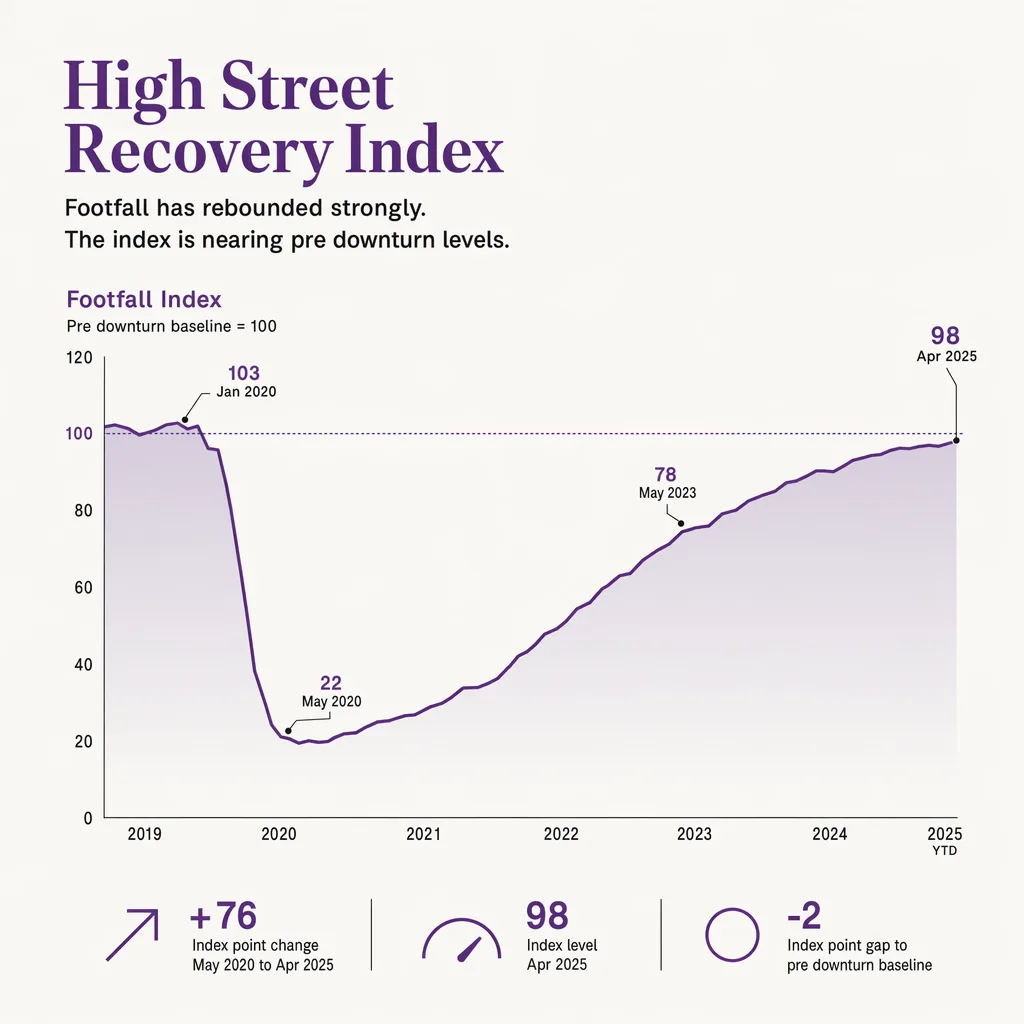
Recovery is a trajectory, not a snapshot. A single headline count, "footfall was 40,000 last week", tells you almost nothing on its own, because you have no idea whether that is better or worse than it should be. The number only means something against a baseline and read as a trend over time. That is the difference between a benchmark and a recovery measurement: a benchmark asks how you compare to other places right now, while recovery asks how far this place has climbed back toward where it was, and whether it is still climbing.
This post sets out how a town centre, a BID, or a high-street partnership measures and evidences recovery: choosing the baseline period, tracking a recovery index rather than a raw count, reading the dwell and repeat-visit signals that say whether the visit itself got better, and attributing the rebound to the interventions that actually caused it. For the comparison-against-other-places question, that is a different job covered by high street footfall benchmarks; this post owns the recovery-over-time method.
How do you measure high street recovery?
High street recovery is measured against a baseline, usually footfall in a comparable pre-downturn period, and tracked as a recovery index rather than a single headline number. Raw counts tell you whether people came back; dwell time and repeat-visit signals tell you whether the visit got better or worse, which is what decides tenant survival and rents. A BID or town-centre partnership sets the baseline, counts continuously at consistent points, and reads recovery as a trend line against that baseline, then attributes movement to specific interventions like events, new tenants, or public-realm work.
The rest of this post takes those pieces one at a time, because each one is where a recovery claim usually goes wrong: a baseline chosen to flatter, an index built on inconsistent counting points, a raw count that hides a hollowing-out of dwell, or a rebound credited to a scheme that had nothing to do with it.
Setting the baseline: which pre-downturn period to compare against, and why
The baseline is the single most consequential choice in the whole exercise, because everything downstream is expressed relative to it. Pick a flattering baseline and every month looks like a triumph; pick a punishing one and a genuine recovery reads as failure.
The defensible baseline is a comparable pre-downturn period, matched to the same season and, where possible, the same trading pattern as the period you are measuring. Footfall is strongly seasonal, so comparing a December against a pre-downturn December is honest, while comparing a December against the preceding March is not. Where a town centre has continuous data reaching back before the downturn, an average across a full pre-downturn year makes a more stable baseline than a single month, because it absorbs the weekly and seasonal swings that would otherwise be read as recovery or decline.
Two traps recur. The first is baselining against the trough itself: measuring recovery from the very bottom of the downturn makes almost any subsequent number look like a strong rebound, which is comforting and meaningless. The second is silently changing the counting points between the baseline period and now. If the sensors, their positions, or the streets they cover are not the same, the comparison is between two different definitions of the high street, and the movement you are reporting is partly an artefact of the change. Consistency of measurement points over time is what makes a recovery index trustworthy, and it is worth documenting exactly which points feed the baseline so the comparison can be defended later.
The recovery index: reading footfall as a trend, not a headline
Once the baseline is fixed, recovery is best expressed as an index: this period's footfall as a percentage of the baseline period, tracked continuously. An index at 100 means the centre is back to its pre-downturn level; 85 means it is still 15 percent short; a reading above 100 means it has passed where it was. The value of the index is that it turns a noisy stream of weekly counts into a single line anyone can read, and it puts every week in the honest context of where the centre used to be.
The index is read as a trend, not a verdict. One week above baseline is weather or an event; a rising line sustained across months is recovery. Plotting the index over a long enough window separates the signal from the noise and shows whether the trajectory is still climbing, has plateaued below baseline, or has stalled. That shape is what a funding case actually needs, because it answers the question a funder is really asking: is this place on the way back, and is the money helping.
An index is also where recovery measurement and static benchmarking meet without being confused. The index tells you how far this centre has come against its own past; a benchmark tells you how it sits against comparable centres today. A centre can be well below its own pre-downturn baseline yet still ahead of its regional peers, or the reverse, and reporting only one of the two invites the wrong conclusion. For the peer-comparison side, see high street footfall benchmarks; keep it separate from the recovery index rather than blending the two into one number.
Beyond counts: dwell time and repeat visits as recovery signals
Raw footfall answers whether people came back. It does not answer whether the visit got better, and that second question is the one that decides whether tenants survive and rents hold. A high street can post a recovering count while the visit underneath it is hollowing out: people passing through faster, buying less, coming once instead of weekly. The count looks healthy right up until the vacancies start.
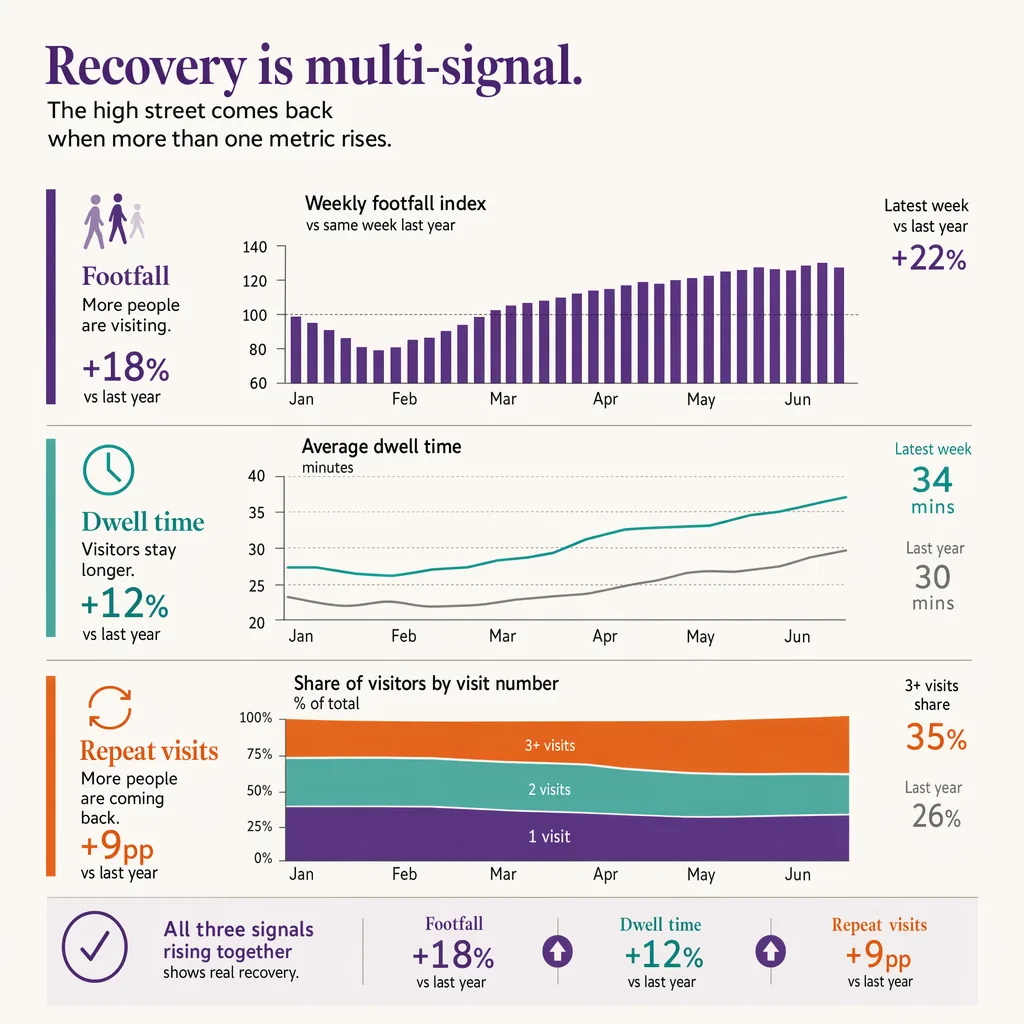
Two signals catch this that a headline count misses. Dwell time, how long people stay, is a direct read on whether the centre is somewhere people want to be or somewhere they pass through. A recovery in count with flat or falling dwell is a warning that footfall is returning as throughput rather than as trade. Repeat visits, the share of footfall that is the same people coming back rather than one-off visitors, tells you whether the centre is rebuilding a habit or living on occasional traffic. A centre recovers properly when it wins back its regulars, not just its passers-by, and the distinction between counted visits and returning visitors is exactly the ground covered in unique visitors versus raw footfall.
Read together, count, dwell, and repeat visits give a truer picture than any one of them alone. The strongest recovery story is a rising count with holding or rising dwell and a growing base of repeat visitors: more people, staying as long or longer, and increasingly the same people returning. The weakest, and the one a raw count hides, is a rising count with falling dwell and no repeat growth, which is a centre filling with traffic that does not trade and will not stay.
Attributing recovery to interventions: events, tenants, public realm
A recovery index that only rises and falls tells you the weather of the high street. What a funder wants next is causation: which of the things we did actually moved it. This is where continuous measurement earns its place, because it lets you read the index around a specific intervention rather than guessing.
The method is comparison in time, and where possible in space. When a new event runs, a new tenant opens, or a public-realm scheme completes, you read the index before and after against the same period a year earlier, so the seasonal pattern is already netted out. A step-change in the index that lines up with the intervention and holds afterward is attributable evidence; a brief spike that decays back to trend is a one-off. Comparing a treated street against an untreated comparison street in the same centre strengthens the case further: a rise on both is the wider trend, while a rise only on the treated street points to the intervention.
Pedestrianising or activating a street is one of the interventions most often credited with recovery, and it is also one of the most testable, since the change is physical and dated. The mechanics of measuring an activation, and the tactics that make one work, are covered in activating a pedestrianised street; the recovery index is what lets a partnership show that the activation moved the trajectory rather than merely coinciding with it. The discipline throughout is the same: never credit a scheme with a rise the trend would have delivered anyway.
Counting a whole street without cameras
Measuring recovery across a town centre means counting in the open, on streets and in squares that belong to the public, where a camera-based system raises objections a private store never has to answer. Residents and civil-liberties groups reasonably ask what a council-funded sensor on a lamp post is recording, and a system that captures images invites a harder conversation than one that does not. Camera-free counting is not a nicety in public space; it is often what makes continuous measurement acceptable at all.
Ariadne measures this with Hybrid Fusion, its patented camera-free method. Time-of-Flight depth sensing counts every visitor at the entrances, capturing geometry rather than images, while patented phone signal sensing follows movement through the interior, detecting the signals a phone emits even in airplane mode, and tracks that movement to about one-metre precision. The sensor streams both feeds to Ariadne, where Hybrid Fusion combines them into one trajectory per visit and computes counts, dwell, and paths. The streams carry no identifier: no MAC address, no device ID, no biometric data, and no camera is involved. Identifiers are stored only when a visitor explicitly opts in, which keeps the method GDPR-friendly and outside biometric territory.
For a town centre this matters twice over. It answers the privacy question up front, and because Time-of-Flight measures distance rather than light, it keeps working outdoors and after dark, so a high street's evening economy is measured as reliably as its Saturday afternoon. The same open-area measurement logic extends to the squares and green spaces a centre wraps around, which is its own subject in public-space occupancy. For how a continuous, camera-free count feeds a whole town-centre programme, see how people counting supports smart-city analytics.
FAQ
How do you measure high street recovery?
Against a baseline, usually footfall in a comparable pre-downturn period, tracked as a recovery index rather than a single headline number. You count continuously at consistent points, read the index as a trend over time, and check dwell and repeat visits alongside the raw count to see whether the visit itself improved, not just the volume.
What baseline should I compare recovery against?
A comparable pre-downturn period matched to the same season, ideally an average across a full pre-downturn year rather than a single month. Avoid baselining against the trough of the downturn, which flatters every later number, and keep the counting points identical between the baseline and now so the comparison is not distorted by a change in measurement.
Is footfall count enough to prove recovery?
No. A count tells you people came back but not whether the visit got better. Dwell time and repeat visits reveal whether footfall is returning as trade or merely as throughput. A rising count with falling dwell and no repeat growth is a centre filling with traffic that does not stay, which a headline count hides.
How do you attribute recovery to a specific intervention?
Read the recovery index before and after the intervention against the same period a year earlier, so the seasonal pattern is netted out, and where possible compare the treated street against an untreated comparison street. A sustained step-change that lines up with the intervention is evidence; a brief spike that decays back to trend is not.
Do I need cameras to count a high street?
No. Ariadne counts with Hybrid Fusion: Time-of-Flight depth sensing plus patented phone signal sensing, never cameras. Time-of-Flight captures geometry rather than images, and signal sensing captures no MAC address by default, so the measurement involves no video, no faces, and no biometric data.
---


