
What pedestrian zone activation actually means
Pedestrian zone activation is the work that turns a closed-to-traffic high street into a place people use. It covers the programming a city puts on the street: markets, festivals, parades, summer terraces, late-night shopping, repaired benches, new lighting, music, free Wi-Fi. The point of the work is straightforward. A pedestrian zone earns its keep when more people come, stay longer, and spend more in the shops along it. The trouble is that most cities run the programming without measuring any of those three numbers in detail, which makes it hard to know which interventions worked and which simply filled a calendar.
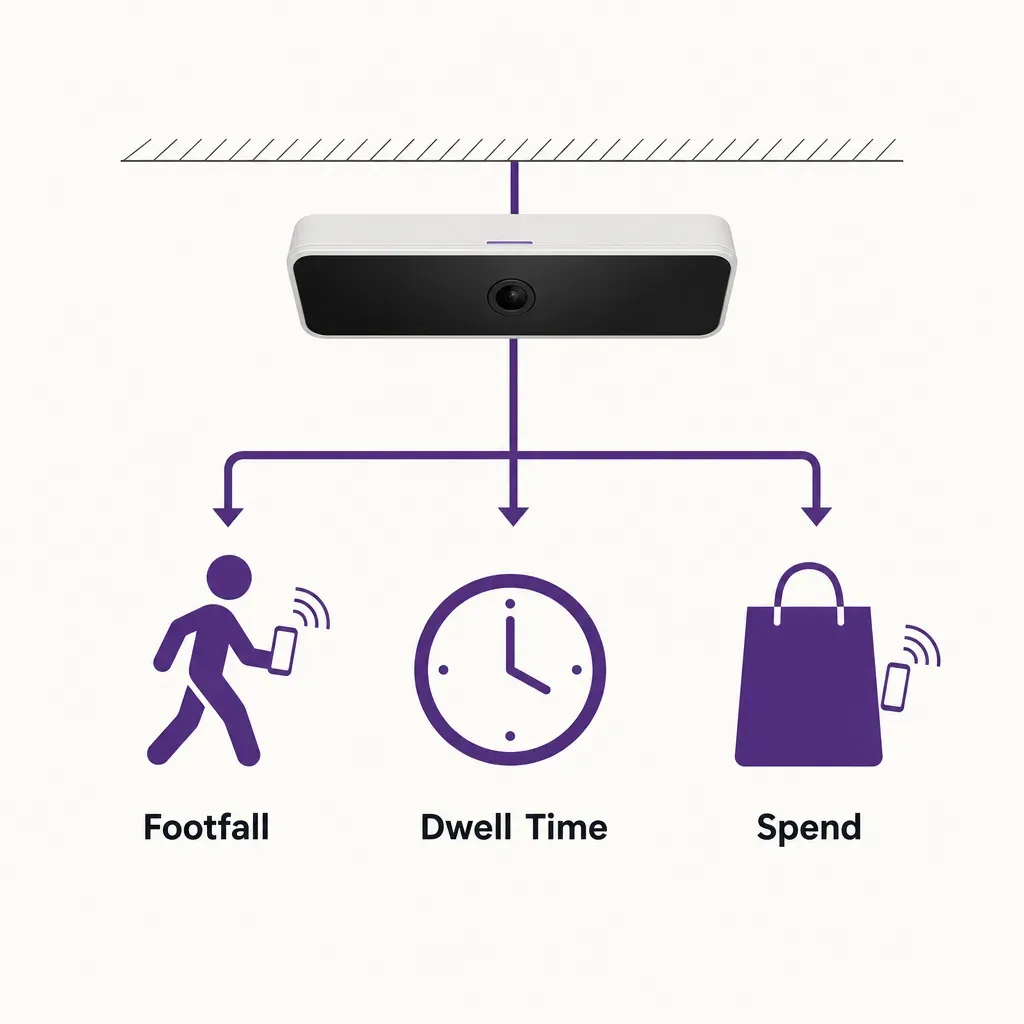
A small or medium European city does not need a research department to fix this. It needs continuous footfall, dwell, and flow data on its main pedestrian streets, broken down by time of day and by zone. With those numbers in hand, activation stops being a matter of intuition and becomes a portfolio of measurable bets. This post walks through what a city should measure on a pedestrian zone, what one real city (Traunstein, in southern Bavaria) does with that data on its central square, and what the model looks like for other small or medium European cities that want to follow.
Why activation work needs data, not impressions
Pedestrian zones in Europe were laid out in waves. The first wave, from the 1970s on, simply pushed cars out. The second wave, much later, asked what to do with the recovered space. That second question is still live in 2026. A city centre competes with out-of-town retail, with online shopping, and with the next town over. Activation is the local lever, but the conversation around it is usually narrative rather than numerical.
A traditional Christmas market draws a crowd, but does it spread the crowd along the whole street or concentrate it on two stalls? A new bench cluster outside a bakery: do people actually sit, or do they walk past? A late-night shopping evening: did dwell on the main square go up, or did people simply pass through on the way home? Each of these is a real question with a real answer. The answer comes from continuous counts and dwell readings on the zone, not from a satisfaction survey two weeks later.
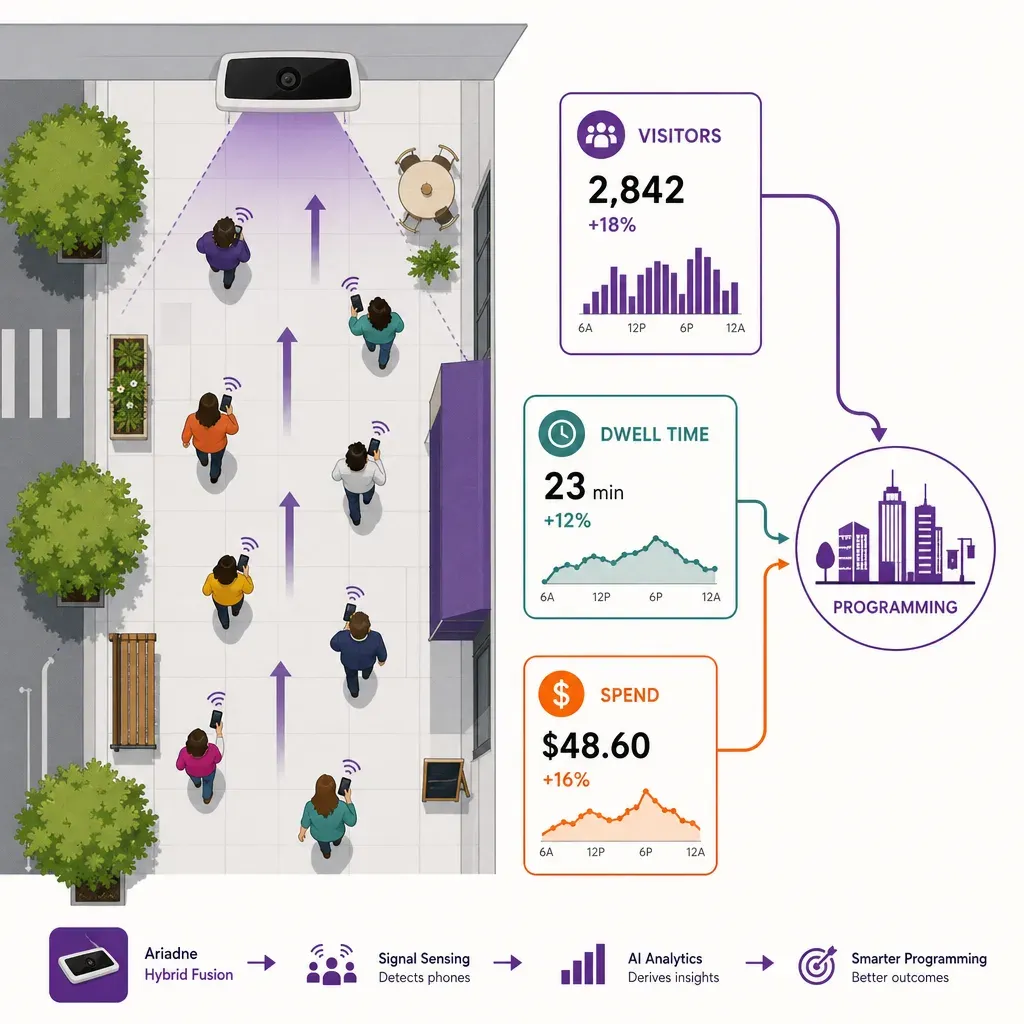
Three measurements anchor that work. The first is visitor flow: how many people enter the zone, and how they distribute across it. The second is dwell time: how long, on average, a visitor stays in a given square or stretch of street. The third is the day-part pattern: when activity peaks (morning, lunch, after-work, evening), how that shifts by day of the week, and how a programmed event changes the shape of the curve. A serious people counting setup reports all three for any zone you place sensors in, and reports them continuously.
Traunstein: a working example
Traunstein is a regional centre in southern Bavaria with a population of 21,551. The old town is compact, pedestrianised, and built around two connected squares, with Maxplatz acting as the centre of gravity for retail and events. The city worked with Ariadne to put continuous footfall measurement on its pedestrian zone, with Smart City Analytics on top, and uses the resulting data to plan activation work and report event impact. The deployment is documented on the Traunstein customer page.
The most useful illustration of why this data matters is the annual Carnival parade. Carnival is the single biggest annual event the city programmes on its pedestrian zone. On carnival Saturday 2024, the deployed sensors counted 42,682 visitors in the town centre, far above a typical January day in the same area. Maxplatz, the central square, showed a 14% increase in dwell time during the event. Three figures, all of them measured rather than estimated, and they answered a set of questions the city would otherwise have argued about.
- Was the parade actually bigger than a normal weekend? Yes, by a wide margin, and you have the count to put in front of a sponsor or a council committee.
- Did visitors linger in the central square, or did they pass through? Dwell on Maxplatz went up 14% during the event, which is the difference between a parade that moved past and one that held the crowd.
- How does that inform next year's programming? The same sensors will count next year's parade against the same January baseline, so the city can see whether changes to the route, the stalls, or the schedule actually moved the needle.
That is what a small city gets from a few well-placed sensors on its pedestrian zone: measured before and after numbers, on the streets the city actually wants to activate, that survive the conversation with a treasurer or a board.
What to measure on a pedestrian zone
If you are scoping a similar deployment for another small or medium European city, the measurement set below is a reasonable starting point. Each item is something a continuous footfall system reports as a matter of routine, and each maps to a question activation work routinely raises.
Visitor flow by zone
Treat the pedestrian zone as a small set of named zones, not one undifferentiated area. The central square is one zone. Each connected street is another. A side passage with a high concentration of shops is a third. With sensors placed across the zones, the system reports how many visitors enter each one and how they move between them. Over a week, that gives a flow picture of the whole pedestrian quarter: which streets pull traffic, which sit underused, and where the natural bottlenecks form.
Dwell time
Entries on their own are not enough. A square that draws 5,000 people who stay 90 seconds is a different problem from a square that draws 3,000 people who stay 12 minutes. Dwell time separates a place visitors pass through from a place visitors use. For activation work, dwell is often the more honest measure of whether an intervention worked: a market stall, a seating cluster, a new lighting scheme, or a busking pitch is supposed to make people stay, and dwell shows whether they do.
Day-part patterns
A pedestrian zone has a daily curve. Most have a lunchtime hump and a late-afternoon peak, with a long tail into the evening on Thursdays and Fridays in cities that programme late-night shopping. Layered over that, the weekly curve shows a different shape on Saturday than on Tuesday. Knowing the curves matters for two reasons. It tells the operations team when to schedule cleaning, parking enforcement, and security cover. And it shows the impact of a programmed event by the shape of the change, not just the headline number: a late-evening event that pulls the curve right, an early-morning market that adds a new bump, an extended Saturday programme that flattens the afternoon dip.
Event impact
An activation event is, in measurement terms, a treatment. The baseline is what the same zone normally does on the same day of the week, at the same time of year. The treatment effect is the difference: how many more people entered the zone, how much longer they stayed, and how the day-part curve shifted. Traunstein's Carnival numbers are a clean example. Continuous counts over the year give the baseline; the event then sits on top of that baseline as a measurable shift, not a vague impression of busyness.
How Ariadne measures all of this
Public-space measurement carries a higher privacy bar than measurement inside a private building. A pedestrian zone is a public street; visitors did not choose to enter a measured environment, and the city has a duty to keep what is collected proportionate. The right way to clear that bar is not to soften a camera feed after the fact, but to use a method that never captures identifying data in the first place.
Ariadne measures this with Hybrid Fusion, its patented camera-free method. Time-of-Flight depth sensing counts every visitor at the entrances, capturing geometry rather than images, while patented phone signal sensing follows movement through the interior, detecting the signals a phone emits even in airplane mode. The sensor streams both feeds to Ariadne, where Hybrid Fusion combines them into one trajectory per visit and computes counts, dwell, and paths. The streams carry no identifier: no MAC address, no device ID, no biometric data, and no camera is involved. Identifiers are stored only when a visitor explicitly opts in, which keeps the method GDPR-friendly and outside biometric territory.
For a pedestrian zone, the practical consequences line up with what a city's data protection office is going to ask. There is no camera and no video, so there is no image of a passer-by to store or to lose. The streams carry no MAC address by default and no device identifier, so the count does not contain personal data. The result is continuous flow, dwell, and day-part data on the streets a city wants to activate, produced without anything a DPO would classify as personal data. The sensor hardware sits in the Ariadne sensor lineup, and the data handling is set out in the privacy policy.
What a similar deployment looks like for another small city
If you are a planning office, a city marketing organisation, or a Business Improvement District in a small or medium European town, the model Traunstein uses is replicable. The work breaks into a small number of decisions.
- Pick the zones, not the doors. Map the pedestrian quarter into three to seven named zones (squares, streets, key passages). Each one becomes its own counting area, with its own flow and dwell reading.
- Place sensors at flow boundaries. Sensors at the entrances and connections between zones give entry counts; sensors inside the zones give dwell. For a small city, the count usually runs to a small number of units rather than dozens.
- Establish a baseline year. Continuous counts through one full year give the seasonal shape. After that, any event or intervention sits against a real baseline, not a guess.
- Tag the calendar. Mark every market, parade, festival, late-night shopping evening, and pedestrianisation trial in the system. The reporting then attributes each event to its measured effect on counts and dwell.
- Share the data inside the city. City marketing, the planning office, the police, retailers, and the BID often each have a use for the same numbers. A single, trusted data source avoids three separate counts and three separate arguments.
- Use the data on budget cycles. Activation budgets are usually set annually. Measured before and after numbers, reported per event, are what move a budget conversation away from anecdotes.
None of those steps is technically demanding. The harder work is upstream: agreeing which zones matter, agreeing what counts as a successful event, and agreeing that the city is going to treat the numbers as the measure rather than as a talking point. A city that does that work gets a year-on-year picture of what activation is actually producing. That, more than any individual event count, is what the model from Traunstein offers other cities.
FAQ
What is pedestrian zone activation?
Pedestrian zone activation is the work a city does to bring more people into a car-free street or square, keep them there longer, and turn that footfall into local economic activity. It covers programming (markets, parades, events), the physical environment (seating, lighting, planting), and the way the zone is promoted. Activation is measurable: continuous footfall, dwell time, and day-part data on the zone show whether an intervention actually moved visitors and how long they stayed.
How is footfall measured in a public pedestrian zone?
No. Ariadne counts with Hybrid Fusion: Time-of-Flight depth sensing plus patented phone signal sensing, never cameras. Time-of-Flight captures geometry rather than images, and signal sensing captures no MAC address by default, so the measurement involves no video, no faces, and no biometric data.
What does Traunstein measure on its pedestrian zone?
Traunstein uses Ariadne's Smart City Analytics to monitor visitor flow and measure the economic impact of major events on its pedestrian quarter, centred on Maxplatz. On carnival Saturday 2024, the system counted 42,682 visitors in the town centre, with a 14% increase in dwell time on Maxplatz. The details are on the Traunstein customer page.
Is this approach suitable for other small European cities?
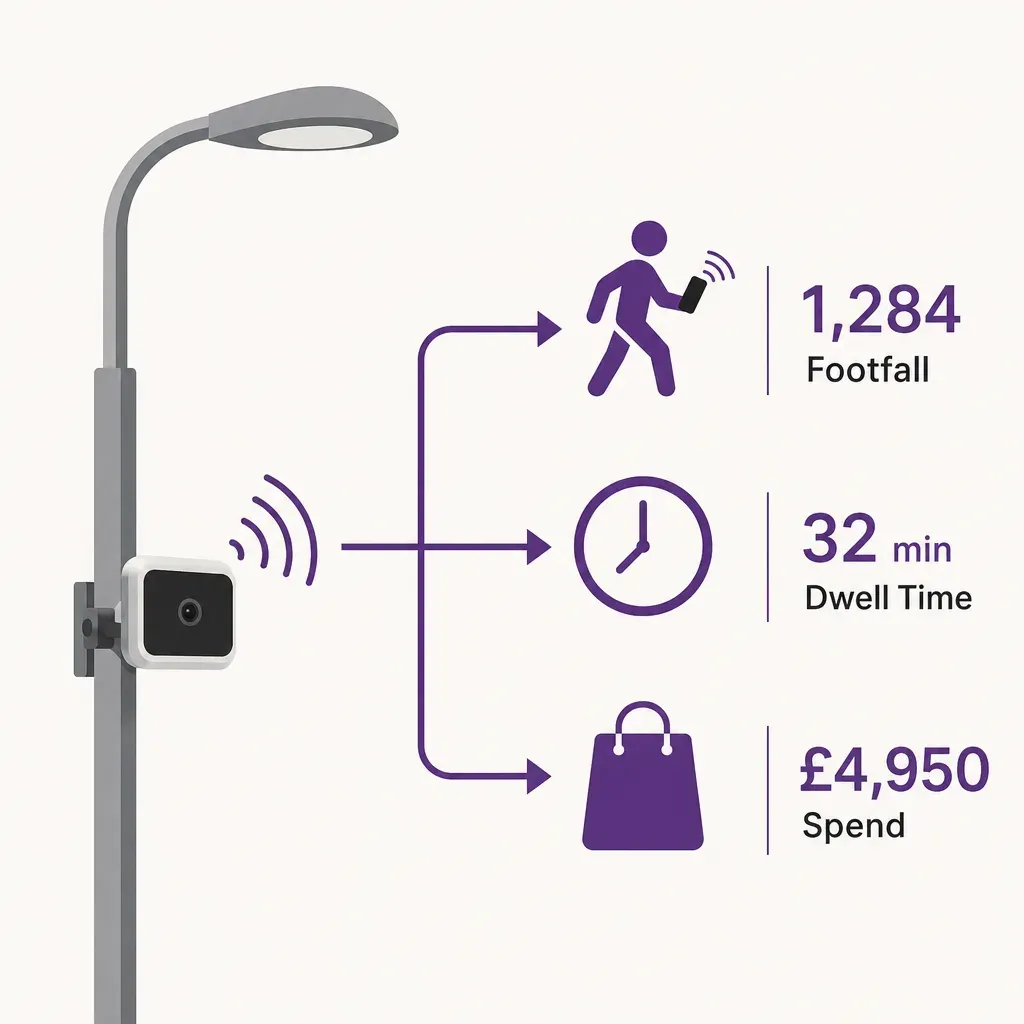
Yes. The measurement set (visitor flow per zone, dwell time, day-part patterns, event impact against a baseline) does not depend on the size of the city. A small city with a compact pedestrian quarter often gets more out of the data than a large one, because a few well-placed sensors cover the whole zone and the council can act on the results without crossing many layers of administration.


