
What a high street footfall benchmark really is
Cities ask for a high street footfall benchmark when they want a defensible answer to a simple question: how busy is our main shopping street, and how does this week compare with last year, the year before, the street one town over, or the day the Christmas market opened. The word benchmark does a lot of work in that sentence. It can mean a single live counter at the busiest crossing, a year-on-year index that the city centre association publishes every Monday, or a peer comparison against other towns of the same size. Each version asks different things of the underlying measurement.
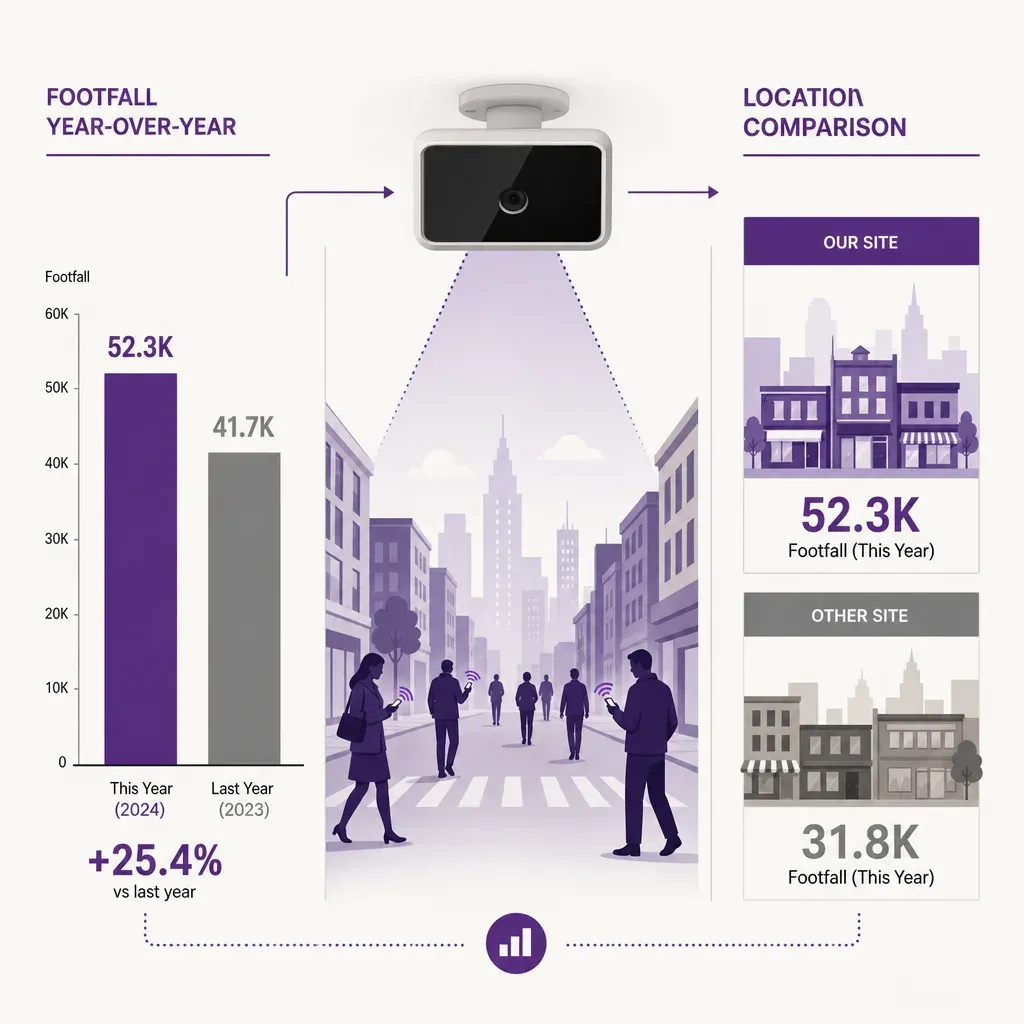
What the literature and practice agree on is that a benchmark is only as good as the count behind it. If the sensor misses one in five visitors on a busy Saturday, or sees them twice when they walk back to the car, the index moves for reasons that have nothing to do with the high street. This guide sets out the methodology a city should put behind a smart-city footfall programme, and the typical European patterns to expect once the data is clean enough to compare. All numbers used as illustrations are clearly labelled as typical ranges. No measured study is implied.
Why high streets are harder to count than malls
A shopping mall has a roof, a fixed set of entrances, and a private operator who decides where sensors go. A high street has none of that. Pedestrians move along the pavement in both directions, cross into and out of side streets, walk into shops and back out, share the space with cyclists and delivery vans, and split into and out of groups several times per block. The counter is outdoors, exposed to weather and seasons, and usually attached to street furniture the city had to permit.
That makes three problems unavoidable, and any honest benchmark has to deal with them head on:
- Open geometry. There is no door frame to define a count line. The sensor sees a wide strip of pavement, and the count line is a virtual one in software.
- Weather as a confounder. Rain, heat, wind, and short winter daylight move pedestrian volumes by large factors. A benchmark that ignores weather will mislead more often than it informs.
- Repeated passes. On a high street, the same visitor often crosses the count line several times: into a shop, back out, down to the next one, back to the car. Without a way to distinguish a fresh visitor from a returning one, the count overstates demand.
Counter geometry: where and how to mount
The single biggest determinant of a usable benchmark is where the counter is placed and what it can physically see. Three rules cover most cases.
Pick the cross section, not just the corner
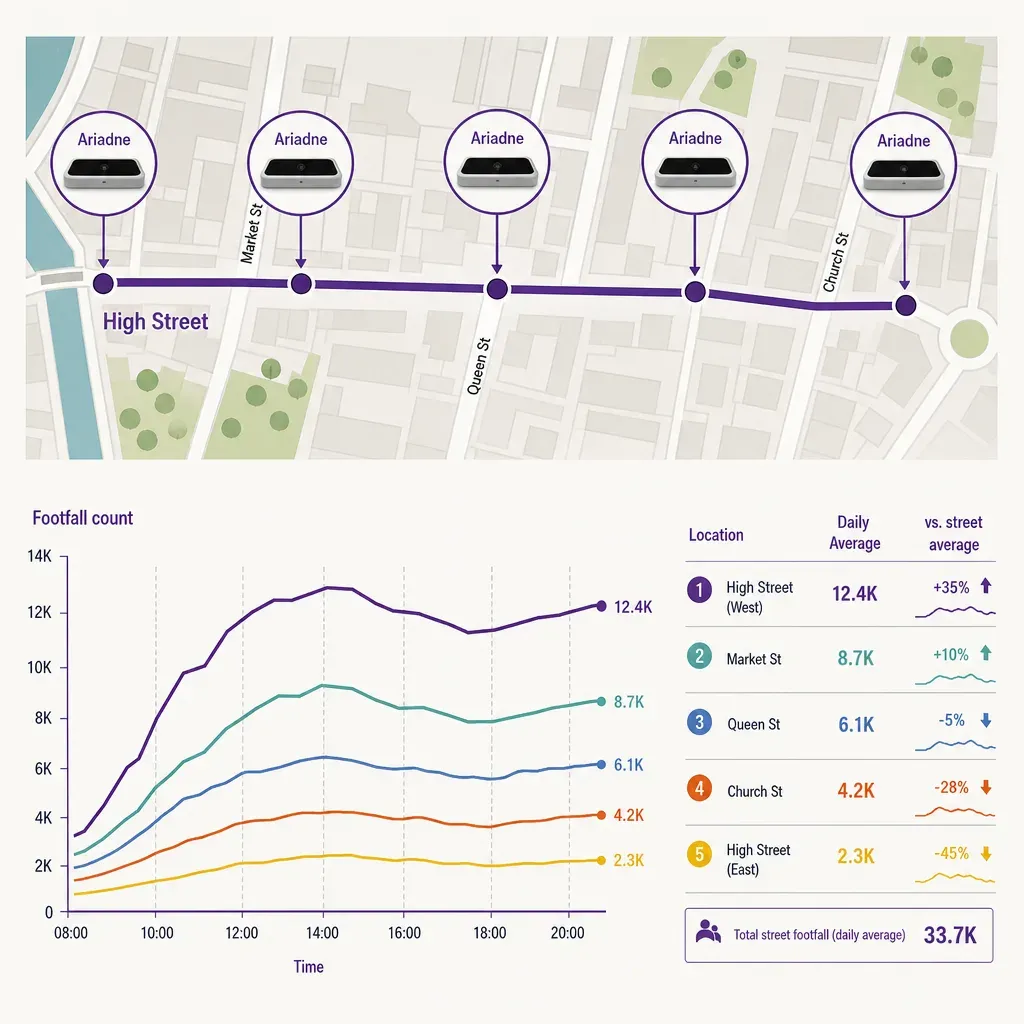
A high street benchmark should sit at a cross section that captures the dominant pedestrian flow, not at a side door of one shop. That usually means a point on the main shopping axis where pavement width is consistent and there are no large obstructions (planters, kiosks, tram islands) blocking the line of sight. If the street has a clear narrowing or a gate (the historic centre arch, the start of a pedestrianised zone), that is often the right spot, because the geometry forces almost all pedestrians through the same strip.
Mount height and viewing angle
A ceiling-style mount, typically on a lamp post or building facade four to six metres above the pavement, gives the sensor a steep angle on the count zone. The steeper the angle, the less one person occludes another, and the more reliable group counting becomes. A shallow angle (a sensor pointed sideways down the street) reads heads from behind one another and undercounts groups. Mount height is one of the few install choices that is hard to fix later, so it pays to get it right at install.
Count line width and pavement width
The virtual count line should span the whole pedestrian space the city actually wants to measure. If half of the pavement is outside the sensor footprint, the benchmark will be biased toward whichever side the sensor sees. On wider high streets, that usually means two or more sensors at the same cross section, configured as one logical counter in software.
Capture rate: the metric your benchmark depends on
Capture rate, sometimes called catchment rate, is the share of the actual pedestrian flow at a cross section that the sensor records. It is the single most important quality metric for a high street counter, and it is the one most often glossed over. A counter with a 70 percent capture rate is not 70 percent of the truth; it is the truth at a 30 percent discount that can shift week to week.
There are three contributors to capture rate worth tracking explicitly:
- Geometric coverage. How much of the pavement strip is inside the sensor field of view. If pedestrians can pass on a side the sensor does not cover, those visitors are silently missing from the count.
- Occlusion behaviour. In a dense group, how well the sensor separates one person walking close behind another. A steep mount and high resolution help here; a shallow mount loses people in crowds, exactly when the city most wants the data.
- Weather and lighting robustness. An outdoor counter has to perform in rain, glare, snow, and after dark. Time-of-Flight depth sensing is lighting-independent in a way that camera-based counting is not, and that property matters at six in the evening in November.
A sensible programme audits capture rate at install with a manual count at the cross section over two or three peak hours, then re-checks once a year or whenever the street layout changes. The benchmark only compares meaningfully across periods if capture rate is stable, or if it is corrected for explicitly.
Seasonality: separating the street from the calendar
European high streets follow strong seasonal patterns. A benchmark that does not account for them will turn ordinary calendar effects into apparent trends, which then look like policy wins or failures they are not.
Three layers of seasonality show up almost everywhere:
Weekly cycle
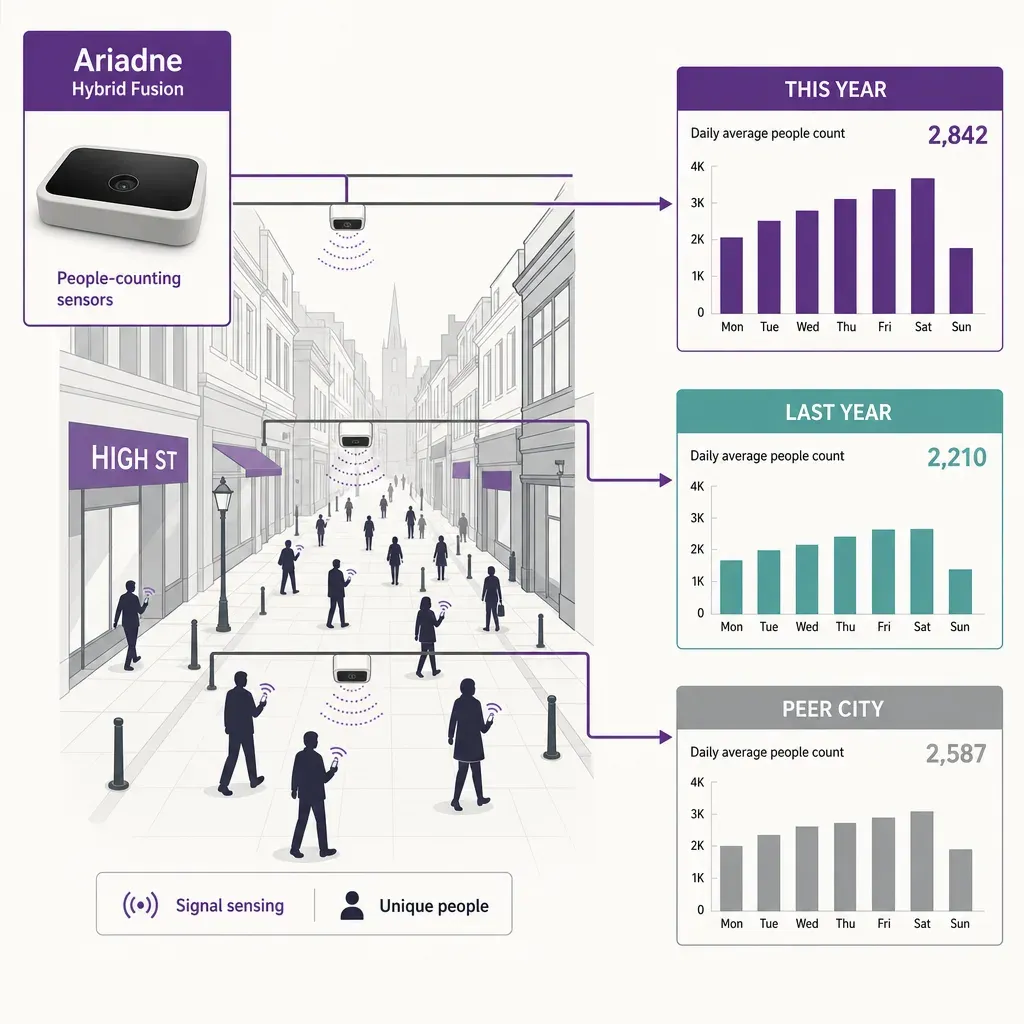
Saturday is the strongest day on most European high streets, often by a wide margin. Friday tends to be the second strongest, followed by a midweek shoulder. Sunday volumes depend heavily on whether the country or canton allows Sunday trading: in Germany, most Sundays are closed by law, so footfall is a small fraction of Saturday and concentrated around four annual Verkaufsoffene Sonntage. A typical illustrative pattern is for Saturday to run roughly 1.4 to 2.0 times an average weekday and Sunday to run a small fraction of it, but the exact ratio is city-specific and worth measuring before publishing the first benchmark.
Annual cycle
The annual pattern on most European high streets has two big peaks, the late autumn run-up to Christmas (typically late November and December, with the Saturdays before Christmas often the busiest days of the year) and the summer holiday peak in tourist towns. There is usually a quieter trough in January and February and a smaller dip in late summer when locals are on holiday. A typical illustrative range is for December weekly footfall to run roughly 1.3 to 1.8 times the rolling year average in a non-tourist city, and substantially higher in destinations with Christmas markets.
Special events
Christmas markets, city festivals, sporting events, parades, and one-off pedestrianisations move footfall by factors that dwarf normal variation. The benchmark should treat these as named events and report them separately, not roll them into the weekly index. Any year-on-year comparison should align on event calendars (the same number of trading Saturdays before Christmas, the same number of festival days) before any conclusion is drawn.
Weather control: the variable that breaks comparisons
Weather can move a single Saturday by 30 to 50 percent in either direction, and it is the single most common cause of unexplained variance in a high street benchmark. A heavy rain day in October can look like a market trend; a sunny February Saturday can look like a recovery. Neither is.
Cities running a serious programme typically capture the weather variables alongside the count, either by pulling hourly observations from a national meteorological service or from a station on the high street itself. The variables that explain most of the variance are:
- Precipitation. Hours and millimetres of rain during opening hours. Even moderate rain can shift Saturday footfall measurably; heavy rain can halve it.
- Temperature. Both very cold and very hot days suppress voluntary outdoor activity. A comfortable shoulder-season temperature is the easiest day to draw a crowd.
- Wind and storm warnings. A red weather alert empties a high street, especially on a Saturday afternoon, and the effect lingers into the next day.
The most honest way to publish a benchmark is to show the weather-adjusted index alongside the raw count, and to flag any single day where weather is the most likely explanation for the move. Some cities also strip out the worst weather days from rolling averages for the same reason.
Typical European high-street patterns
With a clean methodology in place, what do typical European high streets look like once the noise is taken out. The summary below uses illustrative typical ranges drawn from the standard practice and published patterns. None of these numbers represent an Ariadne-measured study. Every city will sit somewhere different, and the only way to know is to measure for at least a full year.
Weekday versus weekend
On a typical European high street, the weekend pulls the lion's share of the week. Saturday is usually the strongest day, often running 1.4 to 2.0 times an average weekday. Friday is the second strongest. In countries with Sunday trading, Sunday can match or exceed a midweek day; in countries without it, Sunday is a fraction of Saturday. Lunchtime peaks on weekdays (broadly between noon and 14:00) reflect office workers and locals doing errands; weekend peaks tend to be broader and concentrated in the afternoon.
Summer versus winter
Tourist cities and historic centres see the strongest summer peaks, with footfall often running 1.5 to 2.5 times the winter shoulder months in heavily visited destinations. Non-tourist high streets show a flatter seasonal curve, with the Christmas peak as the biggest single feature of the year. Outdoor seating, evening events, and longer daylight all push summer evening footfall up, and the typical hourly peak moves later in the day.
Large versus medium cities
Large city centres (think a Landeshauptstadt or a national capital) carry higher absolute volumes and a flatter hourly distribution, because the catchment includes commuters, tourists, students, and residents all at once. Medium and small towns show sharper peaks. A typical small-city high street has a strong Saturday and a quiet midweek, with a single visible peak across the afternoon, while a large city centre runs steady from late morning to early evening. Per-metre-of-pavement volumes are not always proportional to city size; a tightly bounded historic centre in a medium town can outperform a more dispersed large city on the busiest hour.
How Ariadne measures high-street footfall
Ariadne is the smart-city counting partner for a number of European cities, including German municipalities such as Traunstein and Bernkastel-Kues, where the same camera-free method runs across pedestrian zones and historic centres. The underlying measurement is the same one used inside larger buildings: counts and movement, captured without anything that can identify a visitor.
Ariadne measures this with Hybrid Fusion, its patented camera-free method. Time-of-Flight depth sensing counts every visitor at the entrances, capturing geometry rather than images, while patented phone signal sensing follows movement through the interior, detecting the signals a phone emits even in airplane mode. The sensor streams both feeds to Ariadne, where Hybrid Fusion combines them into one trajectory per visit and computes counts, dwell, and paths. The streams carry no identifier: no MAC address, no device ID, no biometric data, and no camera is involved. Identifiers are stored only when a visitor explicitly opts in, which keeps the method GDPR-friendly and outside biometric territory.
For a high street, the consequences are practical. There is no camera on the pavement, so there is no image of a passer-by stored anywhere and no facial-recognition concern to manage with the local data protection authority. The sensor reads the geometry of who passes the count line and the broad signal patterns of devices in the area, which is enough to produce hourly counts, weekly indices, and a stable benchmark across years, without ever capturing anything a regulator would treat as personal data. The hardware itself is documented in the Ariadne sensor lineup, and the data handling sits in the privacy policy.
A city benchmark checklist
If your city is starting or upgrading a high-street footfall programme, the questions below are the ones that decide whether the benchmark will hold up to scrutiny from the city council, the local press, and the merchants who pay the levy.
- Is the cross section the right one? Place the counter where the dominant pedestrian flow has to pass, not where it was easiest to permit street furniture.
- Is the geometry steep enough? Lamp-post or facade mounts at four to six metres with a steep downward angle handle groups and crowds better than shallow side-mounted units.
- Has capture rate been audited? A manual peak-hour count at install gives a baseline. Re-audit once a year and any time the street layout changes.
- Are weather data joined to the count? Hourly weather alongside the count is what lets you publish a weather-adjusted index and avoid mistaking rain for a trend.
- Are events named, not averaged? Christmas markets, festivals, and one-off closures should appear as labelled days, not silently inflated weekly indices.
- Is anything captured that identifies a visitor? A camera-free method with no MAC or device identifiers by default is the cleanest answer for a public-space counter and the easiest case to make to a data protection officer.
- Will the data outlive its supplier? Make sure raw counts are exportable and that the city, not only the vendor, retains the historical series. Benchmarks compound in value over years, and the data has to travel.
FAQ
What does a high street footfall benchmark actually measure?
At its simplest, a benchmark measures the number of pedestrians crossing a fixed cross section of a high street over a defined period, indexed against a base. The richer benchmarks add per-hour, per-day, and per-week breakdowns, weather adjustment, named-event flags, and year-on-year comparison. The point is not the absolute number on any one day, but the ability to compare like with like across weeks, years, and (when methodology is shared) cities.
Does the system use cameras?
No. Ariadne counts with Hybrid Fusion: Time-of-Flight depth sensing plus patented phone signal sensing, never cameras. Time-of-Flight captures geometry rather than images, and signal sensing captures no MAC address by default, so the measurement involves no video, no faces, and no biometric data.
How long does it take to build a useful benchmark?
A useful weekly index starts to settle after about three months of clean data. A year-on-year comparison needs at least 12 months, and ideally two full annual cycles before drawing trend conclusions. Seasonality, weather, and the local event calendar all interact, so the first year of data is mostly about understanding the city's own pattern. The benchmark gets sharper every year afterwards.
How is this different from counting inside a shop?
A shop counts visitors at a controlled door with a known capture rate. A high street counts visitors in open space, often with people passing the line several times in one trip. The methodology has to handle weather, repeated passes, and outdoor geometry, and the counter has to be physically robust. The same underlying people counting platform produces both, but the configuration and the way the data is read are different.


