
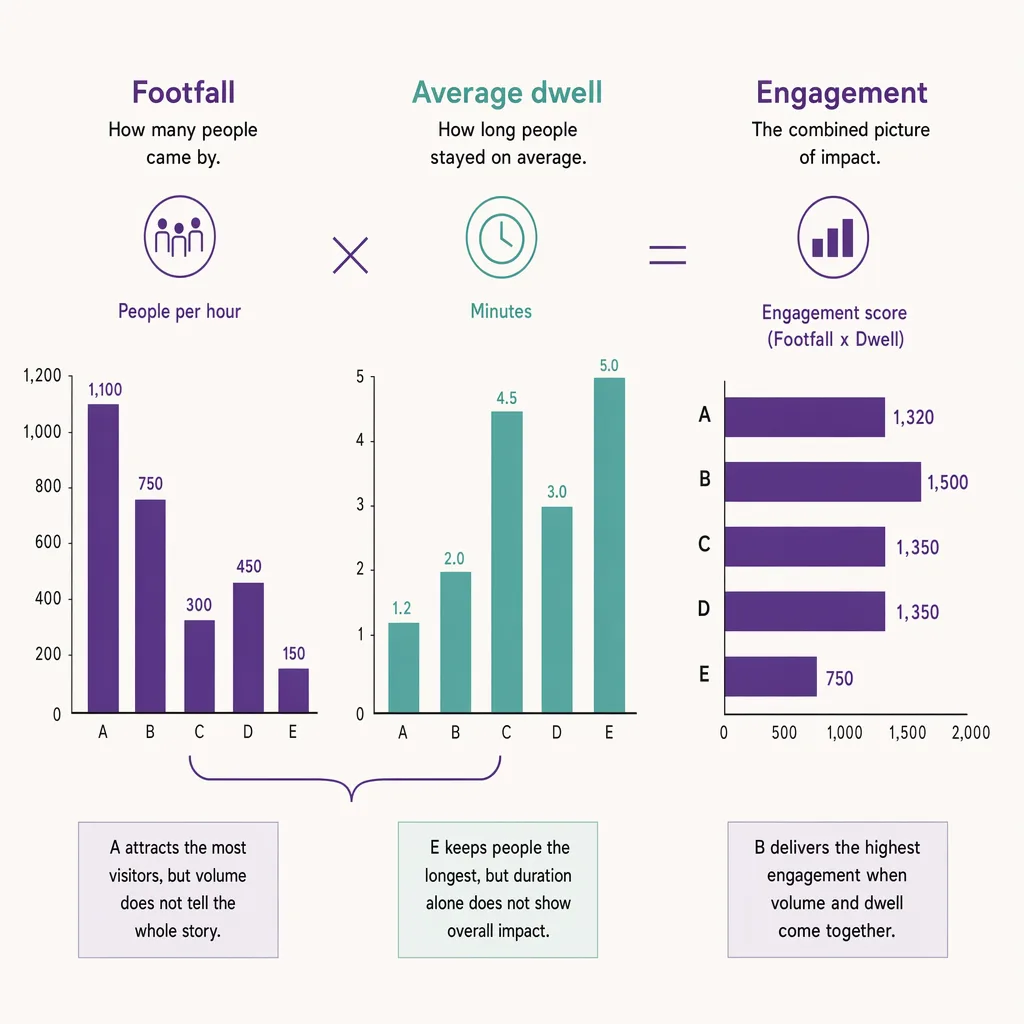
Footfall and dwell time are the two numbers most retail teams reach for first, and they are the two most often confused for each other. Footfall gets treated as the health of the store. Dwell gets treated as a nice-to-have. Read that way, both mislead. Footfall on its own tells you nothing about what happened after the door, and dwell on its own tells you nothing about how many people it applies to. The useful signal is in the relationship between them, and that relationship is where most reporting stops short.
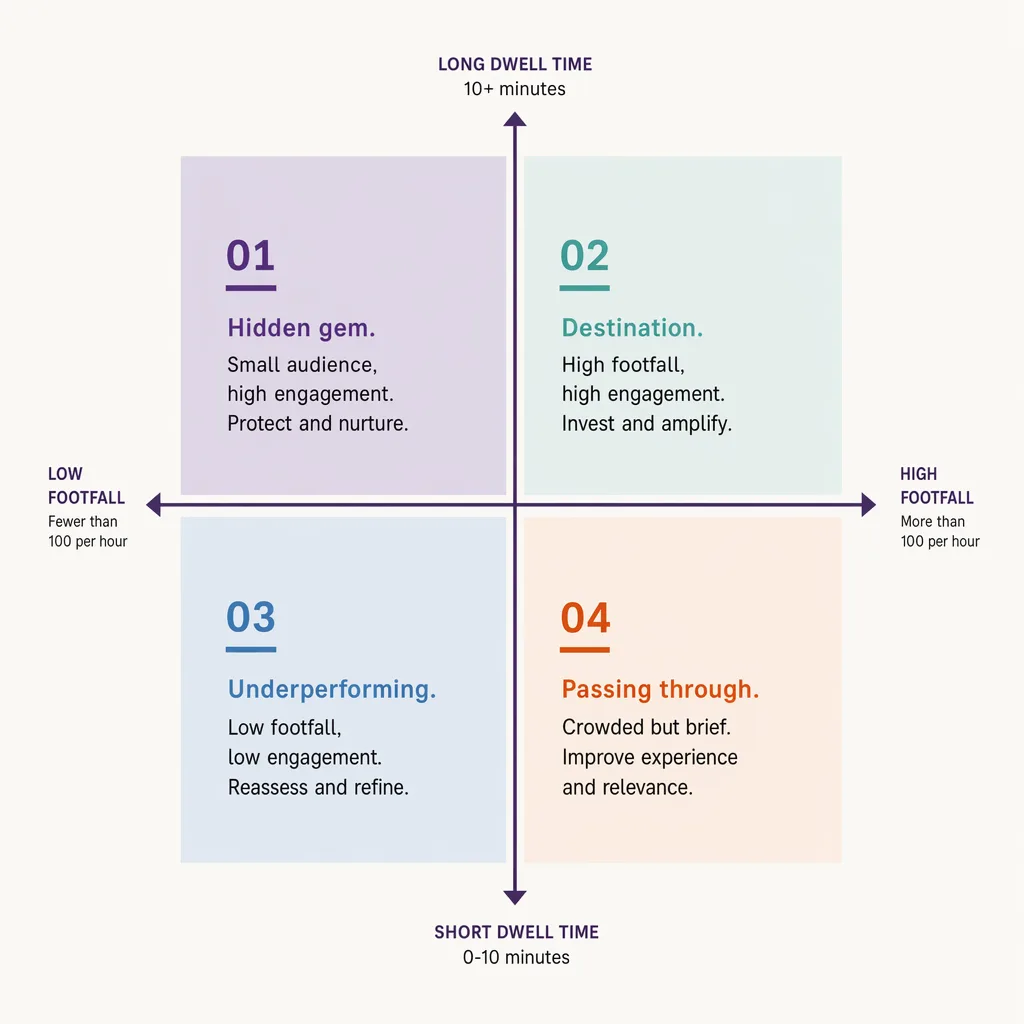
This post sets the two metrics side by side, explains what each one can and cannot tell you, and works through the four combinations of high and low footfall against high and low dwell. Each combination points at a different problem and a different fix. By the end you will be able to look at a store's footfall and dwell together and say whether you are looking at a traffic problem, a layout problem, or a store that is quietly working.
What is the difference between dwell time and footfall?
Footfall is how many people enter a space; dwell time is how long they stay once inside. They answer different questions. Footfall tells you whether your reach and pull are working (the top of the funnel), while dwell time tells you whether what is inside holds attention (the middle). A store can have high footfall and low dwell, meaning people come in and leave fast, or low footfall and high dwell, meaning fewer visitors but deeper engagement. Read together they separate a traffic problem from a layout or assortment problem, which is why neither number means much on its own.
Footfall: what it counts and what it cannot tell you
Footfall is a count of entries over a period. It is the rawest measure a store has, and it is genuinely useful: it sets the denominator for almost every other retail KPI, it shows whether marketing and location are pulling people to the door, and it moves in patterns you can plan against by hour, day, and season. When footfall rises, more people decided to come in. When it falls, fewer did. That is a clean, honest signal about the top of the funnel.
What footfall cannot do is tell you what happened next. Two stores can post identical footfall and behave completely differently once people are inside. Footfall does not know whether a visitor walked three steps and turned around or spent twenty minutes browsing. It does not know whether they found what they came for, whether the store felt crowded or empty, or whether they bought anything. It is a measure of arrival, and arrival is only the first event in a visit.
This is where footfall gets over-read. A store owner sees traffic holding steady and concludes the store is fine, when the real story is that traffic is fine and everything after the door is failing. Footfall reassures you about the one thing that is already working while staying silent on the things that might not be. That silence is exactly what dwell time fills. For the values a healthy footfall figure typically lands at by location type, see footfall benchmarks, and for how footfall feeds the rest of the funnel, see how footfall feeds conversion.
Dwell time: what it counts and where it is measured
Dwell time is how long a visitor stays. That sounds simple until you ask where the clock starts and stops, because dwell is measured at two very different scales and the difference matters.
Store-level dwell is the whole visit: time from entry to exit. It tells you how long the store as a whole holds a person. Zone-level dwell is time spent in a defined area inside the store, a department, a fixture, a fitting-room approach, a queue. Zone dwell is the more actionable of the two, because it localises attention. Store-level dwell says people stay eleven minutes; zone dwell says they spend six of those minutes in one corner and walk straight past another. One number describes the visit, the other describes the layout.
Dwell is a proxy for engagement, but it is not a clean one, and it is worth being honest about that. Long dwell usually means interest: people linger where something holds them. But long dwell can also mean friction. A visitor stuck in a slow queue dwells a long time and hates every second of it. A shopper who cannot find a product dwells while searching, then leaves empty-handed and frustrated. Dwell tells you where time is being spent; it takes the surrounding context (is this a browsing zone or a waiting zone) to tell you whether that time is good or bad. That caveat aside, zone dwell is one of the few metrics that points directly at a physical part of the store and says "look here." For where that time concentrates on the floor, see where visitors actually dwell, and for the values dwell typically lands at in a retail-centre setting, see typical dwell-time benchmarks.
The four quadrants: footfall against dwell, and what each pattern signals
The clearest way to read the two metrics together is a two-by-two: footfall high or low, dwell high or low. Each quadrant is a different store with a different problem. The threshold values that decide "high" and "low" are set relative to your own history and comparable stores, not to a universal number, so read the quadrants as patterns rather than fixed cut lines.
| Footfall | Dwell | What it usually signals | Where to look first |
|---|---|---|---|
| High | High | The healthy pattern: strong pull to the door and something inside that holds attention. Watch that dwell is engagement, not queue friction. | Protect it. Check conversion is keeping pace with the traffic and time spent. |
| High | Low | People come in and leave fast. The pull works; the interior does not hold them. Often an entrance, first-impression, or layout problem. | The decompression zone and front of store, sightlines, and whether the entry experience invites people deeper. |
| Low | High | Fewer visitors, but the ones who come engage deeply. A pull or awareness problem, not an in-store one. The store works; not enough people reach it. | Marketing, frontage, location visibility, and capture from passing traffic. |
| Low | Low | Both levers are down. Few people come and those who do leave quickly. The hardest quadrant, and the one that needs diagnosis before spend. | Split the problem: fix the traffic question and the in-store question separately, not as one. |
The value of the grid is that it stops you spending against the wrong problem. A high-footfall, low-dwell store does not need more marketing; it already has the traffic. Pouring budget into pulling more people through a door they immediately walk back out of just raises the count of people who leave fast. Equally, a low-footfall, high-dwell store does not need its layout reworked; the layout is doing its job on everyone who arrives. It needs more arrivals. The single most common planning mistake in retail is treating every soft-performing store as a traffic problem, because footfall is the number people watch, when half the time the traffic is fine and the visit is where it breaks.
When to prioritise which: diagnosing a traffic problem vs an engagement problem
Given a store that is underperforming, the order of questions is footfall first, then dwell, then conversion. Footfall first, because it sets the denominator and because a traffic collapse is a different emergency from an in-store one. If footfall is holding and dwell is falling, the door is fine and the problem moved inside: layout, assortment, service, or a queue that is punishing people. If footfall is falling and dwell is steady, the store still works for the people who arrive and the job is to arrest the decline in arrivals.
The trap is optimising the metric you can see most easily rather than the one that is actually broken. Footfall is the loudest number in most retail dashboards, so it gets the attention and the budget. Dwell is quieter and often not measured at zone level at all, so the engagement problems it would reveal stay invisible and the store keeps getting treated as a traffic problem it does not have. The discipline is to always read the pair, and to let the quadrant, not the habit, decide where the effort goes. For turning either read into an action, see acting on counting data.
Measuring both from one counting layer, without cameras
Footfall and dwell are only comparable if they come from the same measurement of the same visits. Footfall counted at the door by one system and dwell estimated separately by another will not reconcile, and the quadrant read falls apart the moment the two numbers describe different populations. What you want is one layer that counts entries at the door and measures dwell inside, tied to the same visits, so footfall and dwell are two views of one dataset rather than two systems you have to trust independently.
Ariadne measures this with Hybrid Fusion, its patented camera-free method. Time-of-Flight depth sensing counts every visitor at the entrances, capturing geometry rather than images, while patented phone signal sensing follows movement through the interior, detecting the signals a phone emits even in airplane mode, and tracks that movement to about one-metre precision. The sensor streams both feeds to Ariadne, where Hybrid Fusion combines them into one trajectory per visit and computes counts, dwell, and paths. The streams carry no identifier: no MAC address, no device ID, no biometric data, and no camera is involved. Identifiers are stored only when a visitor explicitly opts in, which keeps the method GDPR-friendly and outside biometric territory.
In practice that gives you footfall at the entrances and zone-level dwell across the interior from the same source. You can read the store's four-quadrant position directly: entries for footfall, area dwell for engagement, and the map of where that time concentrates. Because the interior sensing measures presence in a zone rather than identifying anyone, dwell is a property of the space and the visit, not of a person, which is what keeps the whole picture on the right side of privacy while still telling you where attention lands. See people counting analytics for how entries and interior dwell come from one layer.
Related reading
FAQ
What is the difference between dwell time and footfall?
Footfall counts how many people enter; dwell time measures how long they stay once inside. Footfall is a top-of-funnel arrival signal, dwell is a middle-of-funnel engagement signal, and they describe different parts of the same visit.
Which is more important, dwell time or footfall?
Neither on its own. They are diagnostic together: footfall tells you whether enough people arrive, dwell tells you whether the store holds them. A store can have strong footfall and weak dwell, or the reverse, and the fix is completely different in each case, which is why you read them as a pair.
Can a store have high footfall but low dwell time?
Yes, and it is a common and revealing pattern. It means the pull to the door works but the interior does not hold people: they enter and leave fast. It usually points at an entrance, first-impression, or layout problem rather than a traffic one, so more marketing would not fix it.
Does long dwell time always mean good engagement?
No. Long dwell usually signals interest, but it can also signal friction: a slow queue or a shopper who cannot find a product both produce long dwell for bad reasons. Dwell tells you where time is spent; the context of the zone (browsing versus waiting) tells you whether that time is good or bad.
Do I need cameras to measure footfall and dwell?
No. Ariadne counts with Hybrid Fusion: Time-of-Flight depth sensing plus patented phone signal sensing, never cameras. Time-of-Flight captures geometry rather than images, and signal sensing captures no MAC address by default, so the measurement involves no video, no faces, and no biometric data.
---


