
A digital out-of-home buyer asks one plain question before spending: how many people will this screen actually reach. Much of the market answers with a modelled number, a reach figure assembled from traffic averages, panel surveys, and mobility data, then apportioned to the screen. It is a useful estimate, but it is an estimate, and it invites the follow-up every buyer eventually asks: were those people really there. This post is about answering that question with a measured, place-based count rather than a model, and about doing it without collecting anyone's identity. That distinction, sizing an audience by presence rather than profiling it by face, is the whole point.
How do you measure a DOOH audience?
DOOH audience measurement answers a simple buyer question: how many people were actually in front of the screen, and for how long. Much of the market answers it with modelled estimates built from traffic averages and panel data. Ariadne answers it with a real, place-based count: it measures how many people passed and lingered in the screen's viewing zone, camera-free and with no personal data captured. That is audience sizing, the "how many were present" question, and it is distinct from audience profiling. Ariadne does not detect faces, age, or gender, so the number it reports is verified presence and dwell, not a demographic guess.
The sections below separate the modelled estimate from the measured count, break the measured audience into the three numbers that size it, draw the line between sizing and profiling, and place all of this next to the measurement standards and attribution work it sits beside.
Modelled estimate vs. measured count: why "who was actually there" matters to a buyer
A modelled DOOH audience is built top-down. Start with an average for how many people move through a location, adjust for time of day and season, apply a factor for how many likely faced the screen, and you have a reach estimate. This is the backbone of a lot of out-of-home selling, and for planning across a large network it is reasonable. Its weakness shows up the moment a buyer wants proof for a specific screen over a specific campaign: the model describes a typical location, not the actual audience your money reached on the days it ran.
A measured count is built bottom-up. Instead of inferring the audience from averages, you count the people who were physically present in the screen's viewing zone during the campaign, and you measure how long they stayed. The number is specific to that screen, that fortnight, that flight of content. When traffic to the location was unusually high or low, the measured count reflects it and the model does not. That specificity is what turns a reach claim from a plausible assertion into evidence, and evidence is what a brand's media team increasingly asks for before renewing a physical placement against a digital alternative that reports every impression.
The two are not enemies. A model is the right tool for planning a national buy across thousands of faces; a measured count is the right tool for proving what a screen delivered and for calibrating the model itself. The gap this post addresses is the one where a buyer has only the estimate and wants the count.
The three numbers that size a DOOH audience: passers, viewers in-zone, dwell
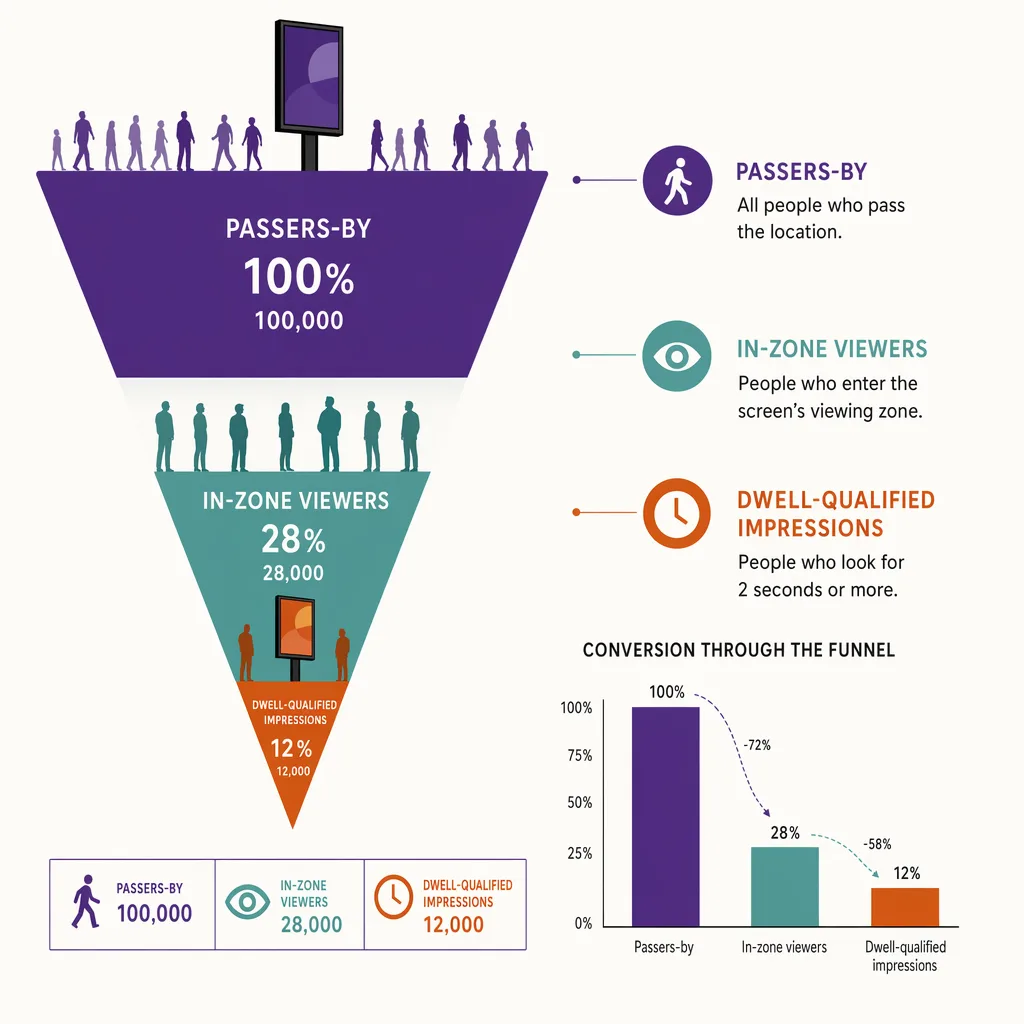
A place-based audience is not a single figure but three, and reporting all three is what makes the number credible rather than round.
- Passers. How many people moved through the broader area around the screen. This is the top of the funnel, the pool from which an audience could form. On its own it overstates reach, because not everyone who passes is in a position to see the screen.
- Viewers in-zone. How many of those passers were actually within the screen's viewing zone, the patch of space from which the content is visible. This narrows the passer count to a defensible reach figure, and the ratio between the two is itself a useful quality signal for a placement.
- Dwell. How long people stayed in the viewing zone. A location where people pause, a transit concourse, a queue, a seating area, delivers a very different quality of audience from one where everyone is moving through fast, even if the passer counts match. Dwell is what distinguishes a screen people can absorb from one they glimpse.
Together these size the audience honestly: a pool of passers, the share genuinely positioned to see the screen, and how long they had to take it in. Dwell in particular is the metric that separates a good DOOH location from a busy but fleeting one, and it is covered as its own subject in dwell time at a screen. Reporting the three as a set, rather than collapsing them into one reach number, is what lets a buyer judge not just how many but how well.
Sizing is not profiling: what Ariadne measures and what it deliberately will not
This is the line that matters most, and it is easy to blur. Some audience-measurement vendors move from sizing straight into profiling: cameras that estimate age and gender, or classify faces, to sell a demographic breakdown of who stood in front of the screen. Ariadne does not do this, and the choice is deliberate. Face-based demographic estimation is exactly the category of processing that draws the heaviest scrutiny under GDPR and the EU AI Act, and it is the opposite of how Ariadne is built.
Ariadne measures this with Hybrid Fusion, its patented camera-free method. Time-of-Flight depth sensing counts every visitor at the entrances, capturing geometry rather than images, while patented phone signal sensing follows movement through the interior, detecting the signals a phone emits even in airplane mode, and tracks that movement to about one-metre precision. The sensor streams both feeds to Ariadne, where Hybrid Fusion combines them into one trajectory per visit and computes counts, dwell, and paths. The streams carry no identifier: no MAC address, no device ID, no biometric data, and no camera is involved. Identifiers are stored only when a visitor explicitly opts in, which keeps the method GDPR-friendly and outside biometric territory.
So the audience Ariadne reports is a count and a dwell, verified presence in the viewing zone, and nothing about who those people are. It will tell a buyer that four thousand people were in front of the screen across a fortnight and that the median viewer lingered several seconds; it will not tell them the age, gender, or identity of a single one, because it never captured that and cannot infer it. For a buyer, that is a feature, not a shortfall: a reach figure grounded in counted presence is defensible to a data-protection officer in a way a camera-derived demographic profile is not. The reasoning behind measuring screen audiences without any facial recognition is set out in measuring audiences without facial recognition.
Where this sits next to measurement standards and attribution
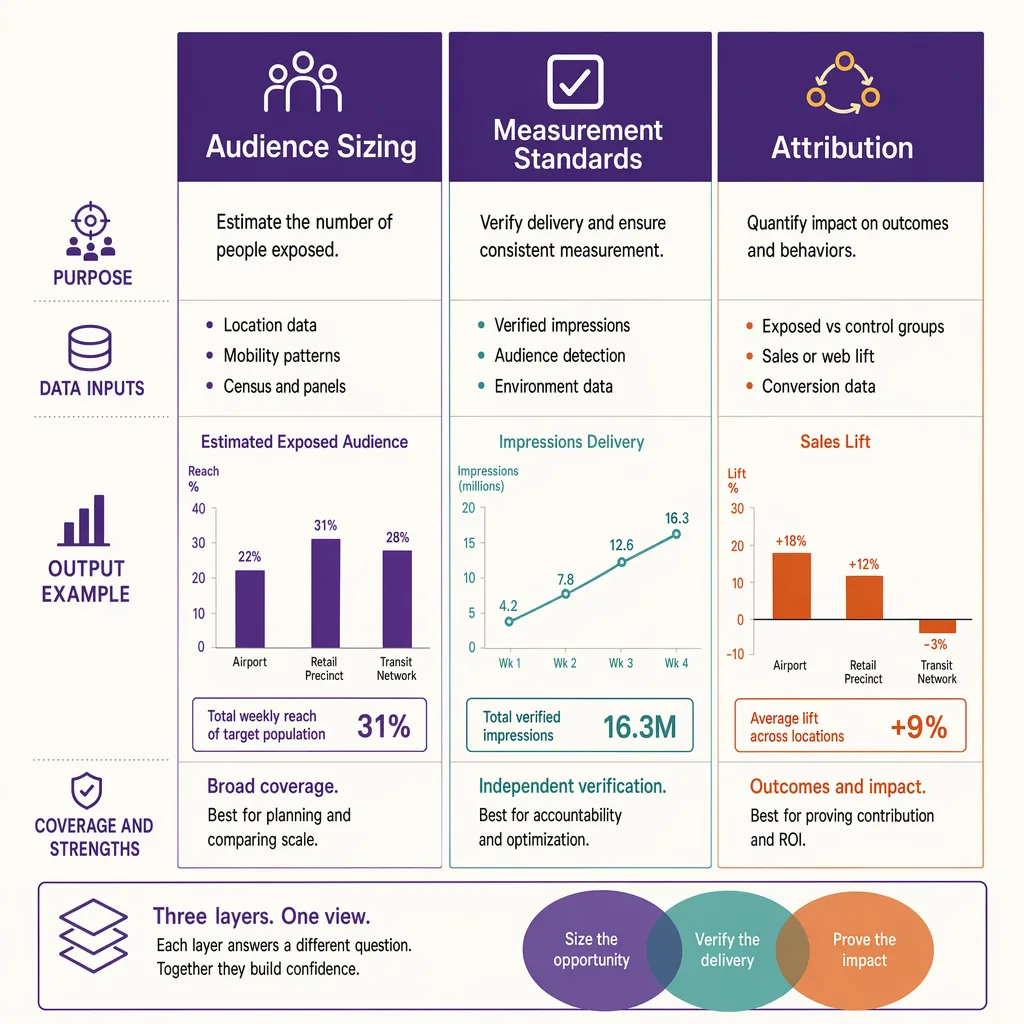
Audience sizing is one piece of a larger measurement picture, and it is worth being precise about where it stops and where the neighboring disciplines begin, because they are often lumped together and answer different questions.
| Layer | Question it answers | What it produces |
|---|---|---|
| Audience sizing (this post) | How many people were actually present in front of the screen, and for how long | A measured, place-based count: passers, in-zone viewers, dwell |
| Measurement standards | Which framework defines and audits an impression, so numbers are comparable across vendors | A methodology and an agreed definition of the metric |
| Attribution | Did exposure to the screen change a downstream action, such as a store visit or purchase | A link between the placement and an outcome |
Sizing tells you who was there. Standards tell you how the industry agrees to count and audit that, so one vendor's number means the same as another's; that territory belongs to DOOH measurement standards, which this post deliberately stays out of. Attribution goes a step further and asks whether the exposure produced an effect downstream, which for programmatically bought inventory is covered in programmatic DOOH attribution. The three stack: a measured audience feeds the standardized report, and the standardized report feeds the attribution case. Confusing them is where a lot of DOOH measurement conversations go in circles, because a buyer asking "how many were there" is answered with a lecture on impression standards, or a buyer asking "did it work" is handed a raw count. Keeping the layers distinct is what lets each answer the question it is actually for.
Turning a measured audience into a sellable, GDPR-friendly reach number
For a screen owner or a media network, a measured audience is not just a proof point; it is a better thing to sell. A reach figure that says "this many verified people were in the viewing zone, and this is how long the median one lingered" is more valuable than an estimate precisely because it is checkable, and it is more defensible than a demographic profile precisely because it carries no personal data. When a brand's procurement team runs its data-protection review, a reach number built on counted presence clears it; a number built on face classification invites questions the network would rather not answer.
Any specific reach or lift figure a network reports should of course come from its own measured deployment rather than a template, and should be presented as what it is: a count for that screen over that period. The value of the approach is that the figure is real and repeatable, not that it is large. For how Ariadne supports place-based audience measurement across a signage or DOOH estate, the DOOH and digital signage analytics hub covers the deployment picture, and the measurement itself rests on camera-free people counting, which is what keeps the reported audience both accurate and free of personal data.
Related reading
- Attention metrics vs impressions in DOOH
- Retail media audience verification without cameras
- How airport advertising audiences are measured and priced
FAQ
How do you measure a DOOH audience?
By counting the people actually present in the screen's viewing zone during a campaign and measuring how long they stayed, rather than modelling reach from traffic averages. The result is a place-based figure made of three numbers: passers in the surrounding area, viewers within the viewing zone, and dwell. Ariadne captures these camera-free, so the audience is reported as verified presence and dwell rather than a modelled estimate.
Do I need cameras to measure a DOOH audience?
No. Ariadne counts with Hybrid Fusion: Time-of-Flight depth sensing plus patented phone signal sensing, never cameras. Time-of-Flight captures geometry rather than images, and signal sensing captures no MAC address by default, so the measurement involves no video, no faces, and no biometric data.
Can Ariadne tell me the age or gender of a DOOH audience?
No, and this is by design. Ariadne sizes an audience by counting presence and dwell; it does not detect faces, estimate age or gender, or profile who anyone is. Face-based demographic estimation is the category of processing that draws the heaviest scrutiny under GDPR and the EU AI Act, so a reach figure built on counted presence is defensible in a way a camera-derived demographic profile is not.
How is audience sizing different from DOOH measurement standards?
Audience sizing answers how many people were actually present and for how long, producing a measured, place-based count. Measurement standards define how the industry agrees to count and audit an impression so numbers are comparable across vendors. Sizing is the count; standards are the framework that makes the count comparable. For the standards side, see the DOOH measurement standards post.
Is a measured audience more useful than a modelled estimate?
For proving what a specific screen delivered, yes, because it reflects the actual traffic during the campaign rather than a typical-location average. A model is still the right tool for planning across a large network, and the two work together: a measured count can calibrate the model and provide the proof a buyer wants for a specific placement.


