
Why measurement standards matter for DOOH in 2026
Digital out-of-home is the part of the media plan that historically had the weakest measurement story. Television had Nielsen panels, digital had cookies and pixels, and out-of-home had vehicle counts and a confident handshake. That has changed. Programmatic DOOH now sits inside the same trading desks as the rest of the buy, and a media buyer reviewing a digital signage network expects the same things they expect from any other channel: a defined impression, a viewability rule, a reach figure that holds up to audit, and a path to attribution. Standards are how the industry produces those things consistently.
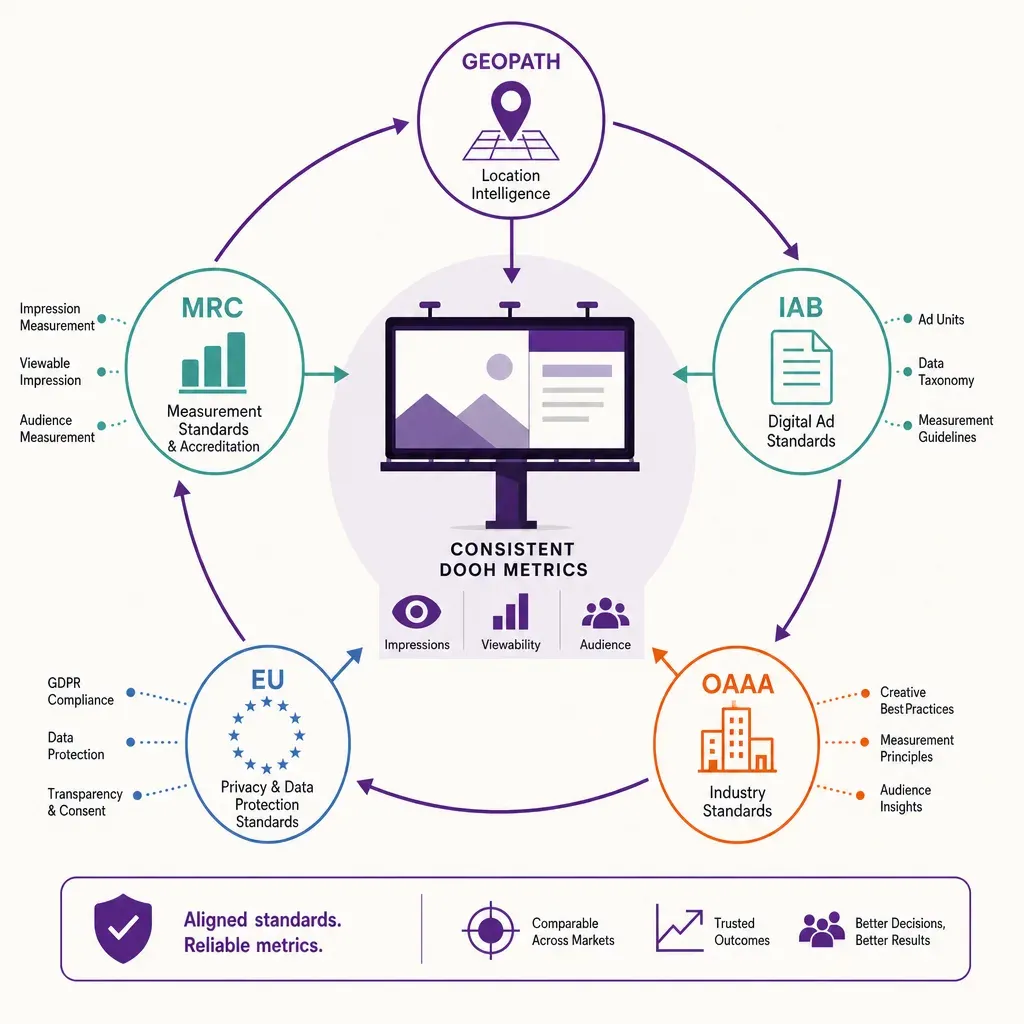
Four bodies do most of the heavy lifting in 2026, with a handful of EU equivalents. This post walks through what each one defines, what is still open, and where the consensus is starting to land on impressions, attention, viewable reach, and audience measurement that does not depend on cameras. It is aimed at the person specifying or auditing measurement on a DOOH buy, not at the person writing the creative.
GeoPath: the US audience-measurement body
GeoPath is the not-for-profit currency body for out-of-home measurement in the United States. It was rebranded from the Traffic Audit Bureau (TAB) in 2016, and it publishes the audience figures that US OOH inventory is traded against, much as Nielsen publishes the equivalent figures for television.
What GeoPath actually publishes are impressions and reach figures for individual OOH faces and networks, computed from a layered audience model. The inputs are familiar to anyone who has worked with traffic-engineering data:
- Traffic volumes. Vehicle and pedestrian counts on the road or path that passes the face, sourced from the relevant transportation authority or from GeoPath's own data partners.
- Demographic overlays. Census and consumer data layered on top of the traffic, so the audience can be reported by age, income, and other standard demographics.
- Visibility adjustments. A correction for how visible the face actually is to a passing audience: angle, distance, illumination, dwell. This is what produces the difference between a traffic count and an impression.
- Mobile movement data. Aggregate location-pattern data that improves the model where on-the-ground traffic counts are thin, particularly for pedestrian and indoor environments.
The output is a single per-face number that the industry treats as currency: how many people had an opportunity to see the face during a given period. GeoPath also defines target audience indices and reach-and-frequency outputs that planners use to compare OOH against other channels. For digital faces inside a venue, the same model is extended with venue-specific dwell and visit data.
MRC accreditation: the audit layer
The Media Rating Council does not publish audience figures. It accredits the methodology behind them. An MRC accreditation is the audit stamp that says a measurement company has documented its methods, opened them up to MRC's auditors, and met the standards in the relevant MRC guidelines. It is the closest thing the industry has to an independent quality bar.
For DOOH specifically, MRC publishes a set of OOH measurement guidelines that set out what an impression is, how visibility should be modelled, how playout data should be combined with audience data, and what kinds of disclosures a measurement company has to make. The guidelines were drafted with the IAB and the OOH industry bodies, and they are revised periodically as the channel changes. When a measurement provider says they are MRC-accredited for a particular DOOH product, the practical meaning is that an auditor has worked through their methodology against those guidelines and signed off.
Two things follow from this for a buyer. The first is that the MRC accreditation is product-specific, not company-wide: a provider can be accredited for static OOH impressions but not for video, or for desktop video but not DOOH. Read the accreditation scope, not just the badge. The second is that the guidelines themselves are the public document. If you want to know what counts as an impression in MRC-accredited terms, the guidelines define it, and any accredited provider has to compute against that definition.
IAB OOH guidance: the digital-first definitions
The Interactive Advertising Bureau publishes the standards that most digital media planners already know, and over the past several years it has extended that work to DOOH. The relevant outputs sit in two places. The IAB and IAB Tech Lab publish DOOH-specific guidance on the buy side: how a DOOH impression should be defined for programmatic trading, how OpenRTB extensions for DOOH should be implemented, what fields a supply-side platform should pass, and how creative should be structured for digital faces.
The technical work matters because programmatic DOOH only functions if a buyer and a seller agree on what an impression is and what data accompanies it. IAB OOH guidance defines the impression unit (a single play of a creative on a face, weighted by the audience associated with that play), the metadata that a bid request should carry, and the measurement events that close the loop. Where IAB guidance overlaps with MRC's OOH measurement guidelines, the two are designed to be compatible: IAB defines the trading mechanics, MRC defines what counts.
For a planner, the practical use of IAB guidance is to set the floor for what an SSP and a DSP have to support before a DOOH inventory line is considered programmatically tradable on the same footing as the rest of the buy.
OAAA: the trade body and its standards work
The Out of Home Advertising Association of America is the US trade body for the channel. It does several things that touch measurement without itself publishing audience figures. It coordinates with GeoPath on the underlying audience methodology, it sits with MRC on guideline revisions, it publishes creative and operational standards (for example specifications for digital creative on different face types), and it produces the industry-level reporting that buyers use to track channel-level growth, share, and category mix.
OAAA's role in the standards landscape is best understood as the convener. When the channel needs a position on a new measurement question, a new ad format, or a new policy area, OAAA is usually the body that brings the operators, the measurement providers, and the trade bodies into the same room. For a buyer, that translates into the place where channel-level definitions live: what counts as a DOOH face, what categories of OOH the industry recognises, how the channel reports itself to advertisers and to the press.
European bodies: FEPE, WOO, and national equivalents
The European picture is more federated. There is no single GeoPath-equivalent for the EU because audience measurement is largely national, run by JIC-style joint industry committees in each market (Outsmart in the UK, mediaPersuasion in some markets, audience-measurement bodies operated by the national trade associations elsewhere). What does exist at the European and global level are the trade and standards bodies that coordinate across markets.
- FEPE International. The global federation of out-of-home trade associations. FEPE convenes national bodies, runs the annual industry congress, and publishes shared positions on policy and measurement. It does not publish audience figures itself; the national bodies do.
- WOO (World Out of Home Organization). The successor to FEPE's global representation work, focused on cross-market standards, industry research, and engagement with global advertisers and agency networks.
- National JICs. The actual currency-measurement bodies in most European markets. They publish the local equivalents of GeoPath's audience figures, defined against the same kinds of inputs (traffic, demographics, visibility) but calibrated to the national context.
For a media buyer running a pan-European DOOH campaign, the practical consequence is that a single measurement currency does not yet exist across the EU. The trade is run against national audience figures, with cross-market normalisation handled either by the agency or by the operator. The standards bodies have been working towards more compatible definitions, and the IAB Europe work on programmatic DOOH has helped on the trading side, but the audience layer is still local.
What the 2026 consensus looks like
Across all of these bodies, there is more agreement than the federated picture suggests. A few definitions have firmed up to the point where most buyers and operators treat them as settled, and a few are still open. It is worth separating the two.
Settled: the impression
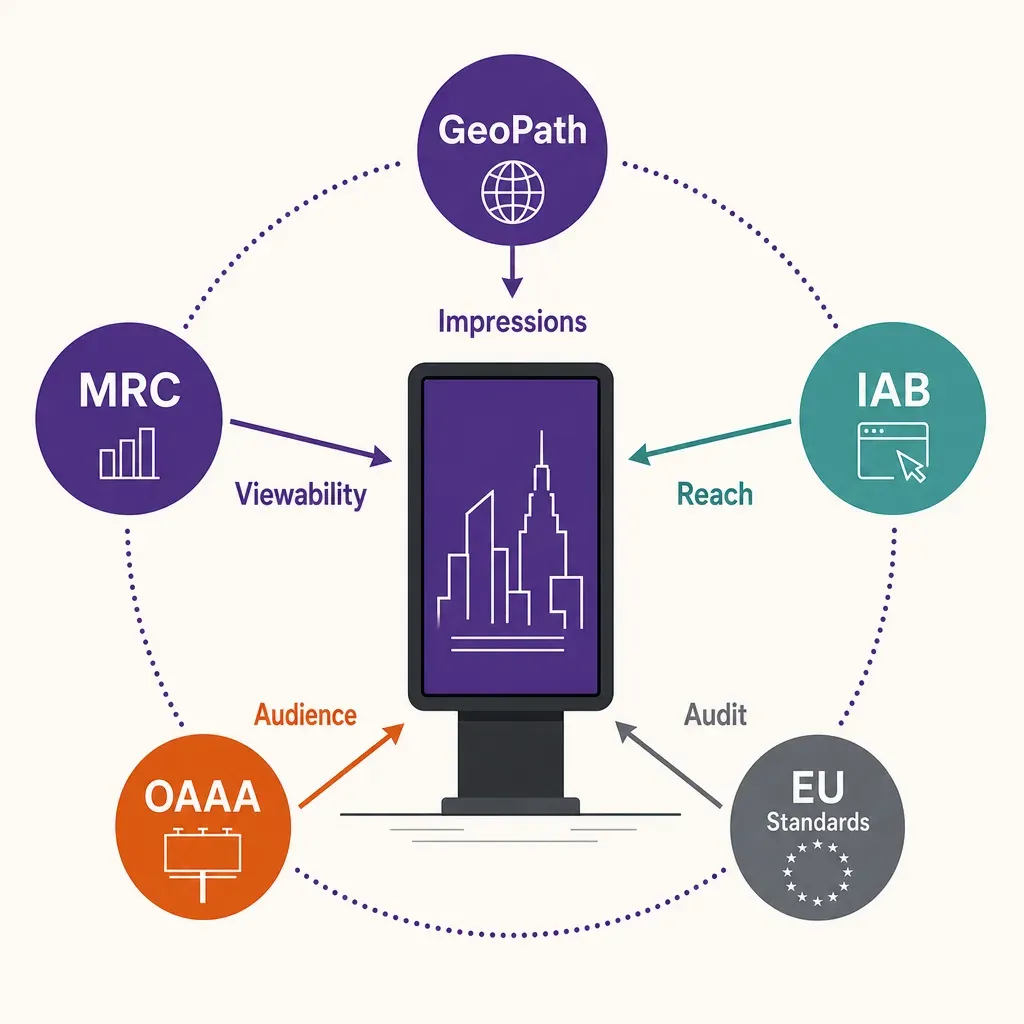
An impression on a DOOH face is one play of one creative, weighted by the audience associated with that play. The audience figure comes from the local currency body (GeoPath in the US, the relevant JIC in Europe), and the play itself is reported by the operator's playout system. The weighting is done at the play level, not at the campaign level, which is what makes the impression count programmatically tradable. MRC's OOH guidelines and IAB's DOOH guidance both describe the impression this way. A buyer auditing a campaign should expect the impression count and the playout log to reconcile.
Settled: viewable reach
Viewable reach is the unique audience that had an opportunity to see the face during the campaign. The definition rests on the local currency model: how the body computes opportunity-to-see from traffic, dwell, and visibility. Across the bodies, the underlying logic is consistent. Where the bodies differ is the input data and the visibility correction, not the concept. A campaign reported as reaching N unique people should be traceable to a published methodology that defines what unique means in that market.
Still open: attention
Attention is the area where the industry has done the most work and reached the least consensus. There is broad agreement that attention is not the same as the opportunity-to-see weighting used for impressions. There is no agreement yet on how to measure it consistently for DOOH at scale. Several attention-measurement providers offer products in the space, with methodologies ranging from in-venue dwell analysis to gaze-tracking panels to neuro-based studies. MRC has issued guidance on what attention measurement has to disclose, but a single accredited attention metric for DOOH is not yet in place.
For a buyer, the practical 2026 position is that attention is useful as a comparative metric within a single methodology (one provider, one campaign, one comparison set), but cannot yet be treated as a currency. Treat it as a planning input, not as the audit figure that closes out the campaign.
Still open: in-venue and indoor audience measurement
Most of the historical OOH currency work was built for roadside faces. The visibility model, the traffic input, and the demographic overlay all assume a moving audience past a static face. Digital screens inside a venue (a transit station, an airport, a shopping centre, a gym, a place-based network of any kind) need a different audience model. The audience is not passing in a vehicle. It is moving on foot at a pace and dwell that the venue itself shapes. The 2026 consensus is that in-venue audience measurement is a distinct discipline that uses venue-level visit and dwell data as its input, and the standards bodies have been extending their definitions to cover it rather than forcing it through the roadside model.
GeoPath has added venue and place-based methodology to its model. MRC has been revising its OOH guidelines to cover in-venue impressions. IAB's DOOH guidance assumes that the buy will include both roadside and in-venue inventory and that the impression definition has to work for both. The remaining open question is what the venue-level input actually is: how visits and dwell are measured at the screen, and how that measurement holds up under privacy law and audit.
Camera-free audience measurement
This is the part of the standards landscape that has tightened the fastest. A few years ago, camera-based audience measurement at the screen (face detection to estimate audience size, demographic inference from facial features) was a routine pitch in DOOH. In 2026, that pitch has narrowed sharply, and for reasons that are not just about privacy preferences.
Under the GDPR, any system that processes images of identifiable people is processing personal data, and any system that infers demographic categories from facial features sits very close to biometric data. Under the EU AI Act, real-time biometric categorisation in publicly accessible spaces is restricted, and demographic inference from facial features is exactly the kind of system the Act is concerned about. A network of camera-based audience-measurement devices on DOOH screens is a hard system to defend under either framework. Several European markets have effectively closed the door on it. The US picture is less prescriptive, but US advertisers running cross-market campaigns are increasingly setting policies that cannot accept camera-based demographic inference even where it is locally lawful.
What the 2026 consensus is converging on, both in operator practice and in the standards work, is that in-venue audience measurement at the screen should not require cameras or face detection. The audience input should come from sources that count people and measure dwell without identifying them. There are three families of method that meet this bar today.
- Time-of-Flight depth sensing at the screen. A ceiling or top-mounted sensor measures the height and shape of whatever passes below it, captures geometry rather than images, and counts visitors entering and leaving the screen's coverage zone. There is no image, no face, and no demographic inference.
- Signal-based dwell measurement at the screen. A sensor detects the radio signals a phone emits and triangulates position. It can measure how long a visitor stays in the screen's coverage zone without recording who they are. Modern implementations do not capture MAC addresses by default.
- Aggregate visit data from the venue. Where the venue already runs people counting at its entries and across its zones, that data can feed the screen-level audience layer directly, weighted by where the screen sits in the venue's flow.
These methods produce the inputs the standards bodies need (visits, dwell, opportunity-to-see at the screen) without producing the inputs the standards bodies and the regulators have moved away from (images, demographic inference, identifiable trace).
How Ariadne fits
Ariadne builds the first two methods above into one sensor unit, designed so that nothing identifying is captured at any point.
Ariadne measures this with Hybrid Fusion, its patented camera-free method. Time-of-Flight depth sensing counts every visitor at the entrances, capturing geometry rather than images, while patented phone signal sensing follows movement through the interior, detecting the signals a phone emits even in airplane mode. The sensor streams both feeds to Ariadne, where Hybrid Fusion combines them into one trajectory per visit and computes counts, dwell, and paths. The streams carry no identifier: no MAC address, no device ID, no biometric data, and no camera is involved. Identifiers are stored only when a visitor explicitly opts in, which keeps the method GDPR-friendly and outside biometric territory.
For a DOOH network, this maps onto the standards work in three concrete ways. Visit counts at the screen feed the impression weighting that MRC and IAB guidance require, without leaning on a camera. Dwell at the screen feeds the in-venue attention proxy that the bodies are still working out, again without identifying anyone. And visitor marketing reporting for the operator and the advertiser can be produced under a no-personal-data design that holds up under GDPR, the EU AI Act, and the audit expectations a buyer is increasingly bringing to the channel. The hardware and the data handling are described in the privacy policy.
A buyer checklist for DOOH measurement
If you are auditing or specifying measurement on a DOOH buy in 2026, these are the questions worth putting to the operator and to the measurement provider in writing.
- What currency body produces the audience figure? Confirm whether the impressions are computed against GeoPath in the US, against a national JIC in Europe, or against an operator-internal model. Operator-internal models are not necessarily wrong, but they are not currency, and they should not be presented as such.
- Is the measurement methodology MRC-accredited, and for what? Read the accreditation scope. A provider can be accredited for static OOH but not for digital, or for one DOOH product but not another. The accreditation is per product.
- How is the in-venue audience input collected? For digital screens inside a venue, ask what produces the visit and dwell figures at the screen. The answer should not be a camera, and it should not be a system that infers demographic categories from facial features.
- How does the impression count reconcile to the playout log? A buyer should be able to take the playout log and the audience model and arrive at the reported impression count. If the two cannot be reconciled, the impression figure is not auditable.
- How is attention reported? Attention is useful, but it is not yet a single accredited metric. Confirm whether the attention figure is from a single provider's methodology and whether it should be treated as a planning input or as a campaign-level figure.
- What is the privacy posture of the measurement stack? Under the GDPR and the EU AI Act, the relevant question is whether any part of the stack captures images, faces, biometric data, or identifiable device traces. A clean answer here is increasingly a precondition for European buys.
Related reading
- DOOH technical specs, decoded
- OOH vs digital reporting standards, metric by metric
- Retail media audience verification without cameras
FAQ
Is there one global standard for DOOH measurement?
Not yet. Audience measurement is run by national currency bodies (GeoPath in the US, JICs in most European markets), and the global standards work happens through MRC accreditation, IAB OOH guidance, and the international trade bodies (OAAA in the US, FEPE and WOO globally). The definitions have converged on impressions and viewable reach. They have not converged on attention or on a single in-venue audience input.
Does DOOH measurement require cameras at the screen?
No. Ariadne counts with Hybrid Fusion: Time-of-Flight depth sensing plus patented phone signal sensing, never cameras. Time-of-Flight captures geometry rather than images, and signal sensing captures no MAC address by default, so the measurement involves no video, no faces, and no biometric data.
Under the GDPR and the EU AI Act, camera-based audience measurement at the screen is hard to defend, particularly when it infers demographic categories. The 2026 standards work is converging on in-venue measurement methods that count people and measure dwell without producing images.
What is an MRC accreditation worth to a buyer?
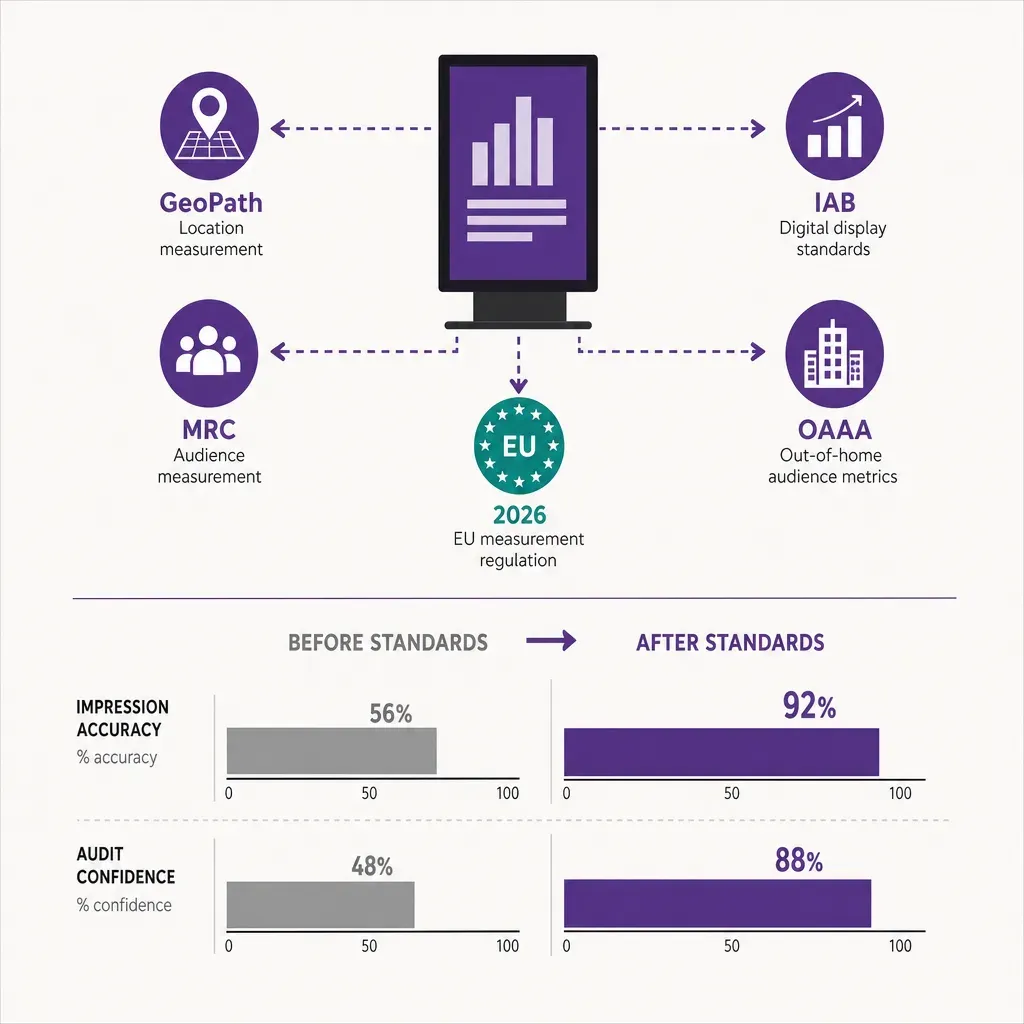
It is the audit stamp that says a measurement provider's methodology has been independently reviewed against the MRC's OOH guidelines. It is product-specific, so read the scope before assuming a single accreditation covers a provider's whole product line. Where it applies, it gives the buyer a documented basis for how the impression figure was computed.


