
A per-store door count tells a mall operator how many people walked into each shop. It says nothing about whether those were the same people. Two tenants can each report a healthy day and still be serving two entirely separate crowds who never crossed paths, or they can be sharing most of their shoppers without either one knowing. That difference is the whole subject of cross-shopping, and it is the question a stack of individual door counts cannot answer.
This post is about the mall-specific, tenant-to-tenant case: which distinct stores a single visit touches, which pairings feed each other, and which stores sit off the main path and get skipped. For movement inside a single store or a generic space, see shopper flow through a space; this post assumes that concept and applies it across tenants, where leasing and cross-promotion decisions actually get made.
What is cross-shopping in a mall?
Cross-shopping is when the same visit touches more than one store: a shopper enters the mall, visits the anchor, then a coffee shop, then two inline tenants before leaving. Measuring it reveals which tenants share shoppers, which pairings feed each other, and which stores sit off the main path and get skipped. Leasing teams use cross-shopping to place complementary tenants near each other and to justify percentage-rent and co-tenancy terms; marketing teams use it to design cross-promotions that actually match real shopper journeys. It needs journey-level movement between stores, not just a count at each door.
The rest of this post separates the two things cross-shopping measures. The first is store affinity, which pairs of tenants share shoppers. The second is coverage, which stores a visit reaches and which it never gets near. Both come from the same underlying record: the sequence of stores a single visit touched, not a headcount at any one door.
Store affinity: which pairings share shoppers, and why leasing cares
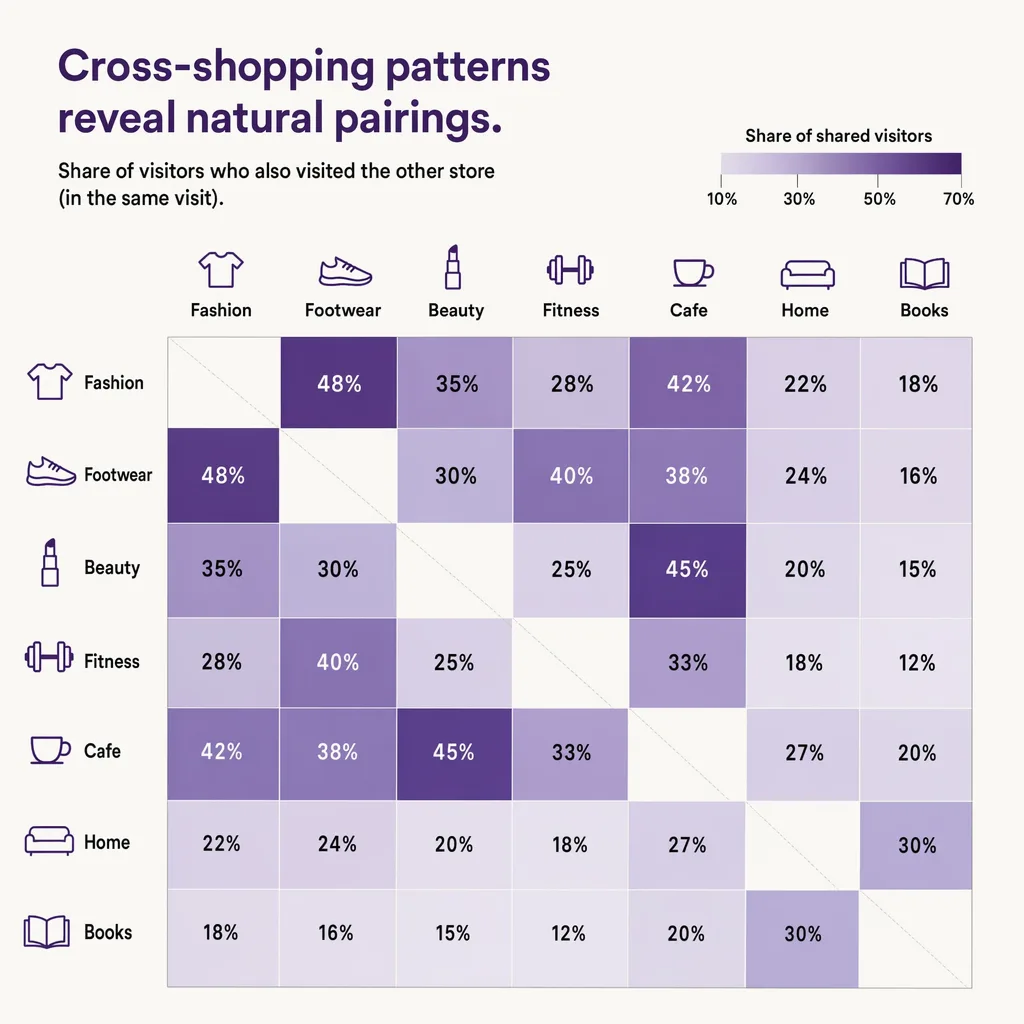
Store affinity is the measured overlap between two tenants: of the shoppers who visited store A on a given trip, what share also visited store B. A high affinity means the two stores draw from the same visits; a low affinity means they serve crowds that rarely coincide, even if both are busy.
Leasing teams care about affinity because it turns tenant placement from intuition into evidence. The classic assumption is that complementary categories belong near each other, a fashion retailer beside a footwear store, a supermarket beside a pharmacy, a cinema beside food and beverage. Affinity data either confirms that or complicates it. Sometimes two stores that planners expect to share shoppers do not, because a physical break, a level change, or a poorly placed corridor keeps their visits apart. Sometimes an unexpected pairing shows strong overlap, which is a signal to place those tenants closer at the next lease renewal or refit.
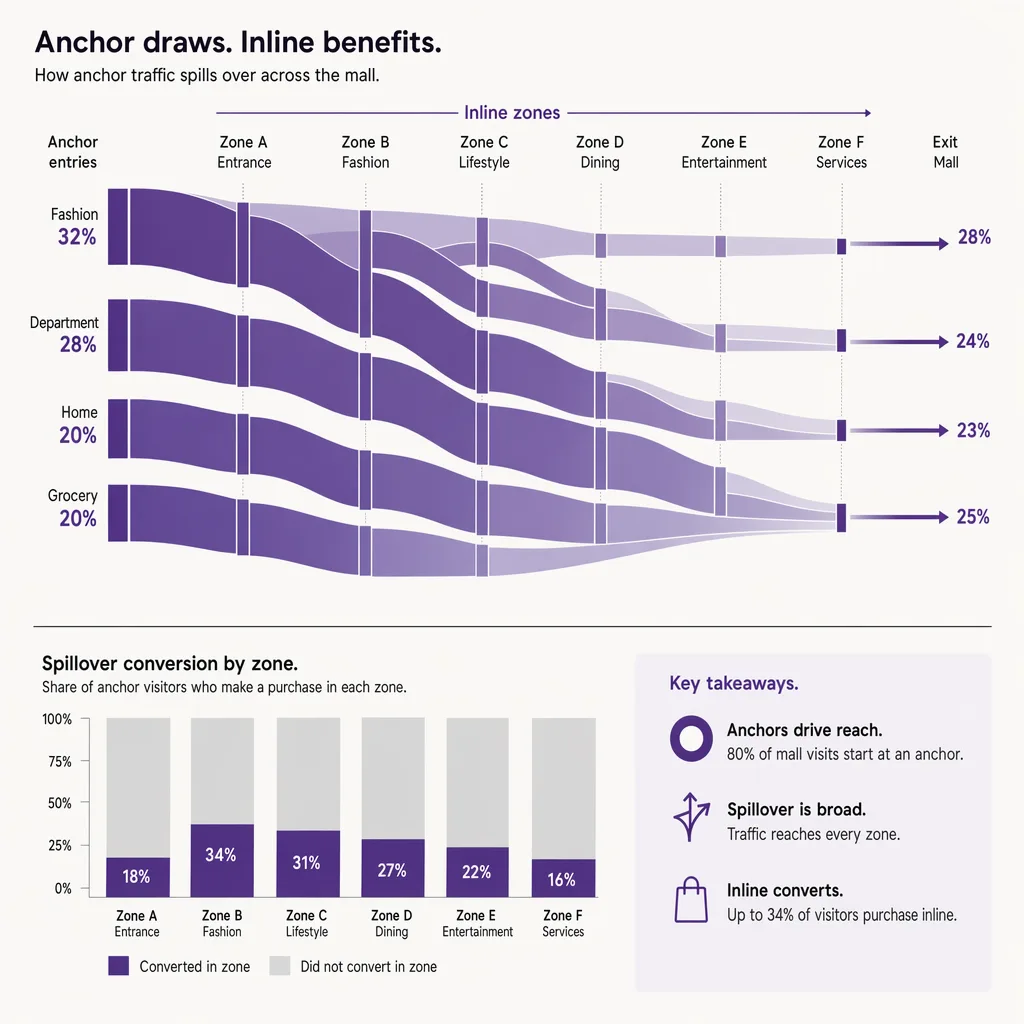
Affinity also feeds the commercial terms themselves. Percentage-rent and co-tenancy clauses rest on an assumption that certain tenants pull traffic the rest of the center lives on. If a landlord can show that a given anchor's visitors reliably cross-shop the inline units around it, that is evidence the anchor is earning its role rather than coasting. If the overlap is weak, the same data flags a placement or programming problem worth fixing before it shows up in inline-tenant sales.
What cross-shopping reveals that per-store door counts cannot
A door count is a snapshot at one threshold. It answers "how many arrived here" and nothing else. Stack a hundred of them across a mall and you still have a hundred separate snapshots with no thread connecting them, so you cannot tell whether the mall is one shared visit spread across many stores or many isolated visits that happen to share a roof.
Cross-shopping restores the thread. Because it works from the sequence of a visit rather than the count at a single door, it can answer questions that are invisible in a door count. Which stores does a typical visit reach before it ends. Which tenant is almost always the first stop, and which is almost always the last. Which stores are consistently skipped, not because they are unpopular in isolation but because they sit off the path most visits take. A store can report a respectable door count and still be a dead end that no cross-shopping journey passes through on the way to somewhere else, which is a very different commercial position from a store on the main artery, and only journey-level movement makes the two distinguishable.
Uses: tenant placement, cross-promotion design, common-area programming
Three teams use cross-shopping data, and each uses it differently.
Leasing uses affinity for tenant placement and mix. If two categories show strong measured overlap, placing them near each other shortens the walk between them and tends to lift the shared visit; if a category shows weak overlap with everything around it, that store may be misplaced or the mix around it may be wrong for the traffic it draws.
Marketing uses cross-shopping to design promotions that match real journeys rather than assumed ones. A cross-promotion between two tenants only works if their shoppers actually overlap, and cross-shopping data says whether they do before the campaign runs, then measures whether the promotion lifted the shared visit afterward. For the measurement side of that, see measuring mall cross-promotions.
Operations uses the same movement data to program common areas: where to place seating, events, a pop-up, or directory signage so it sits on the paths visits actually take rather than the paths a floor plan suggests. That is closely tied to how much of each shared space gets used, covered in common-area utilization. The broader single-visit view that all three build on is customer journey mapping.
Measuring tenant-to-tenant movement without cameras or PII
The hard part of cross-shopping is that it needs the sequence of a visit, and a sequence is exactly what a door-line counter throws away. To know that the same visit touched the anchor, then a coffee shop, then two inline units, you need interior movement resolved to the store level and connected into one trajectory, not a set of unlinked door events. The obvious way to do that is cameras, which raises exactly the privacy problem malls are trying to avoid.
Ariadne measures this with Hybrid Fusion, its patented camera-free method. Time-of-Flight depth sensing counts every visitor at the entrances, capturing geometry rather than images, while patented phone signal sensing follows movement through the interior, detecting the signals a phone emits even in airplane mode, and tracks that movement to about one-metre precision. The sensor streams both feeds to Ariadne, where Hybrid Fusion combines them into one trajectory per visit and computes counts, dwell, and paths. The streams carry no identifier: no MAC address, no device ID, no biometric data, and no camera is involved. Identifiers are stored only when a visitor explicitly opts in, which keeps the method GDPR-friendly and outside biometric territory.
Read against cross-shopping, that matters in a specific way: the trajectory is what makes tenant-to-tenant movement measurable, and it carries no identity. The method sees that a visit moved from one store to another and how long it spent in each, without capturing who the visitor was. Cross-shopping here is aggregate movement between stores, not a record of a named person's shopping, which is the distinction that keeps the analysis useful and outside biometric territory at the same time. For how this supports leasing and mix decisions across a whole center, see shopping center analytics.
Reading a cross-shopping matrix: a worked, illustrative example
Cross-shopping is usually presented as a matrix: rows and columns are tenants, and each cell is the share of one tenant's visitors who also visited the other on the same trip. The figures below are illustrative and are not measured from any specific center; they exist to show how to read the shape, not to quote a benchmark.
| Of visitors to... | also visited Anchor | also visited Coffee | also visited Apparel | also visited Electronics |
|---|---|---|---|---|
| Anchor | - | high | medium | low |
| Coffee | high | - | medium | medium |
| Apparel | medium | medium | - | low |
| Electronics | low | medium | low | - |
Read across a row to see where a tenant's shoppers go next. In this illustrative example the anchor and the coffee shop share a large part of their visits, which suggests they sit on the same path and reinforce each other, a pairing worth protecting in placement and worth testing with a cross-promotion. Electronics shows low overlap with both the anchor and apparel, which is the pattern to investigate: is the store genuinely serving a separate, purpose-driven crowd, or is it off the main path and being skipped by visits that would have entered if the route ran past it. The matrix does not answer that on its own, but it tells the leasing team exactly where to look, which a stack of door counts never could.
The read is always relative, not absolute. A single overlap figure means little in isolation; the value is in comparing cells, spotting the pairings that run far above or below what the mix would predict, and acting on the outliers. That comparison is what turns cross-shopping from a curiosity into a leasing and marketing input.
FAQ
What is cross-shopping in a mall?
Cross-shopping is when a single visit touches more than one store: a shopper enters, visits the anchor, then a coffee shop, then an inline unit or two before leaving. Measuring it shows which tenants share shoppers and which stores sit off the path most visits take and get skipped.
How is cross-shopping different from a per-store footfall count?
A per-store count is a snapshot at one door and cannot tell whether two busy stores served the same people or two separate crowds. Cross-shopping works from the sequence of a visit across stores, so it reveals shared shoppers, common routes, and skipped tenants that a stack of separate door counts hides.
Do I need cameras to measure cross-shopping?
No. Ariadne counts with Hybrid Fusion: Time-of-Flight depth sensing plus patented phone signal sensing, never cameras. Time-of-Flight captures geometry rather than images, and signal sensing captures no MAC address by default, so the measurement involves no video, no faces, and no biometric data.
Does measuring cross-shopping identify individual shoppers?
No. The method builds one trajectory per visit and measures movement between stores in aggregate. It sees that a visit moved from one store to another and how long it stayed, without capturing who the visitor was. Identifiers are stored only when a visitor explicitly opts in.
How do leasing teams use cross-shopping data?
They use store affinity, the measured overlap between two tenants, to place complementary stores near each other, to test whether an anchor's visitors actually reach the inline units around it, and to support percentage-rent and co-tenancy terms with evidence rather than assumption.
---


