
What cross-promotion measurement is actually measuring
A shopping centre runs cross-promotions all the time. The anchor department store gives a stamped receipt that opens a coupon at a specialty tenant down the corridor. A food court vendor hands out a chit redeemable at the cinema upstairs. The mall app pushes a category-day offer that ties three tenants together. The question that decides whether any of this is worth running again next quarter is the same one in every case: did the promotion move a visit, a basket, or a redemption that would not have happened anyway. That question is harder than it looks because mall shoppers are mobile across the building, the tenants run their own promotions in parallel, and the obvious metric, total redemptions, is the one most contaminated by spend that would have happened with or without the campaign.
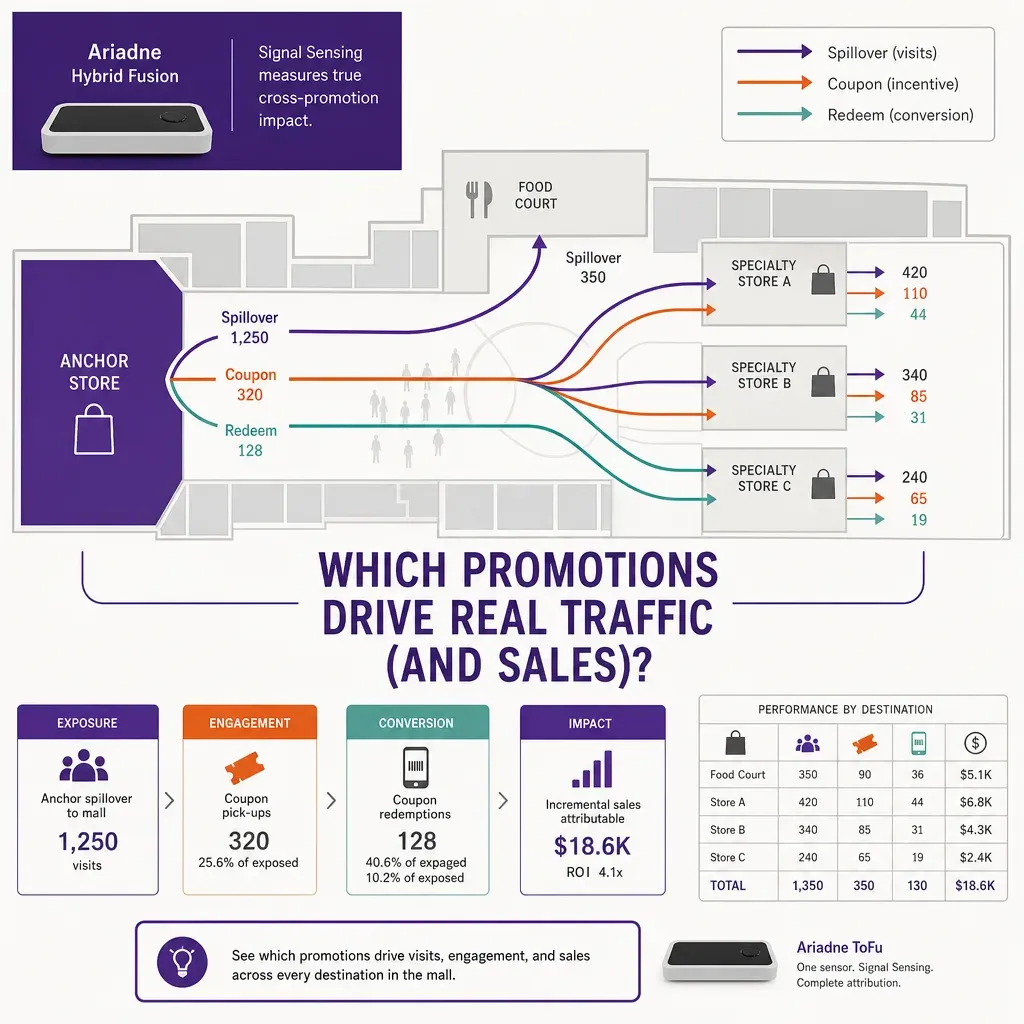
This post walks through the measurement layer underneath any cross-tenant promotion: how to detect anchor-to-specialty spillover, how to attribute a coupon redemption fairly across the tenants involved, what a zone-capture metric is for, and how to build a lift loop that holds up to scrutiny when the marketing team reports results to the leasing committee. Paired with what a visitor marketing platform contributes once the cross-promotion is live and how that data gets joined back to the in-store outcome without identifying individual shoppers.
Anchor-to-specialty spillover: what to look for and how to detect it
Spillover is the part of an anchor's visit that ends up benefiting another tenant in the centre. A shopper enters the anchor for a planned purchase, leaves the anchor, and then walks into a specialty tenant they had no plan to visit. The cross-promotion is supposed to raise the share of anchor visits that produce that second stop. Measuring whether it did is a question about visit sequence, not a question about total footfall.
Three signals matter for spillover detection, and a measurement plan that does not produce all three is incomplete.
- The anchor-to-specialty visit pair within a single trip. A shopper enters the centre, visits the anchor, and within the same trip visits the specialty tenant covered by the promotion. The pair is what counts, not two separate visits on different days.
- The time-between-stops distribution. The interval between leaving the anchor and entering the specialty tenant tells you whether the promotion is being used for a planned next stop (typically under 15 minutes) or whether shoppers are wandering the corridor and the join is incidental. The shape of the distribution is part of what you report, not just the mean.
- The conversion of pass-by to entry at the specialty. A specialty tenant cannot benefit from spillover that walks past the storefront without entering. The pass-by to entry conversion at that tenant during the promotion window, compared with a baseline week, is the cleanest local measure of whether the promotion is changing behaviour at the moment of decision.
All three signals can be produced from anonymous zone counts and a corridor-level flow picture, joined at the trip level rather than at the individual level. You do not need to know which shopper made the pair to know that pairs are happening at a higher rate during the promotion window than in the matched baseline.
Coupon redemption attribution across tenants
A cross-tenant coupon is usually attributed by whichever tenant scans the redemption. That answers a transactional question, not a marketing question. The marketing question is which tenant's activity earned the redemption: the anchor that triggered the offer, the specialty tenant that fulfilled it, the centre's marketing team that staged the campaign, or some defined split between them. Attribution that holds up across a year of running this loop needs a model that is set explicitly, written down, and applied consistently across campaigns.
Four attribution patterns recur in mall cross-promotion practice, and the right one depends on the question the leasing committee actually wants answered.
- Originator attribution. The tenant whose action produced the coupon (often the anchor receipt, sometimes a specialty referral) takes the credit. This is the right model when the question is whether the originating tenant is driving traffic into the centre.
- Redeemer attribution. The tenant who scans the coupon takes the credit. This is the right model when the question is which tenants are converting the offer once a shopper is in front of the storefront.
- Even split. Half the credit each to originator and redeemer. Plain to communicate to the leasing committee, easy to audit, and the right starting model when neither side dominates the value chain.
- Centre-weighted split. A share is reserved for the centre's marketing budget, on the basis that the mall-level promotion staged the conversation between the two tenants in the first place. Common when the centre is co-funding the offer with a vendor budget.
The cleanest practice is to pick one attribution model per campaign, write it into the campaign brief before launch, and report the same redemption figure under all four models in the post-mortem so the committee can see how sensitive the result is to the choice. A campaign that only looks like a win under one attribution model is a campaign worth re-examining before the next quarter.
Zone-capture metrics: from footfall to share-of-trip
Footfall in a mall zone is easy to count and tells you very little on its own about whether a tenant is winning the corridor. A zone with a busy footpath and low entry conversion is a different kind of problem from a zone with a quiet footpath and high conversion, and a cross-promotion that lifts one without lifting the other is doing different work to a campaign that lifts both. Three zone-capture metrics carry most of the weight in a serious measurement plan.
- Pass-by count. How many shoppers walked past the storefront, measured at the corridor entry-points on either side of the unit. This is the denominator that anchors every other capture figure.
- Entry conversion. Entries divided by pass-by, expressed as a percentage. A tenant lifting entry conversion during a cross-promotion window is winning the moment of decision at the storefront, which is usually the goal of the campaign.
- Share-of-trip. Of the shoppers who visited the anchor during the same trip, what share also entered the promoted specialty tenant. This is the cleanest spillover figure: it indexes the specialty's performance to the cohort the promotion is actually trying to influence, rather than to all shoppers in the centre.
A reporting line that holds up across campaigns looks like: pass-by stable, entry conversion up two to four points, share-of-trip up three to six points against the matched baseline. The absolute values vary widely by category, centre size, and corridor geometry, and the right benchmark is always the same centre's own baseline rather than a sector-wide average pulled from a slide deck. The reporting discipline is to publish the matched-baseline figure and the campaign-window figure side by side, not the campaign window on its own.
The lift loop: campaign window vs matched control
Total redemptions, total entries, and total share-of-trip during a campaign window are not the lift. They are the gross outcome. The lift is the difference between the campaign-window figure and what a comparable window without the campaign would have produced. A measurement plan that does not produce that comparison is reporting correlation. The loop has four moving parts.
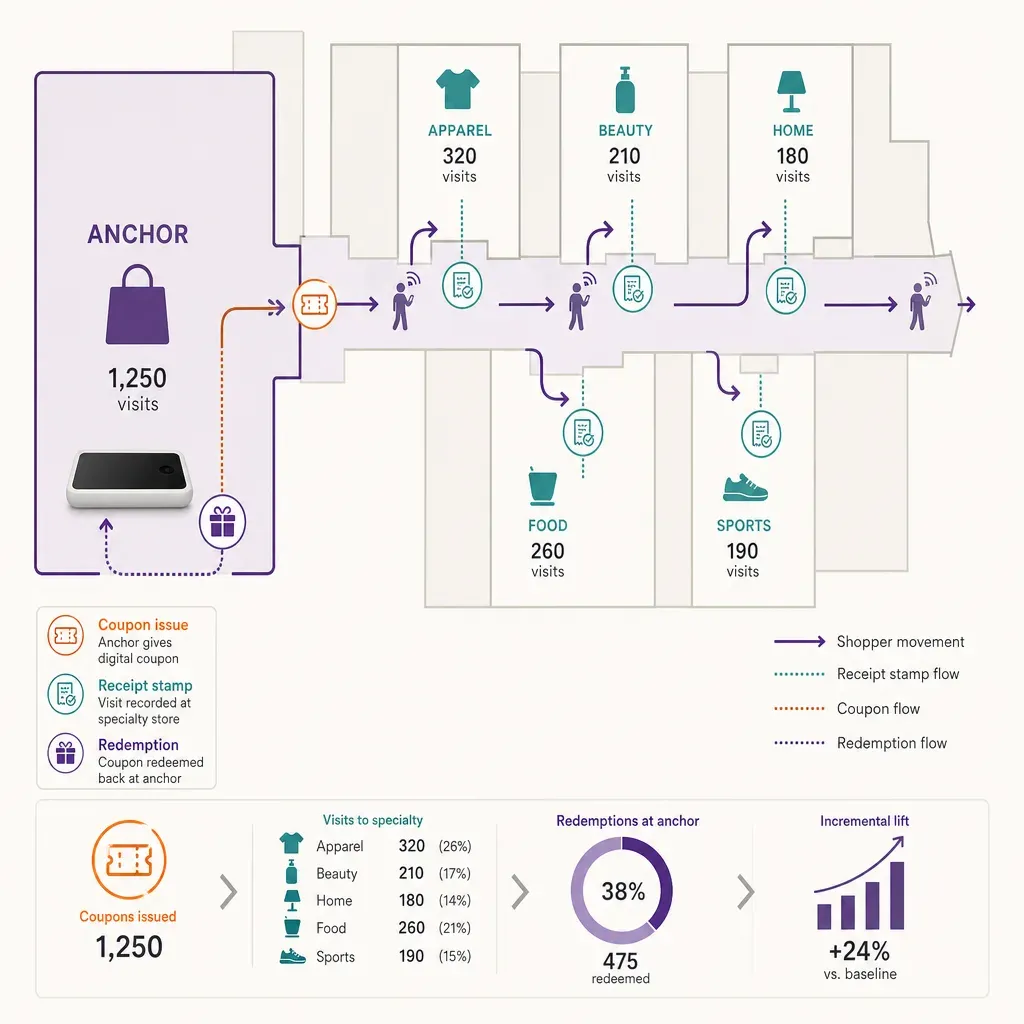
- A matched baseline window. Pick a window before the campaign that matches it on the variables that move footfall most: day-of-week pattern, school-holiday status, weather, presence of other tenant promotions, and any known event in the centre. A four-week prior baseline aligned by day-of-week is the common starting point. Avoid an immediately prior week if the run-up to launch was itself promoted.
- A control corridor where possible. If the centre is large enough that two corridors carry comparable tenant mixes, run the cross-promotion on one and use the other as a within-centre control. The lift is the difference-in-difference: campaign corridor change minus control corridor change. This factors out the centre-wide weather and weekday effects that confuse a single-corridor read.
- Tenant-level entry counts. The lift is reported at the tenant the campaign is supposed to lift, not at the centre level. A campaign that pulls the centre's total entries up by half a point but did not move the specialty tenant the offer pointed at is a campaign that did not do its job. The door-level counter at the tenant is the figure the lift loop is scored on.
- Aggregate join, not individual tracking. The comparison is between two cohorts at the population level, not between two specific shoppers. The matched-baseline window and the campaign window are scored against each other in aggregate, which is the join the measurement loop needs and the only join consistent with the centre's privacy posture.
Honest lift figures from cross-promotions tend to be smaller than the campaign report suggests. Single-digit to low-double-digit percentage lifts on the targeted zone's entries, against a matched baseline, are the practical range that survives a difference-in-difference review. The discipline is to report the actual range and to retire campaign formats that do not produce a real lift against control after two or three repetitions.
Mall app and offline redemption: closing the data loop
Most centres now run a mall app that handles loyalty, parking, and offers. The app is the cleanest place to deliver a cross-promotion offer because the consent layer is already in place and the redemption can be tracked through the app's own back-end. Two patterns make the app data useful for cross-promotion measurement, and one common pattern degrades it.
- Offer impressions are logged. The app records every time a shopper saw the cross-promotion offer card, not just the redemptions. Impressions divided by redemptions is the conversion figure that says whether the offer is doing its job in the app, separate from whether it is moving the in-store metric.
- Offline redemption is captured. A cross-promotion that is redeemed at a paper-coupon till is invisible unless the till scan flows back into the campaign system. Either the redemption is registered through the app (a scanned QR at the tenant), or the tenant's till exports a coded redemption count that joins the campaign data. Without one of those, the centre is reporting on the redemptions it can see rather than on what actually happened.
- Avoid tying the lift loop to app users only. The lift figure has to be scored at the door, not at the app, because most shoppers walking the corridor are not in the app on any given visit. Reporting that the campaign worked because app users redeemed is reporting on a self-selected cohort, not on the corridor. The door-level entry count is the figure that closes the loop honestly.
How Ariadne fits
Ariadne is the centre-side measurement layer. It produces the pass-by, entry, and share-of-trip figures that a cross-promotion measurement plan needs, designed so that nothing identifying is captured at the door or in the corridor.
Ariadne measures this with Hybrid Fusion, its patented camera-free method. Time-of-Flight depth sensing counts every visitor at the entrances, capturing geometry rather than images, while patented phone signal sensing follows movement through the interior, detecting the signals a phone emits even in airplane mode. The sensor streams both feeds to Ariadne, where Hybrid Fusion combines them into one trajectory per visit and computes counts, dwell, and paths. The streams carry no identifier: no MAC address, no device ID, no biometric data, and no camera is involved. Identifiers are stored only when a visitor explicitly opts in, which keeps the method GDPR-friendly and outside biometric territory.
For a mall running cross-tenant promotions, the practical consequences line up with the measurement plan above. Pass-by, entries, and share-of-trip are reported per tenant and per corridor, with the matched-baseline window held against the campaign window for the lift figure. The anchor-to-specialty pair within a trip is detectable because the corridor flow picture is continuous and the trajectories are aggregated at the trip level. And because the in-centre data layer carries no MAC address, no device identifier, and no biometric data, the leasing committee gets the measurement they need without the door-side counter being the weak link in the centre's privacy posture. The wider picture sits alongside the shopping centre work, with tenant-level people counting as the foundation, and the data design is set out in the privacy policy.
A measurement checklist for the next cross-promotion
If you are setting up the measurement plan for a mall cross-promotion, these are the questions worth putting on the campaign brief in writing before launch.
- What is the spillover hypothesis? Which tenant pair (anchor and specialty, or specialty and specialty) is the campaign trying to move, and what does success look like in pairs per trip rather than in total entries.
- What attribution model is being used, and who agreed to it? Originator, redeemer, even split, or centre-weighted. Write it into the brief and report the redemption figure under all four in the post-mortem so the leasing conversation is grounded in numbers.
- What is the matched baseline? Define the prior window and the matching variables (day-of-week, holiday status, weather, parallel promotions) before launch, not after. Retro-fitting the baseline to flatter the campaign is the most common reporting failure in this space.
- Is there a control corridor? If the centre's geometry allows it, run the campaign on one corridor and use a comparable corridor as the within-centre control. Difference-in-difference is the cleanest read.
- What does the door-level counter capture? Camera-based or demographic-inference counters drag the privacy posture of the whole campaign down to the level of their weakest component. A camera-free, identifier-free entry count is the cleanest pairing for cross-tenant measurement that has to satisfy a centre's data protection review.
- How will the result be reported to leasing? Decide the format before the campaign runs: matched-baseline figure and campaign-window figure side by side, lift under the chosen attribution model, sensitivity under the other three, and a short note on what would have to change to repeat the campaign next quarter.
FAQ
Can a centre measure cross-promotion lift without identifying shoppers?
Yes. The lift loop only needs aggregate figures: pass-by, entries, and share-of-trip at the tenant level, joined against a matched-baseline window. The anchor-to-specialty pair is detected at the trip level rather than at the individual level. A door-level counter that produces accurate entries without capturing personal data is the right shape for the join, and it is the shape that keeps the centre's data protection review short.
What is a realistic lift figure for a well-run cross-promotion?
Single-digit to low-double-digit percentage lifts on the targeted tenant's entries, against a matched baseline and ideally with a within-centre control corridor, are the practical range. The exact figure varies widely by category, centre size, and corridor geometry. The discipline is to publish the figure honestly against the matched-baseline window rather than against a flattering year-over-year comparison.
Does cross-promotion measurement require cameras at the storefronts?
No. Ariadne counts with Hybrid Fusion: Time-of-Flight depth sensing plus patented phone signal sensing, never cameras. Time-of-Flight captures geometry rather than images, and signal sensing captures no MAC address by default, so the measurement involves no video, no faces, and no biometric data.
How should redemption credit be split between the anchor and the specialty?
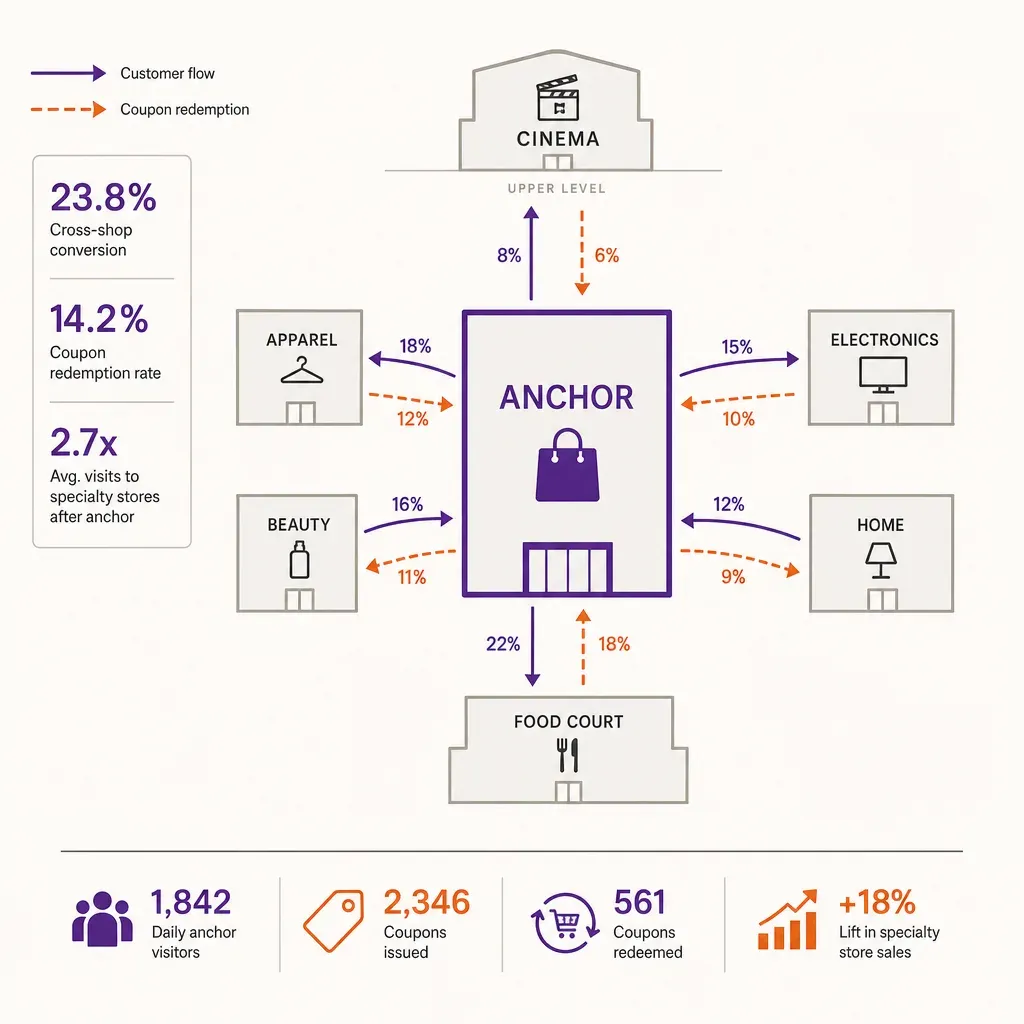
There is no single right answer; the choice depends on the question the leasing committee wants to answer. Originator attribution favours the tenant that triggered the offer (often the anchor), redeemer attribution favours the tenant that converted it, an even split is the simplest to communicate, and a centre-weighted split reserves a share for the marketing budget that staged the campaign. Pick one model per campaign, write it into the brief, and report under all four in the post-mortem so the choice is visible.


