
The metric the airport CFO actually watches
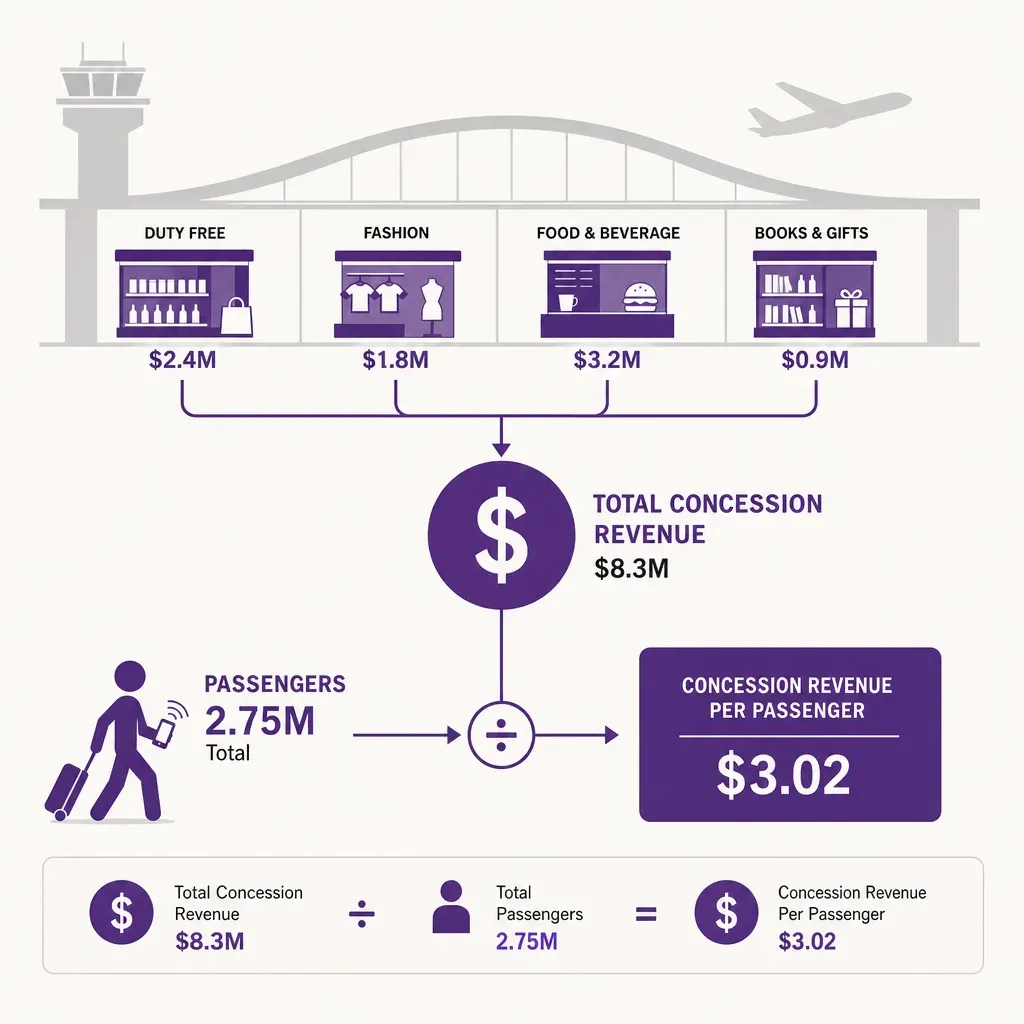
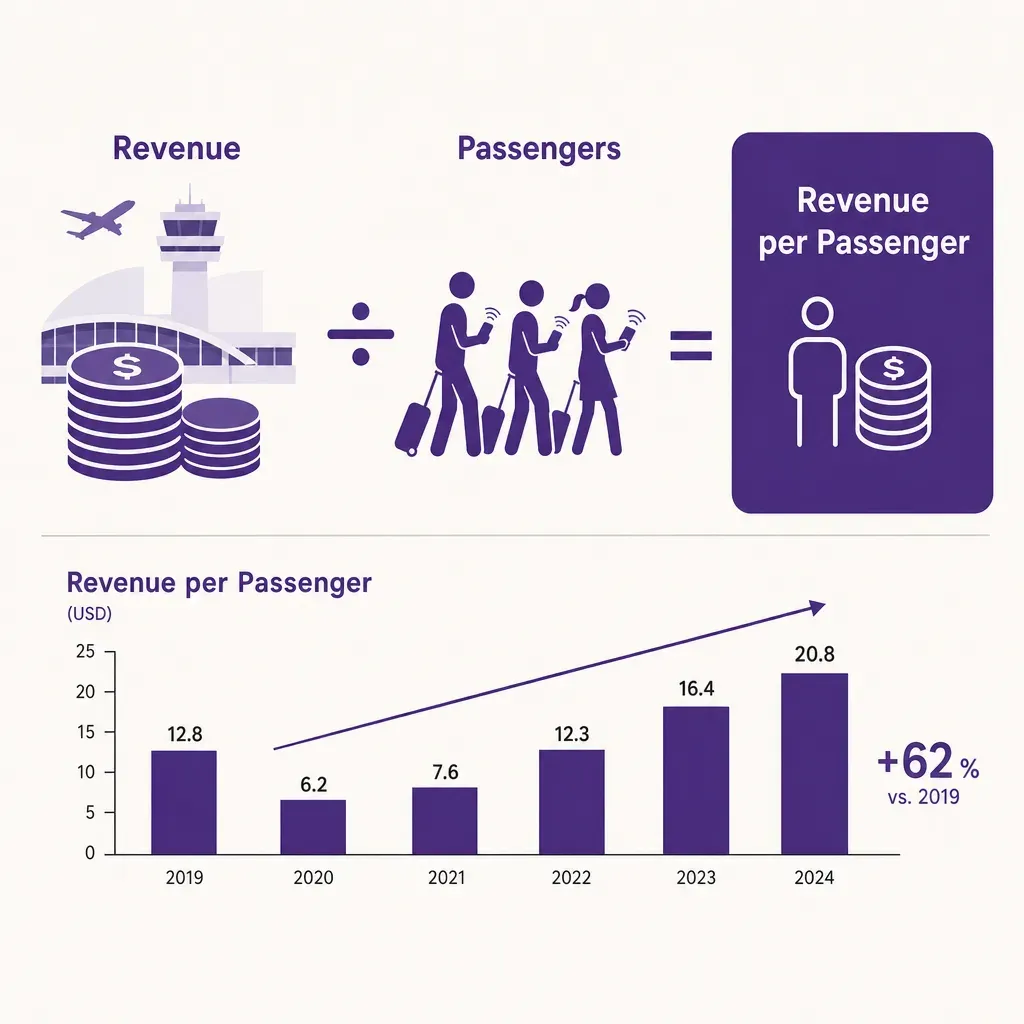
Concession revenue per passenger is the single line that ties airport commercial performance to passenger growth. Take the total spend in retail and food and beverage across the terminal for a period, divide by the enplaning passengers in the same period, and you have the number the finance team writes into the annual report, the rating agencies model against, and the board interrogates when a soft year arrives.
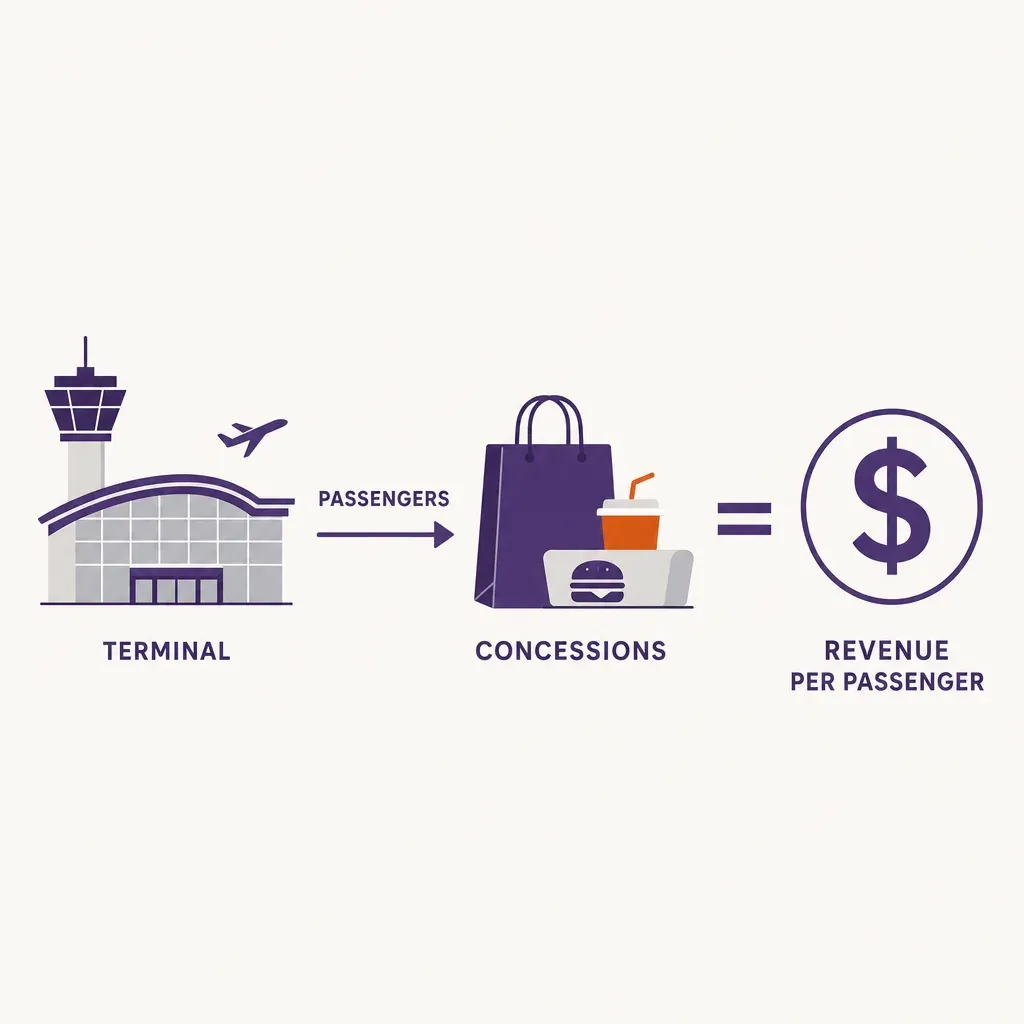
It sounds clean. In practice the denominator is the part that hides most of the truth. Enplaning passengers is the airport-wide count, the one already published in the traffic statistics. But the people who can spend at the retail concourse are not the same set as the people who flew through the airport. Domestic transit at an airside hub, early-morning low-fare departures with limited shopping intent, contract carriers whose passengers move through a separate satellite, late-night arrivals through a terminal where the F&B has closed: all of them are in the enplaning number and none of them is on the concourse with a wallet open. Dividing total commercial revenue by total enplanements quietly buries every one of those mismatches in a single ratio and calls it performance.
This post is for the airport commercial and operations teams who have to defend that number, and for the analysts inside concessionaires who have to negotiate against it. It sets out a tighter definition, a flow-based decomposition that turns one ratio into a diagnostic, and the conversation the better-instrumented airports are now having when a renewal lands on the table.
The illustrative numbers in this piece are not Ariadne-measured results and not study findings. Industry aggregates published by trade bodies move year to year and vary by region and terminal type. Treat any range below as the shape of the effect, not a target for your own terminal.
Defining the number, carefully
Concession revenue per passenger, written most simply, is:
Revenue per pax = (Gross retail and F&B sales in the terminal, net of duty and excise where applicable) divided by (Enplaning passengers in the same period).
Three definitional choices inside that single line drive most of the variance between published numbers at different airports:
- What counts as commercial revenue. Some airports include duty free at gross, some at net of duty, some include advertising and currency exchange, some restrict the number to retail and F&B. The denominator is the same across all of them, so the published per-pax number depends heavily on what is rolled into the top.
- Which passengers are in the denominator. Most airports use enplaning passengers, which is departures only and avoids double-counting an originating passenger as both arriving and departing. A few use total passengers (arriving plus departing plus transit). The two produce very different per-pax numbers from the same revenue line.
- Which terminal or concourse is the unit. A single airport-wide ratio averages across terminals with very different concession mixes. A long-haul international terminal with a premium duty-free zone produces a different per-pax than a low-fare domestic concourse in the same airport on the same day.
Before any benchmarking conversation, the first job is to pin down which version of the metric is being compared to which other version. The Airports Council International publishes regional aggregates that are useful as orientation, but they are aggregates of airports that themselves define the metric inconsistently. Two airports can report a 30% difference in revenue per pax and have identical commercial performance once their definitions are aligned.
Why the denominator is the part that breaks
Even with a tight definition, the denominator does not measure what the numerator depends on. The numerator is the revenue made by passengers who walked the retail concourse with time and intent to buy. The denominator counts everyone who took a flight from the airport, including the ones who never went anywhere near retail.
A short list of the people who sit in the denominator without having had the chance to be in the numerator:
- Airside transit passengers in a separate transit zone. At a hub terminal, transit traffic between long-haul flights can be a large share of total enplanements, especially in evening peaks. If the transit zone is geographically separated from the main retail concourse, those passengers contribute to the denominator and have no realistic path to the numerator.
- Late-night and early-morning departures past closed F&B. An early bank of low-fare departures before most outlets open, or a late-night wave after closing, adds passengers without commercial opportunity. The revenue line for that bank is structurally near zero, not soft trading.
- Bus-gate and remote-stand passengers. Passengers boarding through a remote stand often bypass the central retail concourse entirely. They enplane, they count, and they do not pass a single till.
- Crew, staff, and meeters-greeters. These do not enplane, so they are correctly excluded from the denominator. They do, however, generate revenue, which lands in the numerator and lifts the apparent per-pax. This is the rare distortion that goes the other way.
The combined effect is that the published per-pax at any given terminal can move by a meaningful share without any change in shopper behaviour. A schedule change that adds a bank of remote-stand departures will compress the ratio. A new long-haul wave with a long pre-flight dwell will lift it. The CFO sees the metric move; the commercial team is asked why; the answer often has nothing to do with anything the commercial team controls.
Two better measurements: capture rate and dwell-weighted reach
The fix is not to abandon revenue per passenger. It is to keep it as the financial headline and instrument two operational metrics underneath it that explain where the headline number is moving from and to. Both depend on measuring passenger flow at the retail concourse independently of airport-wide enplanements.
Concourse capture rate
Capture rate is the share of enplaning passengers who actually pass through the retail concourse, measured as concourse entries divided by enplaning passengers for the same period. The concourse boundary has to be defined in the same way every period (which doors, which floor levels, which transit corridors), and entries to the concourse have to be counted at those boundaries, not inferred from gate scans.
At a hub terminal, capture rate can sit well below one. At a single-concourse origin and destination terminal it can sit close to one. The point is not the absolute level, it is the trend. A falling capture rate with stable revenue per concourse-passing pax is a routing problem. A flat capture rate with falling revenue per concourse-passing pax is a commercial problem. The headline number that aggregates the two looks the same in both cases and tells you nothing about which lever to pull.
Dwell-weighted reach
A passenger who passes the concourse for two minutes between gate and security is not a commercial opportunity in the same sense as a passenger who sits in the F&B zone for forty minutes before boarding. Dwell-weighted reach takes the population of concourse-passing passengers and weights each by the time they actually spent in the commercial area, producing a measure of available shopper-minutes rather than just shopper-heads. Passenger gate dwell time is the input, the retail concourse zone is the boundary, and the output is a number that correlates much more cleanly with revenue than headcount alone.
Together the three numbers (revenue per enplaning pax, concourse capture rate, dwell-weighted reach) decompose the headline into something a commercial director can defend. A weak quarter on the headline now has a fingerprint: was capture down, was dwell down, was capture stable and per-minute spend down. Each answer points at a different fix.
How to measure passenger flow at the retail concourse independently
The mechanical requirement is independent counting at the concourse, not derived from airport-wide reports. Airport-wide enplanements come from the airline check-in and boarding feeds. Concourse flow has to be measured at the concourse boundary, by sensors that count every passenger crossing into the commercial area, with hourly granularity and accuracy good enough to compare against the airport's own departure schedule.
Three things matter in the count itself:
- Every entry, regardless of phone or device. If the count depends on a passenger carrying a connected phone, the share you are missing is the share that flies without one, which is correlated with traveller type and therefore with spend. The base count has to be device-independent.
- Group sizing. Families and couples enter together. If the sensor records a group of three as one event, the count is low. If it splits the group across separate frames, the count is high. Neither error is acceptable when you are dividing revenue by the number.
- Dwell in the zone, not just at the door. Dwell-weighted reach needs an interior measurement: how long each passenger lingers inside the commercial area, separable from time spent waiting at a gate. The two are different zones with different sensors and different reports.
Ariadne measures this with Hybrid Fusion, its patented camera-free method. Time-of-Flight depth sensing counts every visitor at the entrances, capturing geometry rather than images, while patented phone signal sensing follows movement through the interior, detecting the signals a phone emits even in airplane mode. The sensor streams both feeds to Ariadne, where Hybrid Fusion combines them into one trajectory per visit and computes counts, dwell, and paths. The streams carry no identifier: no MAC address, no device ID, no biometric data, and no camera is involved. Identifiers are stored only when a visitor explicitly opts in, which keeps the method GDPR-friendly and outside biometric territory.
For a concession-revenue conversation, Ariadne contributes the part of the stack that has to be right first: hourly entries to the retail concourse counted at every door, group sizing from the patented signal sensing inside, dwell time measured in the commercial zone separately from time at the gate, and live occupancy. Those four numbers feed a clean denominator and a clean dwell weighting. The airline schedule and the sales feed sit on top in the analytics environment the airport already runs. The sensor lineup is documented at the Ariadne hardware page, the platform overview is on the Ariadne Analytics page, and the data handling is set out in the privacy policy.
Defending a concession renewal on the number
Concession renewals tend to land every five to ten years and involve significant capital commitments from the operator. The negotiation usually centres on minimum annual guarantees, percentage rent above a threshold, and capital contributions to the buildout. Revenue per passenger sits behind all three.
Without a decomposition, the conversation is structurally lopsided. The concessionaire arrives with same-store performance and a comparison set of other airports. The airport arrives with the headline per-pax and a year-on-year line. Neither side has a clean view of the variable that actually determined performance: how many passengers reached the concourse and how long they had to spend there. So the negotiation defaults to the level the concessionaire is more comfortable on (their own sales) and the airport's lever (rent) is the only thing that moves.
With independent concourse-flow measurement on the airport side, the conversation changes. A concessionaire arguing that revenue per pax is soft because of macroeconomic headwinds can be met with the actual capture rate and dwell-weighted reach for the period in question. If capture is unchanged and dwell is unchanged, the soft performance is on the concessionaire to explain. If capture has fallen because of a route or schedule change the airport made, the concessionaire has a legitimate claim. The decomposition does not pick a winner. It moves the negotiation from assertion to data on both sides.
Three pieces of evidence pull weight in a renewal:
- Capture-rate trend over the lease term. Independent of revenue, did the share of enplaning passengers reaching the concourse rise, fall, or stay flat? This is the variable the airport controls more than the concessionaire does, and putting it on the table early is a fairness signal.
- Dwell-weighted reach by concession type. A duty-free concession needs longer dwell to convert than a quick-service food concession. The same overall dwell number can hide a redistribution of available shopper-minutes that hurts one concession type and helps another.
- Per-passing-passenger spend, not per-enplaning-passenger spend. Re-base the comparison so the denominator is the count of passengers who actually entered the concourse, then compare like with like across years and across concessionaires. This is the number a category manager inside the concessionaire is already tracking internally; aligning the airport's view with that one removes a major source of friction.
The operator who walks into a renewal with these three lines stops being the side that can only quote rent. The concessionaire who walks in with the same three lines stops being the side that can only quote macroeconomic conditions. The conversation gets shorter and lands closer to what both sides actually believe.
Putting the metric to work, period over period
Once the decomposition exists, a few practical uses follow. Weekly per-pax reports can be flagged against the schedule mix for the week (long-haul share, low-fare share, remote-stand share) so the commercial team sees whether a soft week is a schedule effect or a trading effect, rather than comparing only against last year. Dwell heatmaps across the commercial area show where shopper-minutes concentrate and where they do not, turning underused zones near busy gates into a leasing opportunity and saturated zones into a layout problem. The concessionaire can staff against expected passing passengers per hour rather than against last year's pattern, which helps both sides at peak. And combining the concourse capture model with a four-week schedule and the same forecasting approach used for airport queue prediction gives a forward view of revenue per passenger that is not just a regression on last year.
None of this requires the airport to publish a different headline number. Revenue per enplaning passenger stays where it is, on the cover of the annual report. The decomposition sits underneath it as the internal diagnostic that turns the headline from a verdict into a conversation.
Related reading
FAQ
What is a typical concession revenue per passenger at an airport?
Published per-pax figures vary widely by region, terminal type, traffic mix, and what is counted in the numerator. Trade body aggregates put the global average in a single-digit-dollar range, with international hubs and premium long-haul terminals well above that and low-fare or short-haul terminals well below. Use any published number as orientation, not a target. The number that matters is your own, defined consistently period over period, and compared against your own capture rate and dwell.
Why is revenue per passenger sometimes a misleading metric?
Because the denominator counts every enplaning passenger, including those who never had the chance to spend (passengers in a separated transit zone, remote-stand departures past closed outlets, early-morning low-fare banks). The numerator counts only the spend that actually happened. A change in the schedule or the route mix can move the ratio by a meaningful share without any change in commercial performance. Decomposing the headline into capture rate and dwell-weighted reach makes the source of any movement visible.
How do you measure how many passengers reach the retail concourse?
By counting at the concourse boundaries (the doors and corridors that bound the commercial area) with hourly granularity, independent of airline check-in or boarding feeds. The count has to capture every passenger entering the area, including those without a connected phone, and it has to handle group entry correctly so a family of three is counted as three.
Do you need cameras to measure passenger flow on the concourse?
No. Ariadne counts with Hybrid Fusion: Time-of-Flight depth sensing plus patented phone signal sensing, never cameras. Time-of-Flight captures geometry rather than images, and signal sensing captures no MAC address by default, so the measurement involves no video, no faces, and no biometric data.
How does dwell-weighted reach differ from a simple footfall count?
A footfall count records that a passenger entered the commercial area. Dwell-weighted reach also records how long they stayed there, weighting each passenger by their time in the zone. A passenger transiting the concourse in two minutes contributes far fewer shopper-minutes than a passenger sitting in the F&B zone for forty. Revenue tracks shopper-minutes more closely than it tracks shopper-heads, which is why a dwell-weighted denominator usually explains more of the variance in per-pax than a raw count does.
Can the same flow data be shared with the concessionaire?
Yes, and many of the better-instrumented airports do. Sharing concourse capture rate, dwell-weighted reach, and per-passing-passenger spend with the concessionaire turns a renewal negotiation from two parallel monologues into a shared problem. The data is not airline-passenger personal data (it is aggregate flow counted at boundaries), so sharing is operationally straightforward when both parties agree on the definitions in advance.


