
What airport gate dwell time actually means
Airport gate dwell time is the average length of time a departing passenger spends inside the terminal between two specific events: clearing the security checkpoint and crossing the gate threshold to board. It is one of the few terminal metrics that bridges landside operations, commercial concession performance, and gate-side punctuality, which is why a single dwell number rarely tells the whole story.
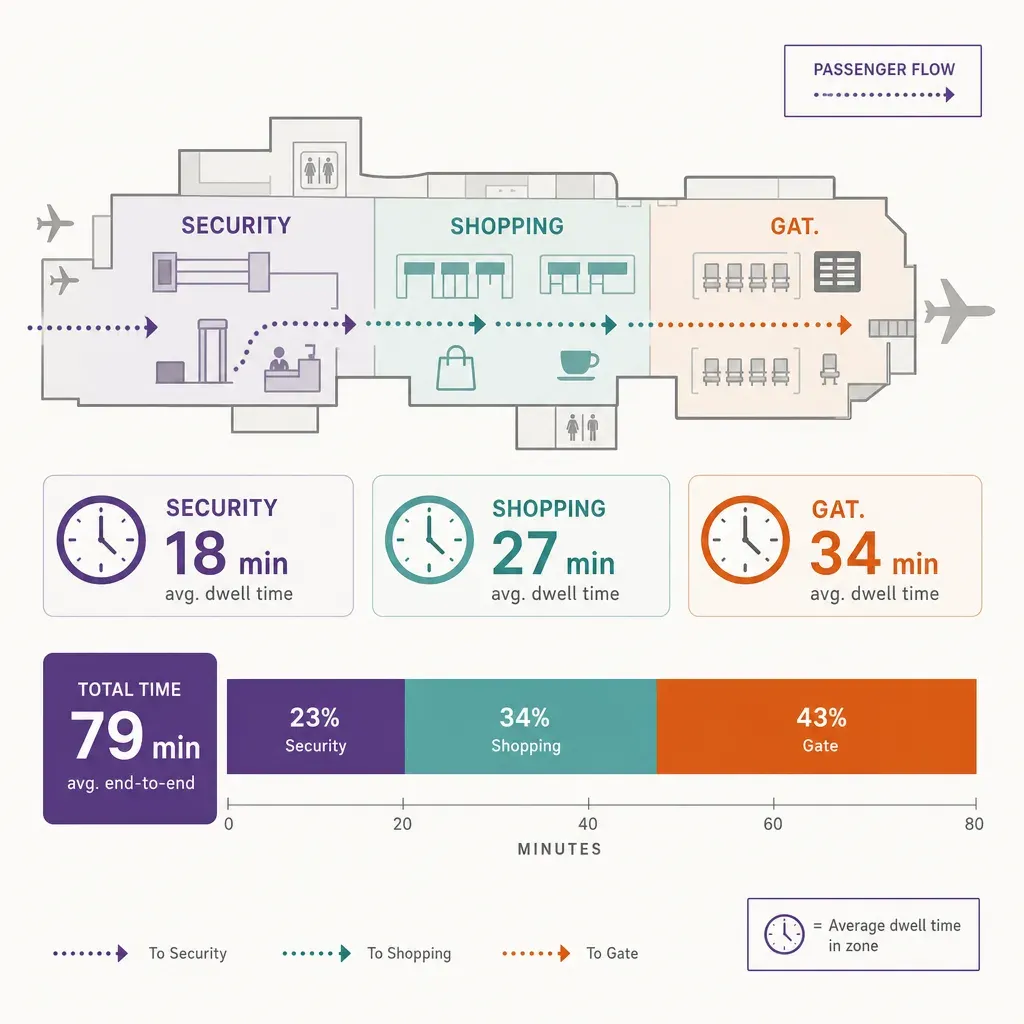
Most airport operators talk about gate dwell as if it were one figure. In practice the airside experience breaks into several distinct zones, each with its own time budget and its own variance drivers. A passenger does not spend their dwell time uniformly. They move from the security exit, through the retail concourse, into a gate hold area, and possibly into a lounge or a restroom corridor along the way. A useful dwell analysis is a typology, not a single number.
This piece sets out a working typology: what typical dwell looks like in each zone, what drives the variance, and how to interpret a measured dwell against the planning assumptions an airport already runs. The ranges in this piece are illustrative, drawn from publicly discussed terminal-planning rules of thumb. They are not Ariadne-measured results, they are not a study, and any single terminal's measured dwell will sit differently inside or outside these ranges depending on its layout, its passenger mix, and its schedule.
The five zones inside the airside dwell
Once a passenger clears security, the airside experience is best broken into five zones for dwell purposes. Each one earns its own measurement line, because each one is driven by something different.
1. The security exit funnel
The first few minutes after the checkpoint are functional. Passengers re-pack laptops and liquids, re-buckle belts, and look for the first directional sign. Dwell in this zone is typically short, often only a couple of minutes, and the main thing that pushes it up is queue release behaviour at the checkpoint. When security clears passengers in bursts, the recovery zone briefly fills and the average dwell ticks up. When the checkpoint runs at a steady tempo, the zone empties as fast as it fills.
If the security exit dwell is rising on a given day and queue release is steady, the cause is almost always downstream: passengers cannot move into the retail concourse because the first commercial choke point (a duty-free funnel, a centre walkway crossing) is blocked. Reading the security exit dwell on its own misses this. Reading it alongside the concourse dwell finds the cause.
2. The retail concourse and duty-free
The retail concourse is where most of the airside dwell budget gets spent in a hub terminal, and it is the zone with the widest range of typical values. Passengers walking through a forced duty-free path on the way to satellite gates can spend anywhere from a few minutes (a hurried connection) to twenty or thirty minutes (an early international departure with a confident traveller and a strong shop). The wide range is not noise. It is the signal: dwell here is driven by passenger purpose, available time, and the strength of the retail offer relative to the route.
A useful measurement breaks this concourse into entry, central, and gate-side sub-zones. A passenger who lingers in the central sub-zone is browsing. A passenger who walks through fast and dwells at the gate-side end is using the concourse as a corridor. Those two patterns look identical in a single concourse dwell average and very different in a sub-zoned one. The commercial implication is direct: a concourse with high overall dwell but most of it concentrated at gate-side is not converting browsing into purchase, even if the headline number looks healthy.
3. The gate hold area
Gate hold dwell is the time a passenger spends seated or standing in the immediate gate area before boarding starts. The base shape is set by the airline's boarding policy and the scheduled gate-open window, not by passenger behaviour. A long-haul departure with a 60-minute boarding window pulls the typical hold dwell up. A short-haul turn with a 25-minute window pulls it down.
On top of that base, two things move it: passenger anxiety about missing the flight (which inflates hold dwell at the expense of concourse dwell) and gate change frequency. Terminals with frequent late gate changes train passengers to arrive at the gate early, which shifts dwell out of the retail concourse and into a zone that earns nothing for the operator. A measured rise in gate hold dwell alongside a measured fall in concourse dwell, with no schedule change, usually points back at operational reliability rather than at passenger behaviour.
4. The lounge
Lounge dwell is a small fraction of total airside passengers and a large fraction of high-value passengers. The typical pattern is bimodal: a short visit (under thirty minutes) by passengers who came for the lavatory and a quick drink, and a long visit (often over an hour) by passengers who treat the lounge as their whole pre-flight experience. Mixing those into a single average loses both signals.
From a terminal-wide dwell perspective, the lounge matters because it is a substitute zone for the retail concourse. A passenger eligible for a lounge and confident in the schedule will spend their discretionary dwell there rather than in a paid retail context. A growth in lounge-eligible passengers without lounge capacity to match will, all else equal, show up as concourse dwell rising and concession spend per passenger falling.
5. Restroom corridors and circulation
Restroom corridors and circulation routes are not usually thought of as dwell zones, and the average is correctly short. But the measurement matters because a rising dwell in a restroom corridor is one of the cleanest early indicators of capacity stress in the surrounding area: passengers queueing, fixtures out of service, or a gate cluster oversubscribed for the available facilities. A terminal that measures circulation dwell catches these before they show up in passenger complaints. A terminal that does not measure them catches them after.
What drives the variance
Two terminals with identical layouts and identical passenger volumes can post very different gate dwell numbers, and the reasons are usually structural rather than behavioural. The dominant drivers are well known to airport planners and worth stating in one place.
Hub versus origin and destination
Origin and destination passengers arrive at the terminal from outside, are unfamiliar with the building, and tend to clear security with more time in hand. Their airside dwell skews longer and more variable. Connecting passengers arrive from airside, know the building well, and run on a tighter clock between flights. Their airside dwell skews shorter and tighter, and is dominated by walking distance between gates. A terminal with a heavy connecting mix will read a shorter average dwell than a terminal with the same flight schedule and a heavy origin-and-destination mix, and the difference is mostly composition, not behaviour.
Short-haul versus long-haul
Long-haul departures pull dwell up across all zones. Passengers arrive earlier, lounges fill earlier, retail browsing is longer, and the gate hold window is wider. Short-haul departures compress the same sequence. A satellite that serves a 70:30 short-haul mix and a satellite that serves a 30:70 short-haul mix will sit in very different parts of the typical-dwell range, and reporting them under one number averages out the planning value.
Time of day
Early morning departures sit at the short end of the dwell range. Passengers arrive close to gate close, retail is partly shut, and lounges run at reduced service. Late morning to mid-afternoon departures sit at the longer end, when passengers have more buffer and retail and F&B are at full strength. Late evening departures shorten again, especially on red-eye banks where lounges have closed and passengers are willing to wait at the gate. A daypart-aware dwell read separates these. A 24-hour average does not.
Schedule reliability
Terminals with frequent delays and gate changes train passengers into defensive behaviour. The measurable consequence is that dwell shifts out of the retail concourse and into gate hold and restroom corridors, which depresses concession revenue per passenger without the total dwell budget actually changing. A measured drop in retail concourse dwell with no change in scheduled flights is often a delay-and-reliability story before it is a commercial-offer story.
How to interpret a measured dwell
Once a terminal is measuring airside dwell properly, the question becomes what to do with the number. The illustrative ranges above are starting points, not targets. The interpretation that delivers operating value sits in three steps.
- Read the zones, not the total. A single "airside dwell of 47 minutes" is too coarse for any decision. The same total can sit on a healthy retail concourse with short gate hold, or on a short concourse with long gate hold, and those two terminals need opposite actions. The first measurement line worth installing is the breakdown into the five zones above.
- Control for passenger mix before comparing periods. Year-on-year dwell comparisons that do not control for hub-versus-origin-and-destination mix and for long-haul share usually report passenger composition as if it were operational performance. The fix is straightforward in principle: report dwell within mix segments first, then aggregate.
- Pair dwell with throughput. A long dwell at a full gate hold is a different operational situation from a long dwell at a half-full gate hold, even though the dwell number is identical. Concession revenue per passenger only makes sense when concourse dwell is read alongside concourse throughput. The metric that travels well across reports is dwell-by-zone joined to passengers-by-zone over the same daypart.
Where the measurement comes from
Most of what is described above only becomes possible when the count and the dwell at each zone are themselves reliable. Three properties matter.
- Zone-level dwell, not just door counts. A single throughput line at the security exit and another at the gate door cannot reconstruct what happened in between. The measurement has to track the passenger through the retail concourse, gate hold, lounge, and circulation corridors as zones in their own right.
- Group sizing, not just headcounts. Families and travel parties move together, dwell together, and shop together. A counter that splits a four-person family into four independent counts misreads dwell as well as throughput, because the group's dwell shape is one shape, not four.
- No personal data at capture. Airports operate under strict passenger-privacy expectations, and the cleanest position to defend with a board or a data protection officer is one where no images, no faces, and no device identifiers are captured by default.
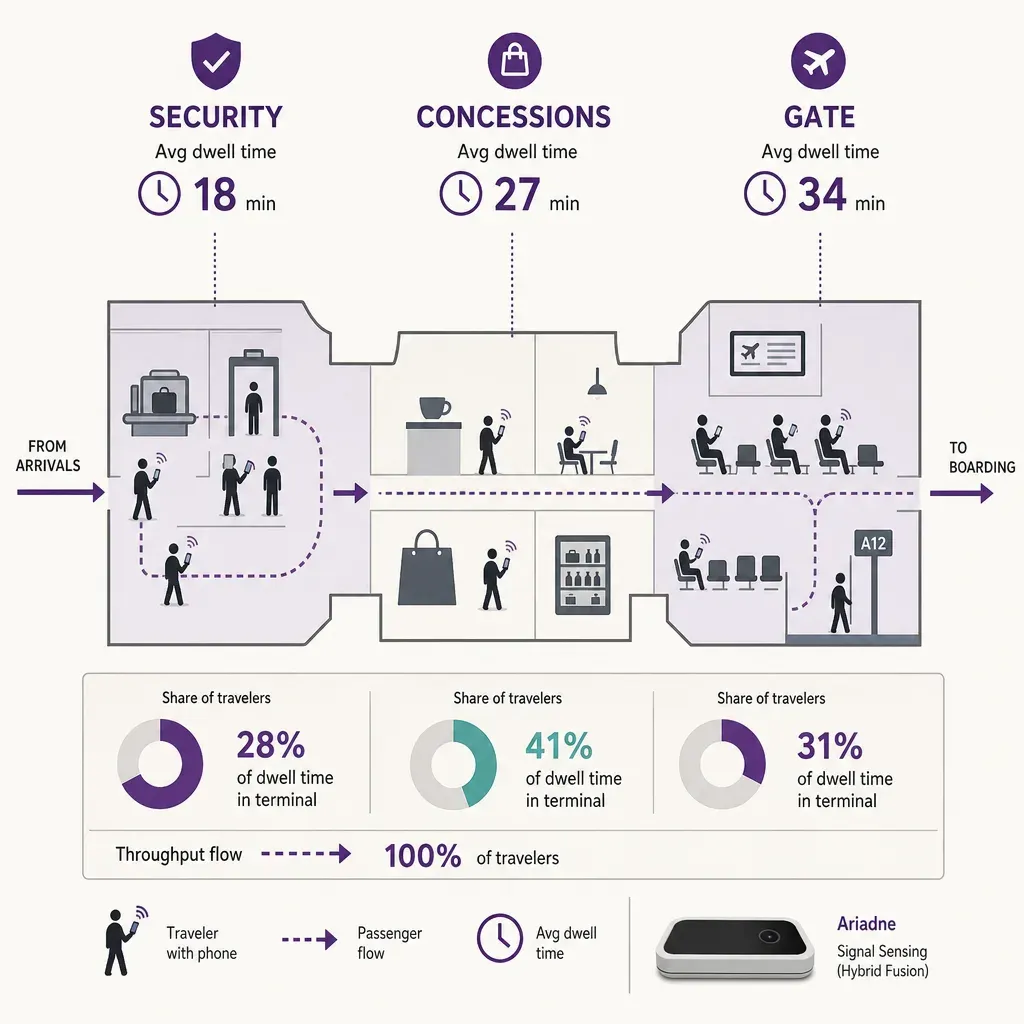
Ariadne measures this with Hybrid Fusion, its patented camera-free method. Time-of-Flight depth sensing counts every visitor at the entrances, capturing geometry rather than images, while patented phone signal sensing follows movement through the interior, detecting the signals a phone emits even in airplane mode. The sensor streams both feeds to Ariadne, where Hybrid Fusion combines them into one trajectory per visit and computes counts, dwell, and paths. The streams carry no identifier: no MAC address, no device ID, no biometric data, and no camera is involved. Identifiers are stored only when a visitor explicitly opts in, which keeps the method GDPR-friendly and outside biometric territory.
For airside dwell reporting, Ariadne people counting contributes the parts that have to be right first: zone-level entries and exits, group-aware passenger counts, live occupancy at each gate hold and concourse sub-zone, and dwell distributions per zone joined to flight schedule data downstream in the analytics environment a terminal already uses. The sensor lineup is documented at the Ariadne hardware page, and the data handling is set out in the privacy policy.
FAQ
What is a typical airport gate dwell time?
There is no single typical number that survives contact with a real terminal. The illustrative pattern across most planning discussions is that total airside dwell for a departing passenger sits between roughly 40 and 90 minutes depending on hub mix, long-haul share, and daypart, with the retail concourse holding the largest portion in long-haul morning departures and the gate hold area holding the largest portion in short-haul evening departures. Use those ranges as a sanity check, not a target. The number that matters at your terminal is whatever your own zone-level measurement, controlled for passenger mix, tells you it is.
Why does my measured dwell differ from published industry numbers?
Three reasons usually account for it. First, definitions: some sources measure from check-in, some from security exit, some from terminal entry, and the differences are large. Second, passenger mix: a connecting-heavy terminal naturally reads shorter than an origin-and-destination one. Third, daypart: a 24-hour average compresses very different morning and evening patterns into one number. A measured dwell that looks off against a published benchmark is usually a definition or composition gap, not an operational gap.
Do you need cameras to measure airside dwell?
No. Ariadne counts with Hybrid Fusion: Time-of-Flight depth sensing plus patented phone signal sensing, never cameras. Time-of-Flight captures geometry rather than images, and signal sensing captures no MAC address by default, so the measurement involves no video, no faces, and no biometric data.
Can dwell be reported per gate, per concourse, and per zone separately?
Yes, and for any serious operational use it has to be. With sensors placed across the airside footprint, each gate hold area, concourse sub-zone, lounge, and circulation corridor becomes its own measurement zone, with its own entry count, live occupancy, and dwell distribution. A single airside average is not enough to act on. The per-zone breakdown is what lets a terminal separate a commercial story from a punctuality story when the headline number moves.
How does gate dwell relate to concession revenue per passenger?
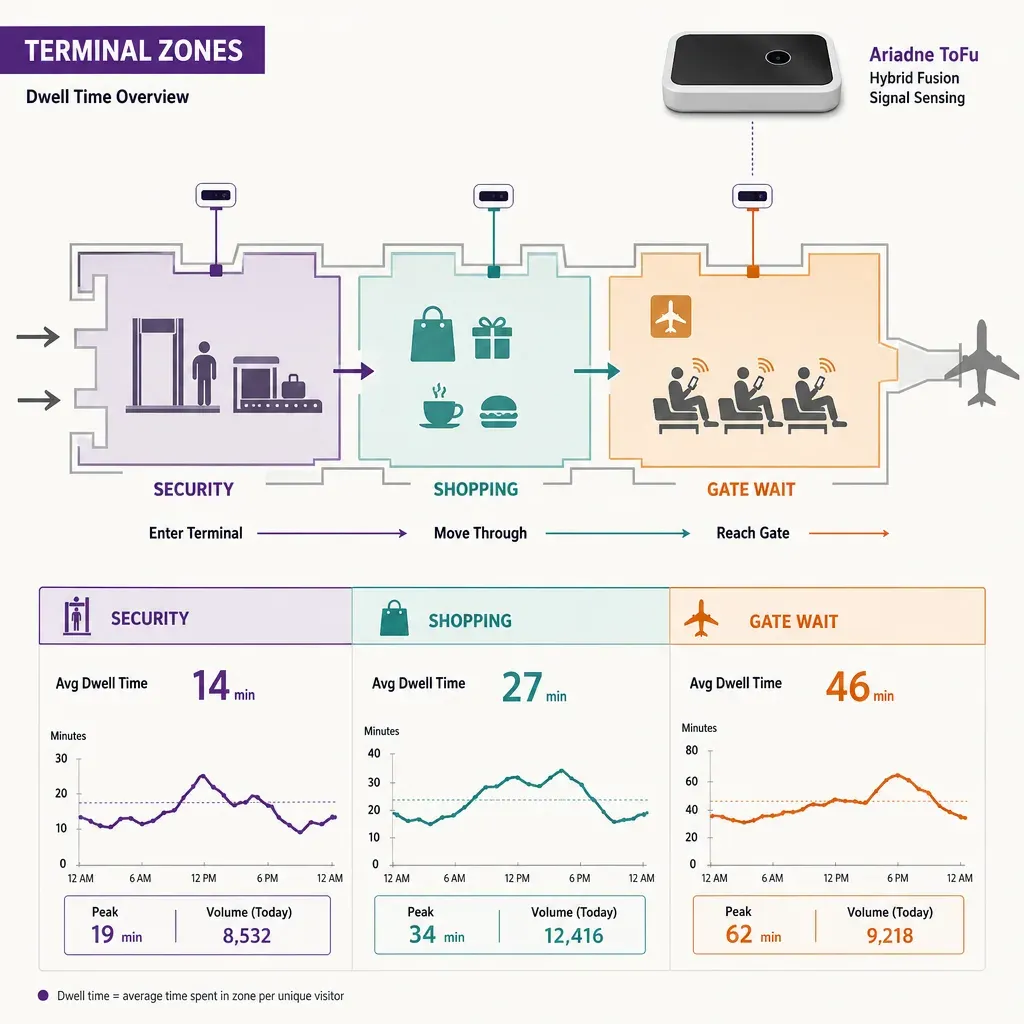
Concession revenue per passenger is driven by retail concourse dwell, not by total airside dwell. A passenger spending 60 minutes airside but 50 of them at the gate hold contributes very little concession revenue. A passenger spending 45 minutes airside with 30 of them in the retail concourse contributes substantially more. Reporting concession revenue against retail concourse dwell, not against total dwell, is what makes the metric defensible at lease renewal.


