
Computer vision and time-of-flight are the two technologies most often pitched for "smart" people counting, and they sound similar enough that buyers treat them as interchangeable. They are not. They capture different things, they fail in different ways, and they put very different compliance obligations on you. This compares them fairly on the four things that decide a purchase: accuracy, privacy, cost, and install.
What is computer-vision counting? What is time-of-flight counting?
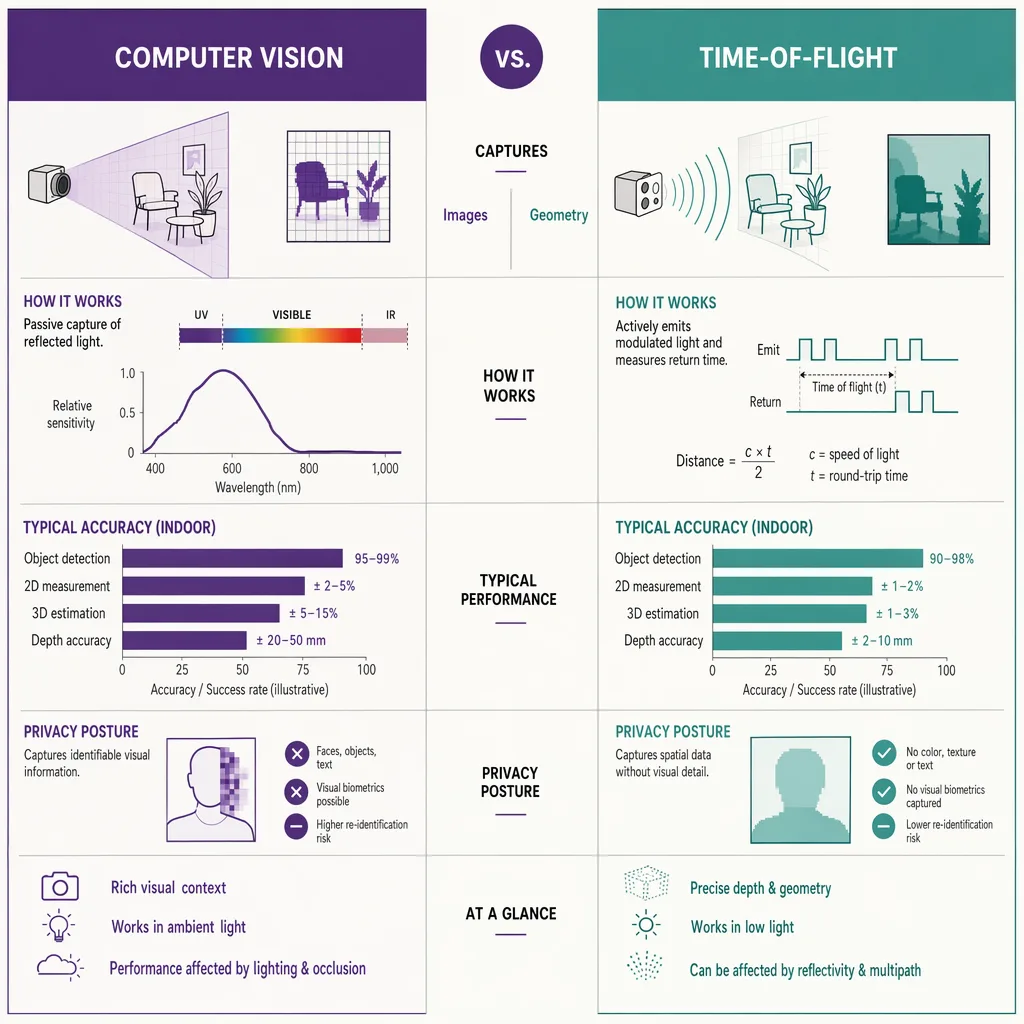
Computer-vision counting uses a camera and a model that detects and tracks people in the image. The sensor captures pictures, and software decides which shapes are people.
Time-of-Flight counting uses a sensor that fires a light pulse and times its return to build a depth map of the scene. The output is the geometry of shapes, not a photograph.
Both can be accurate. The difference is what sits between the sensor and the count.
Accuracy: how each handles the hard cases
On a calm, well-lit, single-file doorway, both methods count well. The split appears on the hard cases:
- Groups. Both can separate people, but depth has an inherent advantage because it measures volume, not just a flat outline.
- Low light. Computer vision degrades as light drops, because a camera needs light to see. Time-of-Flight supplies its own infrared pulse and is largely unaffected.
- Spoofing. A poster or a reflection can fool a flat image. Depth rejects anything without real volume.
Neither is universally more accurate. In bright, controlled conditions they are close; as conditions get harder, depth tends to hold up better.
Privacy: what each captures
This is the row that often decides the purchase. A computer-vision system captures images of the people it counts. Even if those images are processed and discarded quickly, the system is, at the point of capture, recording pictures of identifiable people, which brings GDPR obligations and, where biometric processing is involved, EU AI Act exposure: biometric identification and categorisation are listed as high-risk under Annex III of Regulation (EU) 2024/1689, and certain biometric categorisation is restricted under Article 5. A Time-of-Flight sensor captures depth geometry, not faces, so there is no image of a person to manage in the first place.
The practical effect: the camera route adds compliance work, a DPIA in many cases, and a harder conversation with a works council. The depth route avoids most of it by capturing less.
Cost and install
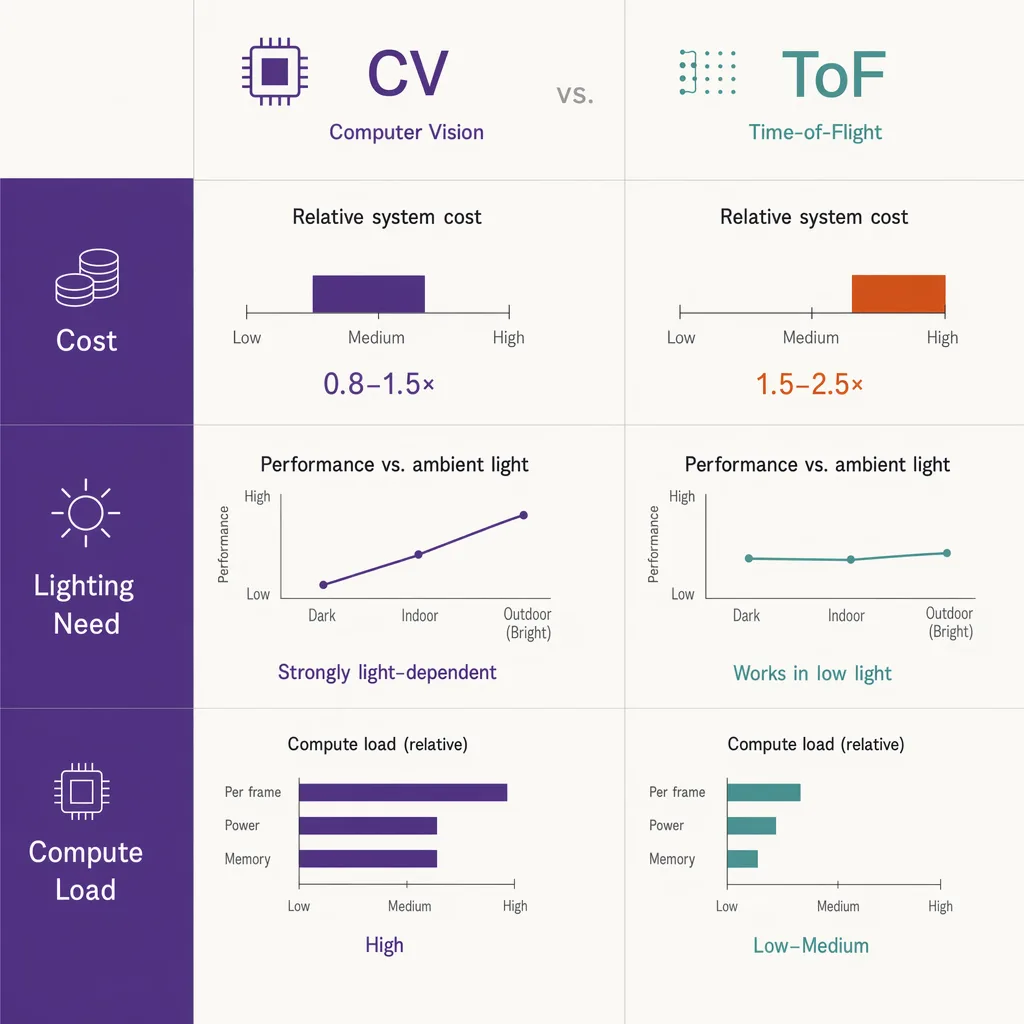
- Compute. Running detection models on video is heavier than processing a depth map, which can affect hardware cost and power.
- Lighting infrastructure. Cameras may need consistent lighting to hit their rated accuracy. ToF does not.
- Mounting. Both have working ranges to check against your ceiling height and door width.
Where Ariadne sits
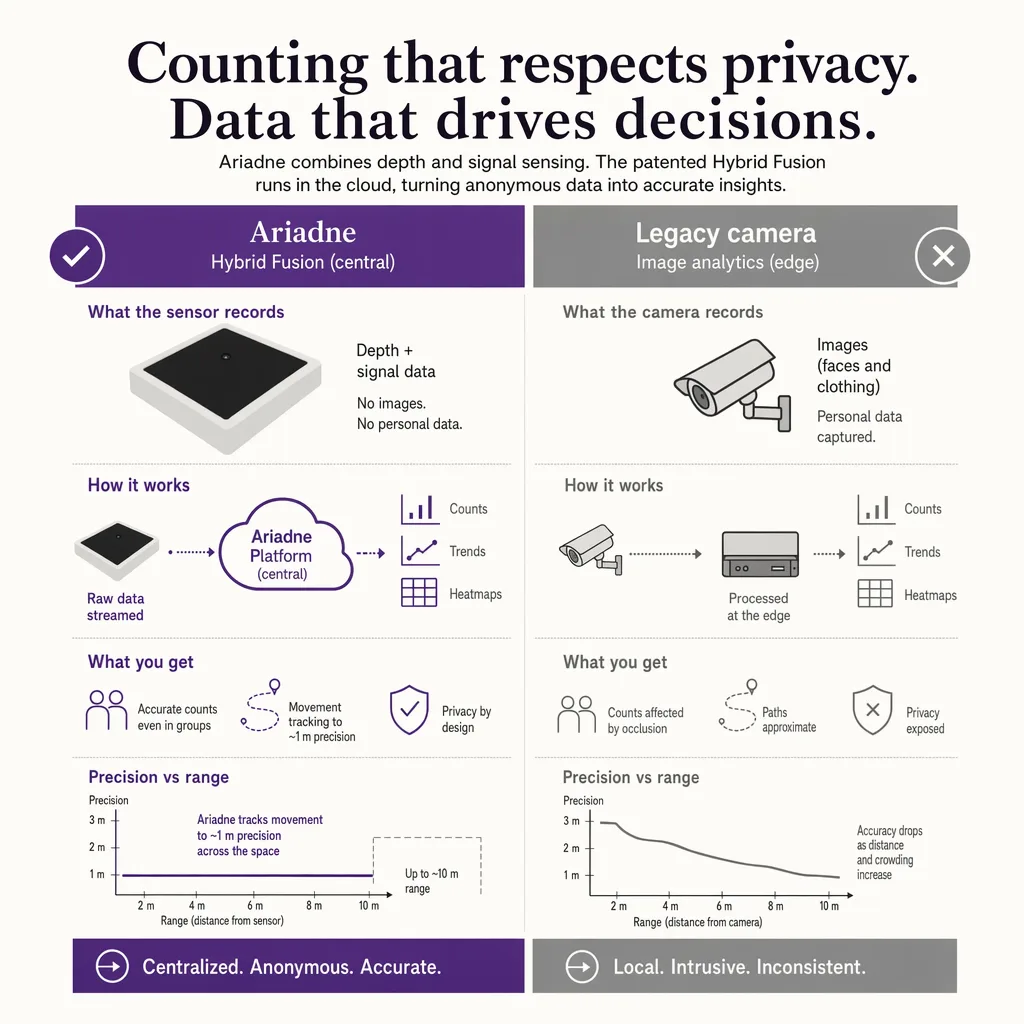
Ariadne does not use computer-vision cameras for counting. Ariadne measures this with Hybrid Fusion, its patented camera-free method. Time-of-Flight depth sensing counts every visitor at the entrances, capturing geometry rather than images, while patented phone signal sensing follows movement through the interior, detecting the signals a phone emits even in airplane mode, and tracks that movement to about one-metre precision. The sensor streams both feeds to Ariadne, where Hybrid Fusion combines them into one trajectory per visit and computes counts, dwell, and paths. The streams carry no identifier: no MAC address, no device ID, no biometric data, and no camera is involved. Identifiers are stored only when a visitor explicitly opts in, which keeps the method GDPR-friendly and outside biometric territory.
Related reading
- Sensor fusion for people counting
- Time of Flight people counters: the buyer guide
- 3D people counting explained: stereo, depth, and accuracy
FAQ
Is time-of-flight better than computer vision for people counting?
For privacy and low-light performance, ToF has clear advantages. For raw detail in good light, computer vision is strong. The right choice depends on your conditions and your compliance appetite.
Does a time-of-flight sensor record video?
No. It records a depth map of shapes, not images.
Is computer-vision people counting GDPR compliant?
It can be, but because it captures images it usually requires more compliance work, often including a DPIA.
Which is more accurate in the dark?
Time-of-Flight, because it provides its own light. Cameras need adequate ambient light.
---


