
A casino floor is designed to disorient gently. There are no clocks, no windows, and no daylight cues, and the layout is built to keep players moving and engaged. That design works against the operator in one respect: it is genuinely hard to know, from the floor itself, where players actually go, which sections fill and when, and where the dead corners are quietly losing revenue. Surveillance cameras blanket the floor, but they are a security and compliance system under tight, separate controls, not an operations analytics tool, and they were never meant to answer "which entrance feeds the slots, and when does the east bank empty out."
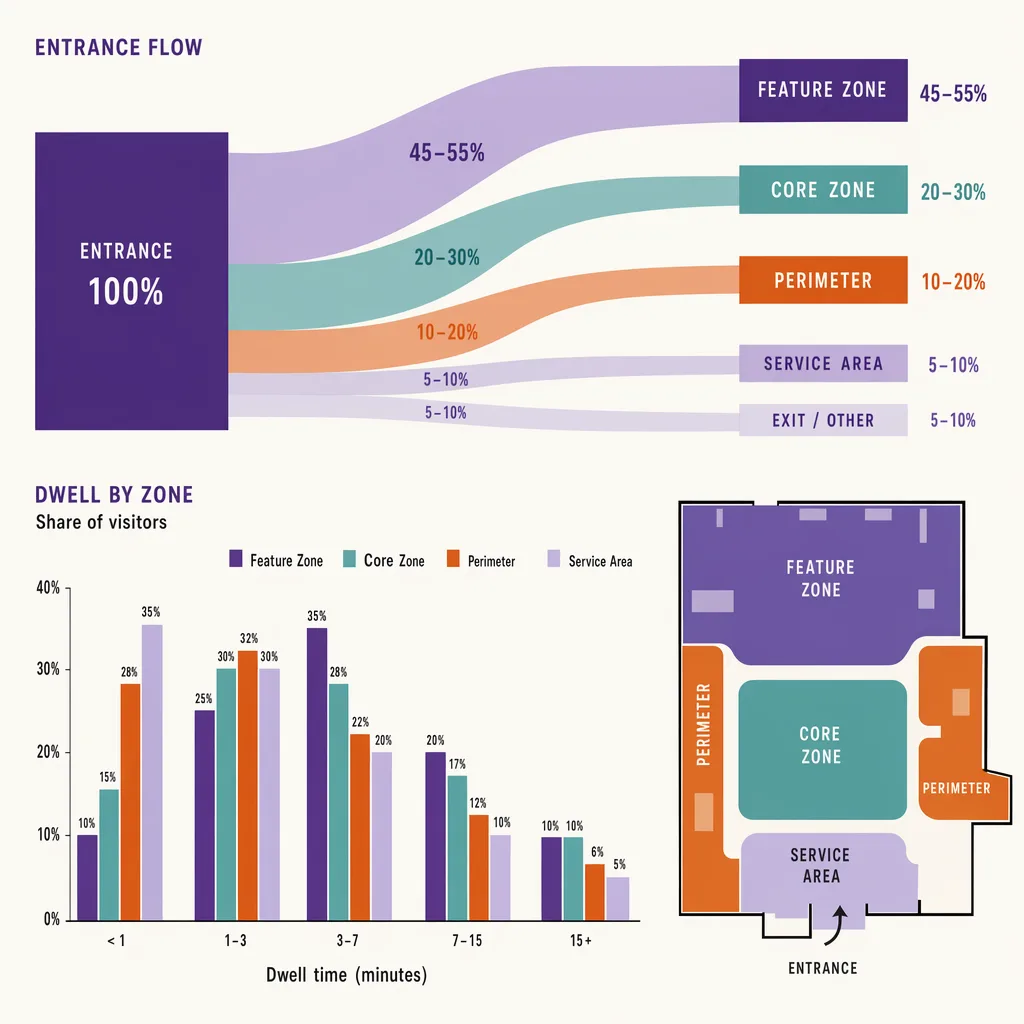
Floor traffic analytics answer exactly that. They map how players move between zones, how table and slot areas fill through the day and night, and where dwell concentrates. Because the counting is camera-free and carries no identity, it sizes traffic and dwell by zone without touching the surveillance or player-tracking systems that sit under their own regulatory regime. This guide covers what that data tells a casino, why it is deliberately separate from surveillance, and how it informs layout and staffing.
What does floor traffic data tell a casino?
Floor traffic data shows where players actually move on a gaming floor: which entrances feed which sections, how table and slot zones fill through the day and night, and where the dead corners are. That informs floor layout, machine placement, and how many staff to put on each section by hour. Because the data is camera-free and carries no identity, it sizes traffic and dwell by zone without touching surveillance or player-tracking systems, which sit under separate, tightly regulated controls.
The sections below work through zone flow, dwell by zone, the hard line between this and surveillance, and the layout and staffing decisions the data supports.
The casino pain point: a huge floor with no daylight cues, where dead zones quietly lose revenue
A gaming floor is a large, deliberately uniform space. The lighting is constant, the layout is dense, and the whole environment is engineered to remove the cues that would normally tell anyone, player or staff, how time and traffic are moving. For the operator, that means the floor's own rhythm is hard to read. A section near a side entrance might run hot while a back corner sits dead, and without measurement the operator learns this slowly, from takings reports that lag by days and cannot say why a zone underperformed.
Dead zones are the cost. Floor space in a casino is expensive and finite, and a corner that players rarely reach is machines and tables earning below their footprint. The question is not just "which machines win" but "which machines do players even walk past," and the floor itself does not answer it. A traffic map by zone turns the invisible flow into something an operator can see and act on, which is the same logic behind reading a floor heatmap in retail, applied to a far larger and more deliberately featureless space.
There is a subtler version of the dead-zone problem that performance data alone hides. A machine in a low-traffic corner can show weak takings, and the obvious read is to swap the title. But if almost no players walk past it, the title was never the issue, and a new machine in the same dead corner will fail the same way. Traffic data separates the two diagnoses that takings conflate: a machine that players reach and reject, which is a product problem, from a machine that players never reach, which is a placement problem. An operator who acts on takings alone keeps re-merchandising the same dead spot; one who reads traffic first knows whether to change the machine or change the route that should bring players to it.
Zone flow: which entrances feed which sections, and where players stall
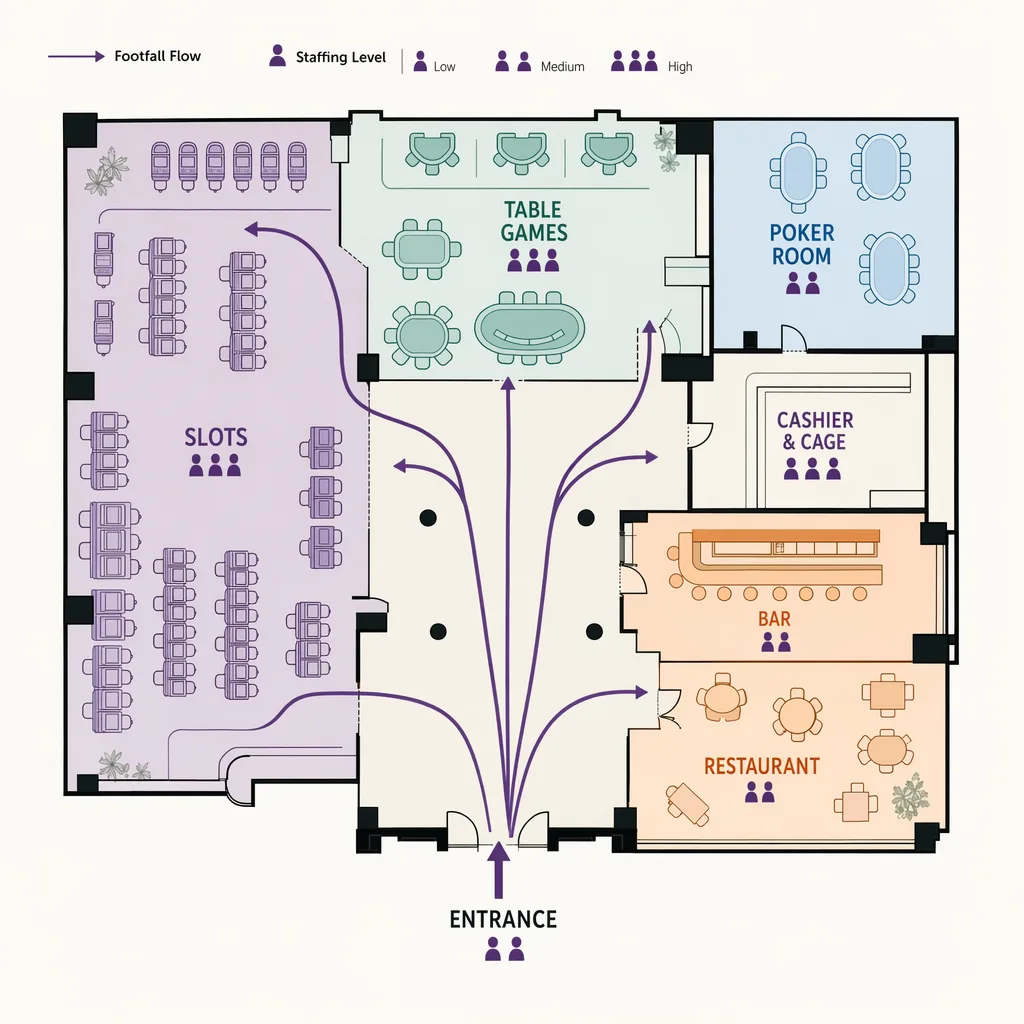
The first thing floor traffic data reveals is the geography of movement. A casino usually has multiple entrances, from the street, the hotel, the car park, the restaurants, and each feeds the floor differently. Mapping which entrance pushes traffic into which section shows how the building actually channels players, which is rarely how the floor plan assumes it does.
From there, the flow shows where players stall and where they pass through. A wide aisle that everyone walks down but nobody stops in is a transit corridor, not a gaming zone, and the machines lining it may be wasted there. A pinch point where players cluster is either a popular draw or a bottleneck, and the difference matters for both revenue and comfort. Reading the flow between zones over the day and night, casinos run around the clock, turns the floor from a fixed plan into a measured system you can adjust.
The entrance-to-section mapping is where the most actionable surprises tend to surface. Many casinos assume the main street entrance is the dominant feed and lay out the prime floor accordingly, when in practice the hotel corridor or the car-park entrance may push more players in at the hours that matter. If most evening traffic enters from the car park and immediately hits a wall of low-performing machines before it ever reaches the prime banks, the floor is spending its best first impression on its weakest product. Knowing which door feeds which section, and at which hours, lets an operator put the draw where the traffic actually arrives, rather than where the architect assumed it would.
Dwell by zone: tables vs slots vs F&B vs cashier
Counts tell you how many; dwell tells you how long. The two together are what make zone analytics useful on a gaming floor. A section that draws high traffic but short dwell is a pass-through; a section with lower traffic but long dwell is where players settle and play. Those are very different signals for how a zone is performing and how it should be staffed.
Comparing dwell across the table area, the slot banks, the food and beverage outlets, and the cashier surfaces practical patterns. Long queues building at the cashier at certain hours is a staffing signal. F&B dwell that peaks at a different time from the gaming peak tells you when to staff the bar against the tables. Slot banks with high dwell are the engine of the floor; ones with traffic but no dwell may be poorly placed or poorly matched to the players who reach them. Dwell is the dimension that separates a busy zone from a productive one.
It is worth being precise about what dwell can and cannot say here. Anonymous dwell tells you how long the crowd lingers in a zone, which is a strong proxy for engagement and a useful staffing input. It does not tell you what any individual player did, how much they wagered, or who they are, and it is not a substitute for the gaming-system data that records play at carded machines and tables under its own regime. The right read is that dwell flags where to look: a bank with high anonymous dwell but weak performance on the gaming system is a different problem (machine mix, denomination, an outdated title) from a bank with neither traffic nor dwell (placement, sightline, a dead corner). The traffic layer and the gaming-performance layer answer different questions, and keeping them distinct is both a privacy discipline and an analytical one.
Why this is separate from surveillance and player tracking
This is the line that has to be clear. A casino already runs two heavily regulated systems that watch the floor: surveillance, for security and gaming-integrity compliance, and player tracking, which identifies carded players by consent for loyalty and play analysis. Floor traffic analytics is neither, and must not be confused with either. It does not identify players, it does not feed surveillance, and it does not replace either system. It measures anonymous flow and dwell by zone, full stop.
Ariadne measures this with Hybrid Fusion, its patented camera-free method. Time-of-Flight depth sensing counts every visitor at the entrances, capturing geometry rather than images, while patented phone signal sensing follows movement through the interior, detecting the signals a phone emits even in airplane mode, and tracks that movement to about one-metre precision. The sensor streams both feeds to Ariadne, where Hybrid Fusion combines them into one trajectory per visit and computes counts, dwell, and paths. The streams carry no identifier: no MAC address, no device ID, no biometric data, and no camera is involved. Identifiers are stored only when a visitor explicitly opts in, which keeps the method GDPR-friendly and outside biometric territory.
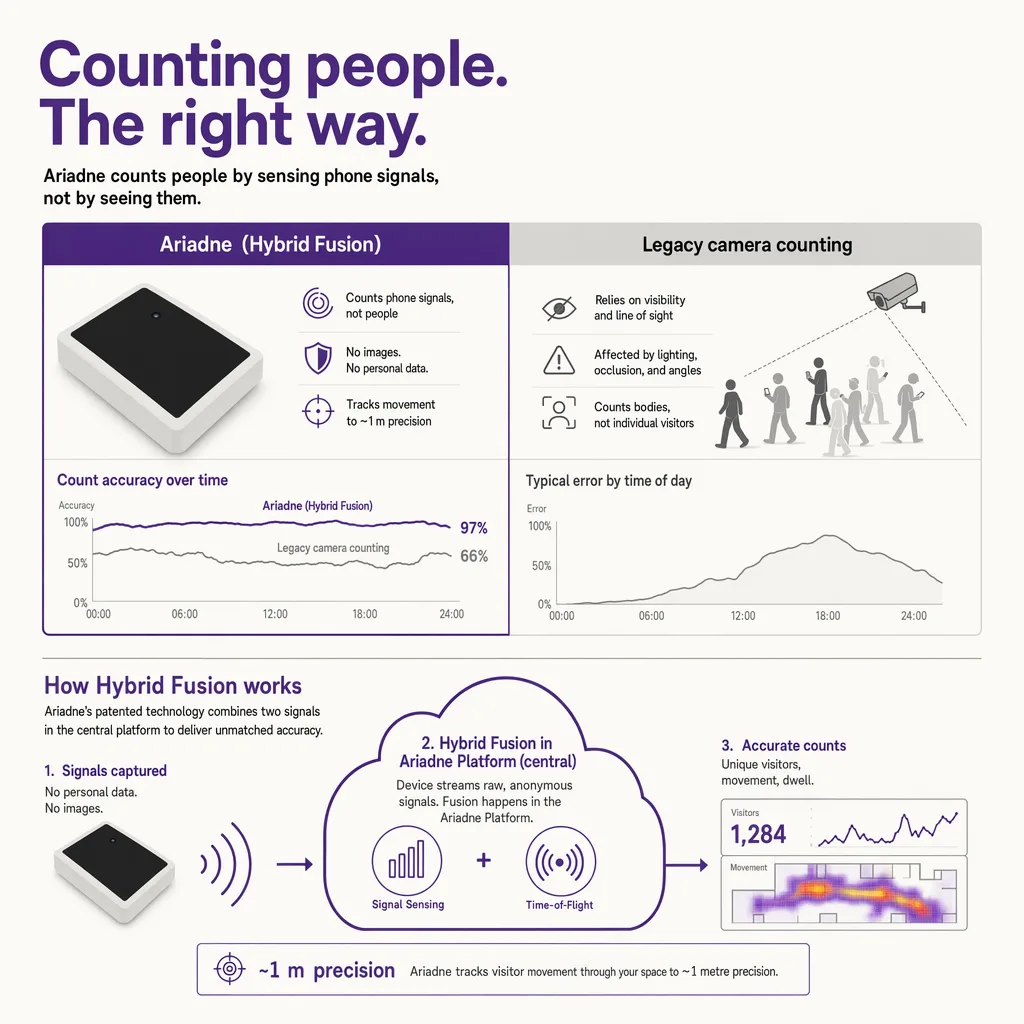
Because the method captures no image and no identifier, it is structurally non-biometric, no identity, which is exactly what keeps it separate from surveillance. It does not see faces, so it cannot be a security camera. It does not hold an identity, so it cannot be player tracking. It answers an operations question, how the anonymous crowd moves and lingers, and it stays out of the legally distinct territory that surveillance and player tracking occupy. This is not anonymising data after capture; no personal data is collected at the sensor in the first place.
Staffing and layout decisions from the data
The data is worth collecting because it changes real decisions, in the spirit of acting on flow data.
Layout and machine placement. Zones with high traffic but low dwell are candidates for re-merchandising or for moving machines that perform better elsewhere. Dead corners flagged by low traffic are the first place to test a new attraction, a relocated bank, or a route change that pulls players in. The discipline that makes this pay is measuring the change. A casino that relocates a bank, moves an attraction toward a dead corner, or reroutes an aisle can read the traffic to that zone before and after and see whether the intervention actually pulled players in, rather than judging it on the next monthly takings report, which folds in too many other variables to attribute cleanly. That before-and-after read turns floor changes from expensive guesses into tested ones.
Section staffing. Dealers, attendants, and cashier staff can be matched to the hours each section actually peaks, which on a 24-hour floor with shifting day and night patterns is a more useful guide than a fixed roster. This is the same staffing each section discipline used in large retail, applied to a floor that never closes and whose peaks move around the clock. The cashier is the sharpest case: a queue to cash out is the last thing a player experiences before they leave, and a queue there at a predictable nightly hour that the roster never covers is a poor final impression that is entirely fixable once the pattern is measured.
Opening and closing sections. A floor that runs 24 hours rarely needs every table and every bank live at 04:00. Traffic and dwell by zone show which sections genuinely hold players through the quiet overnight hours and which sit empty, so an operator can consolidate live gaming into the zones that draw, close or re-cover the dead ones, and concentrate the limited overnight staff where the few remaining players actually are. That is a labour and an atmosphere decision at once: a handful of players spread thinly across a vast dim floor feels worse than the same players gathered in a section that is kept lively.
The throughline is that a casino floor is too large and too deliberately featureless to manage by intuition, and traffic analytics give the operator a measured map without crossing into the surveillance and identity systems that are governed separately.
FAQ
Is casino floor traffic analytics the same as surveillance?
No, and the distinction is deliberate. Surveillance is a regulated security and gaming-integrity system that records identifiable footage. Floor traffic analytics is camera-free, captures no image and no identity, and measures only anonymous flow and dwell by zone. It does not feed, replace, or duplicate surveillance.
Does it track individual players?
No. It is not player tracking. Player-tracking systems identify carded players by consent; floor traffic analytics holds no identity at all. It measures how the anonymous crowd moves and lingers, not who anyone is, and captures no personal data at the sensor.
What does the data actually show?
Which entrances feed which sections, how zones fill through the day and night, and where dwell concentrates across tables, slots, F&B, and the cashier. That reveals dead zones, transit corridors, and the hours each section peaks, which informs layout, machine placement, and section staffing.
How does counting work without cameras on a gaming floor?
Depth sensing at entrances measures the shapes of people passing through, and phone-signal sensing follows anonymous movement across the floor, fused centrally. No image is captured, so the system cannot function as a camera and is not part of the surveillance estate.
Can it help reduce dead zones?
Yes. By showing which corners players rarely reach, the data flags the floor space earning below its footprint. The operator can then test a relocated bank, a new attraction, or a route change and measure whether traffic to that zone actually improves.
Does dwell tell me how much a player wagered?
No. Anonymous dwell measures how long the crowd lingers in a zone, which is a proxy for engagement and a staffing input, not a record of any individual's play. Wager and play data come from the gaming systems at carded machines and tables, which run under their own regulated regime. The traffic layer flags where to look; the gaming-performance layer answers what happened there. They are kept deliberately separate.
Can it help run the overnight floor more efficiently?
Yes. On a 24-hour floor, traffic and dwell by zone show which sections hold players through the quiet hours and which sit empty, so an operator can consolidate live gaming into the zones that draw and concentrate limited overnight staff where the players actually are, rather than keeping the whole floor lit and covered for a thin crowd.
---


