
Most guidance on counting bikes stops at the sensor: which counter to buy, where to mount it, how it detects a wheel. That is the single-site question, and it is answered well elsewhere, including in the post on counting cyclists on a path. This post is about the layer above the sensor: the program. A city rarely needs one counter. It needs a coordinated effort across dozens of sites, run over years, that produces numbers a funder or an auditor will accept as evidence for spending on cycling infrastructure.
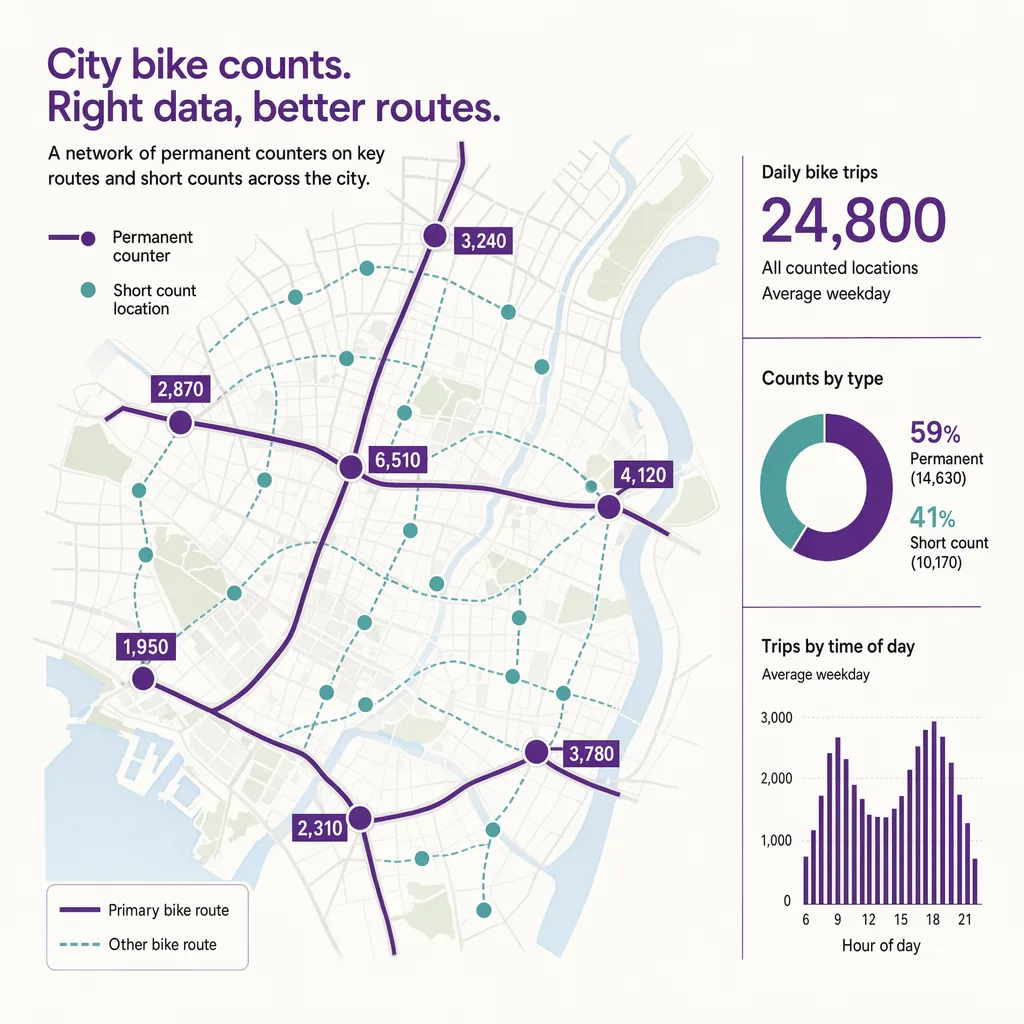
The difference between a scatter of counters and a program is design. A program decides how many permanent counters to run, how to rotate temporary ones, how to turn short counts into annual estimates, and how to fold the results into the case for new lanes and junctions. Get that design right and the data becomes an asset that compounds every year. Get it wrong and you have a pile of counts that no two of which are comparable.
How do cities count bicycles and build a bike-count program?
A bike-count program combines a small number of permanent counters that run all year with rotating temporary counts at many more sites. The permanent counters establish the seasonal and weekly pattern; the temporary counts are then factored up against that pattern to estimate annual traffic at each site without leaving a counter there forever. Cities site counters on key corridors, protected lanes, and junctions, calibrate them against a short manual count, and feed the results into active-travel funding cases and before-and-after evaluation of new infrastructure. The methods overlap with wider pedestrian counting methods, but the program design for cycling has its own logic, which the rest of this post sets out.
Permanent vs temporary counters: what each is for, and the right mix
The two counter types do different jobs, and a program needs both.
Permanent counters run continuously, all year, at a fixed set of sites. Their value is not the raw count at that one location; it is the pattern they reveal. A permanent counter shows how cycling rises and falls across the seasons, how weekday commuting differs from weekend leisure riding, and how a wet month compares to a dry one. That continuous pattern is the reference every other count in the program is measured against. Because they run forever, permanent counters are the more expensive commitment per site, so a program keeps their number small and chooses their locations carefully.
Temporary counters are deployed for a defined window, a week or a fortnight, then moved to the next site. Their value is breadth. A city cannot afford a permanent counter on every corridor, but it can rotate a handful of temporary units across many sites over a season and build a picture of relative use across the whole network. The catch is that a two-week count is a snapshot, and a snapshot taken in July says nothing on its own about the year. That is where the permanent counters earn their keep: they supply the pattern that turns a July fortnight into a defensible annual estimate.
The right mix is a small backbone of permanent counters on the most important and most representative corridors, supported by a larger rotating fleet of temporary counters covering the rest of the network over time. The backbone gives you the shape of the year; the fleet gives you coverage.
Where to site counters: corridors, protected lanes, junctions, and gaps
Siting decides whether the program measures what matters. A counter on a quiet back street produces a tidy number that answers no question anyone is asking. The sites worth measuring fall into a few categories.
Key corridors carry the strategic flows, the routes a city is trying to grow and the ones a funding case will cite. Protected lanes and new infrastructure need a counter precisely because you will want to prove what they achieved; a counter installed before construction gives you the baseline that makes the after-count meaningful. Junctions matter because they are where cyclists are most exposed and where design changes are most contested, so a count there supports both safety analysis and scheme evaluation. Network gaps, the missing links a city hopes to fund, are worth a temporary count too, because demonstrating latent demand on a route that does not yet exist is one of the harder evidence problems a cycling case faces.
The siting principle underneath all of these is representativeness. The permanent backbone in particular should reflect the range of the network, commuter and leisure, urban and suburban, so that the pattern it produces can be applied fairly to the temporary counts elsewhere. A backbone made entirely of city-centre commuter routes will misestimate a suburban leisure path badly.
Factoring short counts up to annual estimates
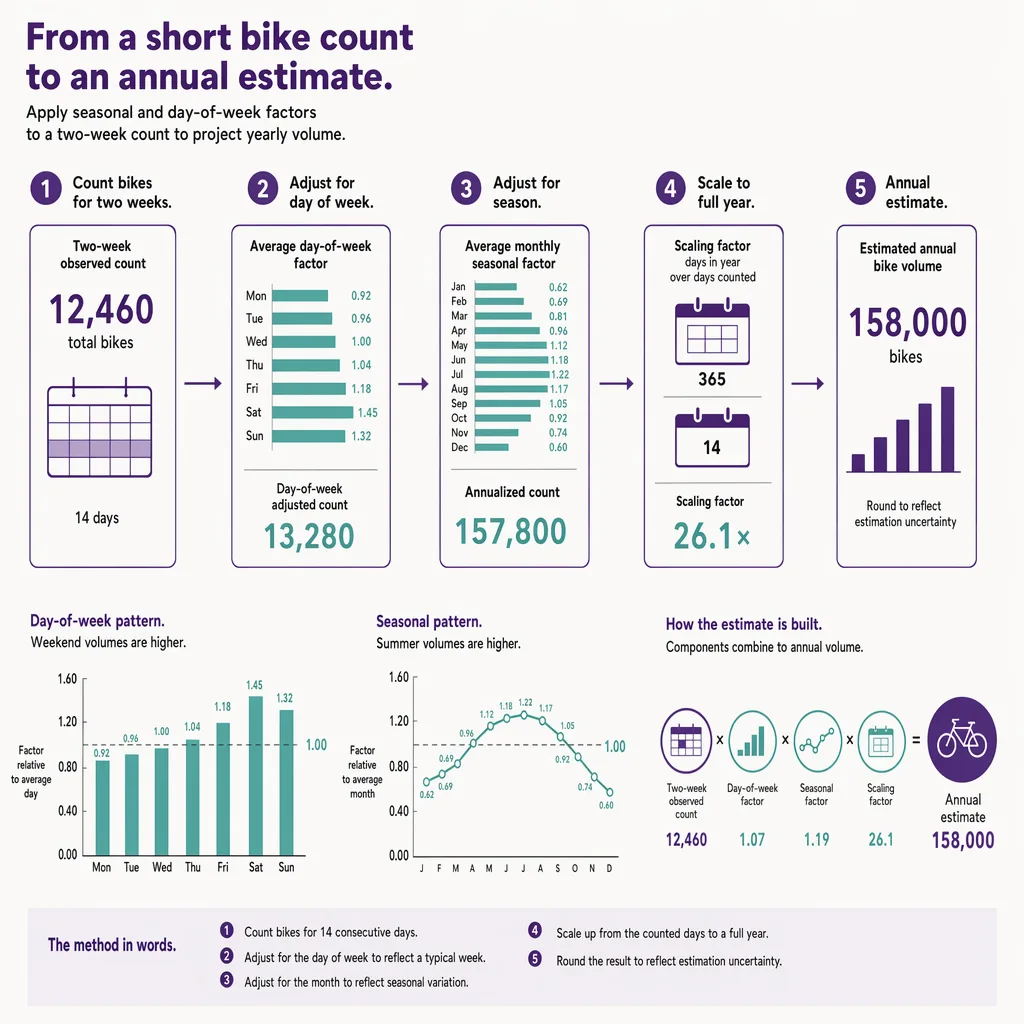
This is the step that separates a program from a collection of counts, and it is where the permanent counters pay off. A temporary counter gives you a raw total for its window, say a fortnight in September. On its own that number is not comparable to a fortnight measured in April at another site, because cycling volumes swing with season, day of week, and weather.
Factoring corrects for that. The permanent counters establish how a typical September fortnight relates to the full year, and that relationship is applied to the temporary count to estimate its annual figure. Done consistently across the whole fleet, factoring makes every site comparable to every other and to itself over time, which is the entire point of building a program rather than taking ad-hoc counts. National active-travel guidance in several countries publishes standard factoring methods for exactly this; where a city adopts one, the estimates become defensible against outside scrutiny because the method is documented and shared rather than invented in-house.
Two things make or break the factoring. The first is calibration: each counter should be checked against a short manual count at install, so its raw error at that site is known and corrected before factoring is applied to it, a point covered in the discussion of accuracy and calibration factors. The second is accounting for weather, because a wet counting window under-reads and a mild dry one over-reads; the seasonal pattern from the permanent counters helps, but the effect of how weather shifts counts is worth understanding directly when a short count lands in an unusual spell.
Counting bikes and pedestrians together where paths are shared
Many of the sites a bike-count program cares about are not cycle-only. Shared paths, riverside routes, and mixed public spaces carry cyclists and pedestrians together, and a program that counts only bikes on a shared path is measuring half the use. For evaluation and funding, the mode split itself is often the point: showing that a route serves both walkers and riders strengthens the case and shapes the design.
Counting a shared, open, public-space site brings the same constraints as any public-realm measurement. The location is outdoors, often unlit, and used by members of the public who did not opt into being recorded, so a camera raises the objections that public space always raises. A method that captures no image and works after dark fits these sites far better.
Ariadne handles mixed public-space measurement with the same camera-free method it uses everywhere. Ariadne measures this with Hybrid Fusion, its patented camera-free method. Time-of-Flight depth sensing counts every visitor at the entrances, capturing geometry rather than images, while patented phone signal sensing follows movement through the interior, detecting the signals a phone emits even in airplane mode, and tracks that movement to about one-metre precision. The sensor streams both feeds to Ariadne, where Hybrid Fusion combines them into one trajectory per visit and computes counts, dwell, and paths. The streams carry no identifier: no MAC address, no device ID, no biometric data, and no camera is involved. Identifiers are stored only when a visitor explicitly opts in, which keeps the method GDPR-friendly and outside biometric territory.
Turning counts into a funding case for active travel
The reason a program exists is usually money. Cycling infrastructure competes for public funds against many other calls on the budget, and the bids that win are the ones backed by evidence rather than aspiration. A bike-count program is the evidence engine.
It works in two directions. Before a scheme, the counts establish demand and a baseline: this corridor already carries a given volume, and here is the latent demand on the gap we want to fund. After a scheme, the same counters measure what changed, and a before-and-after comparison on a consistent method is the single most persuasive artefact a cycling team can put in front of a funder. It answers the question every funder asks, which is not "do people cycle" but "did the money we spent produce more cycling than there would have been otherwise."
That before-and-after comparison is only as good as the consistency behind it. If the counter type, the site, or the factoring method changed between the two measurements, the comparison is contestable, and a contestable number is a weak bid. This is why the unglamorous parts of program design, consistent siting, calibration, and a documented factoring method, are the parts that ultimately decide whether the funding case holds. For how continuous, camera-free counts support public-space and active-travel decisions across a city, see Ariadne's smart-city analytics and the underlying people counting platform.
FAQ
What is a bike-count program?
A bike-count program is a coordinated, multi-site effort to measure cycling across a city over time, rather than a single counter. It combines a small backbone of permanent counters that run all year with a larger fleet of temporary counters rotated across many sites, and it uses consistent factoring so every count is comparable to the others and to itself year on year.
What is the difference between permanent and temporary bike counters?
Permanent counters run continuously at fixed sites and reveal the seasonal and weekly pattern of cycling. Temporary counters are deployed for a week or two, then moved, giving broad coverage at many sites. The permanent pattern is what lets a short temporary count be factored up into a defensible annual estimate.
How do you turn a two-week bike count into an annual figure?
You factor it. The permanent counters establish how a typical counting window relates to the full year, and that relationship is applied to the short count to estimate annual traffic, after each counter has been calibrated against a manual count. Several countries publish standard factoring methods so the estimate is documented and defensible.
Where should a city put bike counters?
On key corridors, protected lanes and new infrastructure, contested junctions, and the network gaps a city hopes to fund. The permanent backbone should be representative of the whole network, commuter and leisure, so its seasonal pattern can be applied fairly to counts taken elsewhere.
Can the same system count bikes and pedestrians on a shared path?
Yes. Shared paths carry both modes, and the split is often the point for a funding case. Ariadne's camera-free Hybrid Fusion counts on open, unlit public-space sites without capturing images or faces, which suits shared paths where cameras raise objections and counting cannot stop after dark.


