
A city that wants to count the people walking through its streets, plazas, and stations has more choices than most buyers realise, and the choices are not interchangeable. A method that is accurate for a two-hour survey is often useless for continuous monitoring. A sensor that performs beautifully in a bright indoor mall can struggle on an unlit pavement at midnight. And a technology that raises no eyebrows in a private store can draw real public objection when it is pointed at a public square.
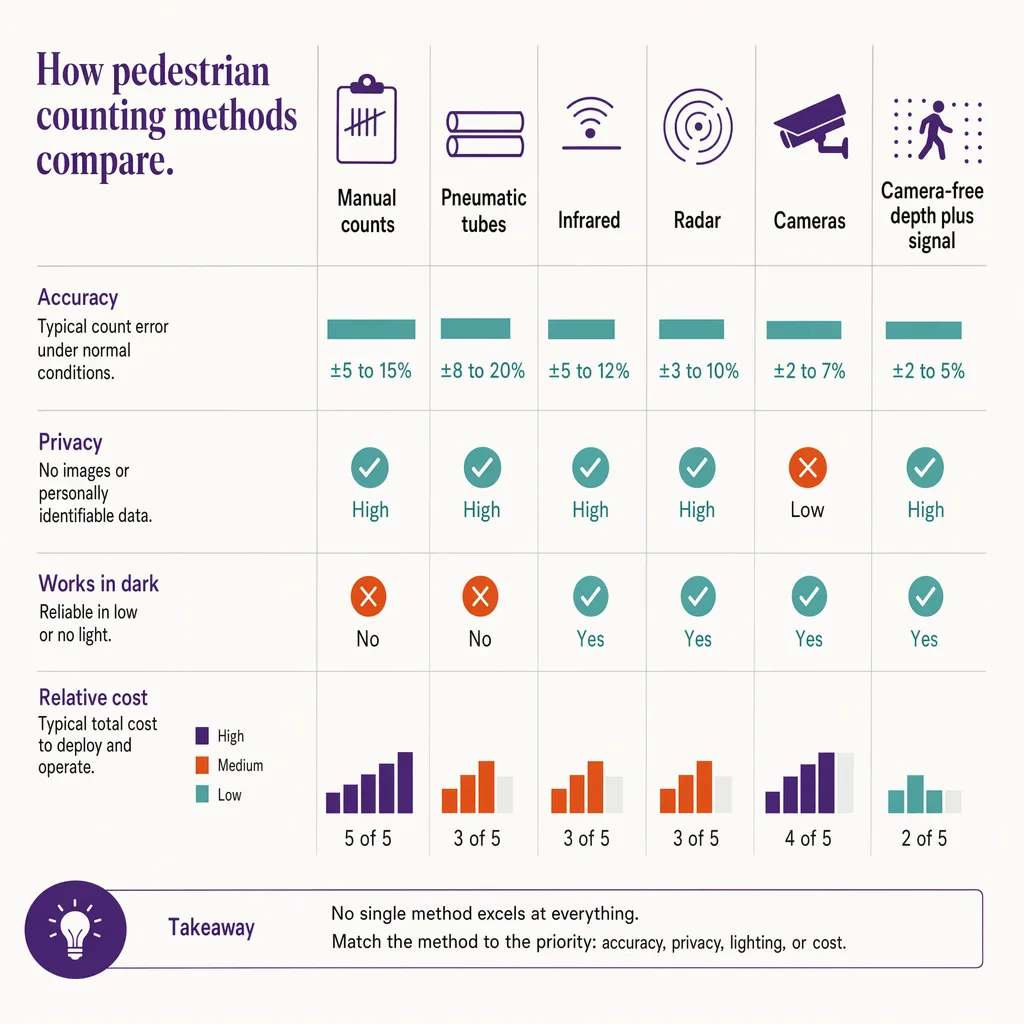
This is the definitional overview the topic usually lacks. It walks every practical way to count pedestrians, sets them side by side in a comparison table, and then explains the two factors that decide the choice most often in public space: privacy and outdoor performance. If you want the single-mode detail on counting cyclists rather than pedestrians, that lives in a separate post on counting cyclists on a path; this one is the parent it links down to.
What are the main methods for counting pedestrians?
Pedestrians are counted either manually or automatically. Manual methods use trained observers with clickers or video review, which is accurate for short studies but too costly to run continuously. Automatic methods run around the clock: thermal and infrared sensors, computer-vision cameras, Wi-Fi and Bluetooth signal detection, pressure or inductive strips in the ground, and Time-of-Flight depth sensing that measures distance rather than capturing an image. Cities pick a method by weighing four things: accuracy at real pedestrian densities, privacy exposure in public space, whether it works at night and in bad weather, and the total cost of installing and maintaining it across many sites.
The rest of this post takes each method in turn, then compares them directly, because a summary sentence hides the trade-offs that actually decide a procurement.
Manual counting: clicker surveys and video review
The oldest method is a person with a hand counter standing at a point and tallying everyone who passes. It is still the right tool for a specific job: a short, one-off study where you need a defensible ground-truth number and can afford to pay someone to produce it. A trained observer counting a single crossing for two hours in daylight is accurate, and that accuracy is exactly why manual counts are used to calibrate automatic sensors rather than to replace them.
Video review is the same idea with the counting moved off-site. A camera records the location, and a person counts the footage afterwards, sometimes assisted by software. It removes the need to stand in the cold and lets one reviewer cover several sites, but it inherits the fundamental limits of manual work: someone still has to watch, so it does not scale to continuous, city-wide coverage, and the reviewer's attention fades over long clips.
The shared ceiling on both is cost per hour of coverage. Manual methods are accurate but expensive per unit of data, so cities use them for periodic snapshots and calibration, not for the always-on picture that continuous decisions need.
Automatic sensor methods
Automatic sensors trade the up-front cost of installation for the ability to run continuously without a person present. Five families dominate.
Thermal and infrared sensors detect body heat or break an infrared beam as someone passes. Beam-break counters are cheap and simple but confused by groups walking abreast, when two people crossing together register as one. Thermal imaging reads the heat signature of a body, works in the dark, and captures no recognisable image of a face, though its accuracy falls when pedestrians cluster tightly or when ambient temperature approaches body temperature.
Computer-vision cameras run image recognition on a video feed to detect and count people. Accuracy can be high in good conditions, and the same camera can classify direction and dwell. The cost is the one that matters most in public space: it is a camera, capturing recognisable images of members of the public, which raises data-protection questions and public objection that a private retailer rarely faces. Performance also drops in low light and heavy rain unless the hardware is specified for it.
Wi-Fi and Bluetooth signal detection counts the wireless signals that phones emit and infers pedestrian numbers from them. It is inexpensive to deploy and covers a wide area from one unit, but it counts devices rather than people, misses anyone whose phone is off or whose radios are disabled, and double-counts a person carrying two devices. Raw probe-based approaches also raise their own privacy questions around device identifiers, a subject covered in the discussion of biometric vs non-biometric counting.
Pressure and inductive strips sit in the ground and register the load or electromagnetic signature of someone crossing. Pneumatic tubes and inductive loops are long-established for road and path traffic and are robust once installed, but they count crossings of a line rather than presence in an area, struggle to separate a tight group, and mean digging into the surface to install.
Time-of-Flight depth sensing fires infrared pulses and measures how long they take to return, building a depth map of the scene. It counts by geometry, the shape and height of a passing body, rather than by any image, so it separates individuals in a group well, works in complete darkness, and captures no faces. It is a mid-cost sensor that has become the standard where accuracy and privacy both matter at once.
Comparison table: accuracy, privacy, night and weather, cost per site
The table below sets the methods side by side. Accuracy is given as a typical qualitative band rather than a precise figure, because real accuracy depends on pedestrian density, mounting, and calibration at each site; treat every cell as a general guide, not a measured guarantee.
| Method | Typical accuracy | Privacy in public space | Works at night / bad weather | Relative cost per site | Best for |
|---|---|---|---|---|---|
| Manual clicker | High in short bursts | No recording; observer present | Limited by observer comfort and visibility | Low hardware, high labour per hour | One-off studies, calibrating sensors |
| Video review | High with careful review | Records recognisable images | Depends on camera and lighting | Low hardware, high labour per hour | Periodic audits where footage is acceptable |
| Thermal / infrared | Moderate; drops in tight groups | No recognisable image captured | Works in the dark; weather-tolerant | Low to moderate | Simple continuous counts where privacy matters |
| Computer vision | High in good conditions | Camera; captures recognisable images | Weaker in low light and heavy rain unless hardened | Moderate to high | Indoor sites where imaging is already accepted |
| Wi-Fi / Bluetooth signal | Moderate; counts devices not people | Depends on identifier handling | Unaffected by light or weather | Low; wide coverage per unit | Rough area-level trends, wide catchments |
| Pressure / inductive strip | Moderate; poor group separation | No image captured | Robust once installed | Moderate; civil works to install | Road and path line-crossing counts |
| Time-of-Flight | High; separates groups well | No image, no face captured | Works in complete darkness and outdoors | Moderate | Continuous public-space counting where privacy and accuracy both matter |
Why privacy and outdoor performance decide it in public space
For a private store, most of these methods are viable, and the choice comes down to accuracy and budget. Public space changes the weighting. A camera pointed at a shop entrance is one thing; a camera pointed at a public plaza, a station concourse, or a residential street is a different proposition, and the objection is not hypothetical. Members of the public did not choose to enter the space the way a shopper chooses to enter a store, and the data-protection bar for recording them is correspondingly higher.
That is why methods that capture no image have an inherent advantage outdoors, and why the second factor, performance after dark and in bad weather, matters so much. A city does not get to count only in daylight. Evening footfall, night-time safety patterns, and winter conditions are often the periods a city most wants to understand, and any method that degrades when the light goes is measuring the easy hours and guessing the hard ones. Camera-free depth sensing works in complete darkness because it makes its own infrared light, and it holds up outdoors, which is the combination public-space counting actually needs. This is covered in more depth in the guide to counting outdoors and after dark.
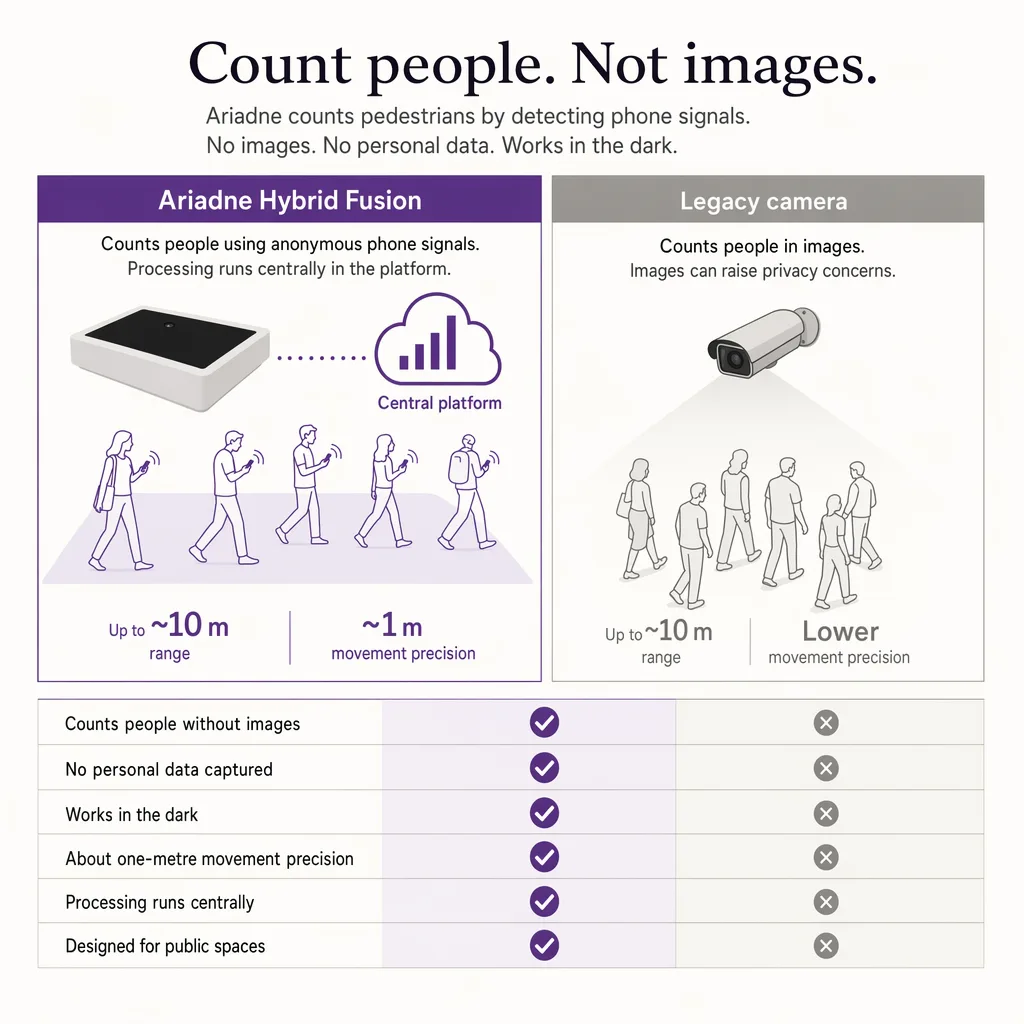
Ariadne is built around exactly this constraint. Ariadne measures this with Hybrid Fusion, its patented camera-free method. Time-of-Flight depth sensing counts every visitor at the entrances, capturing geometry rather than images, while patented phone signal sensing follows movement through the interior, detecting the signals a phone emits even in airplane mode, and tracks that movement to about one-metre precision. The sensor streams both feeds to Ariadne, where Hybrid Fusion combines them into one trajectory per visit and computes counts, dwell, and paths. The streams carry no identifier: no MAC address, no device ID, no biometric data, and no camera is involved. Identifiers are stored only when a visitor explicitly opts in, which keeps the method GDPR-friendly and outside biometric territory.
Choosing a method for a city programme
A single sensor is not a programme. A city that wants footfall data it can act on and defend needs to think past the individual counter to how the whole effort holds together over years.
Start with a pilot at a small number of representative sites rather than a city-wide rollout. A pilot proves the chosen method performs at your real pedestrian densities and in your actual weather before the budget is committed everywhere. Calibrate each automatic sensor against a short manual count at install, so you know the sensor's error at that specific site rather than assuming the vendor's headline figure applies to your geometry.
Then protect comparability over time. The value of footfall data compounds: this month against last month, this year against last year, before an intervention against after it. That only works if the method and the mounting stay consistent, because switching sensor types or moving a counter breaks the trend line you were building. A city gains more from an imperfect method measured consistently for three years than from swapping to a better sensor halfway and losing the comparison. For how continuous counts feed public-space decisions, funding cases, and scheme evaluation, see Ariadne's work in smart-city analytics and the underlying people counting platform.
FAQ
What is the most accurate way to count pedestrians?
For a short study, a trained manual count is the accuracy benchmark and is used to calibrate everything else. For continuous counting, Time-of-Flight depth sensing typically leads because it separates individuals in a group by their geometry and works in any light. Real accuracy always depends on density, mounting, and calibration at the specific site.
What is the difference between manual and automatic pedestrian counting?
Manual counting uses a person with a clicker or video review; it is accurate but too costly to run continuously, so it suits one-off studies and calibration. Automatic sensors run around the clock without a person present, trading up-front installation cost for always-on coverage.
Do I need cameras to count pedestrians?
No. Ariadne counts with Hybrid Fusion: Time-of-Flight depth sensing plus patented phone signal sensing, never cameras. Time-of-Flight captures geometry rather than images, and signal sensing captures no MAC address by default, so the measurement involves no video, no faces, and no biometric data.
Which method works at night and outdoors?
Thermal and Time-of-Flight both work in the dark because neither relies on visible light, and Time-of-Flight makes its own infrared light so it functions in complete darkness. Computer-vision cameras weaken in low light and heavy rain unless specifically hardened for it, and manual counting is limited by the observer's visibility.
How do cities pick a pedestrian counting method?
By weighing four things against each other: accuracy at real pedestrian densities, privacy exposure in public space, night and bad-weather performance, and total cost across many sites over years. In public space, privacy and outdoor performance usually carry the most weight because cameras draw objections and counting cannot stop when the light goes.
---


