
Airside retail runs on a funnel that most terminals never see clearly. Thousands of passengers walk a concourse every hour, a fraction step into any given store, and a fraction of those buy something before their gate is called. The gap between those numbers is where the money is, and it is also where the guesswork usually lives. A retailer can post a strong revenue day and still be leaving most of the concourse on the table, because a busy till says nothing about how many people passed the door and kept walking.
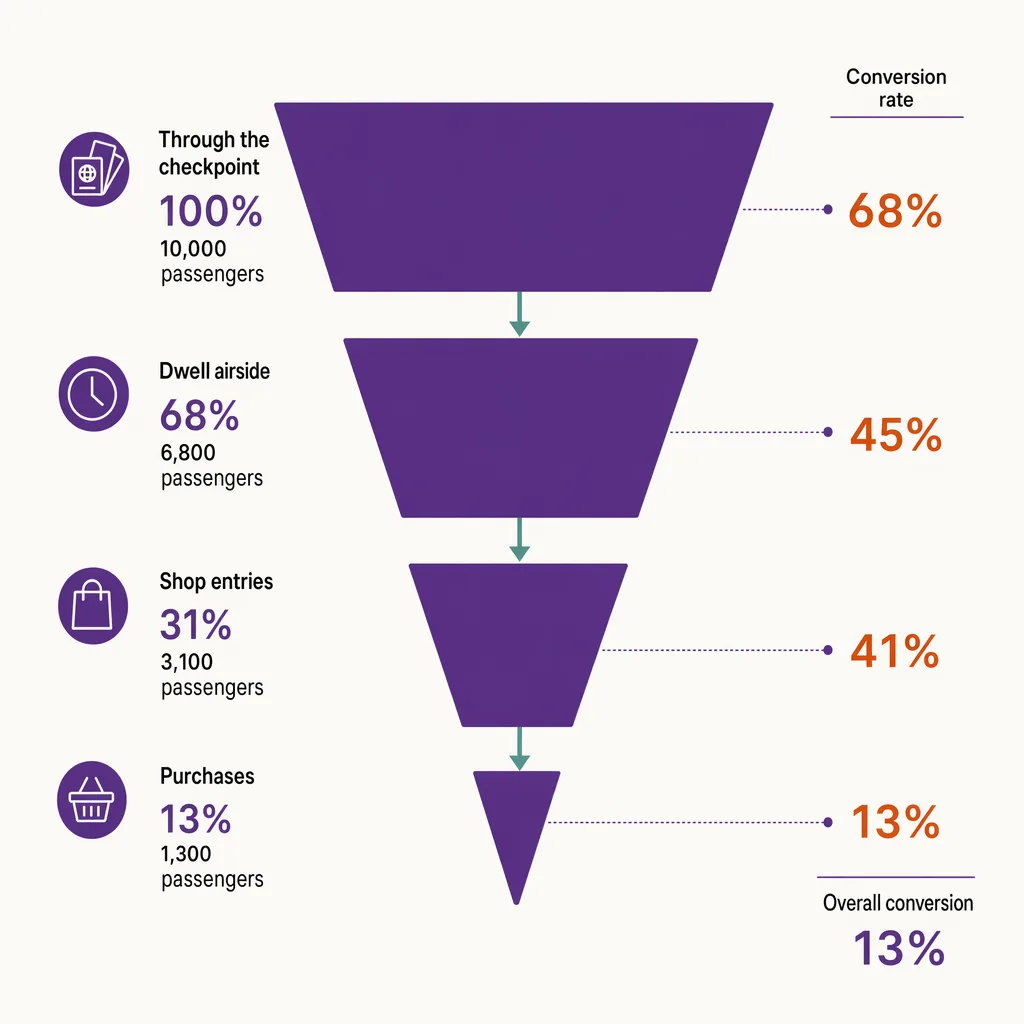
This post breaks airport retail conversion into the two rates that actually move it, capture and conversion, and the one constraint that caps them both: the dwell window a passenger has between clearing security and boarding. It sits below the revenue posts in the airport commercial cluster. If you want the outcome metric, concession revenue per passenger reports the spend side; this post explains the traffic-to-purchase mechanics upstream of it.
What drives conversion in airport retail?
Airport retail conversion runs on a two-step funnel set by a hard time constraint. First, capture rate: of the passengers walking the airside concourse, what share step into the store. Second, conversion rate: of those who enter, what share buy. The ceiling on both is the dwell window, the time a passenger has between clearing security and boarding. A long, relaxed dwell lifts capture and conversion; a tight connection kills them. Airside retailers who measure passing traffic, store entries, and dwell can separate a footfall problem (few passengers passing) from a capture problem (they pass but do not enter) from a conversion problem (they enter but do not buy), and then fix the right one.
The rest of this post walks that funnel stage by stage, because the fix for each stage is different, and applying the wrong one is the most common way an airside store wastes effort.
The airside funnel: passing traffic to capture rate to conversion to spend
Think of airside retail as three counts stacked on top of each other, each a subset of the one above.
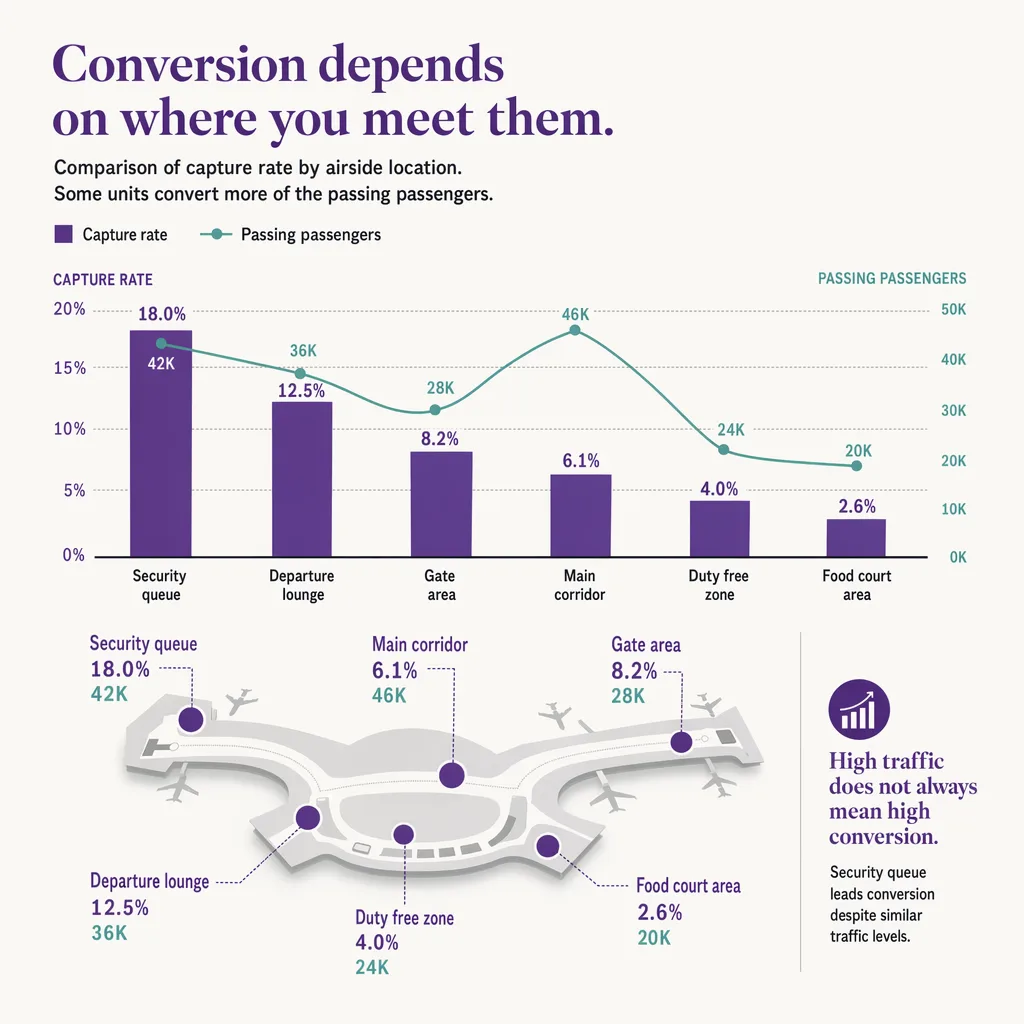
At the top is passing traffic: the passengers who walk past the store's frontage on their way from security to the gates. This number is set by the terminal, not the retailer. It depends on where the store sits relative to the security exit, the gate clusters, and the natural walking line most passengers follow. A unit on the main flow line past every departing passenger sees far more passing traffic than one tucked into a quiet pier, and no amount of merchandising changes that geography.
Below passing traffic is capture: the share of passers who actually cross the threshold. Capture is where store design, frontage, category, and the passenger's state of mind all meet. A traveller who has just cleared security is often tense, time-pressured, and heading somewhere specific. A store earns a capture by giving that passenger a fast, low-friction reason to break stride, whether that is a clear category signal at the door, an open frontage they can read at a glance, or a product the trip makes relevant, such as travel essentials or a gift they forgot.
Below capture is conversion: the share of entrants who buy. This is the stage retailers understand best, because it looks most like conversion anywhere else, product, price, staffing, queue length at the till. But airside adds a twist that stores on the high street do not face, and it is the twist that governs the whole funnel.
The spend that lands at the bottom is the product of all three rates against the passenger base. A store can lift revenue by widening any one of them, but only if it knows which one is actually narrow. That is the diagnostic problem this post keeps returning to.
Why dwell time between security and boarding sets the ceiling
Every airside purchase happens inside a window the passenger did not choose freely: the time between clearing the security checkpoint and needing to be at the gate. That window is the single most important variable in airside retail, and it caps both capture and conversion at once.
When the window is long, a passenger relaxes. They have cleared the stressful part of the journey, they have time to spare, and browsing becomes a way to fill it rather than a risk to the connection. Capture rises because there is no penalty for stepping into a store, and conversion rises because there is time to consider a purchase, try something, or queue at the till without anxiety. A long, comfortable dwell is the closest airside retail gets to a leisure-shopping environment.
When the window is short, the funnel collapses from the top. A passenger with a tight connection walks straight to the gate. They will not risk a capture, let alone a conversion, because the cost of missing the flight dwarfs any purchase. This is why two stores with identical products and staffing can post very different results in different parts of the same terminal: one sits where passengers arrive with time to spare, the other where they arrive already late.
Dwell is not fully in the retailer's control, but it is measurable, and measuring it separates a store's own performance from the hand the terminal dealt it. The relationship between time-before-boarding and spend is close enough that it deserves its own analysis; the mechanics of measuring how long passengers linger before a gate are covered in dwell time before boarding, and the broader pattern of what passengers do with that airside time in passenger behaviour airside.
Diagnosing where a store loses the sale: footfall, capture, or conversion
Because the funnel has three stages, a disappointing revenue figure has three possible causes, and each one has a different fix. Treating them as interchangeable is how retailers spend a refit budget solving a problem they did not have. The table below maps the symptom to the likely cause and the response that actually addresses it.
| Symptom in the data | Likely cause | The fix that addresses it |
|---|---|---|
| Low passing traffic, decent capture and conversion | A location problem: the store is off the main flow line | Rethink placement or signage that pulls passengers off the walking line; this is a terminal-layout question, not a store-operations one |
| Healthy passing traffic, low capture, decent conversion of those who enter | A capture problem: passengers walk past without entering | Frontage, category clarity at the door, and a reason to break stride; the people are there but the store is not stopping them |
| Healthy capture, low conversion of entrants | A conversion problem: people enter but leave without buying | Range, price, till queue, and staffing at the peak; entrants are willing but something inside loses the sale |
| All three rates soft only at certain hours | A dwell problem tied to the flight schedule | Match staffing and offer to the banks when passengers arrive with time to spare, not a blanket change |
The point of the table is that the three symptoms look identical on a revenue report and completely different in funnel data. Only by measuring passing traffic, entries, and dwell separately can a retailer tell a location problem it cannot fix at the store level from a capture problem it can fix this week with a frontage change.
From conversion to revenue per passenger
Conversion is the mechanism; revenue per passenger is the scoreboard the airport commercial team actually reports on. The two are tightly linked, and reading them together is what turns a funnel diagnosis into a commercial case.
A store can lift revenue per passing passenger in exactly three ways, and they map straight onto the funnel: capture more of the passers, convert more of the entrants, or lift the average spend of those who buy. Knowing which lever is loose tells the airport whether the answer is a layout change, a store-operations change, or a range-and-pricing change. Without the funnel split, the commercial team sees only the blended outcome and cannot tell a strong store in a poor location from a weak store in a strong one.
For how the spend metric itself is defined and tracked at the passenger level, see concession revenue per passenger, and for the wider commercial picture that airside retail sits inside, non-aeronautical revenue. The same funnel logic also underpins whether an airside advertising campaign moved anyone into a store, which is the attribution question addressed in attributing airside campaigns.
How Ariadne measures airside passing traffic, store entries, and dwell
The funnel only works as a diagnostic if the three counts are measured consistently and separately: the passengers passing the frontage, the ones who enter, and how long they stay. That is a measurement problem, and in a terminal it comes with a hard constraint, because airside is a sensitive, high-scrutiny environment where video-based counting raises immediate privacy and security questions.
Ariadne measures this with Hybrid Fusion, its patented camera-free method. Time-of-Flight depth sensing counts every visitor at the entrances, capturing geometry rather than images, while patented phone signal sensing follows movement through the interior, detecting the signals a phone emits even in airplane mode, and tracks that movement to about one-metre precision. The sensor streams both feeds to Ariadne, where Hybrid Fusion combines them into one trajectory per visit and computes counts, dwell, and paths. The streams carry no identifier: no MAC address, no device ID, no biometric data, and no camera is involved. Identifiers are stored only when a visitor explicitly opts in, which keeps the method GDPR-friendly and outside biometric territory.
Read against the funnel, that gives an airside retailer the three numbers the diagnosis needs: passing traffic along the frontage, entries at the door, and dwell inside the unit, each as a clean count rather than an impression from the shop floor. Counting here is a commercial input for merchandising, staffing, and placement decisions. It is not a security or screening system, and it does not identify anyone. Glasgow Airport is a live Ariadne customer; for how camera-free measurement is deployed across a terminal, see how airports count passengers and the broader airport analytics view. For the retail-measurement method in general, see measuring store entries.
FAQ
What is capture rate in airport retail?
Capture rate is the share of passengers walking past a store's frontage who actually enter it. It sits above conversion in the funnel: capture measures whether passers become entrants, and conversion measures whether entrants become buyers. A store can have healthy conversion of the few who come in while capturing almost none of the crowd walking past, which is a different problem with a different fix.
How does dwell time affect airside retail conversion?
Dwell time, the window between clearing security and boarding, caps both capture and conversion. A long, relaxed dwell lets passengers browse and buy without risking their connection, so both rates rise. A tight connection sends passengers straight to the gate, and the funnel collapses from the top regardless of how good the store is.
Do I need cameras to measure airport retail conversion?
No. Ariadne counts with Hybrid Fusion: Time-of-Flight depth sensing plus patented phone signal sensing, never cameras. Time-of-Flight captures geometry rather than images, and signal sensing captures no MAC address by default, so the measurement involves no video, no faces, and no biometric data.
How can a retailer tell a footfall problem from a capture problem?
By measuring passing traffic and entries separately. Low passing traffic with decent capture points to a location or layout problem the store cannot fix on its own. Healthy passing traffic with low capture points to a frontage or category-clarity problem the store can address directly. The two look identical on a revenue report and completely different in funnel data.
Is counting passengers airside a security or screening system?
No. Ariadne footfall and flow data is a commercial and operational input for merchandising, staffing, and placement decisions. It does not screen passengers, detect threats, or form part of any security or aviation-regulatory process, and it identifies no one.
---


