
The 30-minute window that breaks landside operations
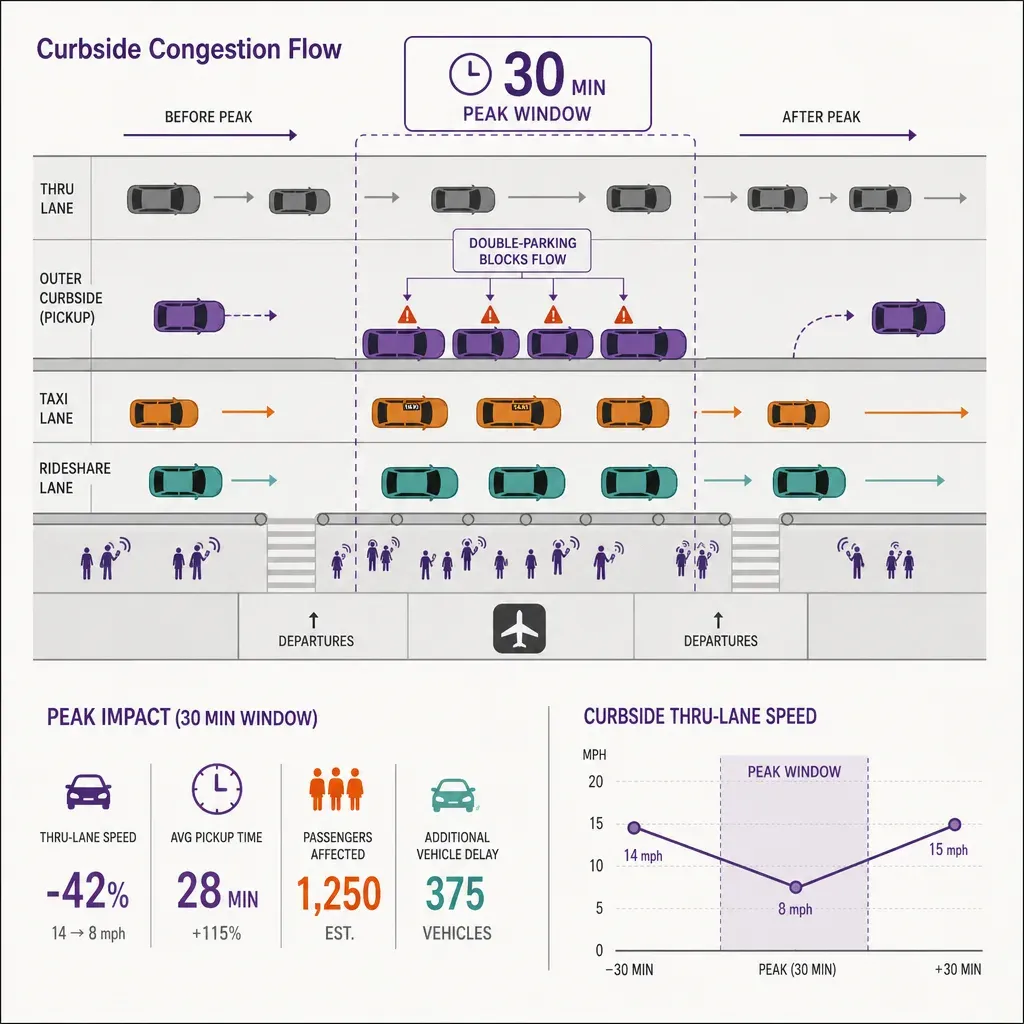
Most of an airport's curbside day is uneventful. Cars and taxis pull up, passengers step out, a marshal waves the next vehicle forward, the lane keeps moving. Then a flight bank lands, three peak departures push at once, an inbound long-haul disembarks into a rideshare cluster, and within about half an hour the whole landside choreography starts to fail. Vehicles double-park. The outer lane becomes a parking lane. Passengers walk between stopped cars to reach the terminal door. The next inbound airport coach cannot reach its bay. The window that broke the operation was short, but the recovery takes the rest of the afternoon.
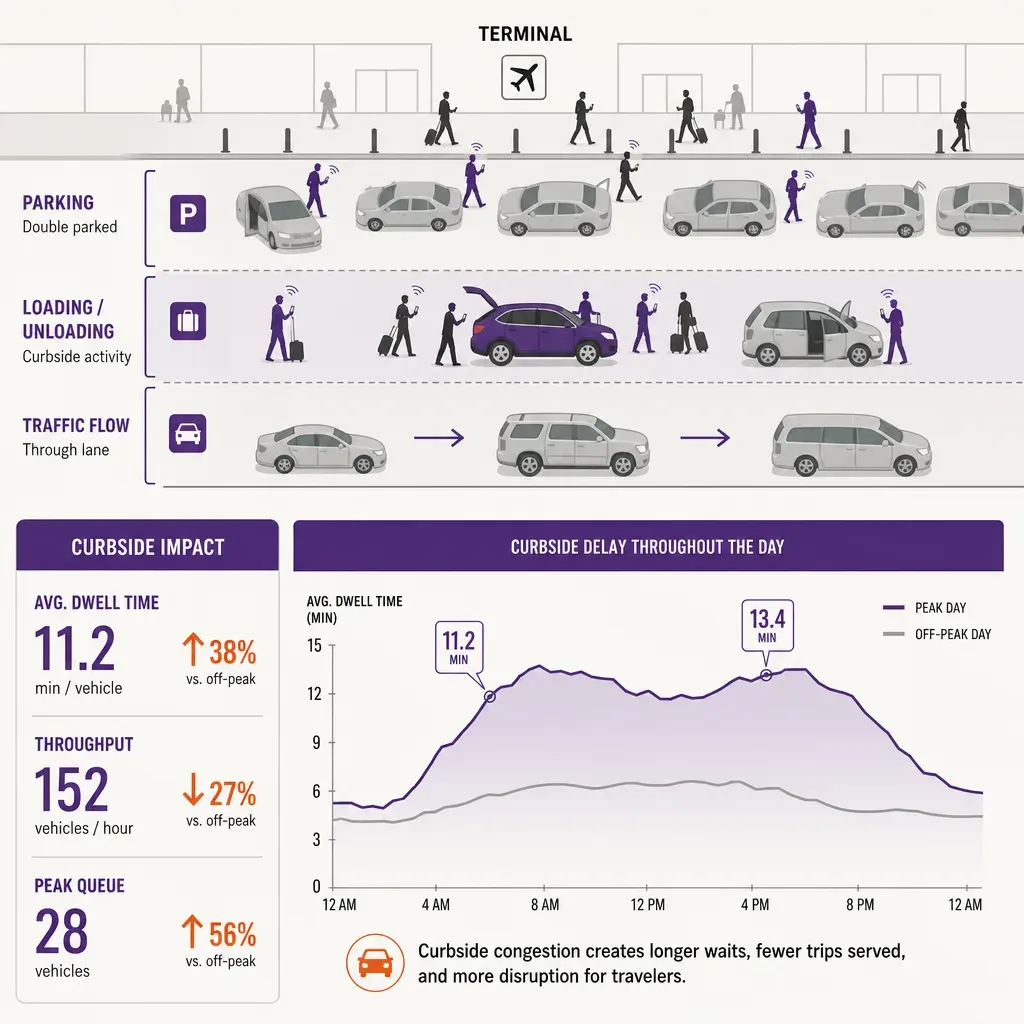
This piece is about that window. Not about car park yield or kerbside pricing, which are commercial questions, but about the operational mechanics: what is actually breaking at the kerb when it breaks, why the standard metrics miss it, and what an airport landside team can measure to see it coming and to staff against it. The numbers in the post are illustrative ranges drawn from publicly discussed airport operations practice. They are not Ariadne-measured results and they are not study results. Treat them as the shape of the problem.
What curbside congestion actually is
Curbside congestion at an airport is not a single thing. It is the failure mode of three different flows arriving at the same length of kerb at the same time:
- Private drop-off and pick-up. Family cars and private vehicles, with the longest per-stop dwell because they involve goodbyes, suitcases, and sometimes a parent walking a passenger to the door.
- Taxi, rideshare, and private hire. Higher throughput per vehicle, but with their own queuing patterns and, for rideshare specifically, a meeting-point uncertainty that often turns the kerb itself into the waiting room.
- Scheduled coach, hotel shuttle, and parking shuttle. Predictable arrival times, larger vehicles, longer dwell while passengers board and luggage moves, and a hard requirement for a clear bay.
Each flow has a different dwell distribution at the kerb and a different sensitivity to delay. A private car blocking a coach bay for three minutes is a different operational problem than a coach blocking a rideshare lane for the same three minutes, and both look identical on a single "vehicles per hour" line. Mixing the three into one number is the first reason curbside dashboards understate what is happening on the ground.
The two measurements every landside team should keep separate
The single most useful change a landside operations team can make to its curbside metrics is to stop reporting one number and start reporting two: vehicle throughput at the kerb, and pedestrian dwell at the kerb. They are different things and they fail in different orders.
Vehicle throughput
Vehicle throughput is a problem for the kerb itself: how many cars, taxis, rideshare, coaches, and shuttles can complete a stop per minute in a given lane. The right sensor for this is a vehicle-counting sensor (inductive loops, radar, ANPR), not a people counter. It is a different problem and should be solved with the right instrument for it. A flat or rising throughput number with the lane visibly choked usually means vehicles are still entering but dwell per stop has lengthened, which the throughput line on its own does not show.
Pedestrian dwell at the curb-to-terminal threshold
Pedestrian dwell is a different problem, and it is the one Ariadne can answer directly. The measurement that matters is how long people spend between leaving the vehicle and entering the terminal door, broken down by entrance, by hour, and by direction. This is the count taken at the curb-to-terminal threshold: the entrance doors and the few metres of pavement immediately outside them.
When pedestrian dwell at the threshold rises while throughput is flat, the kerb is congesting. People are stepping out of vehicles, then waiting on the pavement (for the rest of a party, for a porter, for a rideshare to find them, for someone inside to come out), and that wait compresses the working area between the vehicle door and the terminal door. The next car arriving has less space, the marshal has less room to direct it, and the cycle accelerates.
A people counter at the door cannot solve a vehicle queue. But a people counter at the door is the cleanest leading indicator that a vehicle queue is about to form, because the pavement fills before the lane does. That ordering is what makes the pedestrian-side measurement worth installing alongside the vehicle-side one.
Rideshare changed the curbside problem
Twenty years ago, almost everyone arriving at an airport was either driven, parked themselves, or took a taxi from a marshalled rank. The kerb knew which vehicle was about to do what. Rideshare and on-demand private hire changed that, and the change is not just one of volume.
The structural difference is that the meeting point is negotiated through a phone, not through a queue. A rideshare driver pulls into the lane, looks for a name, sometimes cannot find the passenger and circles back through the perimeter road, sometimes parks and waits. The passenger, in parallel, walks the kerb looking for a registration plate, sometimes against the direction of traffic. The kerb is now both a pickup lane and a waiting area, and the two functions interfere with each other.
Two practical implications follow:
- Pedestrian dwell distributions become longer-tailed. Most passengers still clear the kerb in well under a minute. A growing fraction stand on the pavement for several minutes, waiting for a driver to arrive or for confirmation of the meeting point. The mean shifts a little, the upper percentiles shift a lot.
- The location of the dwell migrates from the lane into the pedestrian threshold. Older operations could read kerb pressure off the vehicle queue. Modern operations read it off the pavement, because the rideshare wait happens on the kerbside footprint, not in the lane.
Most airports that have run the numbers have ended up funnelling rideshare into a dedicated holding area away from the terminal kerb and using a queue-based dispatch into a designated pickup zone. The decision of whether to do that, and where to put the holding lot, depends on knowing pedestrian dwell at the threshold today and projecting what it would look like with the rideshare wait removed from the kerb. That projection is built on the same dwell measurement.
Reading the peak before it forms
Curbside peaks are not random. They are the kerbside echo of the flight schedule, displaced by a predictable lag for arrivals and led by a predictable lead for departures. A landside operations team that has hourly pedestrian dwell at each threshold door, mapped against the flight schedule and the day-of-week pattern, can build the same kind of short-range forecast already common for airport queue prediction on the airside. The mechanics are similar:
- Use the flight schedule as the base demand signal. Departures generate kerb load 90 to 150 minutes ahead of scheduled time, weighted by load factor and by terminal split. Arrivals generate kerb load 20 to 50 minutes after on-block, weighted by stand allocation and immigration throughput.
- Calibrate against the historical pedestrian dwell at each door. Some thresholds absorb peaks better than others. The same scheduled bank lands very differently on door 2 of T1 than on door 7 of T3, and the historical record at each one captures that asymmetry without modelling it.
- Layer in the day-of-week and the holiday calendar. A Friday evening rideshare profile is not a Tuesday morning rideshare profile, and the staffing decision is hour by hour.
The forecast does not have to be sophisticated to be useful. A 30 to 60 minute look-ahead on pedestrian dwell at each threshold, refreshed every few minutes, is enough to move marshals to the door that is about to congest before the kerb behind that door fails.
Staffing curbside marshals to peaks, not to shifts
Most landside teams already know which shifts are heavy. The problem is rarely the shift, it is the half-hour inside the shift when three banks land into a wet evening and one terminal door takes 80% of the load. Marshals scheduled to a flat shift pattern are either over-staffed at the troughs or under-staffed at the peaks, and the troughs are the visible cost while the peaks are the invisible one.
Peak-led staffing for curbside marshals is the same idea as peak-led staffing in retail or hospitality, applied to a landside team. The inputs are:
- Pedestrian dwell forecast by door and by half-hour.
- A baseline coverage level per door, set by the operations team for safety and for vehicle direction.
- A flex headcount that can be redirected between doors at short notice, sized to the difference between baseline and forecast peak.
The structural change is moving from a static map of marshal positions to a published peak roster that gets refreshed daily from the flight schedule. The headcount budget does not have to grow. The same people, deployed against forecast peaks rather than against fixed posts, tend to reduce both the dwell at the threshold and the door-to-vehicle distance the marshals walk. Some of the same patterns from people-aware employee scheduling in retail and hospitality apply directly here.
What Ariadne measures, and what it does not
It is worth being explicit about the scope of the measurement, because curbside is a domain where the wrong sensor on the wrong question wastes a procurement cycle.
Ariadne measures the pedestrian and passenger side at the curb-to-terminal threshold. That is hourly entries and exits through each terminal door, live occupancy of the entrance area, pedestrian dwell distributions between the kerb and the door, and the flow once passengers cross into the terminal itself. It is the same measurement that supports gate dwell time on the airside, applied to the landside threshold instead.
Vehicle counting at the kerb is a separate sensor problem. Inductive loops, radar, and ANPR are the right instruments for it, and a sensible curbside operations stack uses both: a vehicle-counting layer for throughput, occupancy of the lane, and ANPR for compliance, plus a pedestrian-counting layer for the threshold dwell that leads the vehicle congestion. The two streams join in the operations dashboard, not in the sensor.
Ariadne measures this with Hybrid Fusion, its patented camera-free method. Time-of-Flight depth sensing counts every visitor at the entrances, capturing geometry rather than images, while patented phone signal sensing follows movement through the interior, detecting the signals a phone emits even in airplane mode. The sensor streams both feeds to Ariadne, where Hybrid Fusion combines them into one trajectory per visit and computes counts, dwell, and paths. The streams carry no identifier: no MAC address, no device ID, no biometric data, and no camera is involved. Identifiers are stored only when a visitor explicitly opts in, which keeps the method GDPR-friendly and outside biometric territory.
For an airport landside team, the practical properties matter. There is no camera and no video at the threshold, so the system does not interact with the airport's CCTV governance. The streams carry no MAC address by default and no device identifier, so there is no personal data flowing from the pedestrian count into the operations dashboard. The sensor hardware sits in the Ariadne sensor lineup, and the data handling is set out in the privacy policy. The output the landside team sees is door-level pedestrian dwell and live occupancy, by half-hour, ready to join with the vehicle layer and the flight schedule.
Related reading
FAQ
Is airport curbside congestion a vehicle problem or a pedestrian problem?
Both, and the two problems should be measured separately. Vehicle throughput is best measured with inductive loops, radar, or ANPR at the lane. Pedestrian dwell at the kerb is best measured at the terminal threshold, by entrance door. The pedestrian measurement usually leads: the pavement fills before the lane fails. An operations stack that reports only one of the two numbers will be late on the other.
How long should a passenger spend at the kerb?
A typical clean kerbside transaction (vehicle stops, passenger exits, luggage out, vehicle clears) takes well under a minute for taxis and rideshare and a little longer for private drop-off with bags. Pedestrian dwell at the terminal threshold (vehicle door to terminal door) is usually a fraction of that for individual passengers. When the threshold dwell distribution begins to develop a long tail, with a meaningful fraction of passengers waiting several minutes on the pavement, the kerb behind that door is congesting and a vehicle queue tends to follow.
Do you need cameras at the curbside to measure this?
No. Ariadne counts with Hybrid Fusion: Time-of-Flight depth sensing plus patented phone signal sensing, never cameras. Time-of-Flight captures geometry rather than images, and signal sensing captures no MAC address by default, so the measurement involves no video, no faces, and no biometric data.
Can rideshare pickup be coordinated to reduce curbside congestion?
Yes, and the standard pattern is a dedicated holding area away from the terminal kerb with a queue-based dispatch into a designated pickup zone. The decision of whether that lift is worth the build cost rests on knowing current pedestrian dwell at the threshold doors and projecting what dwell would look like with the rideshare wait moved off the kerb. Both numbers come from the same pedestrian-side measurement.
How should curbside marshals be staffed against peaks?
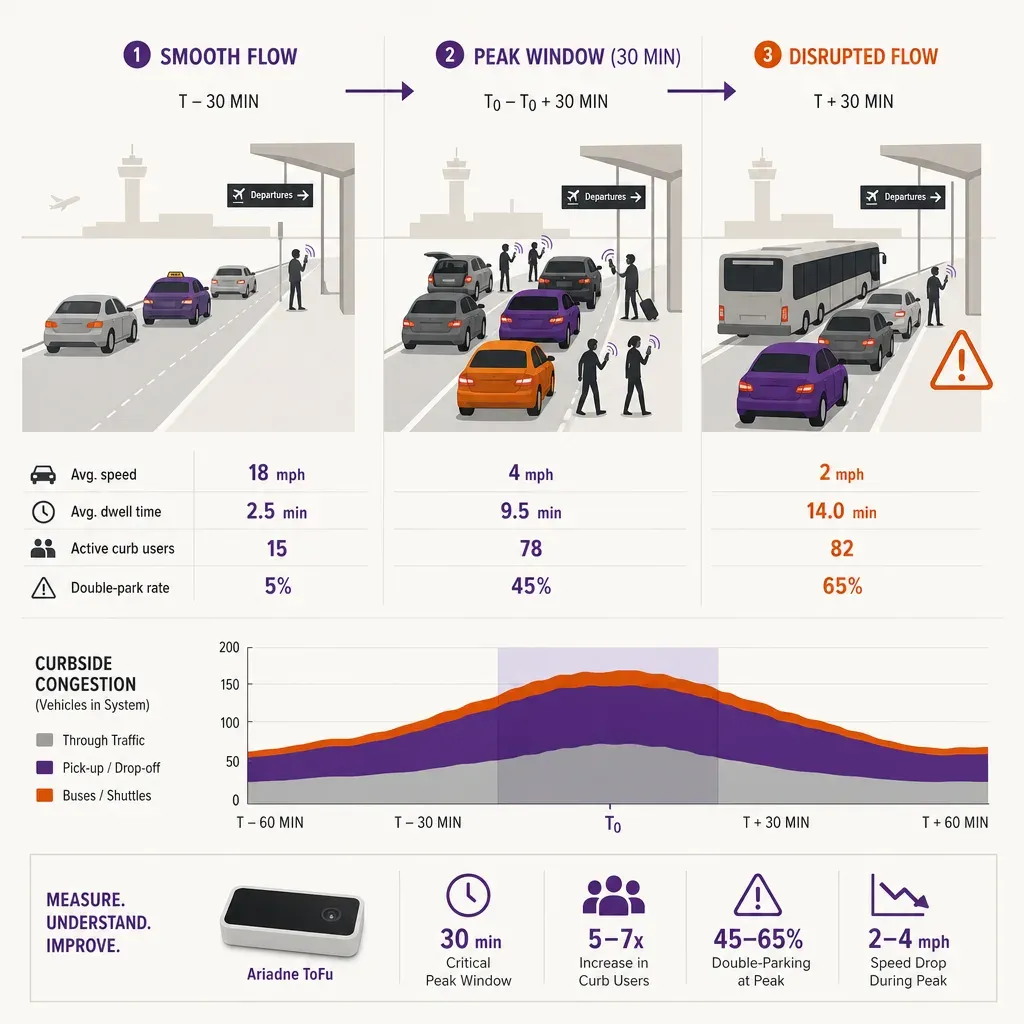
Peak-led, not shift-led. Use a 30 to 60 minute pedestrian-dwell forecast by door, derived from the flight schedule and the historical curve at each threshold, and hold a flex headcount that can be redirected between doors during peaks. The total headcount budget often does not need to grow; the same people deployed against forecast peaks rather than against fixed posts tend to reduce both threshold dwell and the kerb queue behind it.


