
A storefront has one job before any selling happens: convince the person walking past to come in. Window conversion rate is the number that measures whether it is doing that job. It sits earlier in the funnel than most retail metrics, out on the pavement rather than at the till, and it puts a figure on the pull of the window display, the entrance, and the fascia. Get it right and everything downstream has more to work with. Get it wrong and no amount of in-store selling can rescue the traffic that never walked in.
This is closely related to a metric you may already track. Window conversion rate and capture rate are, at their core, the same calculation, and this post says so plainly rather than pretending otherwise. What it does not do is re-derive capture rate or restate its benchmark table. Instead it owns the storefront-pull angle: what the window, fascia, and entrance actually do to the number, and how to use it to test a display change cleanly. Read the capture-rate post for the canonical definition and benchmarks; read this one for the display's point of view.
What is window conversion rate in retail?
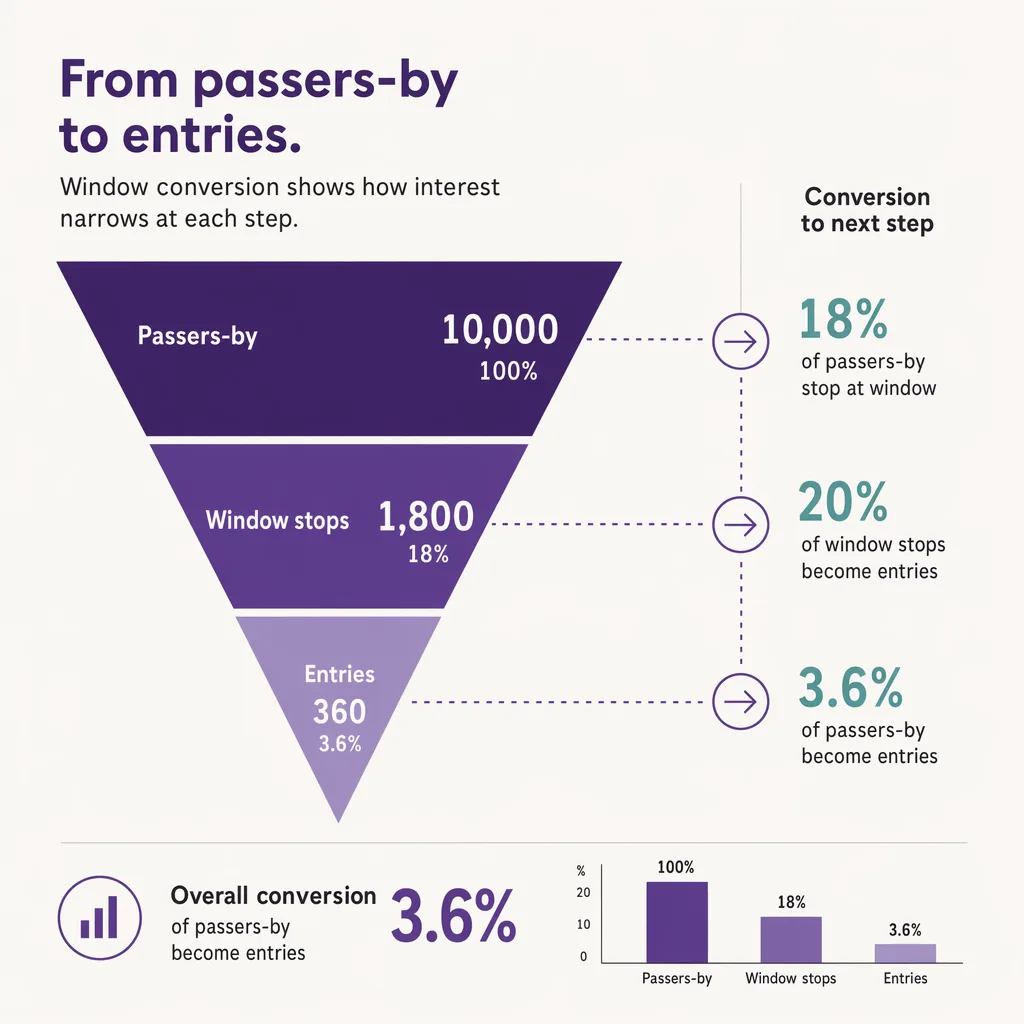
Window conversion rate is the share of people who pass your storefront and then walk in. If 1,000 people pass and 80 enter, the window conversion rate is 8 percent. It measures the pull of the storefront itself: the window display, the entrance, the signage, and the fascia, before any in-store selling happens. It is the same idea retailers often call capture rate, though "window conversion" puts the emphasis on the display doing the converting. Measuring it needs two counts, external passing traffic and store entries, from the same window over the same period.
The formula: entries divided by passing traffic, and the counting window that makes it valid
The calculation is simple. Take the number of store entries over a period, divide by the number of people who passed the storefront over the same period, and express it as a percentage. Eighty entries against a thousand passers-by is 8 percent. The arithmetic is not where the difficulty lives.
The difficulty is in defining the two counts so they describe the same opportunity. Passing traffic has to mean people who genuinely had a chance to notice and enter the store: pedestrians moving along the frontage within sight of the window, not every person somewhere on the street. Entries have to be counted at the same door, over the same clock, and cleaned of staff, deliveries, and re-entries. If the passing count is measured over a wider stretch of pavement than the window actually commands, the denominator is inflated and the rate reads artificially low. If entries include staff coming back from a break, the numerator is inflated and the rate reads artificially high. A window conversion rate is only comparable to itself over time if the counting window, literally the span of frontage and the period of time, stays fixed.
That is also why the metric is most useful as a trend rather than an absolute. The exact percentage depends heavily on location, frontage width, and how passing traffic is defined, so a single figure means little in isolation. What means a great deal is the same figure measured the same way, week over week, so a change points to something real rather than to a change in how you counted.
Window conversion rate vs capture rate vs conversion rate: which door each one measures
Three metrics get mixed up here, and the confusion is understandable because two of them are nearly identical. The clean way to separate them is to ask what each one divides by what, and which door it diagnoses.
| Metric | Numerator | Denominator | What it diagnoses |
|---|---|---|---|
| Window conversion rate | Store entries | People passing the storefront | The pull of the window display, fascia, and entrance |
| Capture rate | Store entries | Passing traffic | The storefront's share of the passing stream (same calculation, different emphasis) |
| In-store conversion rate | Transactions | Store entries | Whether in-store selling turns entries into buyers |
The first two rows are the same sum. Window conversion rate and capture rate both divide entries by passing traffic; the difference is purely one of emphasis. "Capture rate" frames the store as capturing a share of a passing stream. "Window conversion" frames the display as converting a passer-by into a visitor. Treat them as interchangeable in the arithmetic and reach for whichever framing fits the decision you are making. When you want to talk about the display doing work, window conversion is the more natural word.
The third row is a genuinely different metric and the one most often confused with the other two. In-store conversion rate starts counting only after someone is already inside: it divides transactions by entries and measures the selling that happens on the shop floor. A store can have an excellent in-store conversion rate and a poor window conversion rate, which tells you the display is failing to pull people in even though the team sells well to those who do enter. The two numbers point at completely different problems, so keeping them apart is the whole value of the distinction.
What moves the number: display, fascia, entrance friction, and the zone just inside
Because window conversion isolates the storefront, the levers that move it are all physical and all outside the point of sale. The window display is the obvious one: what is shown, how it is lit, how often it changes, and whether it reads clearly at a walking pace. A display that stops people and gives them a reason to step in is doing the exact work the metric measures.
The fascia and signage set whether the store is even noticed. A frontage that blends into the streetscape, a sign that is hard to read from an angle, or a brand that passers-by do not recognise all suppress the number before the display gets a chance. Entrance friction is the next lever and an underrated one: a heavy door, an unclear entrance, a threshold that looks like it might be closed, or a queue visible from outside can all cost entries from people who were otherwise willing. The pull has to survive the last two metres.
Then there is what waits just inside the door. The decompression zone inside the door, the first stretch of floor a visitor crosses before they start shopping, shapes whether a tentative entry turns into a real visit or a quick turnaround. It sits at the boundary between window conversion and in-store conversion, which is why a store working on its entry rate should look at the display and the first few steps together rather than treating them as separate projects. All of this plays out against the high-street passing traffic the location gives you, which sets the size of the opportunity the storefront is trying to convert.
The hard part: counting passing traffic outside the door
In-store metrics have it easy on measurement, because entries are counted at a single, controlled door. Window conversion rate is harder, and the reason is the denominator. Counting the people who pass the storefront means measuring traffic out on the pavement, in the open, where there is no doorway to funnel people through and no obvious line to count across. Get that external count wrong and the metric is meaningless no matter how carefully you count entries.
What you need is two counts taken from the same vantage: passing traffic along the frontage, and entries through the door, measured over the same period so the ratio describes one opportunity. A line count at the storefront that reads the passing stream, paired with an entry count at the door, gives the numerator and denominator the metric requires.
Ariadne measures this with Hybrid Fusion, its patented camera-free method. Time-of-Flight depth sensing counts every visitor at the entrances, capturing geometry rather than images, while patented phone signal sensing follows movement through the interior, detecting the signals a phone emits even in airplane mode, and tracks that movement to about one-metre precision. The sensor streams both feeds to Ariadne, where Hybrid Fusion combines them into one trajectory per visit and computes counts, dwell, and paths. The streams carry no identifier: no MAC address, no device ID, no biometric data, and no camera is involved. Identifiers are stored only when a visitor explicitly opts in, which keeps the method GDPR-friendly and outside biometric territory.
Time-of-Flight at the entrance gives a clean, calibrated entry count, and reading passing traffic from the same fixed vantage keeps the denominator consistent from one week to the next. Because the method counts geometry rather than capturing images, it does the job of measuring pavement traffic without the privacy and consent problems a camera pointed at a public street would raise.
Using window conversion to test a display change
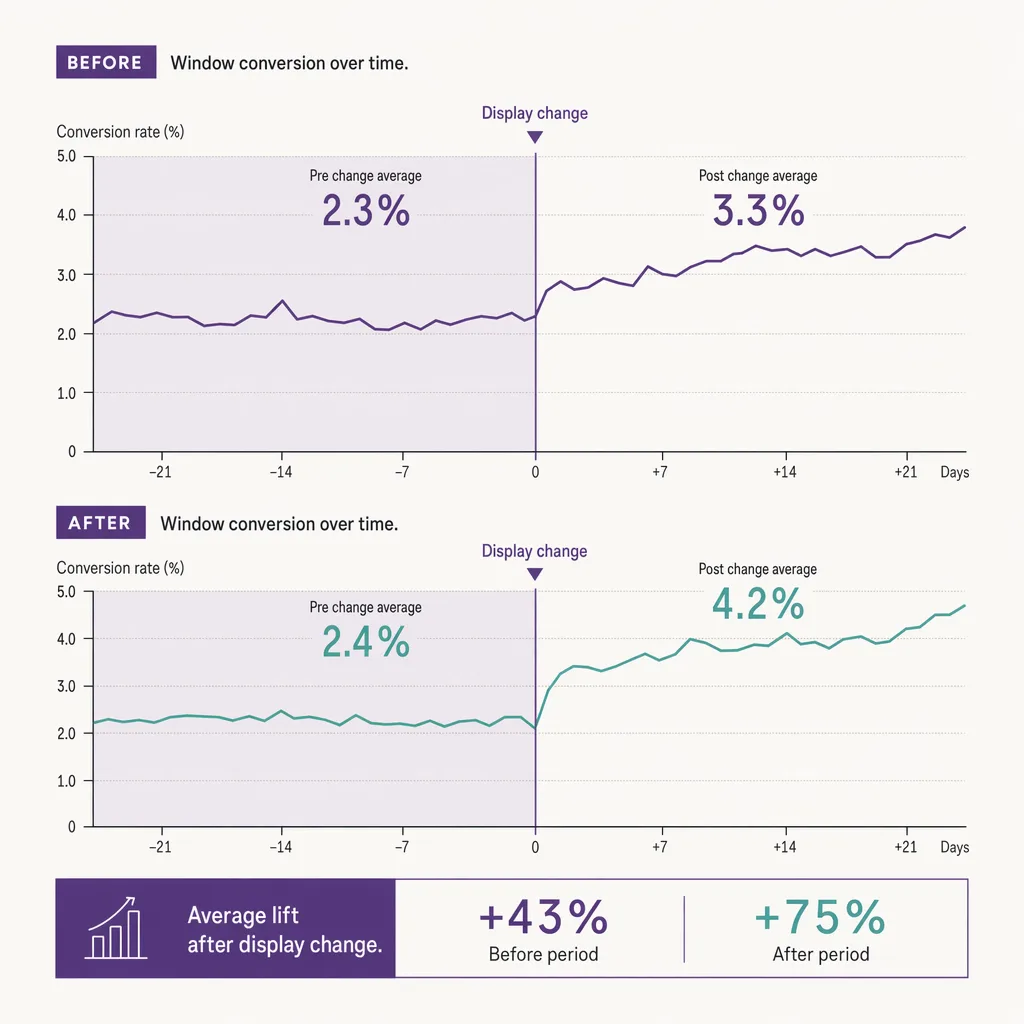
The single most valuable use of window conversion rate is as a controlled test of the storefront itself. Because it isolates the pull of the display from everything happening inside, it gives you a clean before-and-after read on any change you make to the window. Swap the display, and if window conversion rises while passing traffic and the offer stay steady, the new display is pulling more people in. That is a much sharper signal than watching total sales, which move for a dozen reasons that have nothing to do with the window.
The discipline that makes the test valid is holding everything else constant. Compare like periods, the same days of the week and similar weather, so a swing in passing traffic does not get misread as a display effect. Keep the counting window fixed so the denominator is genuinely comparable. Change one thing at a time, the display, then separately the lighting, then the signage, so you can attribute the movement. Run each version long enough to clear normal day-to-day noise before you judge it. Done this way, window conversion rate turns the shop window from a matter of taste into something you can measure and improve on evidence. For the counting method that supplies both numbers, see count entries and passing traffic.
Related reading
FAQ
What is a good window conversion rate?
There is no single benchmark that travels, because the rate depends heavily on location, frontage width, store type, and how passing traffic is defined. A destination store on a quiet street converts a very different share of passers-by than an impulse format on a busy high street. The figure that matters is your own rate measured the same way over time: a rising trend under stable conditions means the storefront is pulling better, whatever the absolute number.
Is window conversion rate the same as capture rate?
Effectively yes. Both divide store entries by passing traffic, so the calculation is identical. The difference is only emphasis: "capture rate" frames the store as capturing a share of the passing stream, while "window conversion rate" frames the display as converting a passer-by into a visitor. Use whichever fits the decision; they are the same number.
How is window conversion rate different from in-store conversion rate?
They measure different doors. Window conversion rate divides entries by passing traffic and diagnoses the storefront's pull, out on the pavement. In-store conversion rate divides transactions by entries and diagnoses the selling that happens once someone is inside. A store can score well on one and poorly on the other, which is exactly why the two are worth tracking separately.
How do you count passing traffic outside the store?
By reading the passing stream along the frontage from a fixed vantage and pairing it with an entry count at the door over the same period. Ariadne does this with Hybrid Fusion: Time-of-Flight depth sensing counts geometry rather than capturing images, so passing pedestrians and store entries are both measured without a camera on the street and without collecting any personal data.
Do I need cameras to measure window conversion rate?
No. Ariadne counts with Hybrid Fusion: Time-of-Flight depth sensing plus patented phone signal sensing, never cameras. Time-of-Flight captures geometry rather than images, and signal sensing captures no MAC address by default, so the measurement involves no video, no faces, and no biometric data.


