
What the decompression zone is
Walk into almost any store and there is a stretch of floor where nothing really happens. The first four or five metres past the door are not, for the visitor, part of the shop yet. They are a buffer between the street and the merchandise, a space the brain uses to slow down, adjust to the lighting, register where the cash desk is, and decide whether to commit to the visit at all. Retail anthropologists have a name for this space: the decompression zone, sometimes called the transition zone. It was named and made widely understood by Paco Underhill's field work and the book Why We Buy, and it is now treated as a basic fact of shop design by most working store planners.
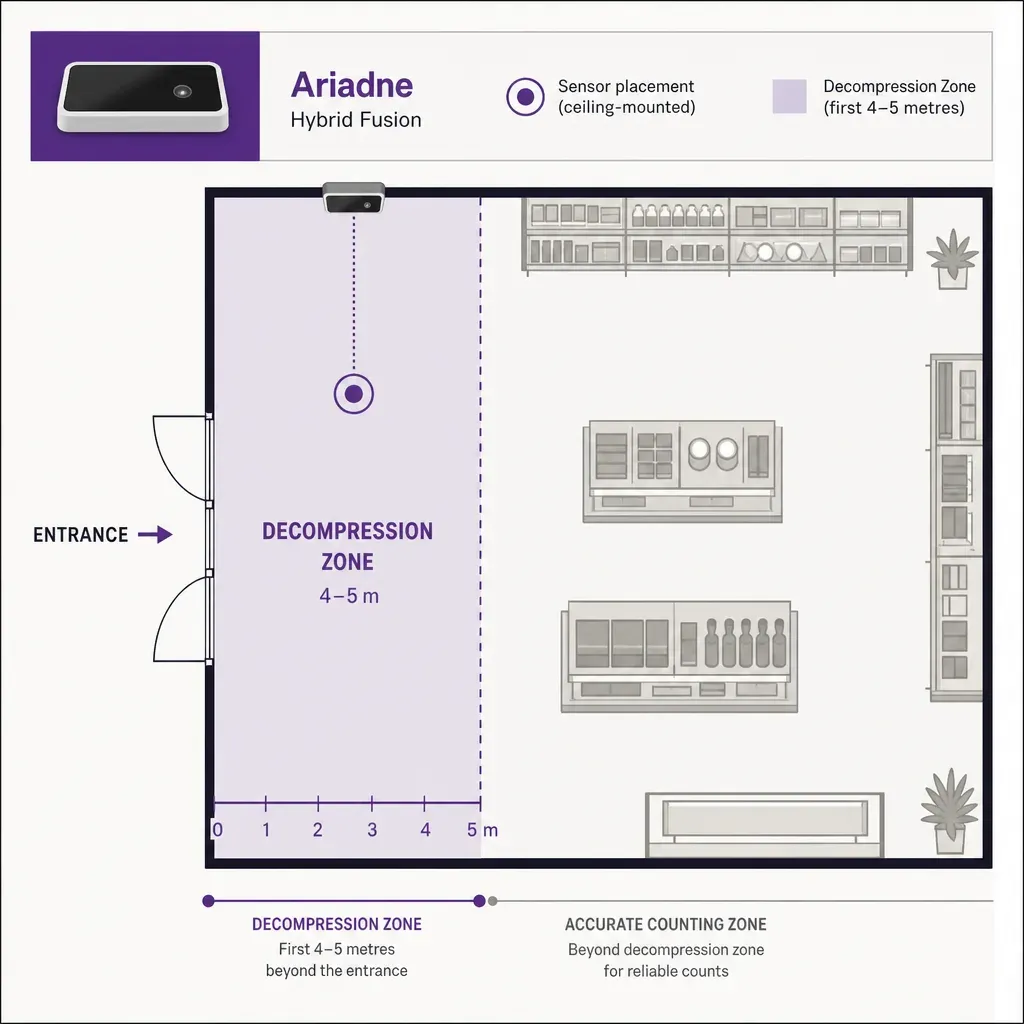
The defining property of the decompression zone is simple. Inside it, shoppers do not notice product the way they will notice it ten seconds later. Their eyes are still adjusting. Their pace is faster than their browsing pace. They are looking ahead, not sideways. Anything you put in this zone is going to be under-seen, under-touched, and under-bought, even if there is nothing wrong with the merchandise itself. That is the part most retailers find counterintuitive, and it is the part footfall and dwell data can quantify directly.
Why the first 4 to 5 metres are dead space
Three things are happening to a visitor in those first few seconds. Each of them works against any merchandising that lives inside the zone.
Sensory adjustment
The visitor has just walked out of a different light level, often a brighter or duller street, and into a different acoustic and thermal environment. The eyes need a few seconds to settle. Peripheral attention drops while that adjustment runs. A display set against the wall two metres past the door is, physiologically, hard to see in a way it would not be five metres further in.
Forward momentum
Pedestrians arriving from a street keep their walking pace for several steps after they cross the threshold. Retail anthropologists call this the carry-over from the outside cadence. A shopper at street pace does not browse. They scan ahead, look for cues about where to go, and only start to slow once they feel they are inside the shop, which is typically four to five metres in.
Orientation
The first job of the brain on entering a new space is to orient. Where is the till? Where is the staff? Where are the categories I came for? Until that question is answered, attention is allocated to layout, not to product. A fixture placed inside the orientation window competes with that work and tends to lose.
The exact depth of the zone is not a single number. It varies with door width, ceiling height, the contrast between street and interior, and the average pace of visitors arriving. Underhill's working figure is roughly four to five metres for a standard high-street store, longer for big-box formats with very wide entries, shorter for boutiques where the visitor knows the shop. The principle holds across formats: there is a length of floor near the door where the visitor is not yet shopping.
The merchandising cost of treating it as selling space
If you treat the decompression zone as ordinary selling space, you pay for it in two ways. The first is the loss on whatever you put there. A premium end-cap or a featured product in the first three metres is bought less than the same product placed ten metres in. The second is the loss on what visitors miss on the way past. A shopper who walks the first stretch on cruise control walks past displays they would have engaged with later, and many of them are gone before they reach the part of the store where their attention has actually arrived.
An illustrative way to see the size of the effect: imagine a store with 200 visitors a day that places a featured product in the first three metres past the entry and sells 6 units of it. The same product placed in the same store at the eight-metre mark might sell 10 or 11 units, because more visitors are now in browsing mode by the time they reach it. The numbers here are illustrative, not measured, but the direction of the effect is what every working store planner reports. The decompression zone is not a small effect at the margins. It is a structural feature of how visitors enter a shop.
Why staffing the zone can repel customers
If product in the decompression zone is under-bought, the temptation is to compensate with staff. A greeter, a clipboard, a sales associate stepping forward to ask if you need help. This is, on the same psychology, usually the wrong move. The visitor in the first few seconds is not ready for a conversation. They are still orienting. A staff approach inside this window reads as pressure, not service, and a measurable share of visitors will reverse course rather than commit to an interaction they did not invite.
The pattern is consistent enough that experienced store managers tend to position service staff just beyond the zone, around the four to five metre mark, where the visitor has slowed to a browsing pace and is more receptive to being approached. The decompression zone itself wants to be open, visually clear, and unstaffed. The visitor needs the space to land.
What footfall and dwell data show
The decompression zone has been understood qualitatively for thirty years. What has changed is that people counting and dwell-time measurement now make it possible to see the zone in a store's own numbers, rather than taking it on faith from a book. A counting system with sensors placed at the door and at points inside the store gives three pieces of evidence that, between them, settle the question for a given location.
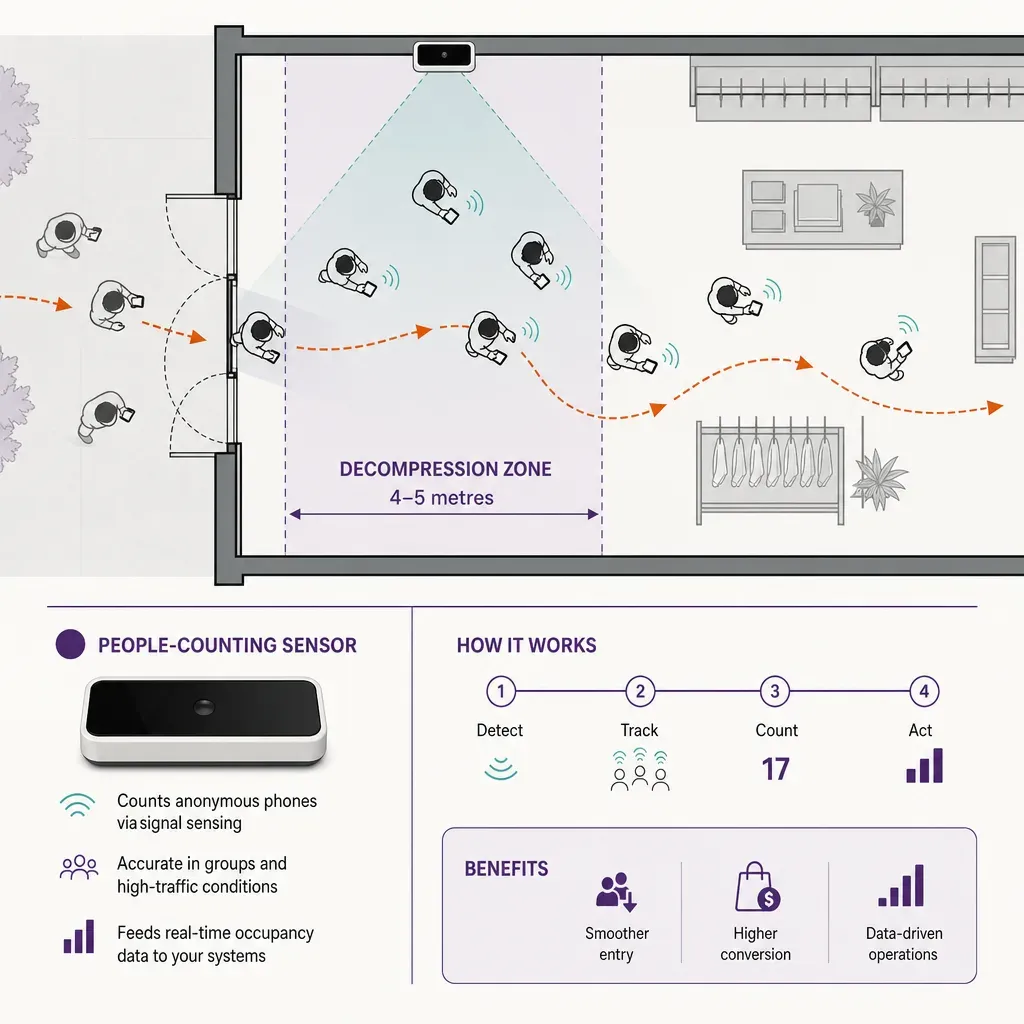
- Entry counts versus zone counts. The total number of visitors who cross the door is the baseline. The number of visitors who actually stop inside the first few metres, rather than continuing through, is the test. In most stores the second figure is dramatically lower than the first, in a way that is visible in the data the same day you start measuring.
- Dwell time at the front. Average time spent in the first zone tends to be a handful of seconds, far shorter than the dwell in zones further inside the store. That is what a transition space looks like in data: traffic without dwell.
- Conversion of front displays. Where a store has point-of-sale data tied to display position, the sales pulled per visitor passing a front display can be compared with sales pulled per visitor passing an interior display. The gap is typically wide and consistent. That is the cost of treating the decompression zone as selling space, expressed in units.
These are not exotic measurements. They are the same entry counts, zone counts, and dwell figures used for retail store analytics more broadly. The decompression zone is just one of the things they make visible. Most retailers, once they look, find that the front of their store is doing less work than they assumed and that the merchandising budget assigned to it has a poor return.
Designing around the zone instead of against it
Knowing the zone exists changes what to put in it. Working store planners tend to treat the first four to five metres as a landing strip rather than as selling space, and they shape it with three jobs in mind.
- Make the shop legible. The visitor's first need is to orient. Sightlines to the till, to category signage, to staff posted further in, and to the back of the store all matter more than any product in the zone. A clean, open front does this work.
- Anchor the eye further in. A focal display, a hero category, or a colour block placed beyond the zone gives the visitor something to walk toward. That is what pulls them through the transition and into browsing pace.
- Hold staff back. Position service staff at the boundary of the zone, not inside it. The visitor will arrive at them already in browsing mode, and the interaction lands differently.
Window displays, brand signage, and basket placement can sit inside the zone, because their job is not to be browsed in the first few seconds. They are read on the way past, registered peripherally, and serve the orientation work the visitor is already doing. The thing to avoid is high-margin, high-effort merchandising placed where it is statistically under-seen.
Measuring the zone without cameras
Quantifying the decompression zone in a real store needs two things: an entry count at the door, and a way to see how visitors distribute and dwell across the front of the floor. Both can be done without cameras, which matters because the front of the store is also the place where shoppers feel most observed and where any sense of being filmed pushes the bounce rate up rather than down.
Ariadne measures this with Hybrid Fusion, its patented camera-free method. Time-of-Flight depth sensing counts every visitor at the entrances, capturing geometry rather than images, while patented phone signal sensing follows movement through the interior, detecting the signals a phone emits even in airplane mode. The sensor streams both feeds to Ariadne, where Hybrid Fusion combines them into one trajectory per visit and computes counts, dwell, and paths. The streams carry no identifier: no MAC address, no device ID, no biometric data, and no camera is involved. Identifiers are stored only when a visitor explicitly opts in, which keeps the method GDPR-friendly and outside biometric territory.
In a retail context, the practical layout is straightforward. A Time-of-Flight sensor over the entry counts every visitor crossing the threshold. Additional sensors inside the store define zones, including a front zone for the decompression strip and one or more interior zones for the rest of the floor. Together they report entries, live occupancy, and dwell time per zone. The system carries no MAC address by default, no device ID, no faces, and no video, so there is nothing about it that changes how the visitor behaves inside the zone the measurement is trying to study. Sensor hardware is documented in the Ariadne sensor lineup, and the data handling sits in the privacy policy.
The same data feeds the wider questions a retailer asks of a store: capture rate, conversion by zone, the effect of a window change, and the way visitor flow moves around new displays. The decompression zone is one chapter of that, but it is the chapter most stores have the most room to act on, because it is structural and it shows up on day one of measurement.
Related reading
FAQ
What is a decompression zone in a retail store?
It is the stretch of floor immediately past the entrance, typically the first four to five metres, where shoppers are still adjusting from the outside environment and not yet browsing. The term was popularised by Paco Underhill's retail anthropology work and is now a standard concept in store planning. Inside this zone, visitors notice product less, walk faster, and respond poorly to staff approaches.
How deep is the decompression zone?
Roughly four to five metres for a standard high-street store, longer for big-box formats with very wide entries, shorter for boutiques and known-brand shops where the visitor arrives oriented. The exact depth varies with door width, ceiling height, light contrast, and the average pace of arrival. The simplest way to find the depth in a specific store is to measure dwell time across the front of the floor and look for the point where it rises.
Should I merchandise the decompression zone?
Not as primary selling space. Window displays, brand signage, and basket placement work inside the zone because they support orientation rather than ask for browsing attention. Featured product, end-caps, and high-margin promotions tend to underperform when placed in the first few metres, because most visitors walk past before their browsing mode has switched on.
Can I measure the decompression zone without cameras?
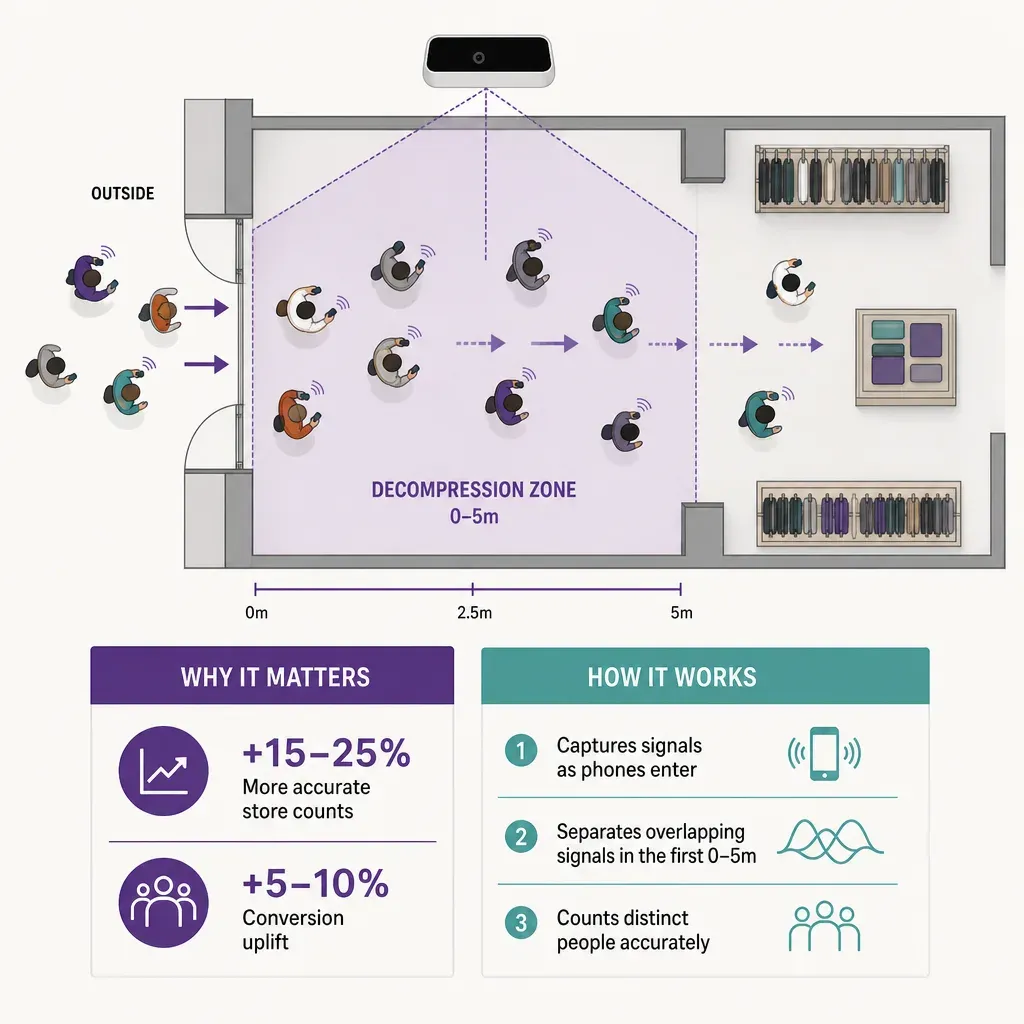
No. Ariadne counts with Hybrid Fusion: Time-of-Flight depth sensing plus patented phone signal sensing, never cameras. Time-of-Flight captures geometry rather than images, and signal sensing captures no MAC address by default, so the measurement involves no video, no faces, and no biometric data.


