
Eine Verweildauer auf Ladenebene sagt Ihnen, dass ein Besuch etwa elf Minuten dauerte. Sie sagt Ihnen nicht, dass acht dieser Minuten an eine Kassenschlange gingen und der Aktionstisch, um den Sie die Kampagne gebaut haben, zwanzig Sekunden bekam. Die durchschnittliche Besuchsdauer ist eine echte Zahl, aber sie verbirgt das, was ein Betreiber eigentlich beheben muss, nämlich wohin innerhalb des Besuchs die Zeit geht. Die Verweildauer pro Zone ist die Messgröße, die den Besuch öffnet und es Ihnen zeigt.
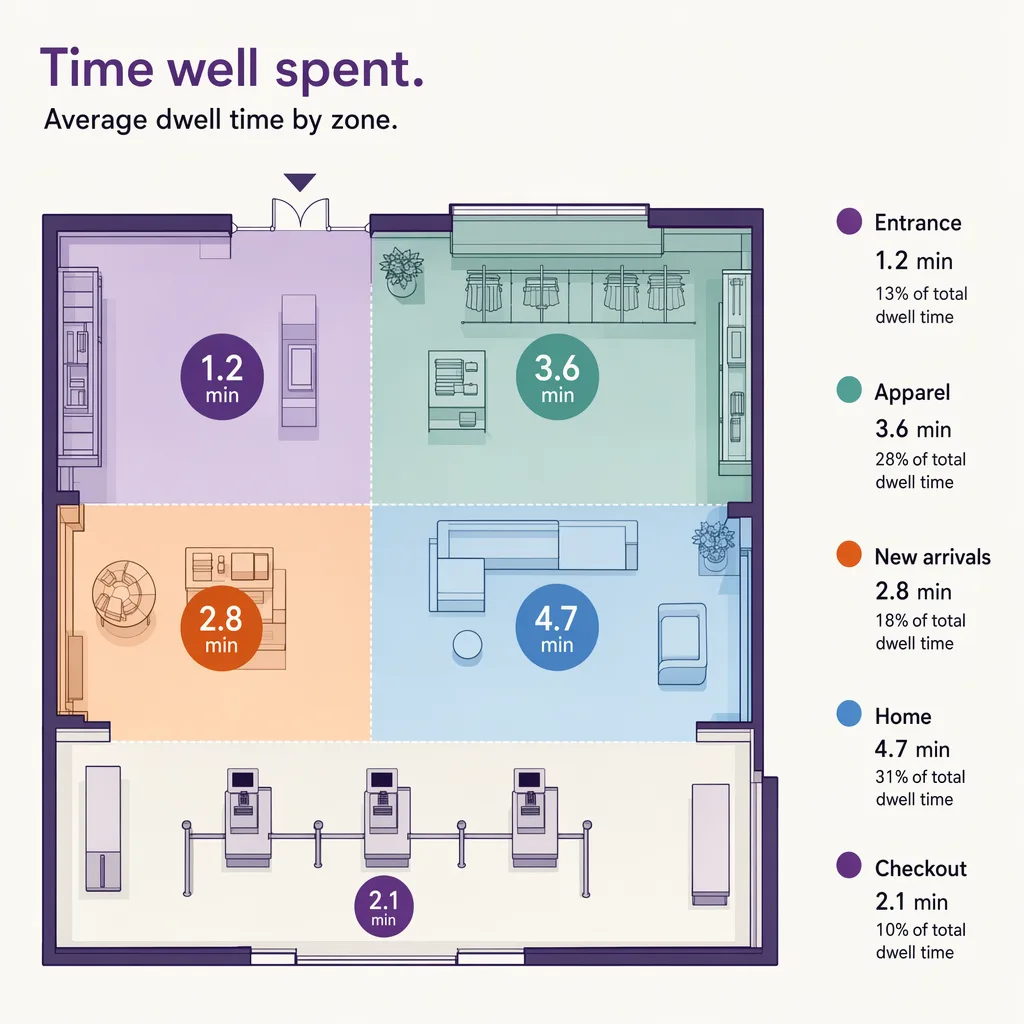
Dieser Beitrag definiert die Verweildauer auf Zonenebene, grenzt sie von der Ladenverweildauer ab, mit der sie oft verwechselt wird, legt dar, wie man aussagekräftige Zonen zieht, und liest die Muster, die die Zonenverweildauer erzeugt. Zu typischen Verweildauer-Zahlen auf Venue-Ebene siehe Benchmarks zur Verweildauer; dieser Beitrag ist der Fall unterhalb des Venues und wiederholt diese Zahlen nicht.
Was ist die Verweildauer pro Zone in einem Geschäft?
Die Verweildauer pro Zone ist die durchschnittliche Verweildauer innerhalb eines definierten Bereichs eines Geschäfts oder Venues: einer Abteilung, eines Gangs, eines Aktionstisches, einer Schlange oder eines Mall-Atriums. Die Ladenverweildauer sagt Ihnen, wie lange ein Besuch dauert; die Zonenverweildauer sagt Ihnen, wohin innerhalb dieses Besuchs die Zeit tatsächlich geht. Diese Unterscheidung macht sie nützlich: Eine Zone mit hoher Verweildauer, die schlecht konvertiert, kann auf Verwirrung oder eine Schlange hindeuten, während eine Zone mit niedriger Verweildauer, von der Sie erwarteten, dass sie funktioniert, schlecht platziert sein könnte. Sie zu messen erfordert eine auf Zonen aufgelöste Bewegung im Innenraum, nicht nur eine einzelne Eintrittszahl an der Tür.
Der Wert liegt ganz in der Granularität. Eine Ladensumme ist eine Zahl für den ganzen Besuch; die Zonenverweildauer ist eine Zahl für jeden Bereich, den der Besuch durchlief, und das erlaubt Ihnen, auf eine bestimmte Fläche zu reagieren, statt über den ganzen Verkaufsraum zu raten.
Ladenverweildauer vs. Zonenverweildauer: warum der Durchschnitt verbirgt, wohin die Zeit geht
Die Verweildauer auf Ladenebene und die auf Zonenebene beantworten verschiedene Fragen, und die erste kann die zweite nicht ersetzen.
Die Ladenverweildauer ist die Länge des gesamten Besuchs, vom Eingang bis zum Ausgang. Sie ist ein nützliches Gesundheitssignal: Steigende Ladenverweildauer geht oft mit Engagement einher, und sie ist die Zahl, in der Venue-Benchmarks angegeben werden, weshalb Benchmarks zur Verweildauer auf Venue-Ebene funktioniert. Aber sie ist ein Durchschnitt über den ganzen Verkaufsraum, sodass sie den Besuch auf eine Zahl abflacht und die interne Verteilung völlig verliert.
Die Zonenverweildauer erhält die Verteilung. Sie ordnet die Zeit jedem Bereich zu, sodass zwei Geschäfte mit einem identischen Elf-Minuten-Durchschnittsbesuch auseinandergelesen werden können: eines verteilte seine Zeit gleichmäßig über die Abteilungen, das andere verlor die Hälfte davon an eine einzige langsame Kasse. Die Ladensumme ist dieselbe. Die Diagnose ist entgegengesetzt. Das ist der Grund, die Verweildauer auf Bereichsebene zu messen, statt sich mit dem Durchschnitt zufriedenzugeben, und der Grund, warum die Zonenverweildauer eine eigenständige Kennzahl ist und nicht eine feinere Scheibe derselben.
Aussagekräftige Zonen definieren
Die Zonenverweildauer ist nur so gut wie die Zonen, die Sie ziehen, und eine schlecht gezogene Karte erzeugt Zahlen, die technisch korrekt und praktisch nutzlos sind. Eine Zone sollte einer Entscheidung entsprechen, die Sie über diesen Bereich tatsächlich treffen könnten. Die wiederkehrenden:
- Eingang und Dekompression. Der Streifen direkt hinter der Tür, wo ankommende Kunden langsamer werden und sich einstellen, bevor sie zu kaufen beginnen. Die Verweildauer hier ist erwartungsgemäß niedrig und im Übergang; sie als Verkaufszone zu behandeln liest sie falsch. Die Mechanik dieses Bereichs wird in die Dekompressionszone behandelt.
- Abteilungen und Kategorien. Die Hauptverkaufsflächen, gezogen passend dazu, wie der Verkaufsraum gestaltet ist, sodass die Verweildauer einer Kaufentscheidung entspricht.
- Aktionsflächen. Feature-Tische, End Caps und saisonale Displays, als eigene Zonen gehalten, damit eine Kampagne gegen die ihr gegebene Fläche gemessen werden kann.
- Schlangen und Servicepunkte. Kassen, Servicetheken und Anläufe zu Umkleidekabinen, wo die Verweildauer ein zu steuernder Kostenfaktor ist statt zu feierndes Engagement.
- Atrien und Gemeinschaftsflächen. In einer Mall die geteilten Räume zwischen Mietern, wo die Verweildauer die Anziehungskraft des Programms widerspiegelt statt eines einzelnen Geschäfts.
Das Prinzip über all diese hinweg ist, dass eine Zone ihren Platz auf der Karte nur verdient, wenn ein hoher oder niedriger Messwert ändern würde, was Sie tun. Eine Zone, auf die Sie nie reagieren würden, ist Rauschen.
Was die Zonenverweildauer diagnostiziert
Die Zonenverweildauer wird handlungsleitend, wenn Sie sie daran lesen, was Sie von der Zone erwartet haben. Die Lücke zwischen Erwartung und Messwert ist die Diagnose.
| Muster | Wahrscheinliche Ursache | Maßnahme |
|---|---|---|
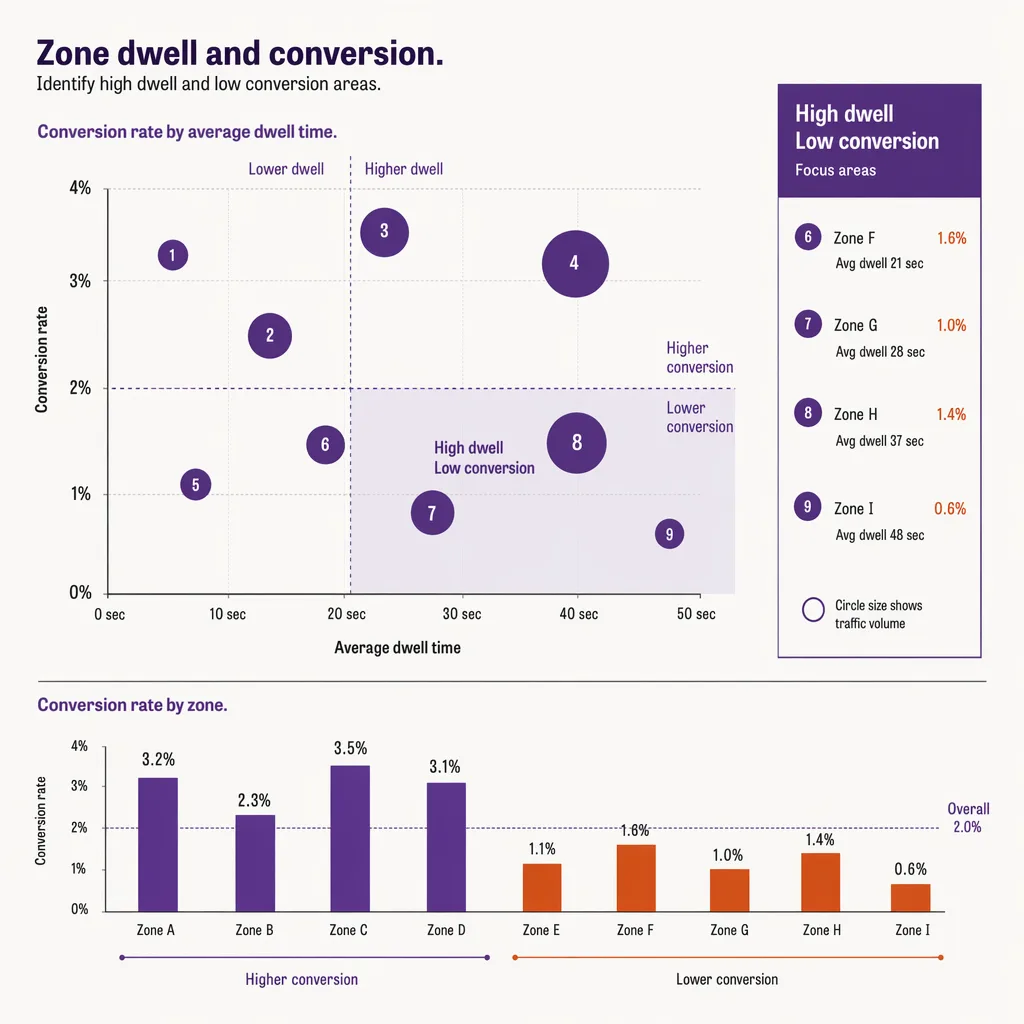
| Hohe Verweildauer, niedrige Conversion | Verwirrung, eine Schlange oder eine schwer zu navigierende Fläche | Beschilderung, Personalbesetzung und Bestand in der Zone prüfen; die Schlange direkt messen |
| Niedrige Verweildauer in einer Zone, von der Sie Wirkung erwarteten | Schlechte Platzierung, schwache Sichtlinie oder falsche Nachbarschaft | Die Fläche in den Hauptweg verlegen oder den Anlauf zu ihr verbessern |
| Steigende Verweildauer an einem Aktionstisch | Die Aktion zieht wie beabsichtigt Aufmerksamkeit | Die Platzierung halten und testen, sie in vergleichbaren Geschäften zu wiederholen |
| Lange Verweildauer an einer Kasse oder einem Servicepunkt | Eine Schlange baut sich auf | Personalabdeckung zu den Spitzenstunden ergänzen, die die Verkehrskurve zeigt |
Die erste Zeile ist die, die die Kennzahl ihre Berechtigung verdienen lässt. Hohe Verweildauer liest sich als gutes Zeichen, bis Sie sie mit der Conversion paaren, und an diesem Punkt kippt eine Zone mit hoher Verweildauer und niedriger Conversion von einem Erfolg zu einer Warnung: Die Menschen stecken dort fest, sind nicht engagiert. Eine Schlange, eine verwirrende Fläche oder eine Bestandslücke erzeugen alle diese Signatur, und keine davon ist in einem Ladendurchschnitt sichtbar. Der Fall der toten Zone ist das Spiegelbild: ein Bereich, in den Sie investiert haben und an dem Kunden ohne Pause vorbeigehen, was meist bedeutet, dass er abseits des Hauptwegs liegt oder seine Sichtlinie schwach ist. Die Zonenverweildauer findet beides, was eine einzelne Besuchsdauer-Zahl nie kann.
Zonenverweildauer mit Layout und Heatmaps
Die Zonenverweildauer ist eine aus einer Familie räumlicher Messgrößen, und sie ist am nützlichsten, wenn sie zusammen mit den anderen beiden gelesen wird statt allein. Eine Heatmap zeigt, wo Kunden sind, als Dichte; die Zonenverweildauer zeigt, wie lange sie bleiben, als Zeit. Die beiden sind verschiedene Fragen, und eine Zone kann dicht, aber schnell sein (eine Durchgangsfläche) oder dünn, aber langsam (ein Bereich mit überlegten Käufen), sodass Store-Heatmaps und die Zonenverweildauer zusammen einen Bereich vollständiger beschreiben als jede für sich.
Die Layout-Arbeit ist der Ort, an dem sie sich auszahlen. Eine Fläche, die lange Verweildauer zieht, aber abseits des Hauptflusses liegt, ist ein Kandidat zum Verlegen; ein stark frequentierter Weg ohne Verweildauer ist ein Kandidat zum Bestücken. Diese Schleife, räumliche Daten zu lesen und auf dem Grundriss zu handeln, ist Gegenstand von datengetriebene Layout-Optimierung. Die Zonenverweildauer speist auch die Bewegungssicht: zu wissen, wie lange Kunden in jedem Bereich verbringen, ist eine natürliche Erweiterung des Nachzeichnens von Kundenfluss zwischen Zonen, das die Abfolge der Bereiche abbildet, die ein Besuch durchläuft. Die Verweildauer fügt dieser Abfolge die Dauer hinzu.
Verweildauer auf Zonenebene ohne Kameras messen
Die Zonenverweildauer hat eine schwierigere Messanforderung als eine Ladensumme. Ein Zähler an der Türlinie kann Ihnen Eintritte und, mit einer Austrittszählung, eine durchschnittliche Besuchsdauer liefern, aber er kann die Zeit nicht Bereichen im Inneren des Geschäfts zuordnen, weil er den Innenraum nie sieht. Die Zonenverweildauer braucht eine Bewegung im Innenraum, die fein genug aufgelöst ist, um zu sagen, in welcher Zone ein Kunde war und wie lange.
Ariadne misst dies mit Hybrid Fusion, der patentierten kamerafreien Methode. Time-of-Flight-Tiefensensorik zählt an den Eingängen jeden Besucher und erfasst Geometrie statt Bilder, während die patentierte Signalerfassung die Bewegung im Innenraum verfolgt und die Signale erkennt, die ein Telefon aussendet, selbst im Flugmodus, und diese Bewegung auf etwa einen Meter genau auflöst. Der Sensor streamt beide Datenströme an Ariadne, wo Hybrid Fusion sie zu einer Trajektorie pro Besuch zusammenführt und Zählwerte, Verweildauer und Wege berechnet. Die Datenströme tragen keine Identifikatoren: keine MAC-Adresse, keine Geräte-ID, keine biometrischen Daten, und es ist keine Kamera beteiligt. Identifikatoren werden nur gespeichert, wenn ein Besucher ausdrücklich zustimmt, was die Methode datenschutzfreundlich und außerhalb des biometrischen Bereichs hält.
Weil die Bewegung im Innenraum auf etwa einen Meter auflöst und zentral zu einer Trajektorie pro Besuch verschmilzt, kann die Verweildauer einer Zone zugeordnet werden: Die Trajektorie zeigt, wie lange der Besuch in jedem von Ihnen definierten Bereich saß, ohne dass eine Kamera den Verkaufsraum beobachtet und ohne zu erfassen, wer jemand ist. Das erlaubt einem Betreiber, einen Gang mit hoher Verweildauer und niedriger Conversion oder eine langsame Kasse als Zeit an einem Ort zu lesen statt als ein Gesicht. Dazu, wie dieselbe Ebene die Bewegungsanalytik auf Zonenebene im ganzen Geschäft stützt, siehe Bewegungsanalytik auf Zonenebene.
FAQ
Was ist der Unterschied zwischen Ladenverweildauer und Zonenverweildauer?
Die Ladenverweildauer ist die Länge des gesamten Besuchs, vom Eingang bis zum Ausgang, als ein Durchschnitt ausgedrückt. Die Zonenverweildauer ordnet diese Zeit jedem Bereich zu, den der Besuch durchlief. Zwei Besuche mit derselben Gesamtlänge können ihre Zeit über die Zonen völlig unterschiedlich verbringen, und nur die Zonenverweildauer zeigt die Verteilung.
Wie definiert man eine Zone für die Verweildauer-Messung?
Ziehen Sie eine Zone passend zu einer Entscheidung, auf die Sie reagieren könnten: eine Abteilung, ein Aktionstisch, eine Schlange, ein Atrium oder der Dekompressionsbereich direkt hinter der Tür. Eine Zone verdient ihren Platz auf der Karte nur, wenn ein hoher oder niedriger Messwert ändern würde, was Sie über diesen Bereich tun. Zonen, auf die Sie nie reagieren würden, fügen Rauschen hinzu, keine Erkenntnis.
Was bedeutet hohe Verweildauer bei niedriger Conversion?
Es bedeutet meist, dass Kunden feststecken statt engagiert sind. Eine Schlange, eine verwirrende Fläche, eine Bestandslücke oder schwer lesbare Beschilderung können alle Menschen in einer Zone halten, ohne Verkäufe zu erzeugen. Hohe Verweildauer liest sich als positiv, bis Sie sie mit der Conversion paaren, und an diesem Punkt wird eine Zone mit hoher Verweildauer und niedriger Conversion zu einem Signal, diesen bestimmten Bereich zu untersuchen.
Brauche ich Kameras, um die Verweildauer pro Zone zu messen?
Nein. Ariadne zählt mit Hybrid Fusion: Time-of-Flight-Tiefensensorik plus patentierte Mobilfunksignal-Sensorik, niemals Kameras. Time-of-Flight erfasst Geometrie statt Bilder, und die Signalsensorik erfasst standardmäßig keine MAC-Adresse, sodass die Messung kein Video, keine Gesichter und keine biometrischen Daten umfasst.
Wie unterscheidet sich die Zonenverweildauer von einer Store-Heatmap?
Eine Heatmap zeigt Dichte, wo Kunden sind. Die Zonenverweildauer zeigt Dauer, wie lange sie bleiben. Eine Zone kann dicht, aber schnell sein, etwa eine Durchgangsfläche, oder dünn, aber langsam, etwa ein Bereich mit überlegten Käufen. Zusammen gelesen beschreiben die beiden einen Bereich vollständiger, als jede für sich es tut.


