
What a Time-of-Flight sensor actually is
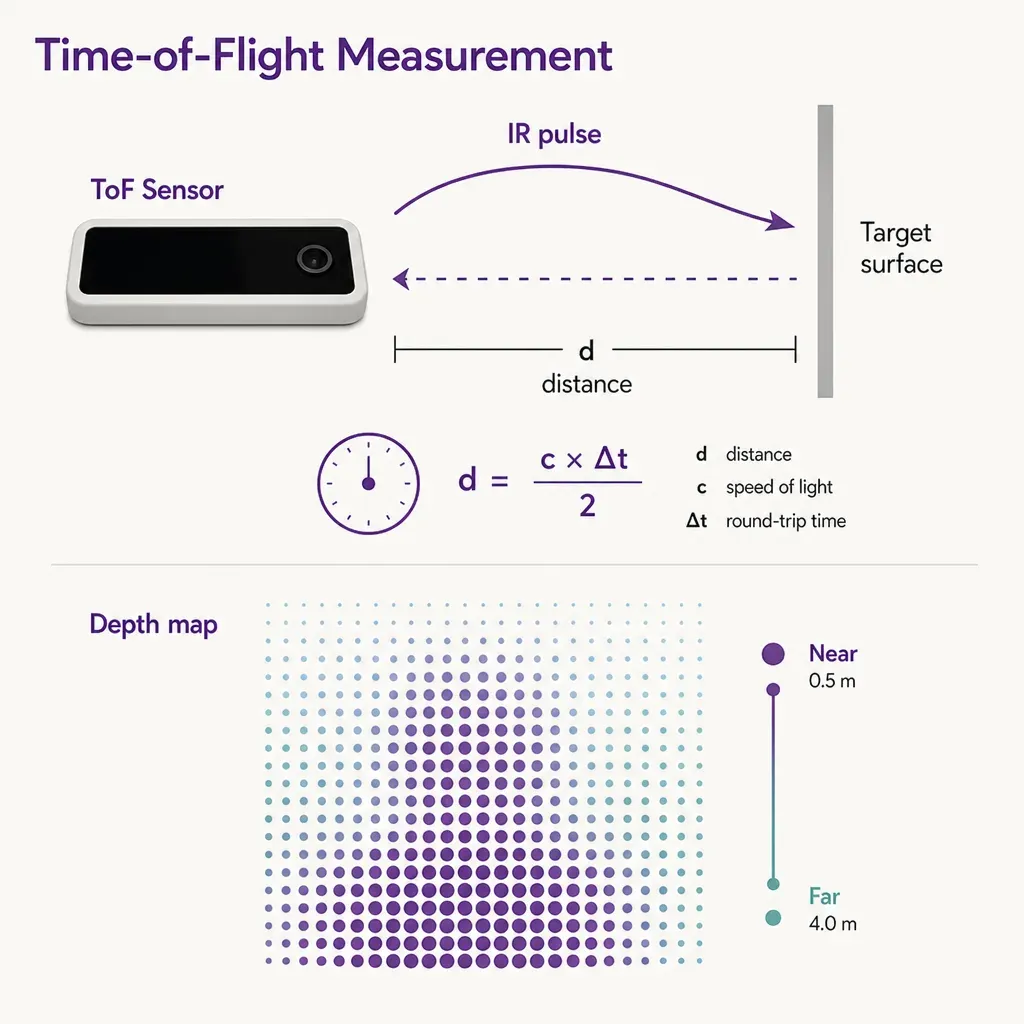
A Time-of-Flight sensor (ToF sensor) is a small device that measures distance by timing light. The name is the method: ToF stands for Time-of-Flight, the time a pulse of light takes to fly out to an object and back. It fires a short pulse of infrared light, waits for that pulse to bounce off whatever is in front of it, and notes how long the round trip took. Because the speed of light is known and constant, that one number, the time of return, converts directly into a distance. Repeat the measurement across a grid of points many times a second, and the sensor builds a depth map: a live picture of how far away every part of the scene is, in centimetres.
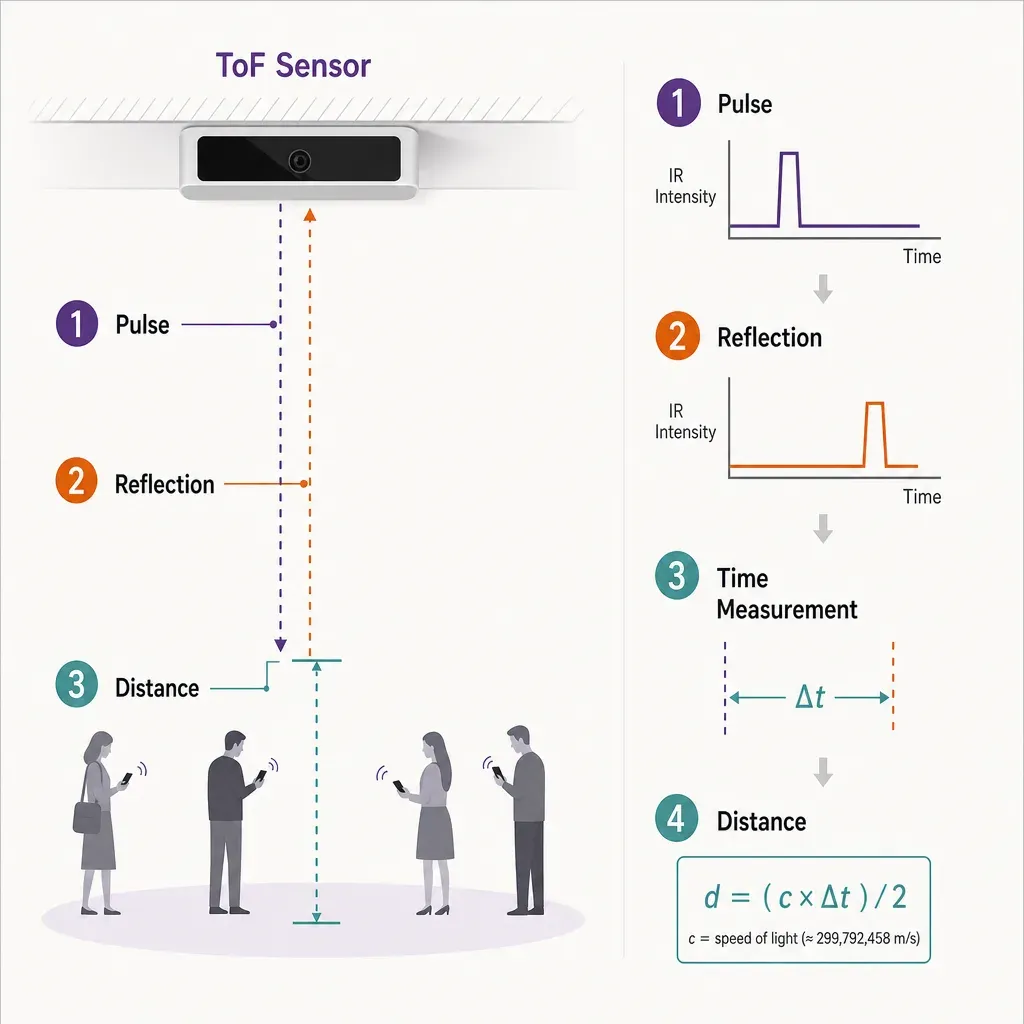
That is the entire principle. A ToF sensor is a tape measure that works with light instead of a ribbon, and it takes thousands of readings at once. The difference between a cheap consumer ToF chip and a sensor engineered for people counting is not the physics, which is the same, but the quality of the light source, the resolution and stability of the timing electronics, and the firmware that turns raw distance readings into something useful. The same principle runs phone camera autofocus, robot navigation, parcel dimensioning and machine safety. Our overview of time of flight sensor applications covers those uses. This guide stays with counting people.
This article is written for people who buy or specify counting sensors and want to understand the technology underneath, without an engineering background. We will walk through how a ToF sensor works, why it is different from a camera in ways that matter to privacy and to accuracy, the properties that decide whether it works well in a real building, and then take Ariadne's ToFu device as a concrete example of a ToF sensor in production use.
How a ToF sensor sees the world
A ToF sensor has three working parts. There is a light source, almost always an infrared laser or LED that emits light outside the range the human eye can see. There is an image sensor, similar in form factor to the one in a phone, but tuned to read the timing of returning light pulses rather than colour and brightness. And there is a processor that turns the raw timing data into a depth map and then into whatever the sensor is meant to report.
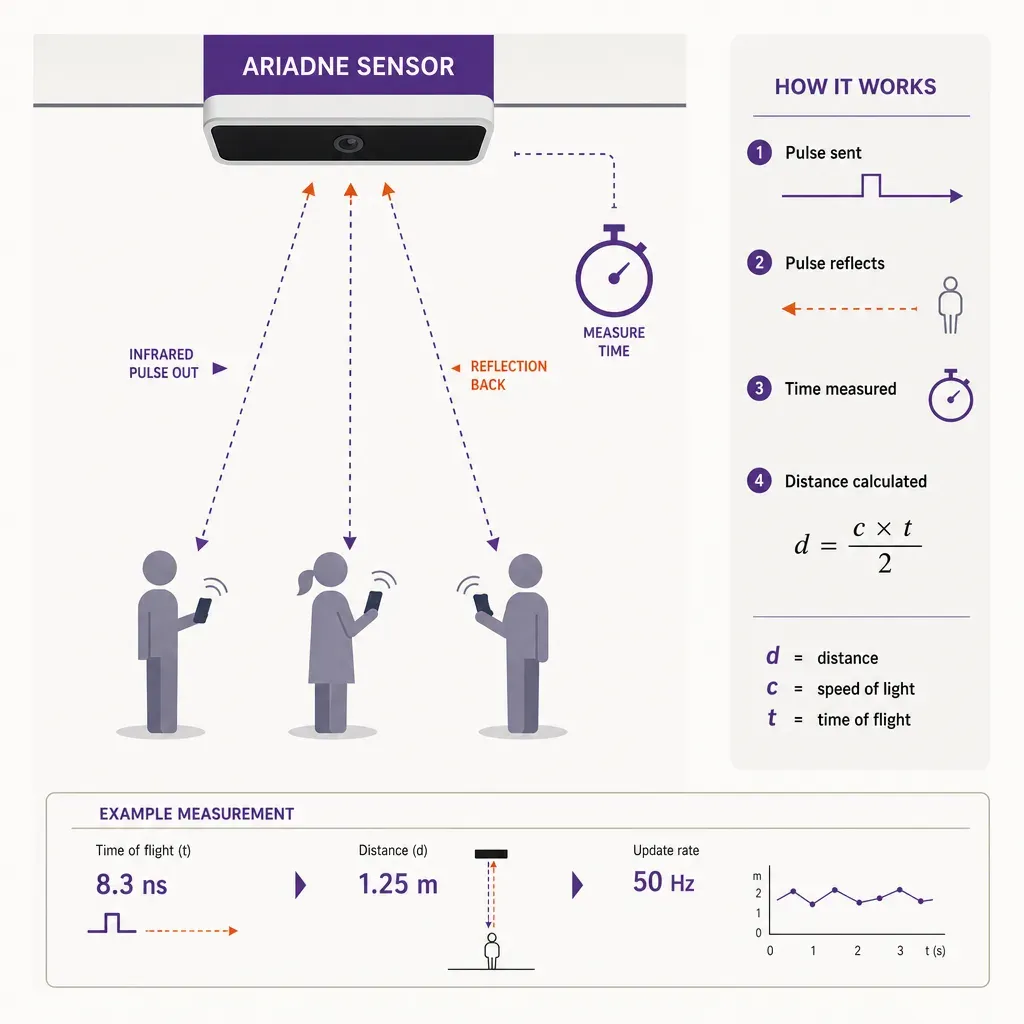
When the sensor fires a pulse, the light spreads out, hits the floor, walls, and any people or objects in the way, and a portion of it scatters back. For each pixel on the image sensor, the firmware records how long it took for light to come back to that pixel. Multiply that time by the speed of light and divide by two for the round trip, and you have a distance for that pixel. Do this for every pixel in the frame, several times a second, and the sensor produces a stream of depth maps: each frame is essentially a contour reading of the scene below.
A ceiling-mounted ToF sensor looking down at a doorway therefore sees the floor at one distance and the top of a person's head and shoulders at a shorter distance. Translating that into a count is then a question of geometry. The firmware looks for closed shapes at a height consistent with a human head and shoulders, watches them move through the count line, and increments an entry or exit counter when one crosses. There is no need to know who the person is, what they look like, or what they are carrying.
Why a ToF sensor is not a camera
It is easy to assume that anything ceiling-mounted with a lens must be a camera, and the engineering distinction is worth making clearly. A camera captures colour and brightness; a ToF sensor captures distance. The output of a camera is a recognisable image of the scene below, with faces, clothing, signage, and anything else the lens can see. The output of a ToF sensor is a depth map: a grid of distance readings, often visualised as a heat map or a contour plot, where the value at each pixel is a number of centimetres, not a colour or a brightness.
Three practical consequences follow from that distinction.
- No image of a person. Because the sensor records distance rather than light, there is no photograph or video frame to store, share, or leak. A depth map of a head and shoulders shows a roughly oval mound on the floor; it does not show a face, hair, clothing, or anything else that would let you recognise the person.
- No biometric data. Facial recognition and similar techniques work on the features a camera can see. A ToF sensor does not see those features at all, so there is nothing for a recognition model to work on. The sensor cannot identify a visitor even if you wanted it to.
- No pixels of a person in the usual sense. The pixels in a depth map are distance readings, not picture elements. Visualising them as a heat map is a presentation choice for engineers; the underlying data is geometry. There is no image to redact or anonymise because no image was ever formed.
That is the property that makes a ToF sensor useful as a building block of a camera-free counting system. The sensor produces enough information to count people accurately, and not enough information to identify any of them. There is nothing to anonymise later because nothing identifying was captured to begin with.
What makes a ToF sensor accurate in a real building
Physics gives you a distance reading; engineering gives you a useful one. Several properties decide whether a ToF sensor counts people reliably once it is mounted on a real ceiling.
Range and mounting height
Each ToF sensor has a working range, the band of distances over which its timing electronics give clean readings. A sensor with a maximum reliable range of around 4 metres can be mounted on a typical doorway ceiling or a low-ceiling shop floor and still see the top of a person's head clearly. Higher ceilings, such as those found in airports, malls, and public buildings, call for a sensor with a longer effective range or a careful choice of mounting position. The first specification to check on any ToF data sheet is the maximum mounting height at which counting accuracy still holds.
Spatial resolution
Resolution in this context is how many distance readings the sensor takes across the scene. A higher-resolution ToF sensor produces a finer depth map, which makes it easier for the firmware to separate two people walking close together, distinguish an adult from a child by head size, and ignore objects that are not people. Resolution matters most at doorways where flow is dense and two visitors often pass through within a half-second of each other.
Lighting independence
A camera depends on visible light: it struggles in low light, sees glare from a setting sun, and changes its readings as the lighting in a building changes through the day. A ToF sensor brings its own light source and only listens for that specific wavelength, so its readings are largely independent of the ambient lighting. The same sensor that counts visitors at a glass-fronted entrance at midday will count them just as well after dark, when shop blinds are down, or when the entrance is briefly hit by direct sunlight. For a 24/7 building, that stability is one of the strongest practical reasons to choose ToF over a vision-based method.
Shadow and reflection rejection
Camera-based counters are easily confused by shadows that move across the floor as the sun tracks across a glazed entrance, by reflections off polished marble, and by the bright stripe a doorway throws when the door swings open. None of those things change distance: the floor is still the floor whether it is shaded or lit. A ToF sensor reads the floor at one distance and a person at a different distance, and ignores the brightness pattern entirely. Shadows do not register as objects, reflections do not register as people, and the count stays stable in the lighting conditions that cause the most trouble for vision sensors.
Privacy by construction
Accuracy is not the only property a buyer cares about. A ToF sensor is also easier to defend in a privacy review than a camera-based counter, because there is no image of a visitor to store, transmit, or argue about. For a public building, a retail tenant, a school, or a hospital, that property removes a whole category of objection before a procurement conversation has even started. We covered the regulatory side of this in our note on biometric vs non-biometric counting.
Where ToF sits in a full counting system
A ToF sensor on its own is excellent at one job: counting people crossing a defined line, with high accuracy and without recording an image. That is enough for a door count, an entrance count, or an occupancy figure for a single space. A larger building, with several entrances and interior zones, needs the door counts joined into one picture of how visitors move through the floor plan. That is where the wider system matters.
Ariadne measures this with Hybrid Fusion, its patented camera-free method. Time-of-Flight depth sensing counts every visitor at the entrances, capturing geometry rather than images, while patented phone signal sensing follows movement through the interior, detecting the signals a phone emits even in airplane mode. The sensor streams both feeds to Ariadne, where Hybrid Fusion combines them into one trajectory per visit and computes counts, dwell, and paths. The streams carry no identifier: no MAC address, no device ID, no biometric data, and no camera is involved. Identifiers are stored only when a visitor explicitly opts in, which keeps the method GDPR-friendly and outside biometric territory.
The headline detail for an engineering reader: the ToF stream and the phone signal stream both come from one hardware unit, and the fusion that links the two streams into a single visit happens centrally in the Ariadne platform, not on the sensor. The sensor is responsible for capturing geometry and signal cleanly; the platform is responsible for turning those streams into counts, dwell times, and paths. The data leaving the sensor carries no images, no MAC addresses, and no device identifiers.
Ariadne's ToFu device as a worked example
Everything above is generic to the Time-of-Flight sensor category. To make it concrete, look at Ariadne's ToFu people counter as a specific implementation. ToFu is one hardware unit with a single Time-of-Flight sensor, designed to be mounted overhead at an entrance, a choke point, or an interior boundary. The same unit also performs the patented signal sensing that handles interior movement, so a building can be instrumented with one sensor family rather than separate boxes for separate jobs.
From a buyer's standpoint, three practical points follow from that design choice.
- One sensor, two streams. The depth stream from the ToF element handles entry and exit counting at the line under the sensor. The phone signal stream from the same unit handles movement in the surrounding area. The two streams are combined centrally to give counts, occupancy, and dwell per zone.
- Camera-free by construction. There is no camera anywhere in the unit. The ToF stream captures depth, the signal stream captures radio. Neither produces an image or a face. There is no video feed to store, retain, or share.
- Wired or PoE deployment. ToFu is designed to be installed on the ceiling and powered over Ethernet, which keeps the install footprint small for a retrofit. The wider Ariadne sensor lineup covers the variant choices and mounting options.
If you want to understand how the depth stream and the signal stream come together in software, the platform overview walks through Hybrid Fusion end to end. The privacy posture, including what is captured, what is stored, and what is opt-in, is set out in the privacy policy.
What to ask a ToF sensor vendor
If you are evaluating a Time-of-Flight people counter, the engineering questions worth putting to any vendor in writing are short and useful.
- What is the maximum mounting height for stated accuracy? Confirm the ceiling height in your building falls inside the band the data sheet supports.
- What is the spatial resolution of the depth map? Higher resolution helps where flow is dense and visitors often pass close together.
- Is the sensor independent of ambient lighting? A clean ToF design should count just as well at night, in direct sun, and with the lights off.
- Does any image, video, or face data leave the sensor? A camera-free ToF sensor should answer no. The data leaving the unit should be depth and counts only.
- Where does the counting fusion run? Confirm whether per-entrance counts and per-zone occupancy are joined inside each sensor or centrally in the vendor platform. Central fusion gives you a single picture of the building and a single place to govern data.
- How does the sensor handle reflective floors and glass walls? Ask for the failure modes the vendor has actually seen in production, not just the working range on the data sheet.
Related reading
- Time of Flight vs LiDAR: what actually separates them
- Direct vs indirect Time of Flight, explained
- ToF sensors in sunlight: why outdoor is hard
- Time of Flight cameras, explained
- Time of Flight sensor applications: from phones to factories
FAQ
Is a Time-of-Flight sensor a camera?
No. A camera records colour and brightness and produces an image; a Time-of-Flight sensor records distance and produces a depth map. The output of a ToF sensor is a grid of distance readings in centimetres, not a picture of the scene. There is no recognisable face, no identifiable person, and no video frame to store.
How does a ToF sensor count people without recognising them?
The depth map shows the floor at one distance and the top of a person's head and shoulders at a shorter distance. The firmware looks for shapes at the height of a human head, watches them cross a defined line on the floor, and increments the count. The sensor never needs to know who the person is, only that something of roughly human height crossed the line.
Does Ariadne's ToFu use multiple sensors?
No. ToFu is one hardware unit with a single Time-of-Flight sensor. The same unit also performs the patented phone signal sensing that handles interior movement, so a building can be instrumented with one sensor family rather than separate devices for separate jobs.
Does a ToF sensor work in the dark?
Yes. A ToF sensor brings its own infrared light source and only listens for that wavelength, so it does not depend on ambient lighting. The same sensor that counts visitors at midday will count them just as well after dark or when the lights are off.
Are cameras involved anywhere in Ariadne's counting?
No. Ariadne counts with Hybrid Fusion: Time-of-Flight depth sensing plus patented phone signal sensing, never cameras. Time-of-Flight captures geometry rather than images, and signal sensing captures no MAC address by default, so the measurement involves no video, no faces, and no biometric data.


