
Wenn Sie eine ShopperTrak Alternative suchen, geht es Ihnen meist nicht darum, einen Namen zu ersetzen. Sie möchten eine Reihe von Kompromissen ersetzen: was das System zählt, was es über die gezählten Personen aufzeichnet, wie es installiert wird und was es Sie über fünf Jahre kostet, sobald Abonnement und Support eingerechnet sind. Dieser Beitrag zeigt Ihnen, wie Sie jeden Zähler nach diesen Kriterien vergleichen, und dann, wo Ariadne, eine kamerafreie Option, im Vergleich dazu steht.
ShopperTrak ist ein reales und weit verbreitetes Produkt zur Personenzählung, vertrieben von Sensormatic Solutions (Teil von Johnson Controls). Es ist keine veraltete oder eingestellte Marke, ein Vergleich damit ist also ein Vergleich mit einem aktiven System. Alle Aussagen zu ShopperTrak unten stammen aus dessen öffentlicher Produktdokumentation. Wo eine Zahl von Ihrem konkreten Standort abhängen würde, ist die ehrliche Antwort, sie an Ihren eigenen Türen zu prüfen, statt einem Datenblatt zu vertrauen.
Vergleiche stützen sich auf öffentliche Dokumentation; es besteht keine Kundenbeziehung und es ist keine Herabsetzung beabsichtigt.
Was ist die beste ShopperTrak Alternative?
Die richtige ShopperTrak Alternative hängt davon ab, worauf Sie optimieren: Zählgenauigkeit, was das System über Besucher erfasst, das Installationsmodell und die Gesamtkosten über fünf Jahre. Ariadne ist eine kamerafreie Option, die mit Hybrid Fusion zählt, Time-of-Flight-Tiefenmessung an der Tür plus patentierter Telefonsignal-Erfassung im Innenraum, fusioniert in der Plattform, sodass die Messung standardmäßig keine MAC-Adresse, keine Geräte-ID und keine biometrischen Daten trägt. Vergleichen Sie jede engere Auswahl anhand der an Ihrem eigenen Standort verifizierten Genauigkeit, anhand dessen, was jedes System erfasst, und anhand der Fünf-Jahres-Kosten, nicht anhand des Listenpreises.
Es gibt keine einzelne "beste" Antwort, weil die Achsen in unterschiedliche Richtungen ziehen. Ein System, das am meisten über jeden Besucher erfasst, ist nicht automatisch das, das Sie wollen, wenn Ihr rechtlicher und betriebsrätlicher Rahmen klein bleiben muss. Ein günstiger Sensor ist nicht günstig, wenn er Verkabelung und eine separate Kamerainfrastruktur dahinter braucht. Der sinnvolle Schritt ist, jeden Kandidaten, ShopperTrak eingeschlossen, gegen dieselben vier Fragen zu halten und dann die beiden besten zu testen, bevor Sie unterschreiben.
Wie Sie jeden Anbieter zur Personenzählung bewerten
Bevor Sie sich ein konkretes Produkt ansehen, legen Sie die Kriterien fest. Diese vier entscheiden über den Kauf zuverlässiger als jede Funktionsliste.
Genauigkeit an Ihrem eigenen Standort, nicht auf einem Datenblatt
Jeder Anbieter bewirbt eine Genauigkeitszahl als Aushängeschild, und jede dieser Zahlen wurde unter Bedingungen gemessen, die möglicherweise nicht zu Ihrem Eingang passen. Breite Türen, gemeinsam ankommende Gruppen, Glasfronten bei starker Sonne und ein hektischer Mittagsandrang ziehen die reale Genauigkeit allesamt von der Laborzahl weg. Akzeptieren Sie weder ShopperTraks beworbene Zahl noch die von Ariadne noch die von irgendjemandem als gegeben. Führen Sie eine gleichwertige Zählung gegen eine manuelle Referenz an Ihrer eigenen Tür durch und lesen Sie wie Sie eine Genauigkeitsangabe an Ihrem eigenen Standort prüfen, bevor Sie den Test entwerfen.
Was das System über Besucher aufzeichnet
Dies ist die Achse, die Käufer am häufigsten überspringen und am häufigsten bereuen, übersprungen zu haben. Zwei Zähler können dieselbe Besuchszahl liefern und dabei sehr Unterschiedliches über die Menschen dahinter erfassen. Laut ShopperTraks öffentlichen Produktseiten umfasst dessen Retail-Analytics-Angebot Video-, Thermal- und Stereokamera-Sensoren sowie Zusatzfunktionen wie OrbitAI, Wiedererkennung von Kunden (Re-ID) und Schätzung demografischer Merkmale. Das ist eine legitime Designentscheidung für Einzelhändler, die diese Daten wollen. Es ist auch eine Entscheidung, die Sie dokumentieren müssen, denn das Erfassen von Bildern und das Ableiten von Merkmalen über Personen bringt Pflichten mit sich, die eine reine Zählung nicht hat. Entscheiden Sie, was Sie tatsächlich brauchen, bevor Sie entscheiden, wer es liefert.
Installationsmodell
Ein Sensor ist nur so einfach wie seine Montage, Verkabelung und Stromversorgung. Fragen Sie, ob ein Kandidat Power-over-Ethernet-Leitungen braucht, ob er am Türrahmen sitzen kann oder in einer festgelegten Höhe an der Decke montiert werden muss und ob eine kamerabasierte Einheit ihre eigene Aufzeichnungs- und Speicherinfrastruktur mitbringt. Die Installationszeile ist der Ort, an dem sich stille Kosten verstecken.
Fünf-Jahres-Kosten
Die Zahl, die zählt, ist nicht der Preis pro Tür. Es ist die Fünf-Jahres-Summe aus Hardware, Installation, Abonnement und Support für die Türen, die Sie tatsächlich haben. Für das vollständige Modell siehe die Aufschlüsselung der Gesamtbetriebskosten, und um konkurrierende Angebote wirklich vergleichbar zu machen, nutzen Sie die RFP-Fragen, die Anbieter vergleichbar machen.
ShopperTrak vs. Ariadne im Überblick
Die Tabelle vergleicht beide anhand der vier Achsen plus dem, was jedes System aufzeichnet. Die ShopperTrak-Zellen spiegeln dessen öffentliche Produktdokumentation wider. Die Ariadne-Zellen geben dessen kanonische Haltung wieder. Jede Zahl, die von Ihrem konkreten Standort abhängt, ist als dort zu prüfen markiert, denn nur dort ist sie real.
| ShopperTrak (Sensormatic) | Ariadne | |
|---|---|---|
| Erfassungsmethode | Video-, Thermal- und Stereokamera-Sensoren, laut ShopperTraks öffentlichen Produktseiten | Kamerafreie Hybrid Fusion: Time-of-Flight-Tiefe an der Tür plus patentierte Telefonsignal-Erfassung im Innenraum |
| Was es über Besucher aufzeichnet | Zählungen plus dokumentierte Zusatzfunktionen einschließlich OrbitAI, Kunden-Re-ID und Schätzung demografischer Merkmale, laut öffentlichen Produktseiten | Zählungen, Verweildauer und Wege ohne MAC-Adresse standardmäßig, ohne Geräte-ID, ohne biometrische Daten und ohne Ableitung demografischer Merkmale |
| Kamera beteiligt | Ja, kamerabasierte Sensoren laut öffentlicher Dokumentation | Keine Kamera |
| An Ihrem Standort verifizierte Genauigkeit | An Ihrem eigenen Standort gegen eine manuelle Referenzzählung prüfen | An Ihrem eigenen Standort gegen eine manuelle Referenzzählung prüfen |
| Grundlage der Fünf-Jahres-Kosten | An Ihrem eigenen Standort prüfen (Hardware, Installation, Abonnement, Support bezogen auf Ihre Türen) | An Ihrem eigenen Standort prüfen (Hardware, Installation, Abonnement, Support bezogen auf Ihre Türen) |
Die Zeile, bei der es sich zu verweilen lohnt, ist "was es über Besucher aufzeichnet". Eine standortübergreifende Kennung und die Schätzung demografischer Merkmale sind für manche Retail-Teams nützlich und für andere eine Dokumentationslast. Das ist die eigentliche Weggabelung zwischen diesen beiden Ansätzen, und es ist eine Entscheidung, die man bewusst treffen sollte, statt sie von einem Datenblatt zu erben. Für denselben Vergleich, angewandt auf einen weiteren kamerabasierten Retail-Analytics-Anbieter, siehe RetailNext auf dieselbe Weise verglichen, und für das breitere Feld Personenzählsysteme im Vergleich.
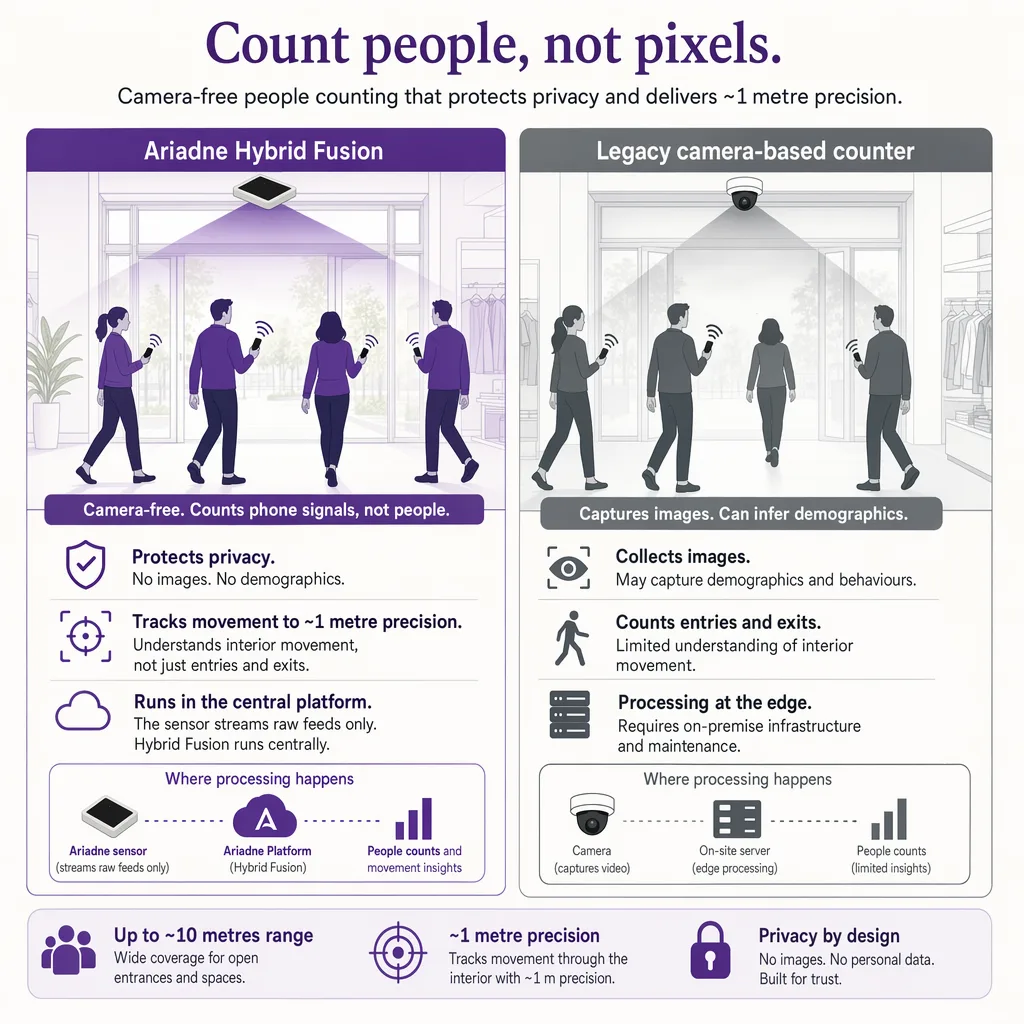
Worin sich Ariadne aus eigener Sicht unterscheidet
Der Kontrast hier beruht nicht auf irgendeiner Schwäche von ShopperTrak. Er beruht auf dem, was Ariadne tut: zählen ohne Kamera und ohne etwas über die einzelne Person zu erfassen.
Ariadne misst dies mit Hybrid Fusion, der patentierten kamerafreien Methode. Time-of-Flight-Tiefensensorik zählt an den Eingängen jeden Besucher und erfasst Geometrie statt Bilder, während die patentierte Signalerfassung die Bewegung im Innenraum verfolgt und die Signale erkennt, die ein Telefon aussendet, selbst im Flugmodus, und diese Bewegung auf etwa einen Meter genau auflöst. Der Sensor streamt beide Datenströme an Ariadne, wo Hybrid Fusion sie zu einer Trajektorie pro Besuch zusammenführt und Zählwerte, Verweildauer und Wege berechnet. Die Datenströme tragen keine Identifikatoren: keine MAC-Adresse, keine Geräte-ID, keine biometrischen Daten, und es ist keine Kamera beteiligt. Identifikatoren werden nur gespeichert, wenn ein Besucher ausdrücklich zustimmt, was die Methode datenschutzfreundlich und außerhalb des biometrischen Bereichs hält.
Weil keine Bilder erfasst werden und keine biometrische Identifizierung oder Kategorisierung stattfindet, fällt die Methode außerhalb der biometrischen Kategorien, die der EU AI Act als hochriskant einstuft. Es werden am Sensor von vornherein keine personenbezogenen Daten erhoben, es geht also nicht darum, Daten nachträglich zu anonymisieren. Diese Haltung ist der ganze Sinn eines kamerafreien Ansatzes: Sie ändert, was Sie dokumentieren müssen, wen Sie konsultieren müssen und wie lange Sie überhaupt etwas aufbewahren dürfen. Wenn Ihr Grund, ShopperTrak zu verlassen, darin besteht, dass Sie kein Kameranetz betreiben oder keine demografischen Merkmale erfassen wollen, ist dies die Achse, die es entscheidet.
Wie Sie einen gleichwertigen Test durchführen
Kaufen Sie einen Zähler nie auf ein Datenblatt hin. Kaufen Sie ihn auf einen Pilotversuch hin.
- Wählen Sie einen repräsentativen Eingang, idealerweise einen stark frequentierten mit der ungünstigen Geometrie, die Ihre anderen Türen teilen.
- Installieren Sie den Kandidatensensor und betreiben Sie ihn über ein festgelegtes Zeitfenster; eine volle Handelswoche ist ein sinnvolles Minimum.
- Erfassen Sie über dieses Fenster eine manuelle Referenzzählung für Stichprobenzeiträume, die sowohl ruhige als auch Spitzenstunden abdecken.
- Vergleichen Sie die Zählung des Sensors mit der manuellen Zählung für dieselben Zeiträume und notieren Sie den Fehler zur Spitzenzeit, nicht nur den Durchschnitt.
- Wiederholen Sie es für den zweiten Kandidaten an derselben Tür, wenn möglich, damit die Bedingungen übereinstimmen.
Führen Sie dasselbe Protokoll für ShopperTrak und für Ariadne durch, und die Frage der Genauigkeit beantwortet sich mit Ihren eigenen Zahlen von selbst. Für die vollständige Methode, einschließlich wie Sie die Stichprobe dimensionieren und den Fehler lesen, siehe die Methodik zum Genauigkeitstest. Wenn Sie bereit sind, Angebote zu vergleichen, legt Ariadnes kamerafreie Personenzählung den Messansatz an einer Stelle dar.
FAQ
Ist Ariadne ein direkter Ersatz für ShopperTrak?
Ariadne ist eine kamerafreie Alternative zur Personenzählung, die Zählungen, Verweildauer und Wegdaten liefert. Es unterscheidet sich von ShopperTrak in der Methode (keine Kamera) und in dem, was es aufzeichnet (keine Schätzung demografischer Merkmale und keine standortübergreifende Kennung). Ob es ein gleichwertiger Ersatz ist, hängt davon ab, welche ShopperTrak-Funktionen Sie tatsächlich nutzen; ordnen Sie also Ihre aktuellen Berichte dem zu, was jedes System erfasst, bevor Sie wechseln.
Brauche ich Kameras, um Personen genau zu zählen?
Nein. Ariadne zählt mit Hybrid Fusion: Time-of-Flight-Tiefenmessung plus patentierter Telefonsignal-Erfassung, nie mit Kameras. Time-of-Flight erfasst Geometrie statt Bilder, und die Signalerfassung erfasst standardmäßig keine MAC-Adresse, sodass die Messung ohne Video, ohne Gesichter und ohne biometrische Daten auskommt.
Verwendet ShopperTrak Kameras?
Laut ShopperTraks öffentlichen Produktseiten umfasst dessen Retail-Sensorreihe Video-, Thermal- und Stereokamera-Sensoren sowie dokumentierte Funktionen wie Kunden-Re-ID und Schätzung demografischer Merkmale. Das ist ein kamerabasierter Ansatz. Ariadne hingegen zählt ohne jede Kamera.
Wie vergleiche ich ShopperTrak und Ariadne hinsichtlich der Genauigkeit?
Vergleichen Sie keine beworbenen Zahlen. Installieren Sie beide an derselben repräsentativen Tür, betreiben Sie sie mindestens eine volle Handelswoche und prüfen Sie die Sensorzählung gegen eine manuelle Referenzzählung für Stichprobenzeiträume einschließlich Spitzenzeiten. Die Zahl, die Sie an Ihrem eigenen Standort messen, ist die einzige, die zählt.
Reduziert ein kamerafreier Zähler meine Datenschutzdokumentation?
Das kann er. Weil Ariadne keine Bilder und keine biometrischen Daten erfasst und standardmäßig keine Kennung speichert, gibt es nichts zu anonymisieren und kein CCTV-Material aufzubewahren, was üblicherweise einschränkt, was ein DSFA- und Betriebsratsprozess abdecken muss, im Vergleich zu einem kamerabasierten Zähler. Bestätigen Sie die Einzelheiten mit Ihrer eigenen Datenschutzleitung gegen Ihr aktuelles Setup.
---


