
QSR runs on throughput, not transactions
A quick-service restaurant lives and dies on how many people it can move through in a peak hour. The point-of-sale system already tells you transactions, but a transaction is the end of a journey, not the whole of it. It does not count the customer who walked up to a busy counter, looked at the line, and left. It does not separate the lunch rush from the steady afternoon drip. And it tells you almost nothing about the drive-thru lane, where most of the volume often sits. To staff a site to demand, plan a menu around peaks, and decide where to put labor between the lane and the counter, you need to count people, not just sales. That is what a people counting system gives a QSR operator: a continuous read on how many people the site is actually handling.
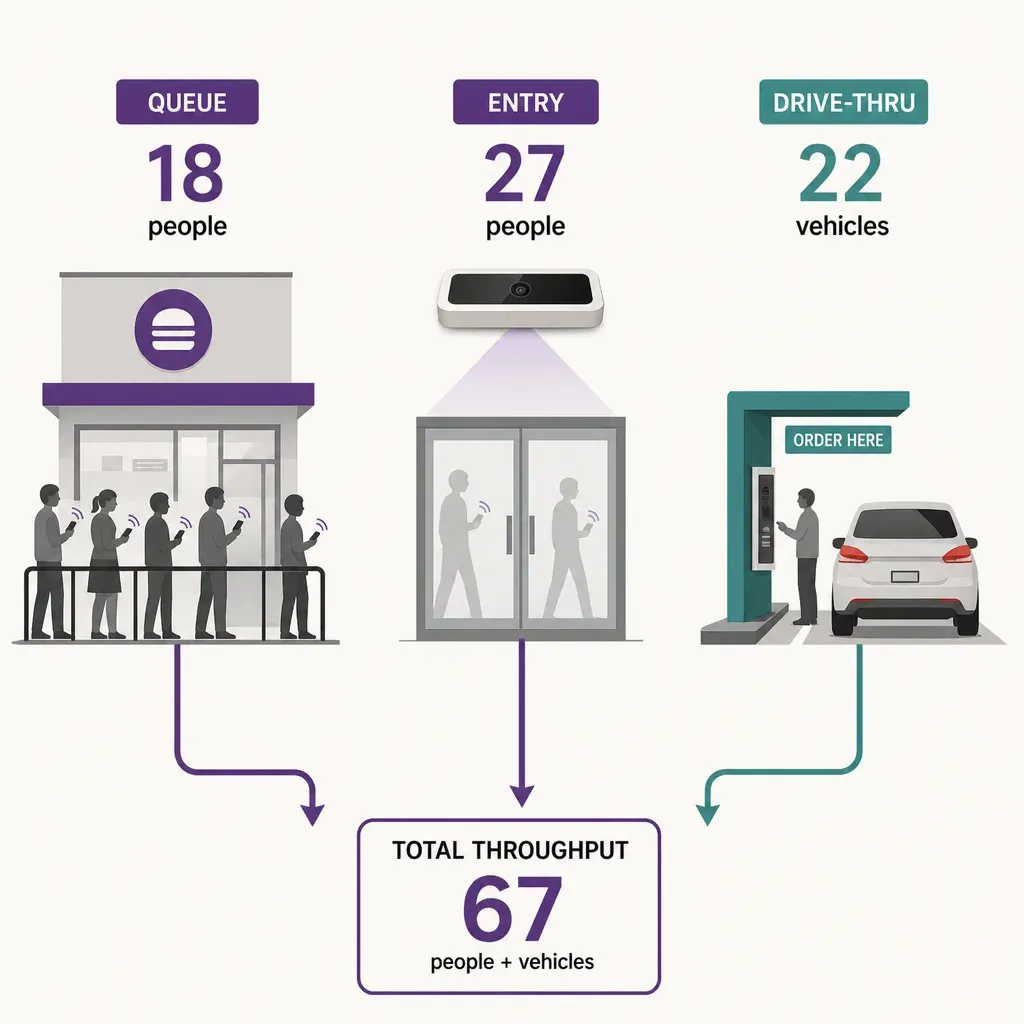
The most useful thing a counter does for a QSR is fold two numbers that managers usually track separately, entry traffic and queue load, into one operating metric: throughput. Throughput is how many people the site successfully serves per unit of time, measured against how many showed up to be served. Once you have that, the labor and menu decisions that used to run on instinct start running on a number.
Why entry and queue belong in one number
QSR operators tend to watch two counts. Entry traffic answers how many people came in or pulled into the lane. Queue load answers how long the line is and how fast it clears. On their own, each is half a picture. A site can have strong entry traffic and still lose sales if the queue stalls and people walk. A site can have a fast-clearing queue and still be underperforming if entry traffic has quietly dropped. Read together, against the same clock, they describe throughput: arrivals in, served out, and the gap between them.
That gap is where the money is. When arrivals climb faster than the line clears, the queue lengthens, balking starts, and you lose sales you never see in the point-of-sale data because the customer left before ordering. When the line clears faster than people arrive, you have staff standing idle. The throughput view shows both failure modes as they happen, so a manager can act in the shift rather than read about it in next week's report.
- Entry traffic. Counted at the door for in-store and at the lane for drive-thru, this is the top of the funnel: demand arriving at the site.
- Queue load and wait. How many people are waiting, and how long the line takes to clear, which is the constraint between demand and a completed order.
- Throughput. Arrivals served per period, read against arrivals counted, which exposes lost sales when the line backs up and idle labor when it does not.
Throughput against the labor schedule
Most QSR labor is scheduled off historical sales by daypart, which bakes in a circular problem: if the site was understaffed during a past peak and lost walk-aways, the sales record under-counts true demand, so the next schedule under-staffs the same peak again. Counting arrivals breaks that loop. You schedule against people who showed up, not only against people you managed to serve.
Used illustratively, the pattern is easy to picture. Suppose a site logs 600 arrivals across a lunch peak but its throughput shows it cleanly served only 480 of them before lines stalled. That 120-person gap is not noise; it is demand the current schedule could not absorb. The same data, read the other way, flags the mid-afternoon hour where arrivals fall to a trickle but the schedule still carries a full counter team. (These figures are illustrative, to show the shape of the decision, not measured results from any Ariadne site.) The point is that throughput turns a vague sense of busy into a staffing input you can defend to a regional manager.
Counting also resolves the question of where labor should sit. A site running both a counter and a drive-thru is really two service lines competing for the same crew. If lane arrivals are climbing while in-store entries are flat, the throughput data says move a person to the window, not the till. That call is hard to make from sales mix alone, because sales mix tells you what was sold, not where the unserved demand was building.
Peak-hour menu and operations decisions
Once throughput is measured by daypart, it stops being only a labor tool and becomes an operations one. A few decisions that get easier:
- Menu simplification at peak. If throughput collapses at the same daypart every week, a limited peak-hour menu or a pared prep list can lift served-per-hour without adding a single staff member.
- Order-ahead and kiosk placement. Entry counts that outrun queue capacity are the case for pushing mobile order-ahead or adding a self-order kiosk, sized to the gap rather than to a hunch.
- Promotion timing. A daypart promotion belongs in a window where the site has spare throughput, not one where the line is already the constraint, or it simply lengthens the queue and pushes balking up.
- Prep and inventory. Arrival curves by daypart, gathered over weeks, give the kitchen a forward read on when to have product staged, instead of reacting once the line forms.
Drive-thru versus in-store
The split between the lane and the dining room is the defining throughput question for most QSR formats, and it is the one point-of-sale data answers worst. A drive-thru order and an in-store order can ring up identically while the journey behind them is completely different: a lane has its own arrival pattern, its own queue dynamics, and its own choke point at the window. Counting each path separately lets an operator see, for example, that lane arrivals peak twenty minutes before in-store entries do, which changes when you pre-position the crew.
Counting both paths against one clock also surfaces substitution. When the lane backs up, some customers divert inside, and some leave entirely. A site that counts only sales sees a normal day; a site that counts arrivals on both paths sees the diversion and the walk-away, and can decide whether the answer is a second lane, a faster window, or simply more crew at the right hour.
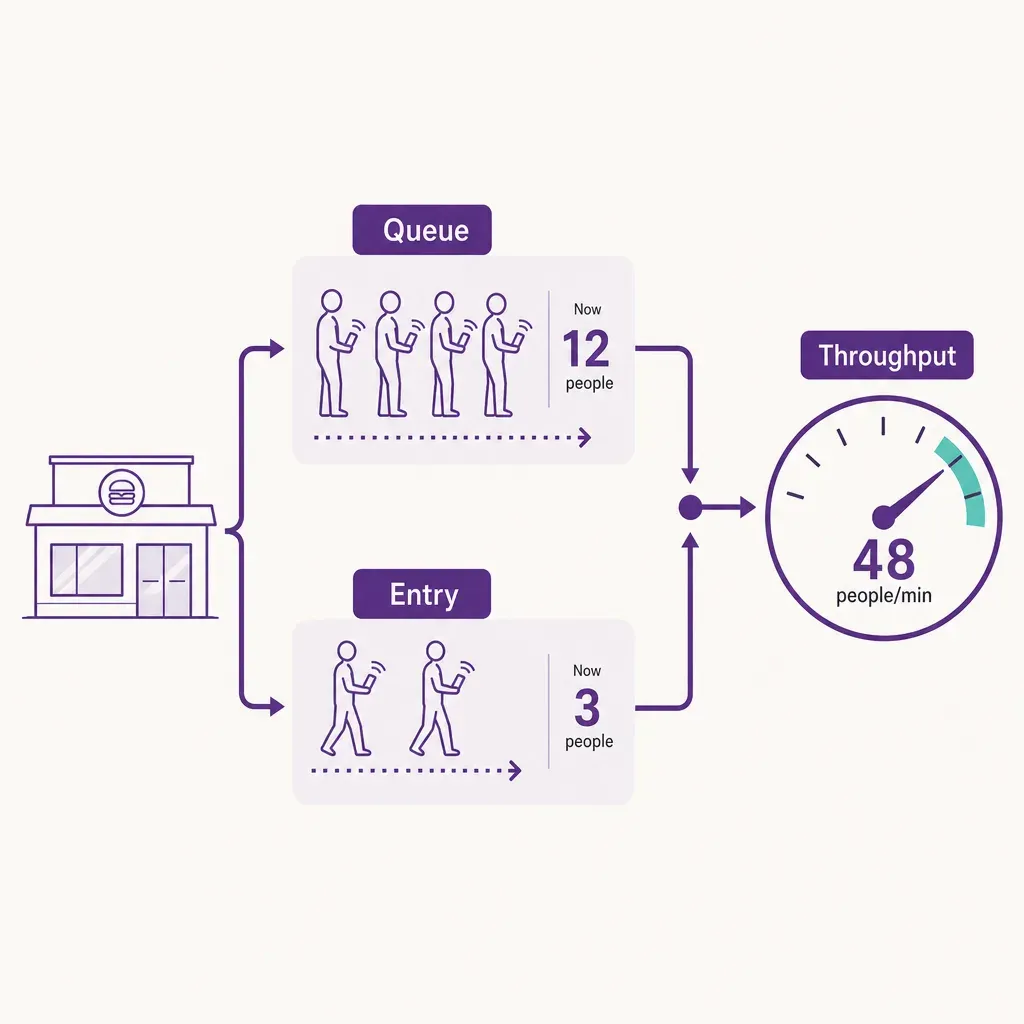
The same throughput thinking maps onto adjacent retail formats. A QSR unit inside a mall food court or a transit hub behaves a lot like a high-velocity counter in a store, where capture and conversion against passing traffic decide the day. The principles carry over to wider work on footfall and conversion in retail.
How Ariadne counts in a QSR
Ariadne measures throughput with a single sensor unit per counting point, designed so that nothing identifying is captured at any stage.
Ariadne measures this with Hybrid Fusion, its patented camera-free method. Time-of-Flight depth sensing counts every visitor at the entrances, capturing geometry rather than images, while patented phone signal sensing follows movement through the interior, detecting the signals a phone emits even in airplane mode. The sensor streams both feeds to Ariadne, where Hybrid Fusion combines them into one trajectory per visit and computes counts, dwell, and paths. The streams carry no identifier: no MAC address, no device ID, no biometric data, and no camera is involved. Identifiers are stored only when a visitor explicitly opts in, which keeps the method GDPR-friendly and outside biometric territory.
For a QSR, that lands in a few practical ways. One Time-of-Flight sensor mounted over a door or a lane counts every arrival by reading geometry, so it works whether or not a customer carries a phone, and it never forms an image of anyone. Inside, the patented signal sensing is what resolves a family arriving as one car or one walk-in into the right number of people, so a four-person group at the lane is not undercounted as a single order. The fusion that turns those two streams into queue length, wait, and throughput happens centrally in the Ariadne platform. Because the streams carry no MAC address by default and no device identifier, there is no personal data sitting in the count, and identifiers are stored only when a customer explicitly opts in, for example through a guest Wi-Fi login that a QSR can simply not offer. The sensor hardware sits in the Ariadne sensor lineup, and the data handling is set out in the privacy policy.
What to ask before you buy
If you are evaluating a counter for a QSR estate, these are the questions worth putting to any vendor in writing before a trial.
- Does it count both the door and the lane? A QSR with a drive-thru needs each path counted separately and read against the same clock, not a single building total.
- Can it tie entry to queue in one view? The value is throughput, arrivals served against arrivals counted, so confirm the system reports queue and entry together rather than as two disconnected dashboards.
- Does it count groups correctly? Ask how a four-person group arriving together is resolved, so a single car or party is not logged as one person.
- Is there a camera anywhere in the path? A method built on one Time-of-Flight sensor plus signal sensing avoids cameras entirely, which is the cleanest answer for a customer-facing food site.
- Does it report in real time? Shift-level labor moves need a live read, not a count you read the next morning.
- Will the data export to your labor and BI tools? Throughput is only useful if it flows into the scheduling and reporting systems your operations team already runs.
Related reading
FAQ
Does a QSR people counter use cameras?
No. Ariadne counts with Hybrid Fusion: Time-of-Flight depth sensing plus patented phone signal sensing, never cameras. Time-of-Flight captures geometry rather than images, and signal sensing captures no MAC address by default, so the measurement involves no video, no faces, and no biometric data.
How is this different from my point-of-sale data?
Point-of-sale data records completed transactions, which is the end of a customer journey. A people counter records arrivals at the door and the lane, queue length, and wait, which is the journey before the sale. The gap between arrivals and transactions is where lost sales hide: the customer who saw the line and left never appears in your point-of-sale system, but a counter sees them. Read together, the two sources tell you not just what you sold but how much demand you could not serve.
Can it separate drive-thru traffic from in-store?
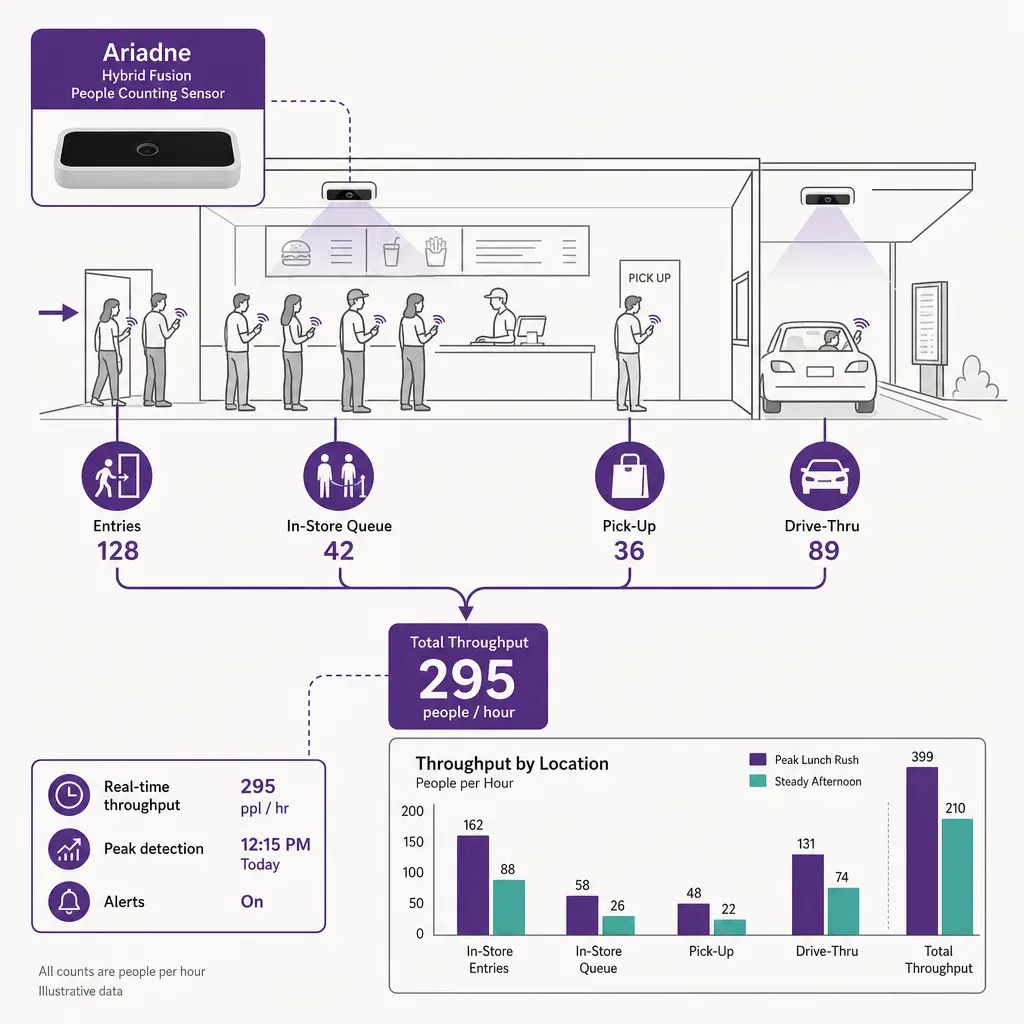
Yes. Each counting point is its own zone, so a sensor over the lane and a sensor over the door report separately, with their own arrival patterns, queue load, and throughput. That separation is what lets an operator see when lane demand and in-store demand peak at different times, and move crew to the path that needs it.


