
Why the post-visit window decides the message
A push notification sent after a store visit is one of the few moments where a retailer can speak to a customer with full context. The visit happened. The customer was inside the building, walked a route, dwelled in zones, possibly bought something, possibly did not. Everything the message can say sits against that recent memory. The question is not whether to send a post-visit push. The question is when. The same message lands differently at T plus one hour, T plus one day, and T plus one week, because the customer is thinking about a different thing in each window.
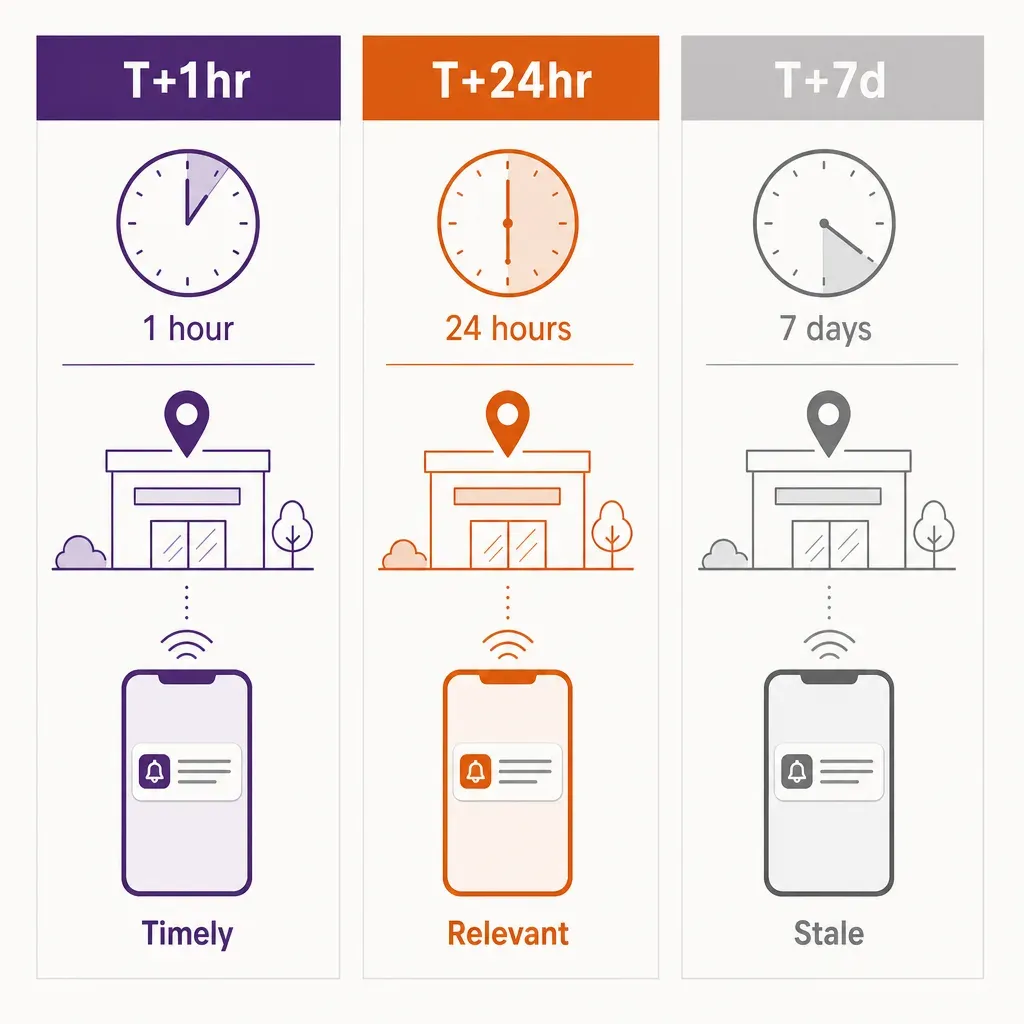
This post is a decision framework for choosing among the three windows. It does not invent open or conversion numbers, and it does not name retailers. The ranges quoted below are illustrative of what a typical retailer running visitor marketing against measured store visits tends to see. The point is the shape of the trade-off, not a benchmark you should hold yourself to before you have run your own programme.
What you need before you can time a post-visit push
The framework below assumes you can answer four things about each customer message. None of them are trivial, and most retailers under-invest in the first one.
- A reliable visit signal. You need to know the visit happened, when it ended, and ideally which store. App-based check-in is the cleanest source. A geofence exit event is the next-cleanest. A point-of-sale receipt only covers buyers and is late. Linking a store-level visit count to a CRM identity needs an opt-in path; see the privacy notes below.
- A dwell or zone signal, if you have one. The richer the in-store signal, the better the post-visit message can be. A visitor who dwelt in the kitchen department for eight minutes is a different audience to one who walked the perimeter and left in ninety seconds. Per-zone occupancy and dwell from a people counting system gives you that audience split without putting an identifier on the floor.
- A purchase signal, if available. Knowing whether the visit ended in a transaction reframes the message. A buyer gets a thank-you and a relevant cross-sell. A non-buyer gets a reason to come back.
- A control group. Every send needs a holdout. Without a control, you cannot tell whether the message moved behaviour or whether the customer would have come back anyway.
T plus one hour: the recovery window
The first window opens roughly when the visit ends and closes within an hour or two. The customer has just left. They remember the trip, the aisle they could not find, the queue they waited in, the item that was out of stock. This is the only window where you can credibly act on the visit itself rather than on a model of what the visit meant.
What T plus one hour is good at
- Friction recovery. If a visit lasted three minutes and ended at the entrance, something probably did not work. A short message that asks one question and offers help can pull a customer back into a conversation before frustration hardens.
- Out-of-stock follow-up. If a customer dwelt in a specific department and the inventory system knows what was sold out there, a notification offering an online order or a notify-when-back link is concrete and helpful.
- Buy-online-pick-up-in-store nudge. For a customer who browsed but did not buy, a one-hour nudge with the item they spent the most time near, available for collection tomorrow, is the closest a retailer gets to recovering a lost sale.
- Service recovery for long queues. If live data shows the store was over capacity during the visit, a brief acknowledgement and a small offer can reset the experience without a complaint ever being filed.
What T plus one hour is bad at
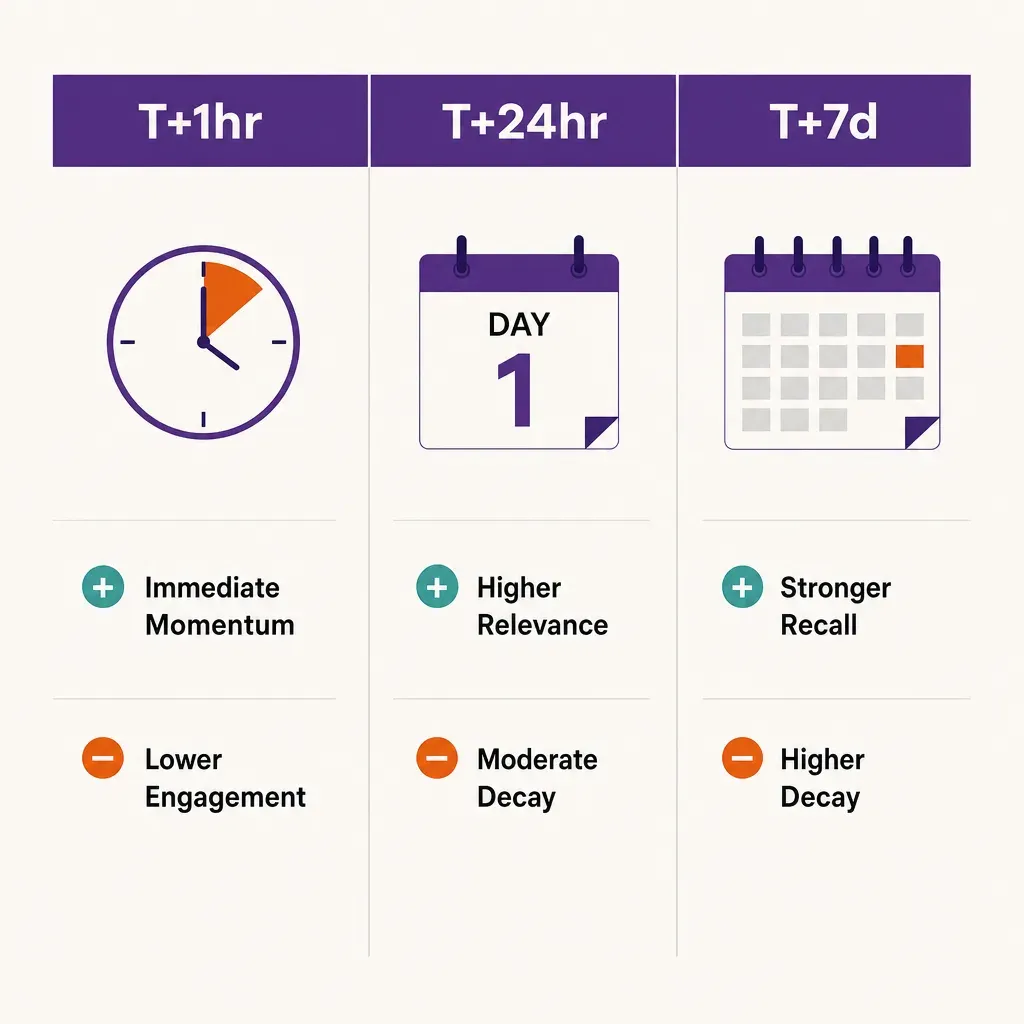
Generic promotional sends in this window feel like the store is watching. A customer who walked out of a shop and gets a 10 percent off coupon ten minutes later is more likely to notice the surveillance than the discount. Reserve this window for content that earns its timing.
What to measure
Open rate is the wrong primary metric here, because the message is read against fresh memory and many opens never convert to a click. The metrics that matter are click-to-action on the specific offer, online or pick-up conversion within twenty-four hours, and the rate of one-star feedback. Treat a high feedback or unsubscribe rate as a stop sign: T plus one hour is the easiest window to make the customer feel followed.
T plus twenty-four hours: the reminder window
The second window opens roughly a day after the visit. Memory of the trip is still present but no longer raw. The customer has had time to think about whether they actually want the thing they considered. This is the window where most retailers do the bulk of their post-visit messaging, because it gets the highest open rates without feeling intrusive.
What T plus twenty-four hours is good at
- Considered-purchase follow-up. Furniture, appliances, electronics, mid-ticket fashion: the customer almost never decides on the day. A reminder twenty-four hours later, with the item they spent the most time near and a short reason to choose now (price hold, available colour, free delivery slot), is timed to the actual decision.
- Cross-sell from a confirmed purchase. If a customer bought yesterday, a related item recommendation is more welcome a day later than ten minutes after they paid, because the decision feels settled rather than upsold.
- Review and feedback prompts. Twenty-four hours is enough time for the experience to be considered, and short enough that the detail is still recoverable. Reviews collected in this window tend to be more specific and less polarised than ones collected a week later.
- Loyalty reinforcement. Confirming points earned, threshold reached, or status retained reads as a courtesy at this distance and as a sales push closer to the visit.
What T plus twenty-four hours is bad at
It is not the right window for a friction recovery message. By a day later, the customer has either moved on or quietly written you off. It is also weak for time-sensitive store events: the same-day promotion is over by the time the push arrives.
What to measure
Open rate is a fair primary metric in this window, because the customer is choosing whether to re-engage at all. Click-to-action remains the conversion metric. The unique metric for this window is incremental purchase rate measured against the control: did the cohort that received the reminder buy at a higher rate over the next seven days than the holdout that did not receive it?
T plus seven days: the return-visit window
The third window opens around a week later. Specific memory of the visit has faded. What remains is the relationship with the store. Messaging here is about pulling the customer back into the building, not about acting on the last trip.
What T plus seven days is good at
- Return-visit prompts tied to cadence. If a customer typically visits every two to three weeks, a seven-day touchpoint sits ahead of the next expected visit and can move it forward.
- Category replenishment. Groceries, beauty, pet, kids: a week is roughly the cycle for several routine categories. A message that hits replenishment timing rather than promotional cadence reads as useful.
- New stock and event invitations. By a week later, the inventory is genuinely different. A message about new arrivals in the customer's most-dwelt department is anchored in something real, not invented urgency.
- Win-back early signals. For a customer who used to visit weekly and did not return in the next seven days, a soft re-engagement here costs less and works better than a heavy win-back campaign two months later.
What T plus seven days is bad at
Anything that needed to be said within the visit is gone. The customer will not act on a service recovery offer a week later, will probably not return a specific item they only half-considered, and will almost certainly find a same-day promotion irrelevant. Use this window for cadence, not for residue.
What to measure
Return-visit rate is the metric this window owns. Compare the seven-to-fourteen-day return-visit rate of the messaged cohort against the holdout, measured with the same store-visit signal you used to trigger the send. Open and click rates are diagnostic only.
Varying the choice by category
The three windows are not equally weighted across categories. A useful exercise before designing a programme is to assign each of your categories a primary window based on how the purchase decision actually behaves.
- Grocery, pharmacy, convenience. Primary window is T plus seven days, because the cadence is the message. T plus one hour can be reserved for out-of-stock follow-up.
- Fast fashion and accessories. Primary window is T plus twenty-four hours, with a secondary T plus one hour for items the customer spent real time with but did not buy.
- Considered purchases (furniture, appliances, electronics). Primary window is T plus twenty-four hours. T plus seven days is the secondary, because the decision often stretches across a weekend.
- Beauty and personal care. Primary window is T plus seven days for replenishment. T plus twenty-four hours for new-launch follow-up after a tester visit.
- DIY and home improvement. Primary window is T plus twenty-four hours, because most projects involve a return trip for the thing the customer forgot.
These are starting points, not rules. Once a programme is running, the measured incremental rate per category will tell you whether to shift weight between windows.
How Ariadne fits into the timing decision
A post-visit push is only as good as the visit signal that triggers it and the dwell signal that personalises it. Ariadne supplies both, without putting an identifier on the customer.
Ariadne measures this with Hybrid Fusion, its patented camera-free method. Time-of-Flight depth sensing counts every visitor at the entrances, capturing geometry rather than images, while patented phone signal sensing follows movement through the interior, detecting the signals a phone emits even in airplane mode. The sensor streams both feeds to Ariadne, where Hybrid Fusion combines them into one trajectory per visit and computes counts, dwell, and paths. The streams carry no identifier: no MAC address, no device ID, no biometric data, and no camera is involved. Identifiers are stored only when a visitor explicitly opts in, which keeps the method GDPR-friendly and outside biometric territory.
For a post-visit programme, the practical consequences are these. The visit count and the per-zone dwell are produced from sensor data that carries no MAC address, no device ID, and no biometric information. Connecting that store-level visit to an individual customer identity for the purpose of sending a notification is a separate step, gated by the customer's own opt-in to your app or loyalty programme. That separation is what makes the design legally clean: the counting layer holds no personal data, and the messaging layer only ever sees customers who chose to be there. The privacy posture is set out in the privacy policy, and the broader retail context sits in retail stores.
A practical sequence for setting timing
- Pick one window per category to start. Resist the temptation to run all three at once. You will not be able to attribute lift cleanly.
- Set a holdout. Ten to twenty percent of the addressable cohort, randomly assigned, never receives the message. This is the only way to read the result.
- Define the primary metric per window. Click-to-action and feedback rate for T plus one hour. Incremental purchase rate for T plus twenty-four hours. Return-visit rate for T plus seven days.
- Run for a full purchase cycle. For grocery, that is two to three weeks. For furniture, that is six to eight. Reading results inside a single week will mislead you.
- Re-weight based on incremental rate, not open rate. The window that lifts the metric against the holdout wins, even when its open rate is lower than the alternative.
- Re-examine the floor. If a window underperforms across categories, the message is wrong, not the window. The fix is rarely a different time.
Related reading
FAQ
Does Ariadne send the push notification itself?
No. Ariadne provides the visit and dwell signal that determines when the push should fire and what audience it should target. The notification is sent by the retailer's existing app, CRM, or marketing-automation platform, using its own opt-in relationship with the customer.
Do you need cameras to know a visit happened?
No. Ariadne counts with Hybrid Fusion: Time-of-Flight depth sensing plus patented phone signal sensing, never cameras. Time-of-Flight captures geometry rather than images, and signal sensing captures no MAC address by default, so the measurement involves no video, no faces, and no biometric data.
How is a visit attributed to a customer if the sensor captures no identifier?
The sensor produces store-level and zone-level counts and dwell, with no identifier attached. Attribution to a specific customer happens at the application layer, where that customer has already opted in (for example by checking into the store in the retailer's app or by being logged in to a loyalty profile). The counting layer and the identity layer stay separate by design, which is what keeps the counting side outside personal-data territory while the messaging side still works.
Which window should we start with?
If you do not have a strong reason to choose, start with T plus twenty-four hours for considered categories and T plus seven days for replenishment ones. T plus one hour rewards retailers who already have a reliable real-time visit signal and an operational reason to use it, and it punishes retailers who do not.


