
Why scheduling for an omnichannel store is a different problem
A retail store that only sells in person has one demand to schedule against: the customers walking through the door. The work for the day looks broadly the same shape every week. A roster that put four associates on the floor at 10:00 last Tuesday and six at 15:00 is a reasonable starting point for this Tuesday. Employee scheduling for that store is a forecasting and matching problem with one input.
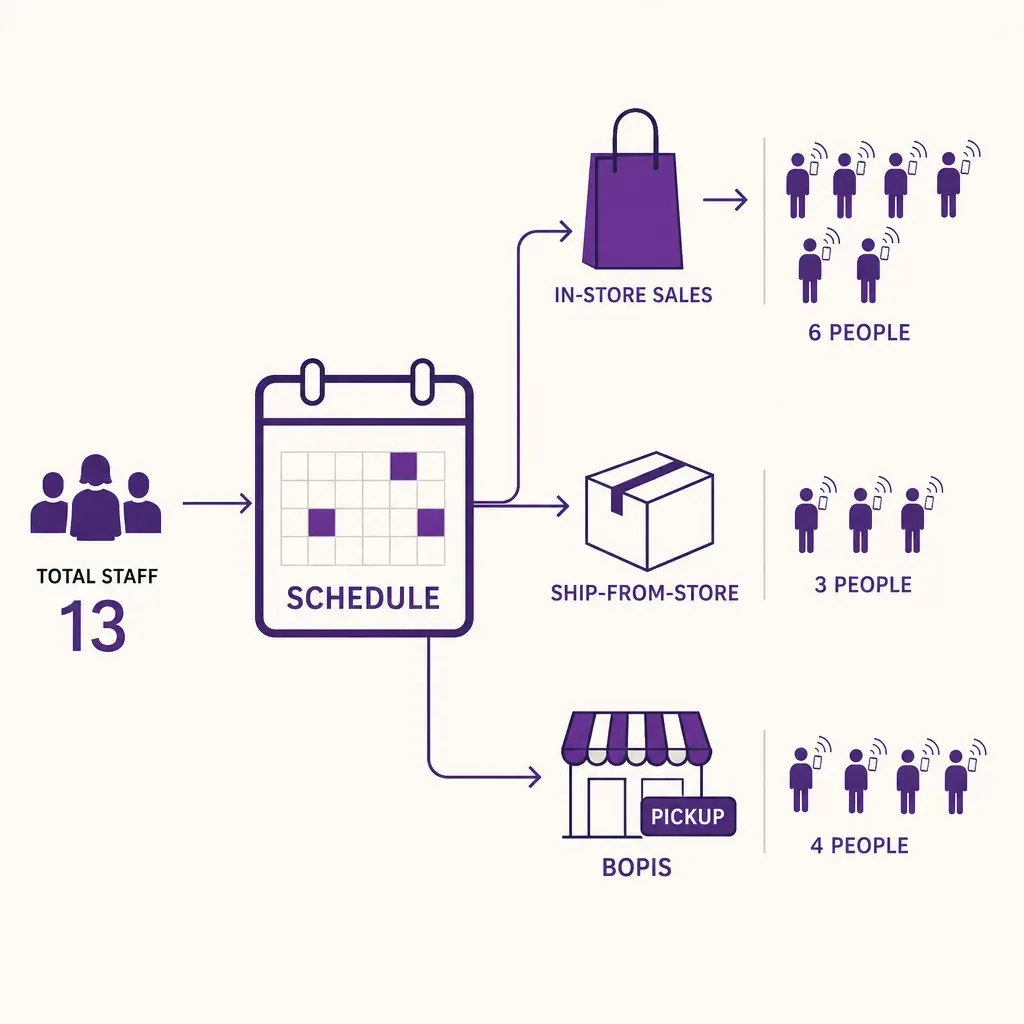
An omnichannel store is not that store. It is a fulfilment node and a shopfloor at the same time. In the same shift, the same team is selling to walk-in customers, picking and packing buy online pickup in store (BOPIS) orders, processing ship-from-store parcels for courier collection, handling returns from both channels, and answering the chat queue for the store's catchment. The work for the day is no longer one curve. It is a stack of curves that peak at different hours, need different skills, and compete for the same pair of hands.
Omnichannel scheduling is the practice of building a roster that respects this stack. It does not treat BOPIS as an interruption to selling or ship-from-store as a back-of-house chore. It treats each channel as a workload with its own forecast, picks an associate mix that can serve all of them, and accepts that the mix on the rota at 11:00 should look different from the mix at 18:00 because the channels themselves move during the day.
This post is for retail operations and store managers who already publish a roster and now have to make that roster work for two, three, or four channels under one roof. It walks through the shape of omnichannel demand, the labor mix problem, how to combine footfall with order queue and ship-out volume into one demand signal, and where the system breaks if any of those pieces is missing.
The four workloads inside a single shift
An omnichannel store runs at least four workloads in parallel, and a roster has to cover all four. Each one has a different demand curve and a different skill profile.
- In-store selling. The walk-in workload: greet, assist, fitting room, queue management, till. Demand is driven by footfall and peaks where the catchment peaks, which for most non-grocery formats is late afternoon and Saturday. Skill profile: product knowledge, selling, payment handling.
- BOPIS picking and handover. Orders placed online for collection in store. Picking has to happen between order receipt and the customer's promised pickup window, which is often two hours. Handover happens at a dedicated counter or at the till. Demand peaks twice: a morning batch for same-day orders placed overnight, and a late-afternoon batch for orders placed during the working day. Skill profile: stock locations, scan-and-pick discipline, identity verification at handover.
- Ship-from-store. Orders placed online that ship from the store inventory instead of a warehouse. Picking and packing has to be done before the carrier's daily collection window, which compresses the work into one or two cut-off times per day rather than spreading it across the trading hours. Skill profile: picking, packing for carrier, address printing, manifest reconciliation.
- Returns and customer service. Returns from both in-store and online channels, plus chat or phone responses for the store's online catchment. Volume tracks shipping returns plus walk-in returns and tends to follow a long tail after sale events. Skill profile: returns processing, reverse logistics, customer service tone.
The roster has to keep all four moving without any of them visibly starving. Most stores that struggle with omnichannel are not understaffed in absolute terms. They are misallocated: too many people on the till in the morning when the picking queue is full, and not enough people on the floor at 17:00 when both walk-ins and the same-day order cut-off arrive together.
How the labor mix shifts through the day
The fundamental claim of omnichannel scheduling is that the ratio of channels changes inside a single trading day, and the roster has to match. Three illustrative dayparts make this concrete. Numbers are illustrative ranges, not Ariadne customer data.
Morning, store opening to mid-morning. Walk-in footfall is low; the queue at the till is thin. The picking queue is its heaviest of the day because overnight orders for same-day pickup landed in the queue at midnight and have to be picked before the first promised pickup window. Ship-from-store has a wave for parcels that missed the previous day's carrier cut-off. Returns and customer service are quiet. The labor mix that fits this hour leans heavily into picking and packing: maybe two thirds of the team on fulfilment tasks, one third on the floor.
Midday, lunch trade. Walk-in footfall climbs. The picking queue thins because the morning wave was cleared. Ship-from-store is in a quiet window between the previous day's cut-off and the current day's. The mix shifts: maybe two thirds on the floor, one third still on fulfilment to absorb new BOPIS orders as they arrive.
Late afternoon, the convergence. Walk-in footfall is at its peak for most non-grocery formats. The afternoon BOPIS wave is in the queue for customers who placed an order during the working day expecting evening pickup. The carrier cut-off for ship-from-store is approaching, which means everything still on the pick list has to be out in the next sixty to ninety minutes or it slips a day. Returns spike because customers run their errands on the way home. This is the hour the team is most likely to break.
The third hour is the one the morning's roster has to be designed for. The most common mistake in omnichannel scheduling is to staff against an averaged daily demand and let the late afternoon convergence sort itself out. It will not. The convergence is structural, it repeats every weekday, and a roster that does not see it will produce understaffed floors and missed carrier cut-offs in the same hour.
One demand signal, three feeds
Scheduling against this requires one composite demand signal that the roster can react to, not three separate forecasts the manager has to mentally combine. The signal has three feeds.
- Footfall. Visitors entering the store per hour, broken down by entrance for stores with more than one. Footfall is the in-store-selling demand feed and also the upstream signal for returns and walk-up service. It is independent of conversion, which matters because a busy non-converting hour still creates floor work.
- Order queue. BOPIS orders awaiting pick, broken down by pickup window. This is a live count from the order management system, not a forecast. The roster needs to see the queue and the time-to-promise on the oldest order in it, because a forty-minute queue with a four-hour promise is fine and a forty-minute queue with a thirty-minute promise is a fire.
- Ship-out volume. Parcels in the ship-from-store pipeline that must clear before the day's carrier cut-off. Like the order queue, this is a live count from the warehouse or order system. The pressure on the team is not the number of parcels, it is the number divided by the time remaining before cut-off.
Each feed can be forecast for the medium horizon (the roster horizon) and read live for the short horizon (the trading day). The forecast lets you build the published rota two weeks out. The live read lets you reallocate associates inside a shift when one feed runs hotter than expected.
Combining the three feeds into one work-units number is the engineering step that makes the rest of the rota mathematical instead of intuitive. The pattern is to define a work-unit coefficient per task type: how many work units a typical visitor creates on the floor, how many a BOPIS pick takes, how many a ship-from-store pack takes, how many a return generates. Apply the coefficients to the feed counts per fifteen-minute or hour window, sum them, and you have a single work-units curve for the day. The roster covers that curve. The decomposition (which channel created the work) remains available for fairness, audit, and post-trade analysis, but the scheduler sees one curve.
Building shifts against the composite curve
Once the demand curve is composite, the rest of the scheduling chain looks similar to single-channel scheduling but with two important differences in how shifts are designed.
The first is that some shifts in the library should be channel-pure and others should be hybrid. A two-hour opener-fulfilment shift that runs only on picking and packing through the morning peak is a useful shape and is easier to staff because not everyone needs full till and floor training. A long core shift that crosses the lunch trade and the late-afternoon convergence has to be hybrid: the associate moves between the floor, the BOPIS counter, and the pack station as the mix shifts. A short on-peak shift sized to the convergence hour fills the gap when the composite curve spikes.
The second is that cross-training matters more than it does in a single-channel store. A roster of channel specialists is brittle: a sick picker on the morning shift cannot be covered by a floor associate without training, and the BOPIS queue blows through its promise window. A roster of generalists is expensive to train but elastic on the day. Most production omnichannel rosters end up somewhere in between, with a core of hybrid associates and a smaller bench of channel specialists used at the heaviest peaks.
Predictive scheduling laws in some jurisdictions (Seattle, NYC, Oregon, several California cities, Philadelphia, plus the EU working-time directive on rest and predictability) constrain how late a hybrid shift can be redefined. If a published shift is on the floor and the manager moves it to picking, that change needs to land far enough in advance to avoid premium-pay triggers. Build the redefinition windows into the swap rules so the system does not violate the law in the act of optimizing for the curve.
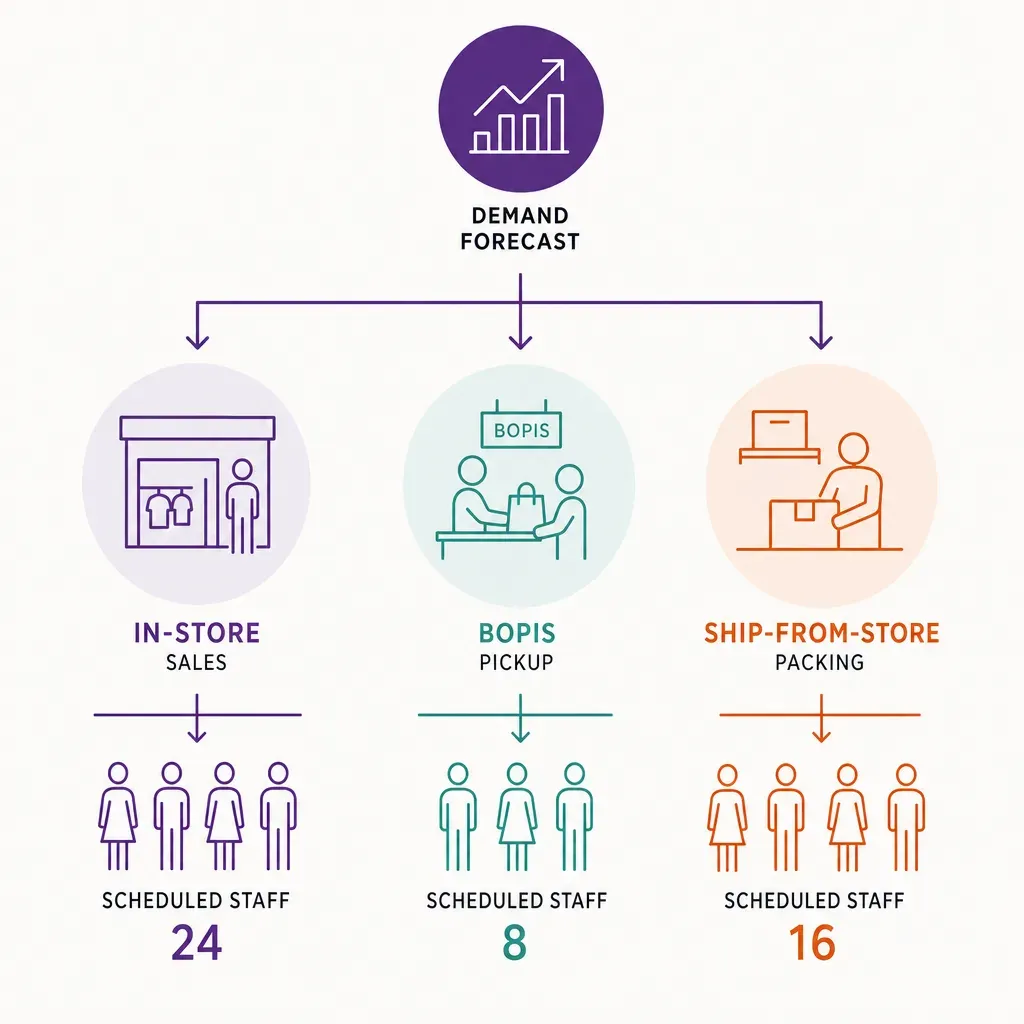
Live reallocation when one feed runs hot
The published roster is the medium-horizon answer. The trading day is the short-horizon problem. Three live reallocation patterns come up repeatedly in omnichannel stores.
- BOPIS queue overflows the promise window. The oldest order in the pick queue is inside, say, twenty minutes of its promise time. The system flags it, a manager pulls a hybrid associate off the floor for the next forty minutes to clear the queue, and a short-horizon backfill (an on-call associate or an extension offer) is triggered to keep the floor at safe coverage. The reallocation is logged so the forecast learns that morning queues at this store are heavier than the model assumed.
- Carrier cut-off in danger. Ship-from-store has, say, ninety minutes until cut-off and fifty parcels still to pack. The system flags the gap, the manager pulls hybrid associates onto the pack station, and the floor runs lighter for the cut-off window. If footfall is also peaking, the manager weighs the cost of a missed cut-off (next-day shipping promises broken, customer service impact, sometimes carrier penalties) against the cost of a thinner floor for an hour.
- Floor under-coverage at convergence. Footfall is running twenty percent above forecast and the floor is below the service ratio for the format. If the BOPIS queue is clear and the ship-out is in its quiet window, the move is a temporary float of fulfilment associates onto the floor. If both other feeds are also running hot, this is the hour where the system surfaces a documented exception and the manager has to choose which channel to under-serve, with the choice fed back into the next roster cycle.
The point of live reallocation is not to micromanage the team inside a shift. It is to make the choices visible. A manager who can see all three feeds in one dashboard is making a decision; a manager who only sees the BOPIS queue is making a guess about the cost of clearing it.
Coverage rules that do not collapse the day
A few coverage rules keep omnichannel rosters honest, and they are worth encoding rather than leaving to a manager's judgement.
- A floor service floor. A minimum number of associates on the sales floor at any hour the store is trading, regardless of how heavy the fulfilment queues are. A floor below this number is a customer-service problem and a safety problem on busy days.
- A pick-promise floor. A maximum acceptable age for the oldest unpicked BOPIS order, expressed as a fraction of its promise window. Common practice is to flag at fifty percent of the window and act at seventy percent. Above ninety percent the order is in active breach territory.
- A cut-off discipline. Ship-from-store packing must finish at the carrier cut-off minus a buffer. A common buffer is fifteen minutes to allow for manifest scanning and carrier handover. Reorder the day around the buffer, not around the cut-off.
- A return service-level. Returns have a less obvious failure mode than the other channels because a slow returns desk only frustrates customers; it does not breach a promise or miss a carrier. Set a returns service level (for example, a target maximum wait at the desk) and hold the roster to it.
- A fairness layer. Hybrid shifts are harder than single-channel shifts. Distribute them across the team rather than always assigning the same associates to the convergence hours, and treat the fulfilment shifts as desirable enough that they have a request channel rather than being a punishment posting.
Common failure modes
Six patterns come up often enough in omnichannel scheduling to be worth naming.
- Scheduling only against footfall. The classic single-channel roster. It produces understaffed picking in the morning and missed carrier cut-offs in the afternoon because the fulfilment feeds are invisible to it.
- Scheduling only against orders. The mirror failure, more common in stores that grew into a fulfilment role after starting as e-commerce dark stores. The floor is starved at the convergence hour because the model treats walk-ins as a noise term.
- Channel specialists with no hybrid layer. Brittle to absence and unable to reallocate inside a shift. One sick associate breaks one channel.
- No live read of the queues. The published roster is correct on average and wrong inside the day. Without a live dashboard the manager learns about the convergence after the order breached.
- Carrier cut-off treated as a soft target. Cut-off is a hard wall, not a goal. Roster the packing finish at cut-off minus a buffer and treat slipping the buffer as an exception that requires a documented choice.
- No feedback from exceptions to forecast. Every reallocation is a data point. Stores that record them and feed them back end up with forecasts that bend around their actual weekday shape; stores that do not keep needing the same override every week.
How Ariadne fits into omnichannel scheduling
Three of the inputs to an omnichannel scheduler come from systems most retailers already run: the order management system carries the BOPIS queue, the warehouse or shipping system carries the ship-from-store pipeline, and the workforce management platform holds the contracts, availability, and shifts. The missing piece for most omnichannel rosters is the live walk-in feed: how many visitors are entering the store right now, broken down by hour or finer.
Ariadne provides that feed. A people counting system at the entrance counts every visitor crossing the threshold, independent of whether they carry a phone or whether they buy. The count goes into the scheduler as the in-store-selling demand feed, and into the live dashboard alongside the BOPIS queue and the ship-out countdown. The composite work-units curve described above becomes calculable instead of inferred.
Ariadne measures this with Hybrid Fusion, its patented camera-free method. Time-of-Flight depth sensing counts every visitor at the entrances, capturing geometry rather than images, while patented phone signal sensing follows movement through the interior, detecting the signals a phone emits even in airplane mode. The sensor streams both feeds to Ariadne, where Hybrid Fusion combines them into one trajectory per visit and computes counts, dwell, and paths. The streams carry no identifier: no MAC address, no device ID, no biometric data, and no camera is involved. Identifiers are stored only when a visitor explicitly opts in, which keeps the method GDPR-friendly and outside biometric territory.
Two properties of the measurement matter for omnichannel rosters specifically. The first is that one ToF sensor at each entrance is enough to produce the count itself; group sizing inside the store comes from the patented signal sensing, which lets the same sensor stack deliver dwell at the BOPIS counter, dwell at the returns desk, and queue length at the till in addition to the entrance count. That gives the roster a richer picture of where the floor work actually accumulates, not just how many people walked in.
The second is that the count carries no personal data: no images, no faces, no MAC addresses, no device identifiers by default. The scheduler sees an integer per period and the dashboard shows queue and dwell figures, not a stream of recognized people. That is the right answer when the works council, the data protection officer, or a retail group with a multi-country footprint asks what the sensor sees. Hardware details and data handling sit in the privacy policy.
Most workforce management platforms can accept an external time series as a forecast input and most order management systems can publish queue and ship-out volumes through an API. The integration pattern is straightforward: footfall per fifteen-minute window from Ariadne, BOPIS queue and promise-clock from the order system, ship-out countdown from the warehouse or shipping system, all into the scheduler and the live dashboard. The manager sees one composite curve and three drill-downs. The team sees a roster that holds together when the convergence arrives.
A short evaluation checklist
If you are reviewing an omnichannel scheduling design for a retail estate, these seven questions cover most of what matters.
- Are all four workloads modelled? In-store selling, BOPIS, ship-from-store, returns and customer service. A roster missing any one of them will fail in the channel it ignored.
- Is the demand signal composite? Footfall plus order queue plus ship-out volume, combined into a single work-units curve, with the decomposition retained for audit.
- Is footfall measured independently of conversion? A walk-in count is needed, not a transaction count. Non-converting hours create floor work and should be visible.
- Does the shift library include hybrid shapes? A small set of hybrid shifts sized to the convergence hours, plus channel-pure shifts for the cleaner dayparts.
- Are the coverage floors hard? A floor service floor, a pick-promise floor, a cut-off discipline, a return service level. Each one is an explicit number, not a manager's preference.
- Is live reallocation supported? A dashboard that shows all three feeds and a swap channel that respects predictive-scheduling law triggers.
- Do exceptions feed back into the forecast? Repeated reallocations on the same day of the week are a signal that the model is wrong, not that the team is unreliable.
Omnichannel scheduling is not a single product. It is the discipline of treating four workloads as one curve, building a roster that respects all four, and giving the team the live picture they need to reallocate inside the shift. For the operational context on how the entrance count becomes a usable scheduling input, the retail industry overview and the employee scheduling solution page cover the rest of the chain.
Related reading
FAQ
What is omnichannel scheduling?
Omnichannel scheduling is the practice of building a retail store roster that covers in-store selling, BOPIS picking and handover, ship-from-store packing, and returns and customer service in the same shift. It treats each channel as a workload with its own demand curve and combines them into one composite work-units forecast that the roster covers, rather than scheduling against any single channel in isolation.
Why is the late-afternoon hour the hardest in an omnichannel store?
Three feeds converge there. Walk-in footfall is at its trading peak for most non-grocery formats. The afternoon BOPIS wave is in the queue for evening pickup. The carrier cut-off for ship-from-store is approaching, which forces everything still on the pick list out the door in a narrow window. Returns also spike as customers run errands on the way home. A roster that does not size the convergence hour explicitly will be understaffed on the floor and miss the cut-off in the same trading day.
Why not just schedule against transactions?
Transactions are a lagging indicator and they only count converters. A busy non-converting hour reads as a quiet hour in the point of sale, but it is full of floor work and is exactly the population a sharper roster is trying to convert. The walk-in count from footfall sees both converters and non-converters and is the upstream signal an omnichannel scheduler needs for the in-store-selling channel.
Does the counting system identify customers?
No. Ariadne counts with Hybrid Fusion: Time-of-Flight depth sensing plus patented phone signal sensing, never cameras. Time-of-Flight captures geometry rather than images, and signal sensing captures no MAC address by default, so the measurement involves no video, no faces, and no biometric data.
Does omnichannel scheduling require a workforce management platform?
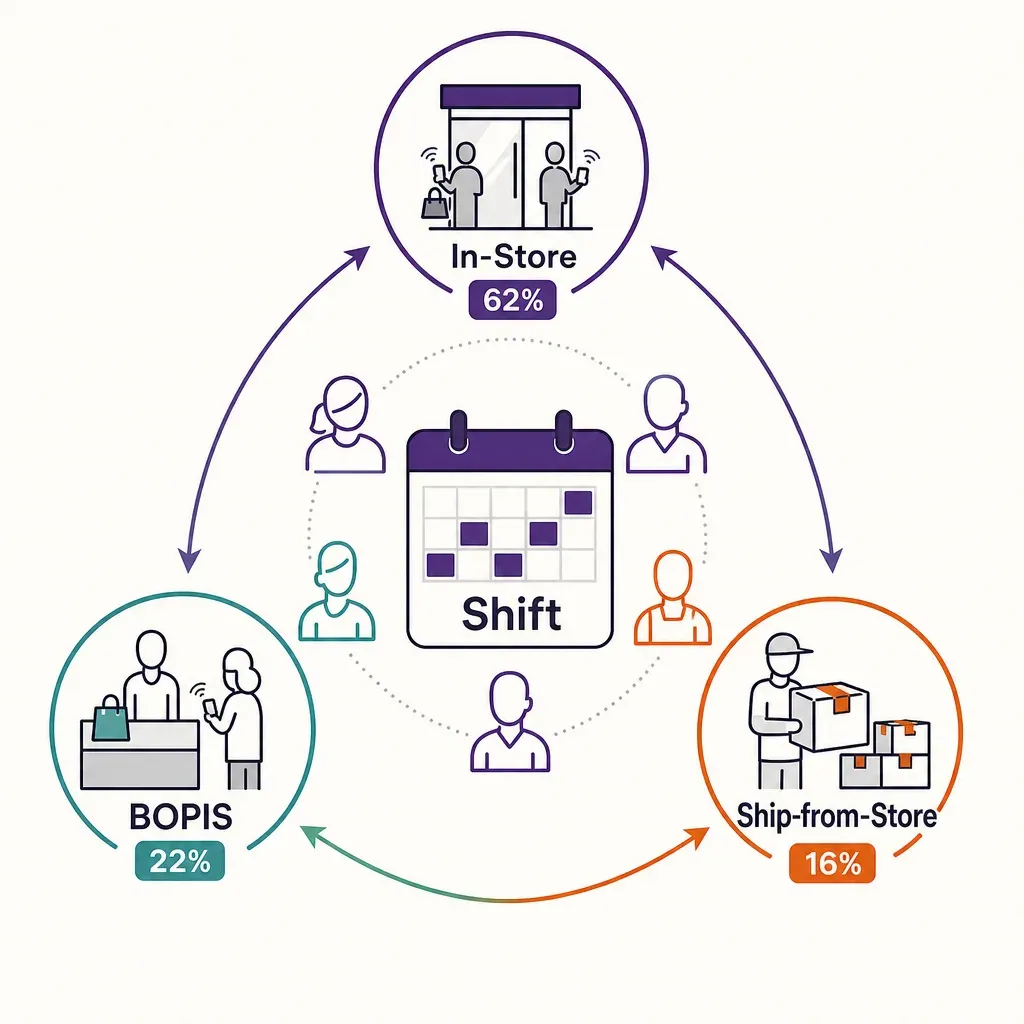
Not strictly. The methodology can run in a spreadsheet for a small estate and many do. A workforce management platform earns its place when the estate is large, the legal landscape around predictive scheduling is complicated, or the swap and live reallocation flows need to be machine-managed. What the platform must accept is an external time series as a forecast input and a live read of the BOPIS queue and ship-out pipeline; without those two integrations, the platform is scheduling against one channel and calling it omnichannel.


