
The department store is no longer the draw
For most of the twentieth century, the shopping center had a simple gravity model. A large department store or two sat at the ends of the mall, paid little or no rent, and pulled enough traffic that the smaller shops in between could charge a premium for the footfall the anchor delivered. The anchor was the reason people drove out, and the inline tenants paid for the spillover.
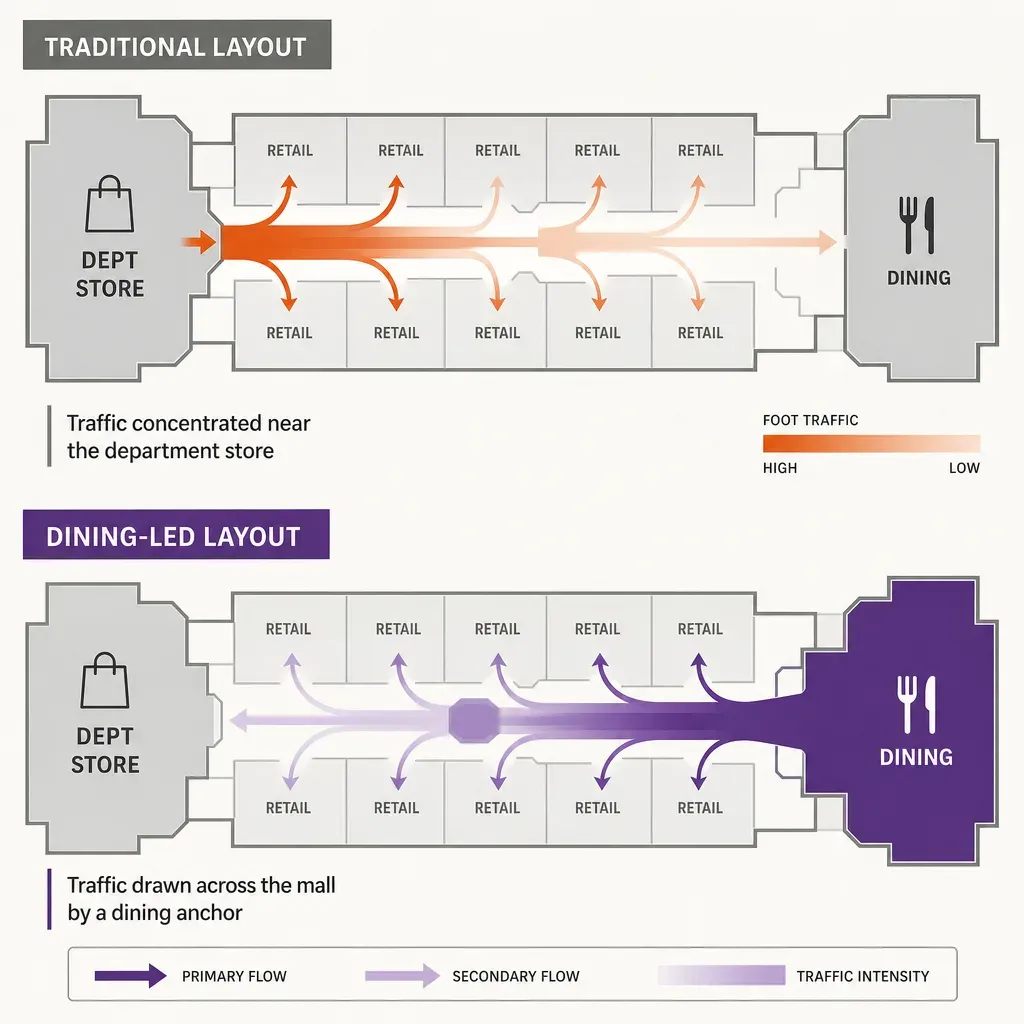
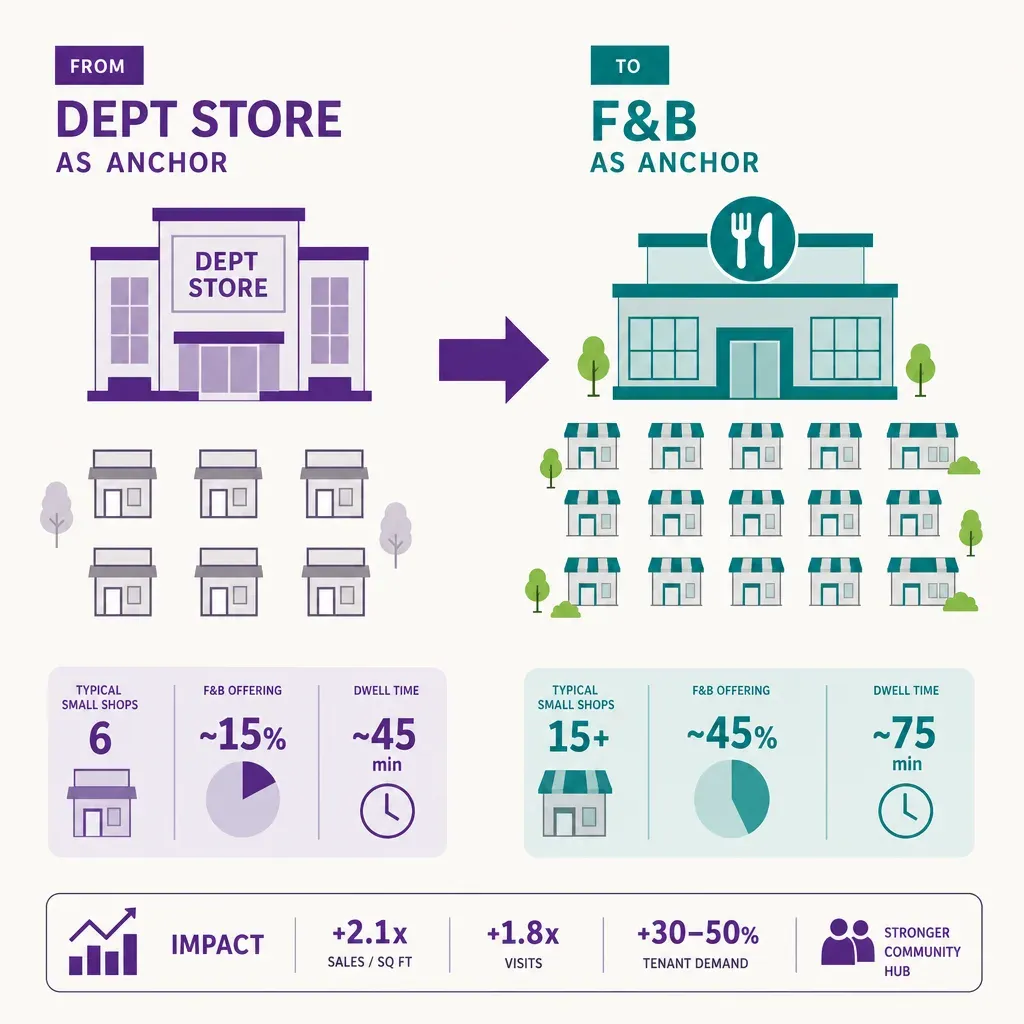
That model has weakened across many European centers. Department store chains have shrunk their estates, gone through restructuring, or closed outright, and the format itself draws fewer dedicated trips than it did. Apparel that once needed a flagship now sells online. The result is a recurring problem for landlords: a large box at the end of the mall goes dark, and the traffic it used to generate goes with it. What replaces it increasingly is not another retailer at all. It is food and drink.
Food and beverage, usually shortened to F&B in leasing language, has moved from a convenience amenity tucked in a corner of the food court to the thing a center is built around. A strong dining lineup now does the job the department store used to do: it gives people a reason to come, a reason to stay, and a reason to come back next week. This piece looks at why that shift works, what landlords give up to make it happen, and how footfall and dwell data tell you whether an F&B anchor is actually pulling its weight.
Why dining works as an anchor
An anchor tenant earns the name by generating trips and holding people in the center long enough that the surrounding shops benefit. Dining does both, and it does a few things a department store never could.
Frequency
People buy a winter coat a few times a year. They eat several times a week. A center anchored by restaurants, cafes, and quick service gives a catchment a reason to return on a cadence no apparel anchor can match. A family that comes for dinner on a Friday is a different visit pattern from one that comes once a season for a shopping list, and the higher frequency compounds: more visits mean more chances for the inline tenants to convert a passing trip into a purchase.
Dwell time
A meal is a long visit. Where a quick errand might keep someone in the building for twenty minutes, a sit-down dinner with a drink beforehand and a coffee afterward can hold a group for two hours or more. That extended dwell is the mechanism that makes dining valuable to neighbors. People who are already in the center, already relaxed, and already past the activation energy of leaving home browse the shops around the restaurants in a way they would not on a targeted errand. Dwell time is the currency, and dining buys a lot of it.
Weatherproof, online-proof demand
Many of the categories that used to anchor a mall can now be served from a warehouse and a delivery van. A restaurant cannot. The act of eating out is the experience itself, which makes dining one of the few retail categories structurally protected from the shift to ecommerce. It is also relatively resilient to weather and season in a way that some destination retail is not, because the demand to eat and to meet people does not pause. For a landlord trying to underwrite a center for the next fifteen years, a category that cannot be shipped in a box is a meaningful hedge.
It changes the time of day a center is alive
A retail-anchored center tends to be busy in a midday band and dead by early evening. Dining stretches the trading day into the evening and pulls a different crowd at the weekend. A center with a strong evening dining trade is open and earning at hours when a pure-retail center would be winding down, which improves the economics of the whole asset, from parking revenue to the viability of late-opening inline tenants.
What landlords trade off
None of this is free. Converting space that was built for a department store or a fashion floor into restaurants is one of the more expensive moves a landlord can make, and the economics are not the same as a like-for-like retail re-let. The trade-offs are worth being honest about.
Rent per square metre
Restaurants generally cannot pay the rent per square metre that prime fashion retail can, because a far larger share of a restaurant's floor is back-of-house kitchen, storage, and circulation that earns nothing directly. A landlord swapping a fashion unit for a restaurant often takes a lower headline rent on that footprint. The case for doing it rests on the spillover: the dining tenant is underwritten partly on the traffic and dwell it brings to the rest of the center, not only on the rent it pays on its own lease. That is exactly the logic that used to justify a department store paying almost nothing, now applied to a category that actually draws trips.
Fit-out and capital cost
Turning retail space into a working kitchen is a heavy build. It needs grease extraction and ventilation, gas and high-capacity power, water and drainage to every unit, and grease management. Much of that infrastructure does not exist in a space designed to sell clothes, so the landlord usually has to fund or contribute to the base build, and the lead time and capital outlay are higher than a standard retail refit. A dining cluster is a multi-year capital project, not a quick re-let.
Operating hours and management load
A center with a serious dining trade runs longer hours and carries more operational complexity. Security, cleaning, waste handling, and the management of smells, noise, and late closing all scale up. Evening trade means the asset is staffed and open when a retail-only center would be shut. The upside is real, but it comes with a heavier operating model that the management budget has to absorb.
Concentration and covenant risk
Leaning the center on dining concentrates risk in a sector with thinner margins than it looks. Independent operators can carry a stronger local pull than a chain but a weaker covenant, while a roster of chains is more bankable but more exposed to a single operator's national troubles. Spreading the dining offer across formats and price points, rather than betting the anchor on one big-name restaurant, is how landlords manage that exposure.
How footfall and dwell data prove an F&B anchor's pull
Because the case for a dining anchor rests on spillover rather than on the rent it pays directly, the landlord needs to prove the spillover is real. A department store could be justified by reputation. A dining cluster has to be justified by data, and the two numbers that matter most are footfall and dwell time. This is where shopping center analytics earns its place in the leasing conversation.
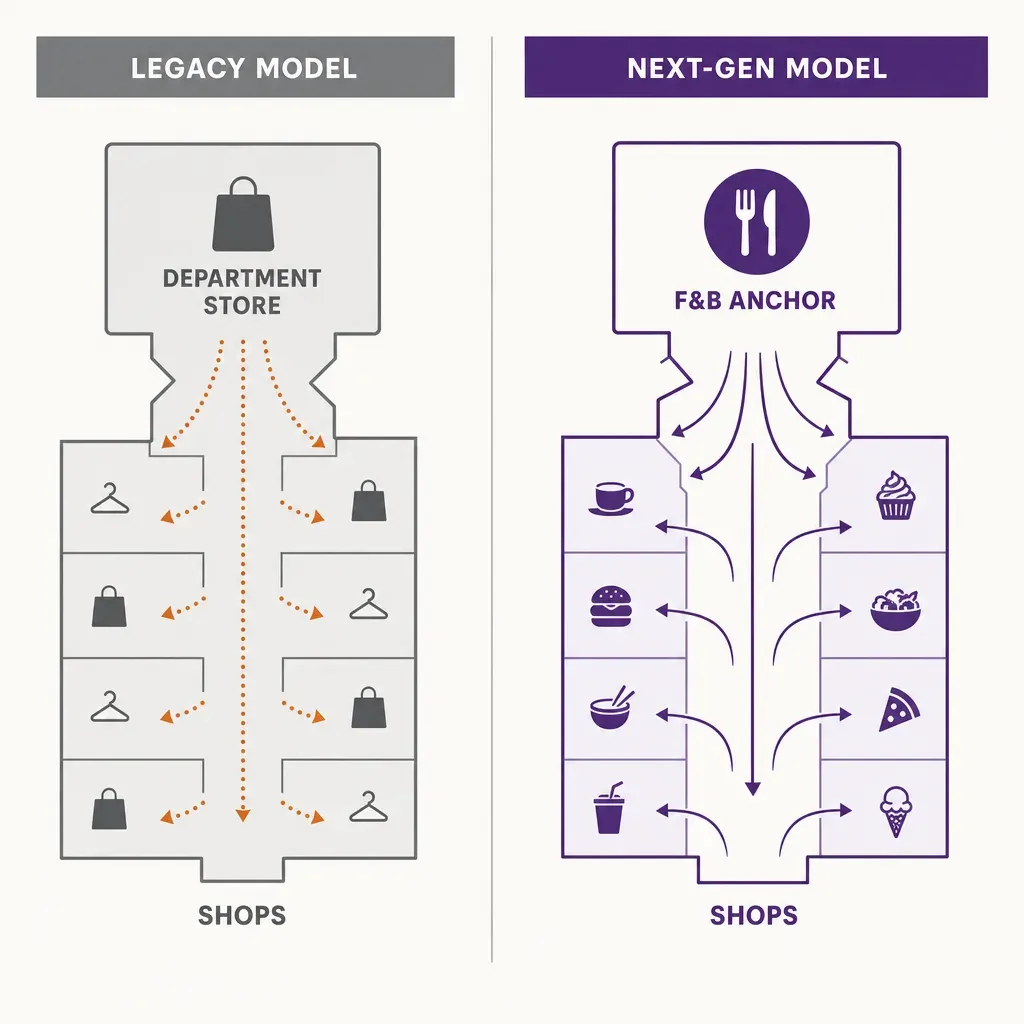
Three measurements turn the spillover argument from an assertion into something a leasing team can put in front of an investor.
- Trips generated. Does the dining cluster bring people to the center who would not otherwise have come? You see this in the entrance counts on evenings and weekends, and in the share of visits that touch the dining zone. If a new restaurant opens and total center footfall in the evening band steps up while the rest of the catchment is flat, the anchor is doing its job.
- Dwell time across the center. An anchor that lengthens the average visit is creating the browsing time the inline tenants depend on. Measure dwell before and after a dining cluster opens. A rise in average time spent on site, especially among visitors who pass through both the dining zone and the retail malls, is the clearest signal that the anchor is feeding its neighbors.
- Cross-shopping between zones. The spillover claim is specifically that diners shop. Zone-level flow data shows whether a visit to the restaurants is followed by a visit to the shops, or whether diners arrive, eat, and leave without crossing into the retail malls. A leasing team that can show what share of dining visits convert into retail browsing has the single most persuasive number in the F&B anchor case.
For example, a center seeing 40,000 visits on a Saturday might find that visits which include the dining zone last 35 percent longer on average and are more likely to also touch two or more retail zones. Those figures are illustrative, not measured results, but they show the shape of the argument: the value of a dining anchor is in the length and the breadth of the visits it creates, and both are measurable directly.
This is also how a landlord underwrites the rent abatement a restaurant expects. If the dining tenant pays a lower rent per square metre but demonstrably adds dwell time and cross-shopping across the center, the foregone rent is recovered through the performance of the surrounding leases. Without the footfall and dwell measurement to show that, the abatement is a leap of faith. With it, the abatement is an underwritten investment in center traffic.
Measuring the visit without identifying the visitor
Footfall and dwell data of this kind has to be collected in a way that a center can defend to a regulator and to its own visitors. Shoppers in a public space have not consented to being individually identified, and biometric capture in a retail environment is both legally fraught under the GDPR and reputationally toxic. The measurement that supports a leasing case should count visits and trace movement between zones without ever recording who anyone is.
Ariadne measures this with Hybrid Fusion, its patented camera-free method. Time-of-Flight depth sensing counts every visitor at the entrances, capturing geometry rather than images, while patented phone signal sensing follows movement through the interior, detecting the signals a phone emits even in airplane mode. The sensor streams both feeds to Ariadne, where Hybrid Fusion combines them into one trajectory per visit and computes counts, dwell, and paths. The streams carry no identifier: no MAC address, no device ID, no biometric data, and no camera is involved. Identifiers are stored only when a visitor explicitly opts in, which keeps the method GDPR-friendly and outside biometric territory.
For a shopping center, the practical effect is that the leasing team gets the numbers it needs, entrance counts, dwell time, and zone-to-zone flow, while the system holds no image of a shopper and no personal data by default. The trips and dwell that prove a dining anchor's pull are produced without the surveillance baggage that would make a center's privacy officer or its visitors uncomfortable. The fusion and analysis happen centrally in the Ariadne platform, not at the sensor, so what sits in the ceiling of the mall is a counter, not a camera.
What this means for a leasing strategy
The shift from retail anchors to dining anchors is not a fashion. It is a response to where consumer demand has actually gone, and it changes how a center should be planned and underwritten. A few principles follow from the analysis above.
- Underwrite dining on the center, not on the unit. A restaurant's value is partly in its own lease and partly in the traffic and dwell it brings to its neighbors. Model both, and use measured footfall and cross-shopping data to defend the lower headline rent.
- Budget the build honestly. Converting retail space into kitchens is a capital project with long lead times. Treat the base build, services, and management uplift as part of the anchor's cost, not an afterthought.
- Mix formats to spread risk. A blend of independents and chains, of casual and destination dining, gives a stronger and more resilient pull than betting the anchor on a single operator.
- Instrument before and after. Put zone-level footfall and dwell measurement in place before a dining cluster opens, so the spillover can be proven against a real baseline rather than claimed after the fact.
The department store anchor worked because everyone understood, intuitively, that it brought people through the doors. A dining anchor works for the same reason, but the proof can no longer rest on intuition. It rests on the visit data: how many trips the dining draws, how long those visits last, and whether the people eating also shop. Get that measurement right and the F&B anchor stops being a hopeful conversion of dark space and becomes the most reliable traffic engine a modern center has.
FAQ
What is an F&B anchor in a shopping center?
An F&B anchor is a food and beverage offer, a restaurant cluster, a dining hall, or a strong lineup of cafes and quick service, that does the job a department store used to do: it gives a catchment a reason to visit, holds people in the center longer, and drives traffic that the surrounding shops benefit from. As dedicated trips to department stores have declined, dining has become one of the main draws a center is planned around.
Why is food and beverage replacing department stores as the draw?
Dining brings people back more often than seasonal shopping does, holds them on site for longer, and cannot be shipped to a doorstep, which makes it structurally resilient to ecommerce. It also extends the trading day into the evening. Department store trips, by contrast, have fallen as apparel and general merchandise moved online, leaving large boxes that landlords increasingly backfill with food and drink.
Does a dining anchor pay less rent than a retail anchor?
Usually a lower rent per square metre, because a large share of a restaurant's floor is non-trading kitchen and storage, and the build is more expensive. The case for accepting that rests on spillover: the dining tenant is underwritten on the traffic and dwell it brings to the rest of the center, recovered through the performance of the surrounding leases rather than its own rent alone.
How do you measure whether an F&B anchor is working?
Track three things with footfall and dwell measurement: trips generated (does center traffic step up in the evening and weekend bands), dwell time (does the average visit lengthen after the dining cluster opens), and cross-shopping (do diners go on to visit the retail zones). Measuring against a baseline taken before the cluster opens turns the spillover argument into evidence.
Does footfall measurement in a center use cameras?
No. Ariadne counts with Hybrid Fusion: Time-of-Flight depth sensing plus patented phone signal sensing, never cameras. Time-of-Flight captures geometry rather than images, and signal sensing captures no MAC address by default, so the measurement involves no video, no faces, and no biometric data.


