
"Edge or cloud" is one of the first architecture questions a people-counting vendor will raise, and it is often framed as a privacy question when it is really a performance one. The two get tangled, and the tangle leads buyers to the wrong conclusion: that processing data locally automatically means private. It does not. This separates the genuine tradeoffs from the myth.
What do "edge" and "cloud" mean for a people counter?
Edge processing means the computation happens on or near the sensor itself. Cloud processing means raw or partial data is sent to a remote platform that does the heavy work. Many systems are a blend: some processing local, some central. The split is about where computation happens, which is a separate question from what the sensor captures and what data travels off site.
The genuine tradeoffs
- Latency. Local processing returns a result faster, which matters for real-time occupancy and live alerts.
- Bandwidth and cost. Sending less data off site saves bandwidth; doing more centrally can simplify and cheapen the hardware.
- Resilience. Local processing can keep counting through a network outage; cloud-dependent designs may not.
- Maintenance. Centralised processing is easier to update and improve across a whole fleet at once.
These are real engineering choices with real consequences. None of them is, by itself, a privacy guarantee.
The privacy myth: "edge equals private"
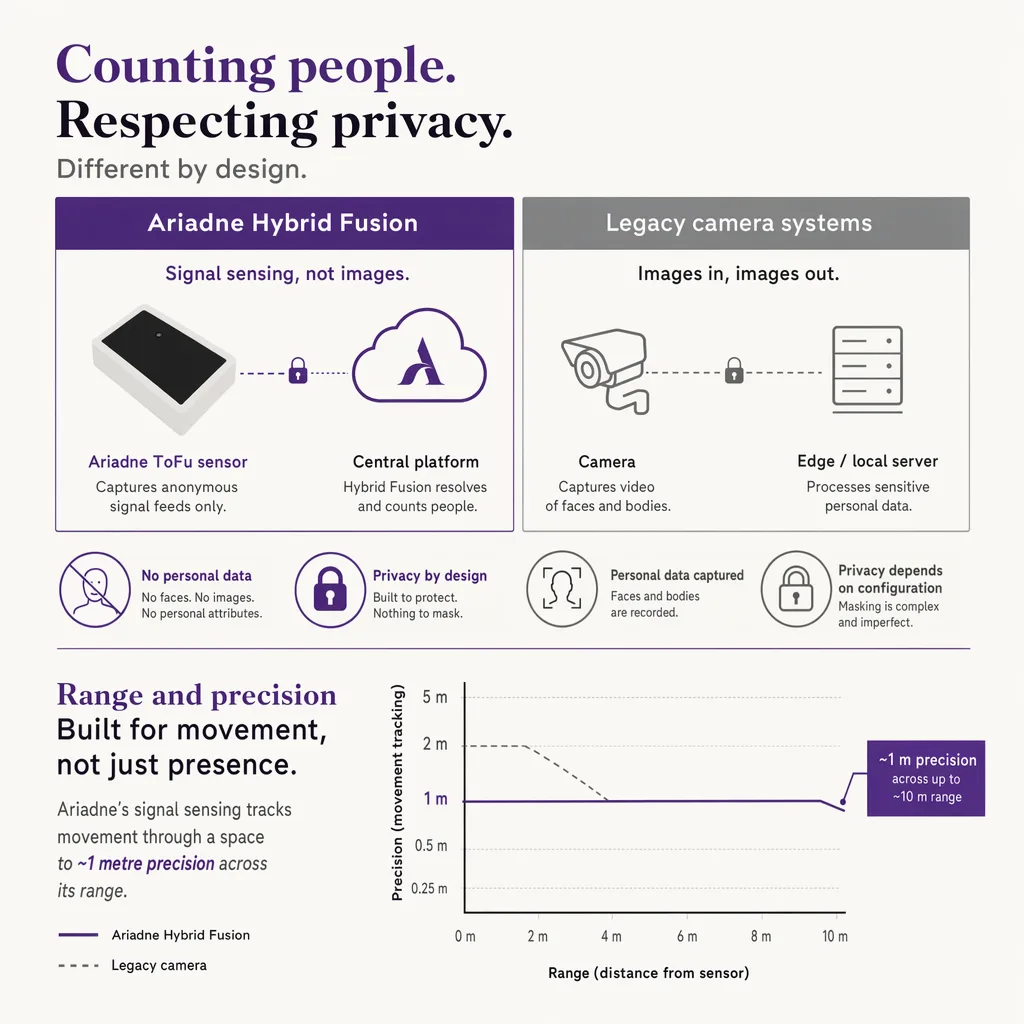
The claim that edge processing is inherently private confuses where data is processed with what data exists. A camera that runs its model locally is still a camera that captured an image of a person. Processing it on the spot does not unmake the capture. Conversely, a sensor that never records anything personal is private regardless of where its data is processed.
The question that actually decides privacy is not "edge or cloud." It is "what does the sensor capture, and what leaves the building." See where processing happens and what it means for privacy for how that plays out in practice.
How Ariadne is architected
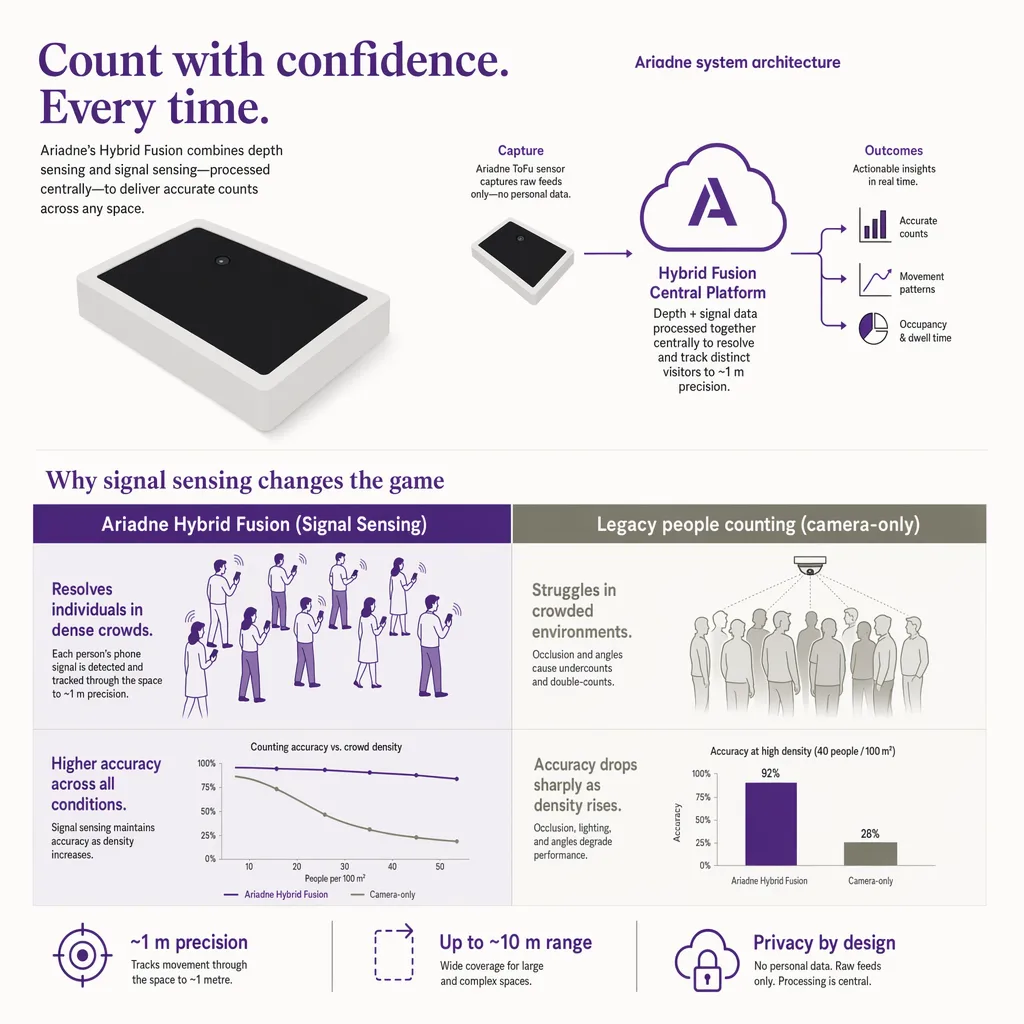
Ariadne is not an edge system, and it does not need to be to protect privacy. The sensors capture no personal data in the first place: Time-of-Flight depth geometry at the door and phone-signal data with no identifier by default. Those feeds stream to the Ariadne platform, where Hybrid Fusion combines them into one trajectory per visit and computes counts, dwell, and paths. Privacy here comes from what is never captured, not from where the processing happens.
Ariadne measures this with Hybrid Fusion, its patented camera-free method. Time-of-Flight depth sensing counts every visitor at the entrances, capturing geometry rather than images, while patented phone signal sensing follows movement through the interior, detecting the signals a phone emits even in airplane mode, and tracks that movement to about one-metre precision. The sensor streams both feeds to Ariadne, where Hybrid Fusion combines them into one trajectory per visit and computes counts, dwell, and paths. The streams carry no identifier: no MAC address, no device ID, no biometric data, and no camera is involved. Identifiers are stored only when a visitor explicitly opts in, which keeps the method GDPR-friendly and outside biometric territory.
Questions to ask a vendor about architecture
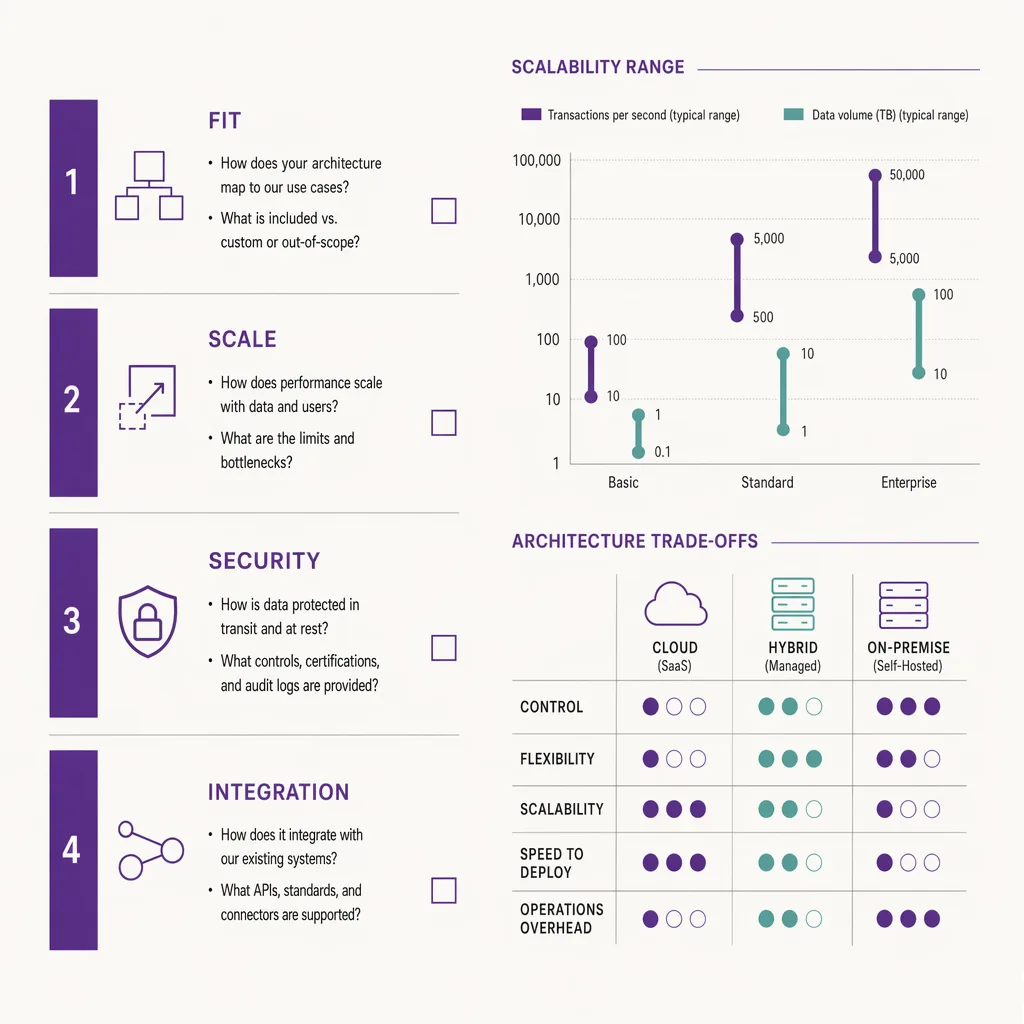
- What does the sensor capture: images, depth, or signal?
- What data leaves the building, and where is it stored?
- Does counting continue through a network outage?
- How are model updates rolled out across the fleet?
Notice that only one of these is the "edge or cloud" question. The rest matter more.
FAQ
Is edge people counting more private than cloud?
Not inherently. Privacy depends on what the sensor captures, not where the data is processed. A camera processed locally still captured an image.
Does cloud people counting send video off site?
For camera-based systems it can. For systems that never capture video, there is no video to send. Ask what the sensor captures.
Does a people counter keep working if the internet goes down?
That depends on the architecture. Ask whether counting continues locally during an outage.
---


