
Why a convenience store needs its own counting approach
A convenience store runs on different rules from a supermarket or a department store. The floor is small, often under 200 square metres. Trading hours are long, frequently around the clock. Margins are thin, so the staffing decision behind a single shift can swing a day from profit to loss. And the basket is built on impulse: a coffee, a snack, a top-up purchase made in under two minutes. Counting people in that environment is not about proving a busy weekend. It is about reading short, sharp swings in traffic and matching the shift pattern and the counter to them. A general retail counter tuned for a 4,000 square metre store will miss the detail that decides whether a small format works.
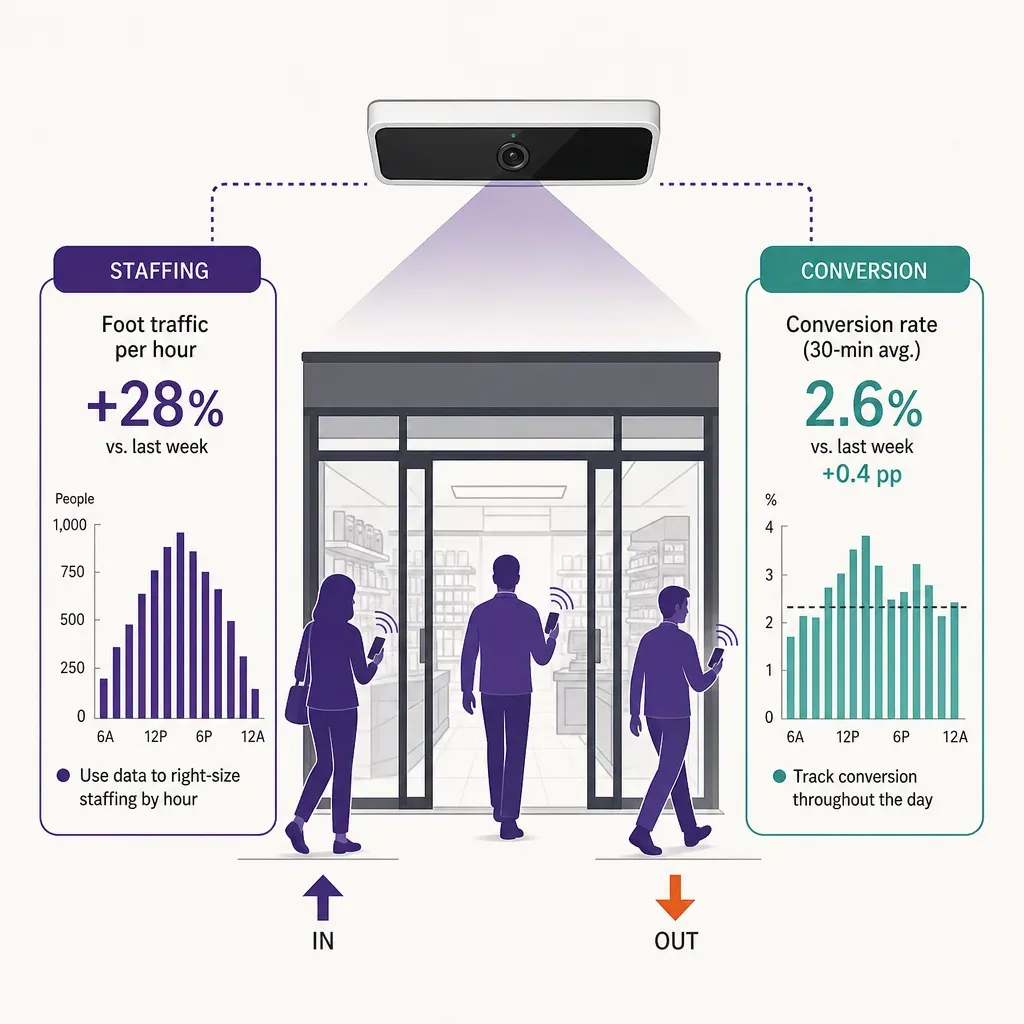
This guide is for operators and franchise managers weighing up a people counting system for one store or a small estate. It covers the metrics that matter for the format, the staffing decisions footfall data actually changes, and how to count accurately in a small, busy space without putting a camera over the till.
Reading 24/7 traffic patterns
A convenience store that trades through the night does not have one peak. It has a pattern that repeats across the day, and the value of a counter is in seeing that pattern clearly enough to staff against it. The shape varies by location: a forecourt store, a commuter-route store, and a residential corner store each draw their traffic at different hours. The point is not to assume a shape, but to measure the one your store actually has.
A typical urban store, for illustration only, might see a morning rush of commuters buying coffee and breakfast between 7 and 9, a flat midday, a heavier evening run from 17 to 19 as people pick up dinner items, and a long quiet tail overnight that still carries enough trade to justify staying open. None of those windows is obvious from till receipts alone, because a receipt only records the visits that converted. Footfall data shows you the visits that did not.
Once you can see the daily curve, two questions become answerable. First, when is the store genuinely busy enough to need a second person on the floor? Second, when is it quiet enough that a single staff member is the right call, or that an overnight period is barely paying its way? Those are the decisions that move the labour line, and they need traffic data measured by the hour, not a weekly total.
Conversion on an impulse format
In a destination store, conversion rate, the share of visitors who buy, is a planning metric you review monthly. In a convenience store it is closer to a live signal, because the format is built on impulse and small frictions cost sales fast. If 100 people enter in an hour and 70 transactions ring up, conversion is 70 percent. (That figure is illustrative, used to show the calculation, not a measured Ariadne result.) The number itself matters less than what moves it.
When you can put footfall next to transactions hour by hour, conversion stops being an abstract percentage and starts pointing at specific problems:
- Queue abandonment. A spike in entries with flat transactions during a known peak usually means people walked in, saw the queue, and left. That is the clearest case for opening a second till or adding a shift, and it is invisible without a count of who came in.
- Out-of-stock on the impulse lines. Steady traffic with falling conversion can point at an empty coffee machine or a gap on the chiller, the high-frequency lines a convenience basket is built on.
- Promotion read. When a meal-deal or front-of-store promotion runs, footfall tells you whether it pulled more people in or simply changed what existing visitors bought. Sales alone cannot separate those two.
For a small format, conversion read against accurate footfall is the metric that connects the door to the till. It is also the one that justifies the counter to a finance team, because it ties directly to recoverable sales rather than to a vanity headcount.
Staffing the micro-peaks
The hardest scheduling problem in a convenience store is not the daily peak. It is the micro-peak: a fifteen or twenty minute surge that does not show up in an hourly average but is exactly when a queue forms and a sale is lost. A train arrives, a nearby office breaks for lunch, a school finishes. The store is calm at five past the hour and three deep at the till by quarter past.
Hourly footfall smooths those surges away. To staff against them you need traffic in finer intervals, so that a recurring 12:10 to 12:30 spike is visible as a pattern rather than averaged into a flat lunch hour. With that resolution, a manager can do two practical things:
- Shift the rota to the surge, not the hour. A second person scheduled to cover a known twenty minute peak costs far less than an extra full shift, and it is the difference between a queue that clears and one that walks out.
- Justify, or retire, an overnight shift. An overnight count that holds steady supports keeping the store open. A count that collapses after a certain hour is the honest case for closing earlier or moving to a reduced service, a decision that is uncomfortable to make on instinct and straightforward to make on data.
Footfall does not write the rota on its own. It replaces the manager's guess about when the store is busy with a measured pattern, which is what turns staffing from a habit into a decision.
Counting accurately in a small footprint
Small stores create two counting problems that larger formats do not. The first is the entrance itself: convenience doorways are narrow and busy, people enter in pairs and groups, and a poor counter either double counts a group or misses the second person through the door. The second is placement: there is no spare ceiling, no back-of-house run for cabling, and no appetite for a visible camera array pointed at customers a metre from the counter.
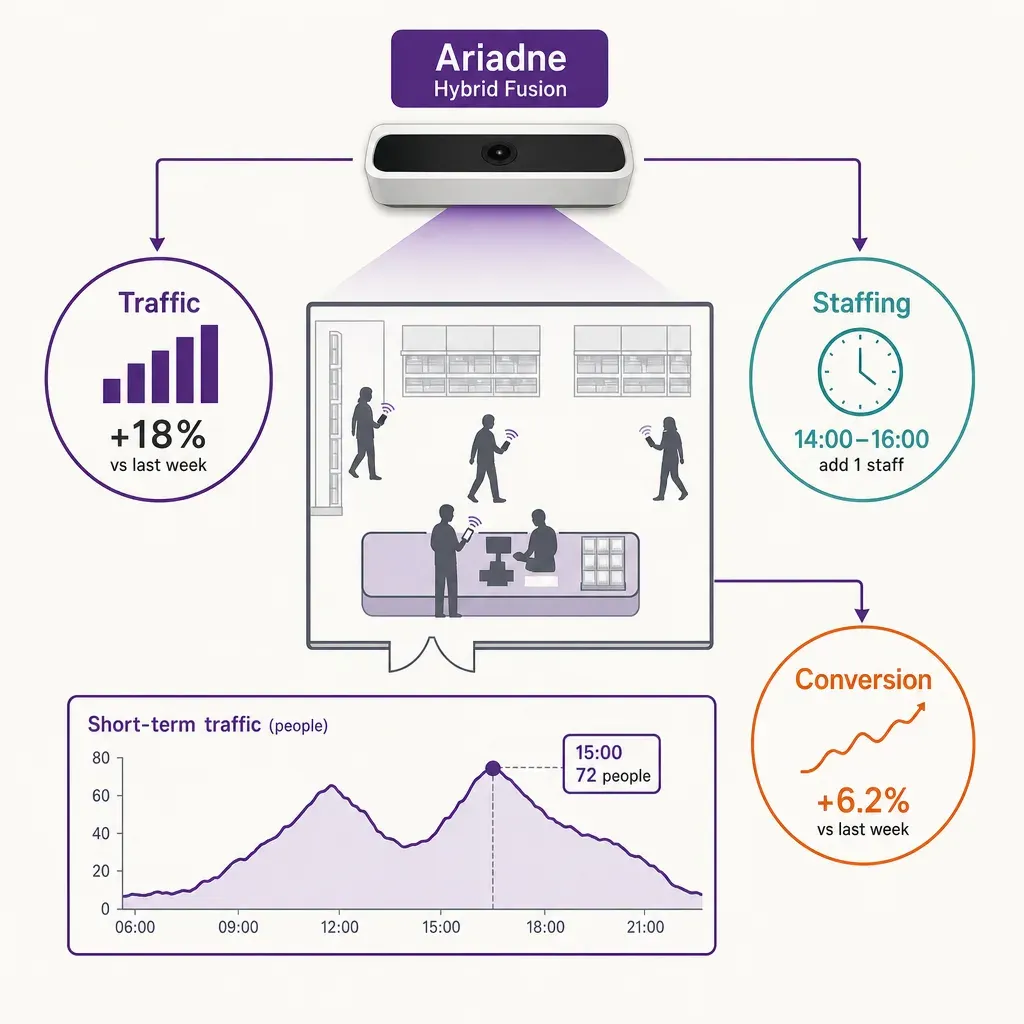
A counting method built for this needs two things. It needs to count every person crossing a tight, busy threshold accurately, including the people who arrive together. And it needs to do that from a single discreet ceiling unit, without a camera, because a small store is precisely where an overhead camera feels most intrusive and where the privacy question lands hardest with customers and staff.
How Ariadne counts in a convenience store
Ariadne measures the small format with one sensing approach that addresses both problems above, and it does so without a camera anywhere in the path.
Ariadne measures this with Hybrid Fusion, its patented camera-free method. Time-of-Flight depth sensing counts every visitor at the entrances, capturing geometry rather than images, while patented phone signal sensing follows movement through the interior, detecting the signals a phone emits even in airplane mode. The sensor streams both feeds to Ariadne, where Hybrid Fusion combines them into one trajectory per visit and computes counts, dwell, and paths. The streams carry no identifier: no MAC address, no device ID, no biometric data, and no camera is involved. Identifiers are stored only when a visitor explicitly opts in, which keeps the method GDPR-friendly and outside biometric territory.
Two parts of that matter specifically for a convenience store. The entrance count comes from Time-of-Flight depth sensing in a single ceiling-mounted unit: it fires infrared pulses and reads the height and shape of whoever passes below, to roughly 30 centimetres, which counts each person crossing a narrow doorway from one discreet sensor rather than a rack of equipment. Where a store needs to tell apart individuals and small groups, that is resolved by the patented phone signal sensing, not by the depth sensor. Together they give an accurate headcount at a busy threshold, plus the ability to read traffic by zone if a larger store wants the floor broken down.
Because there is no camera and no video, there is no image of a customer at the till to store or to lose. The streams carry no MAC address by default and no device identifier, so there is no personal data in the count. Identifiers are stored only when a visitor explicitly opts in, for example by logging into guest Wi-Fi, which a small store can simply choose not to offer. The sensor hardware sits in the Ariadne sensor lineup, the same camera-free approach used across retail store analytics, and the data handling is set out in the privacy policy.
A buyer checklist for small-format operators
If you are evaluating a counter for one store or a small estate, these are the questions worth putting to any vendor in writing before a trial.
- Does it count groups through a narrow door? A convenience entrance is tight and people arrive together. Ask how the system handles two or three people crossing the threshold at once, not just a single person on an open floor.
- What time resolution does it report? Hourly totals hide the micro-peaks that decide your staffing. Confirm you can see traffic in fine intervals, not just by the hour or the day.
- Can it sit in one discreet ceiling unit? Small stores have no spare space and no appetite for visible equipment. A single overhead sensor with no camera is the cleanest fit.
- Does it capture any personal data? Ask whether the system records images, faces, MAC addresses, or device identifiers. You want a clear no by default, with any identifier limited to explicit opt-in.
- Can footfall sit next to my sales data? Conversion is the metric that justifies the counter in a small format. Confirm the data exports cleanly so you can put visits next to transactions by the hour.
- Will it scale across an estate? If you run more than one store, ask whether the same hardware and reporting work across sites, so you can compare stores on the same basis.
Related reading
FAQ
Does the counter use cameras?
No. Ariadne counts with Hybrid Fusion: Time-of-Flight depth sensing plus patented phone signal sensing, never cameras. Time-of-Flight captures geometry rather than images, and signal sensing captures no MAC address by default, so the measurement involves no video, no faces, and no biometric data.
Can it count accurately at a small, busy entrance?
Yes. Time-of-Flight depth sensing in a single ceiling unit counts every person crossing the threshold by reading height and shape, and the patented signal sensing resolves distinct individuals and small groups. That combination is built for exactly the narrow, group-heavy doorways a convenience store has, where a simple beam-break counter tends to undercount.
What can I do with the data that I cannot do with till receipts?
Receipts only record the visits that converted. Footfall records the visits that did not. Putting the two together gives you a real conversion rate by the hour, shows where queues are turning people away, tells you whether a promotion pulled new visitors or just shifted existing baskets, and exposes the short micro-peaks you should be staffing against. None of that is visible from sales data alone.
Is it suitable for a single store, or only a chain?
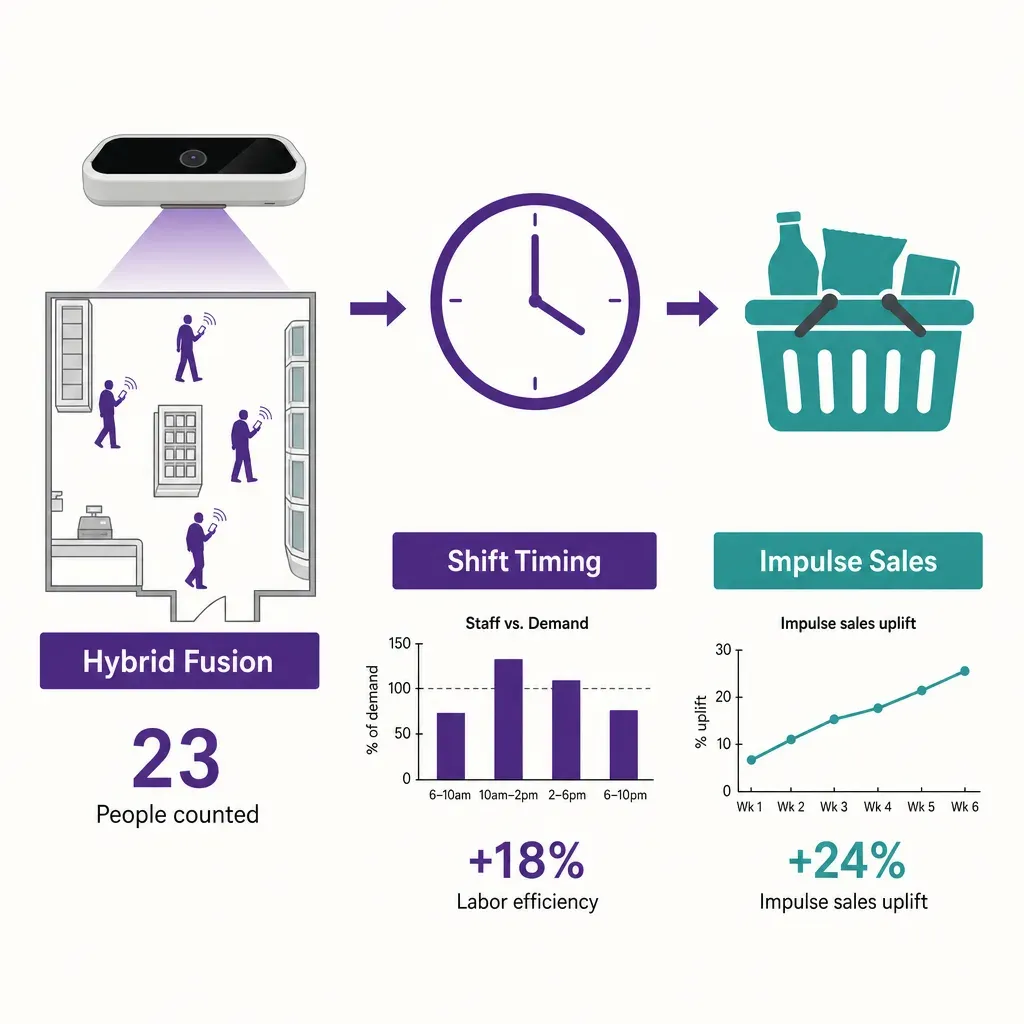
Both. The same single-unit, camera-free approach works for one store and scales across an estate on the same hardware and reporting, so a multi-site operator can compare stores on a consistent basis rather than stitching together different counters.


