
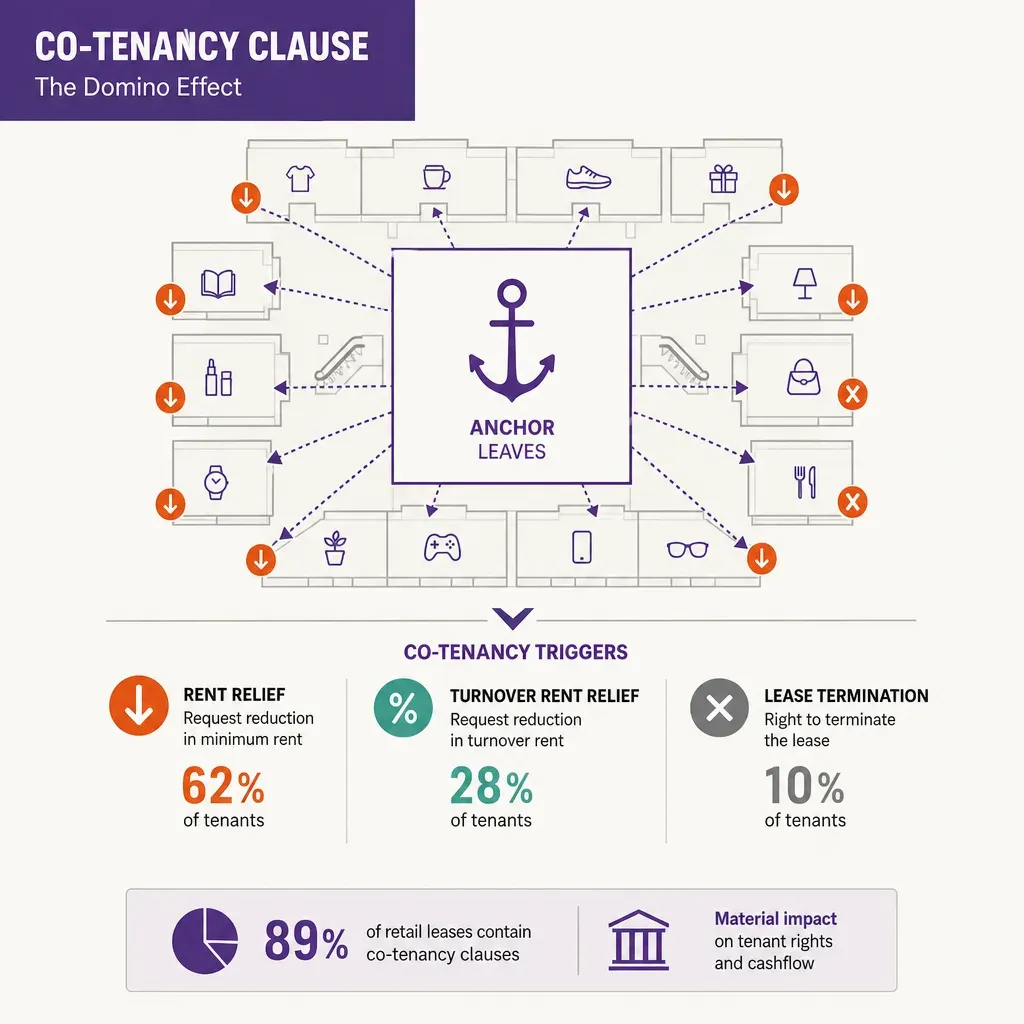
A co-tenancy clause is one of the most consequential lines in a shopping centre lease, and one of the least understood outside the leasing team. It links a smaller tenant's obligations to the presence of other tenants in the same centre, usually the anchors. When the named conditions stop being met, the clause gives the smaller tenant a defined remedy: reduced rent, a switch to turnover-only rent, or in stronger versions a right to terminate. For a landlord, a centre full of co-tenancy clauses behaves like a row of dominoes around each anchor. Lose the anchor, and a wave of rent relief and exit rights can follow across the mall.
This article explains what co-tenancy clauses are, the difference between opening and ongoing co-tenancy, how an anchor departure triggers the remedies, and how landlords use footfall and occupancy data to see the risk coming. It is informational, written for asset managers, leasing teams, and tenants who want to understand the mechanism. It is not legal advice. Co-tenancy provisions are heavily negotiated, vary by jurisdiction, and turn on their exact wording, so treat everything here as general background and take the specific language of any lease to a qualified property lawyer.
What a co-tenancy clause actually does
Anchor tenants, the large department stores, supermarkets, or destination retailers that pull traffic, are the reason many smaller tenants sign at a centre in the first place. A fashion boutique or a quick-service food unit is betting that the anchor will deliver a steady stream of passers-by it can convert. A co-tenancy clause turns that bet into a contractual condition. In effect the tenant says: I will pay full rent on the assumption that the anchors and a certain level of occupancy are there to feed me traffic. If that assumption breaks, my rent should follow it down.
The clause typically defines two things. First, a co-tenancy condition: which tenants must be open and trading, or what percentage of the centre's leasable area must be occupied. A clause might name one or more specific anchors, require a minimum number of national-brand tenants, or set an occupancy floor such as a defined share of the gross leasable area being open. Second, a remedy: what the tenant is entitled to if the condition fails, and after how long.
Because the clause sits between landlord and tenant interests, its exact thresholds and remedies are negotiated case by case. A strong national brand with leverage may secure a tight condition and a generous remedy. A landlord with a desirable, well-let centre may resist co-tenancy entirely or grant only a narrow version. The result is that no two clauses read the same, which is exactly why the wording matters so much.
Opening co-tenancy vs ongoing co-tenancy
Co-tenancy comes in two distinct forms, and they protect against different risks. Reading a clause starts with working out which one, or which combination, is in front of you.
Opening co-tenancy
An opening co-tenancy condition applies at the start of the lease. It protects the tenant against the risk of opening into a half-empty centre. The tenant agrees to take the space, but its obligation to open, or to pay full rent from day one, is conditioned on the anchors and a threshold of other tenants being open and trading when it opens. If a centre is still leasing up and the named anchor has not opened yet, an opening co-tenancy clause may let the tenant delay its own opening, pay reduced or turnover rent until the condition is met, or in some cases walk away if the centre never reaches the threshold by a long-stop date.
Opening co-tenancy matters most for new developments, redevelopments, and major repositionings, where tenants are signing on the strength of a leasing plan rather than a centre they can already see trading. It is the tenant's insurance against being the first shop open in an otherwise dark mall.
Ongoing co-tenancy
An ongoing co-tenancy condition applies throughout the term. It protects the tenant against the centre deteriorating after it has opened: an anchor going dark, occupancy sliding, the co-tenancy mix thinning out. This is the version that turns an anchor departure into a mall-wide event. If a named anchor closes, or occupancy drops below the agreed floor, the ongoing clause activates the remedy for every tenant whose lease contains one.
Ongoing co-tenancy is usually the more dangerous of the two for a landlord, because it is live for the whole lease and tied to events the landlord cannot fully control, such as a national chain deciding to exit the market. It is also the clause most closely linked to shopping centre footfall, because the harm it compensates for is the loss of traffic an anchor was delivering.
How an anchor departure triggers the remedies
The mechanism is best understood as a sequence. When an anchor leaves, a well-drafted ongoing co-tenancy clause does not fire instantly; it runs through a series of gates that the lease defines.
- The condition fails. A named anchor closes, or occupancy falls below the agreed percentage of gross leasable area. The clause's trigger is met.
- A cure period runs. Most clauses give the landlord time, often several months, to replace the anchor or relet enough space to restore the threshold before any remedy applies. This is the window in which the landlord's backfill effort decides the outcome.
- Reduced or turnover rent begins. If the condition is still unmet after the cure period, the tenant moves to the agreed substitute rent. A common form is a switch from full base rent to a percentage-of-sales rent, sometimes called alternative or turnover rent, which falls automatically as the tenant's sales fall with the lost traffic.
- A termination right may open. Stronger clauses give the tenant a right to terminate if the failure persists beyond a longer outside period, for example a year of reduced rent with no replacement anchor. At that point the tenant can hand the space back, and the landlord loses both the rent and the occupancy that other co-tenancy clauses depend on.
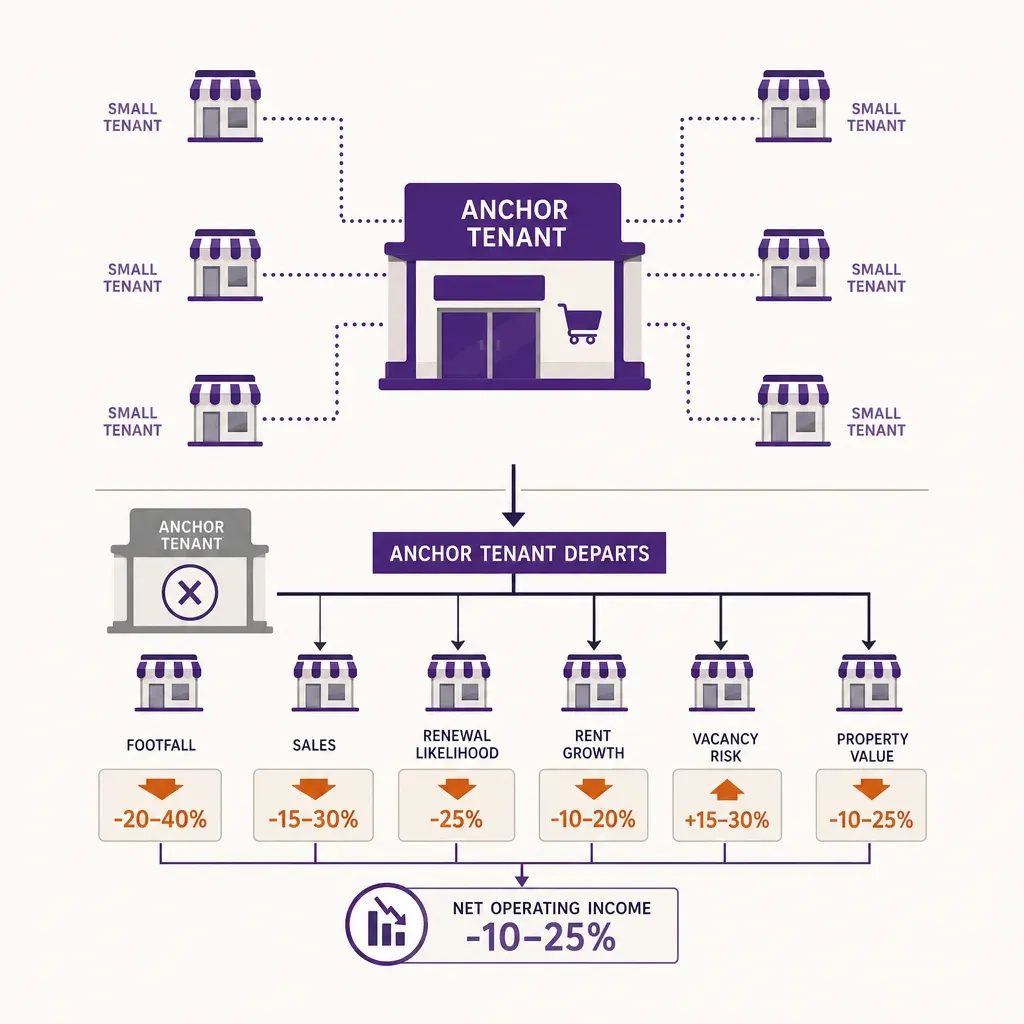
The compounding risk is what makes this serious. One anchor closure can simultaneously breach the co-tenancy condition in dozens of leases. If many of those tenants drop to turnover rent at once, the centre's income falls sharply at the exact moment the landlord most needs cash to fund a backfill. If termination rights then open, the landlord can lose a second tier of tenants, which can push occupancy below other tenants' thresholds and start the cycle again. This is the downward spiral that co-tenancy clauses can accelerate, and it is why backfilling a departed anchor quickly is so much more than filling one large unit.
An illustrative example makes the scale concrete. Suppose a regional centre has 80 smaller tenants, and 30 of them hold ongoing co-tenancy clauses naming the department-store anchor. The anchor announces it will close. After the cure period, those 30 tenants are entitled to switch to turnover rent. If their combined base rent was a meaningful share of the centre's income, the landlord's net operating income can drop by a double-digit percentage from a single closure, before a single replacement deal is signed. These numbers are hypothetical and used only to show the mechanism; real outcomes depend entirely on the specific leases.
What the remedies look like in practice
Co-tenancy remedies are not one thing. The exact entitlement is negotiated, but the common forms sit on a spectrum from mild to severe for the landlord.
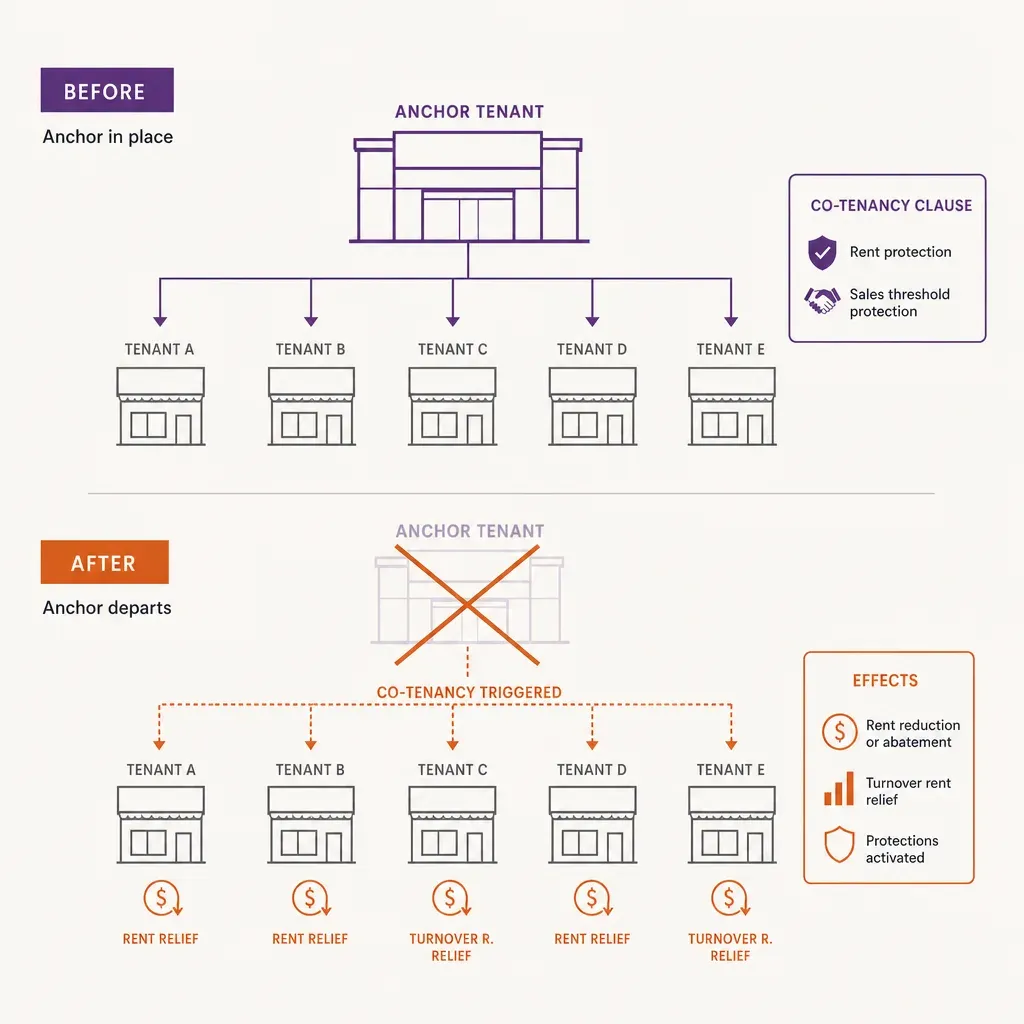
- Rent reduction to a fixed lower base. The tenant pays a stated reduced rent while the condition is unmet, then reverts when it is cured. Predictable, and the gentlest on the landlord.
- Switch to turnover or percentage rent. The tenant pays a percentage of its sales instead of base rent. Because sales usually fall when an anchor leaves, this both reduces the tenant's burden and ties the landlord's recovery directly to how quickly footfall returns.
- Rent abatement. A stronger version where the tenant pays little or no rent for a defined period while the condition is unmet.
- Termination right. The harshest. After a defined period of failure the tenant can end the lease and leave, removing both its rent and its contribution to centre occupancy.
From the landlord's side, the design goal is to keep remedies proportionate and time-bound, with a realistic cure period, so that a temporary vacancy does not detonate the whole rent roll. From the tenant's side, the goal is a remedy meaningful enough to reflect the lost traffic the tenant relied on. Where the line falls is a matter of negotiation and leverage, not a fixed rule.
How landlords manage co-tenancy risk with data
Co-tenancy risk is, at its core, traffic risk. A clause exists because the tenant relied on the anchor for footfall, and the remedy compensates for footfall lost. That makes occupancy and footfall data the natural instruments for managing the exposure, both before a clause is signed and after an anchor leaves.
Before signing, a landlord negotiating co-tenancy thresholds needs to know what its centre actually delivers. Footfall measured per entrance, per zone, and over time tells the leasing team how much traffic the anchors really generate and how a given unit's catchment depends on them. That evidence shapes where to set an occupancy floor, which anchors to name, and how generous a remedy is defensible. Setting a threshold blind, on assumption rather than measured traffic, is how landlords end up agreeing to conditions they cannot meet.
After an anchor leaves, the same data governs the cure. The landlord's question during the cure period is precise: has the centre actually recovered the traffic the clause cares about, or only relet the floor space? A backfill that fills the unit but draws far fewer visitors may technically restore an occupancy threshold while leaving the surrounding tenants underfed and unhappy. Footfall and people counting data lets the asset manager show, tenant by tenant, whether traffic to a given zone has come back, which strengthens the case that the co-tenancy condition is genuinely cured and supports the conversation with tenants who are watching their own sales.
There is also a privacy point worth making, because shopping centres are public spaces and tenants and shoppers alike are sensitive to surveillance. Ariadne measures this with Hybrid Fusion, its patented camera-free method. Time-of-Flight depth sensing counts every visitor at the entrances, capturing geometry rather than images, while patented phone signal sensing follows movement through the interior, detecting the signals a phone emits even in airplane mode. The sensor streams both feeds to Ariadne, where Hybrid Fusion combines them into one trajectory per visit and computes counts, dwell, and paths. The streams carry no identifier: no MAC address, no device ID, no biometric data, and no camera is involved. Identifiers are stored only when a visitor explicitly opts in, which keeps the method GDPR-friendly and outside biometric territory.
Used this way, footfall data does not replace the lease, it informs the people negotiating and administering it. The clause defines the legal trigger; the data tells the landlord whether the underlying traffic, the thing the clause is really about, is present, falling, or restored.
Practical takeaways
Whether you sit on the landlord or the tenant side of the table, a few principles hold across most co-tenancy negotiations.
- Read the trigger and the remedy as a pair. A tight condition with a weak remedy, or a loose condition with a harsh remedy, can each be reasonable. It is the combination that determines the real exposure.
- Check the cure period. The length of the cure window is often where the negotiation really lives, because it sets how long a landlord has to backfill before remedies bite.
- Define the condition in measurable terms. Named anchors and a clear occupancy percentage are easier to administer than vague references to the centre's character. Measurable conditions reduce later disputes.
- Model the domino effect. A landlord should know, for any single anchor, how many leases its departure would trip and what that does to income across the cure period.
- Instrument the centre. Because the clauses turn on traffic and occupancy, continuous footfall data is what lets both sides argue from evidence rather than assumption.
Co-tenancy clauses are a rational response to a real dependency: smaller tenants genuinely do rely on anchors for traffic. Handled well, they share the risk of an anchor loss fairly between landlord and tenant. Handled badly, or signed without understanding the domino effect, they can turn a single closure into a centre-wide income shock. Understanding the mechanism, and watching the traffic that sits underneath it, is how both sides keep the clause working as intended.
FAQ
What is a co-tenancy clause in a commercial lease?
A co-tenancy clause ties a tenant's obligations, usually its rent, to other tenants being present in the same centre. It commonly names one or more anchor tenants or sets a minimum occupancy level. If the condition fails, the tenant gets a defined remedy such as reduced rent, turnover rent, or a right to terminate. It exists because smaller tenants rely on anchors to generate the footfall they convert into sales.
What is the difference between opening and ongoing co-tenancy?
Opening co-tenancy applies at the start of the lease and protects the tenant against opening into a half-empty centre, conditioning its opening or full rent on the anchors and other tenants being open. Ongoing co-tenancy applies throughout the term and protects against the centre deteriorating later, for example an anchor closing or occupancy falling below an agreed floor. A lease can contain both.
What happens to co-tenancy clauses when an anchor closes?
An anchor closure can breach the co-tenancy condition in every lease that names it or relies on the resulting occupancy. After a cure period, during which the landlord can try to replace the anchor, the affected tenants become entitled to their remedy, often a switch to turnover rent and, in stronger clauses, an eventual right to terminate. Because one closure can trip many leases at once, the income impact can be far larger than the single vacant unit.
Is this article legal advice?
No. This is general, informational background on how co-tenancy clauses work. These provisions are heavily negotiated, vary by jurisdiction, and depend on their exact wording. For any specific lease, consult a qualified property or real-estate lawyer.


