
What billboard footfall attribution is trying to prove
Billboard footfall attribution is the practice of measuring whether an out-of-home advertising campaign caused a measurable lift in store visits, rather than coinciding with one. The question sounds simple. The execution is not. A billboard does not carry a click, the audience that sees it overlaps heavily with the audience that walks past the store anyway, and the visits the campaign is trying to influence happen days, sometimes weeks, after the impression. Most reporting that calls itself billboard attribution is correlation: visits during the flight versus visits before it, the gap labelled as lift. That number is almost always wrong, usually in the direction the brand wanted to see.
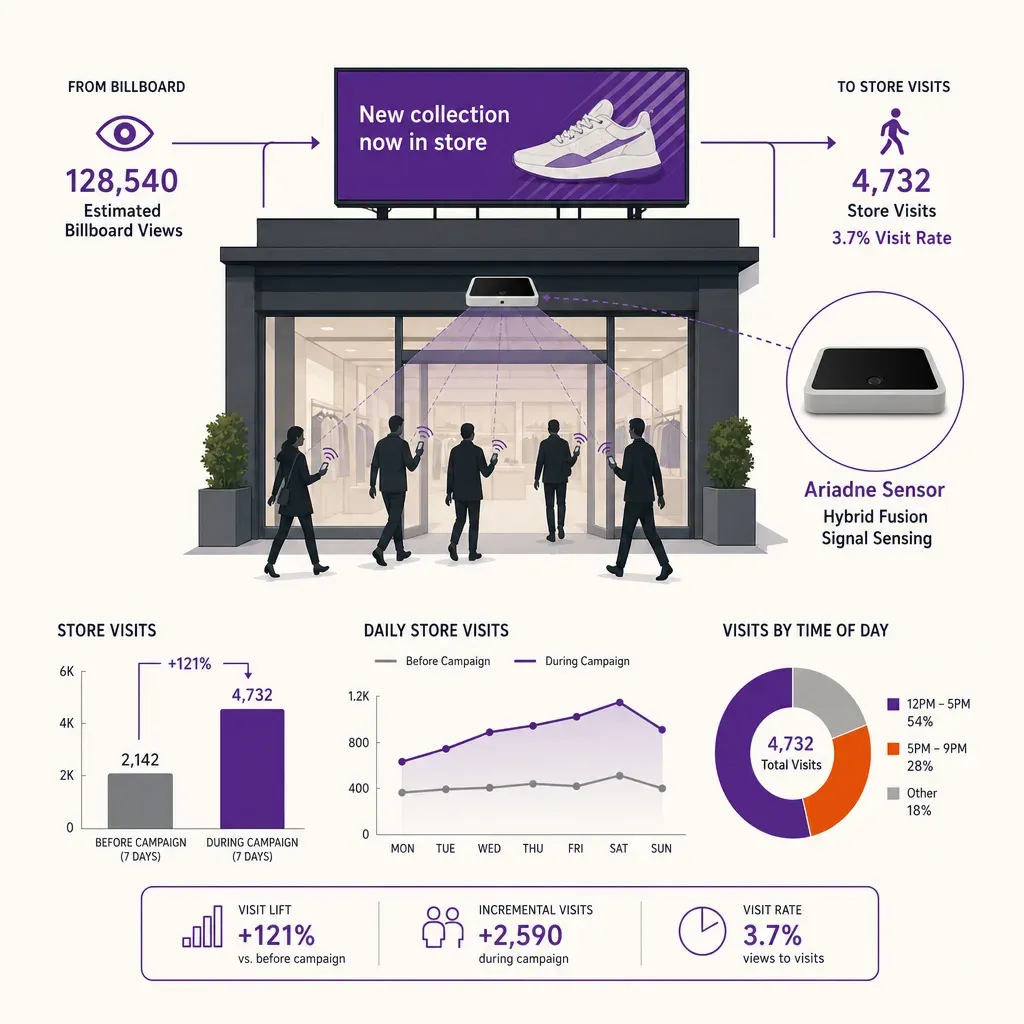
A defensible answer needs three things lined up. A control group that does not see the billboard but matches the test group on everything else that moves store visits. An exposure model that says, with a confidence level, who actually had a chance to see the panel. And a clean in-store visit signal that the exposure model can be joined to. This post walks through each part in 2026, how the windows are chosen, and how a camera-free, identifier-free door-side counter slots into the loop. Throughout, it is the methodology view, paired with what a visitor marketing platform contributes once the visit signal lands.
The lift-and-control design
The core of any honest billboard attribution sits in a lift-and-control experiment. The brand picks a set of stores or a geographic region exposed to the campaign, picks a matched set of stores or a region that is not exposed, and measures the difference in store visits between the two over the same window. The exposed group is the test cell. The unexposed group is the control. Lift is the percentage gap between them, with a confidence interval and a p-value attached. Anything less rigorous than that, including a single-store before-and-after comparison, is a story, not a measurement.
There are four common ways to draw the line between test and control, each with a trade-off.
- Geographic split. Match cities or postcodes that see the flight with ones that do not. Works for regional or national chains; falls down when the control region drifts for unrelated reasons.
- Store-level split. Within one region, expose half the stores and hold the other half out. Works when stores are dense; falls down when the same shopper passes both kinds in a week.
- Time-based holdout. Compare exposed weeks against matched non-exposed weeks in the same locations. Works for short flights; falls down when seasonality or holidays move visits by more than the expected lift.
- Audience-level holdout. When the billboard is paired with a programmatic digital out-of-home or mobile buy, the exchange holds out a slice of the addressable audience. Works with a clean-room join; falls down when the addressable layer is small relative to the panel.
A common pattern is to combine two of these, for example a geographic split with a time-based holdout layered on top. The redundancy is what gives the result a chance of surviving an audit by the marketing science team.
Exposure modelling: who actually saw the panel
A billboard does not deliver impressions, it delivers opportunities. The number that goes into the model is not how many cars drove past, it is the probability that a member of the target audience was exposed to the panel at a moment they could process it, weighted by frequency and dwell. Most large media owners produce panel-level reach and frequency estimates against published industry standards. A defensible exposure model usually combines four inputs.
- Panel reach. A panel-level estimate of how many unique people in the target audience were in line of sight over the campaign window, split by daypart and weekday or weekend.
- Frequency distribution. The distribution of how many times an exposed person saw the panel. Lift typically responds non-linearly to frequency, so an average does not substitute for the distribution.
- Movement data. Aggregate mobility data that says whether the exposed audience overlaps with the store catchment. A billboard on a commuter route is exposed to a different audience than one near a shopping centre.
- Creative weighting. Two panels with identical placement can produce different lifts if one carries a price point and the other a brand message. Run the analysis separately by creative cell.
The output is not a single impression number. It is a probability of exposure for each cell, with an explicit assumption about audience and catchment overlap. That probability is what gets joined to the in-store visit signal.
The in-store visit signal
A lift measurement is only as good as the in-store visit count behind it. Three properties matter.
- Accuracy at the door. Counts have to be reliable for test and control cells over the same window. A counter that drifts under crowd density, or that double-counts groups, contaminates the difference before any modelling begins. Look for accuracy in the high 90s with a stated method for groups and re-entries.
- Granularity by hour and door. Lift sometimes shows up only in specific hours or entrances. Daily store totals hide those effects. Hourly counts per door, summed back up for the regression, give the model the resolution to find the signal where it lives.
- Independence from the campaign. The counter has to be a stable instrument. If the same vendor runs the campaign and the measurement, the conflict of interest is structural; if the campaign team can change the counter during the flight, the experiment is no longer controlled.
The cleanest shape for the in-store signal is a people counting system that produces accurate door-level entries by hour, without depending on the visitor carrying an identifier the campaign owns. That removes the temptation, common in mobile-first attribution stacks, to count only the visits the campaign can claim credit for, which always overstates lift.
Attribution windows: how long is fair
A billboard impression does not produce an immediate visit the way a search ad does. Pick a window too short and a real lift is missed; pick one too long and unrelated visits get credited to the panel. Three windows are commonly run in parallel, and the comparison between them is part of the result, not noise.
- Same-day. Visits on the calendar day of exposure. Useful for grocery, quick-service food, and convenience formats; less informative for considered-purchase categories.
- Seven-day. Visits within a week of exposure. The middle ground that holds for most non-grocery retail and that most marketing science teams default to.
- Thirty-day, decayed. Visits within a month, weighted by a decay curve that puts most of the credit in the first week. Appropriate for high-consideration categories.
The result that survives is usually a same-day or seven-day lift plus a thirty-day decayed lift, with a stated decay curve. A report that quotes only a thirty-day flat window has almost always borrowed visits from the control cell.
Putting the join together
The final attribution sits in a regression that takes the probability of exposure from the exposure model, the visit count from the in-store signal, and a control set of covariates that account for everything else that moves visits in the same window. Common covariates include weather, day-of-week and hour-of-day patterns, local events, the chain's own promotional calendar, competitor openings or closures, and any other paid media running in the same market. The lift estimate is the coefficient on the exposure variable, with a confidence interval that reflects the noise in the underlying counts.
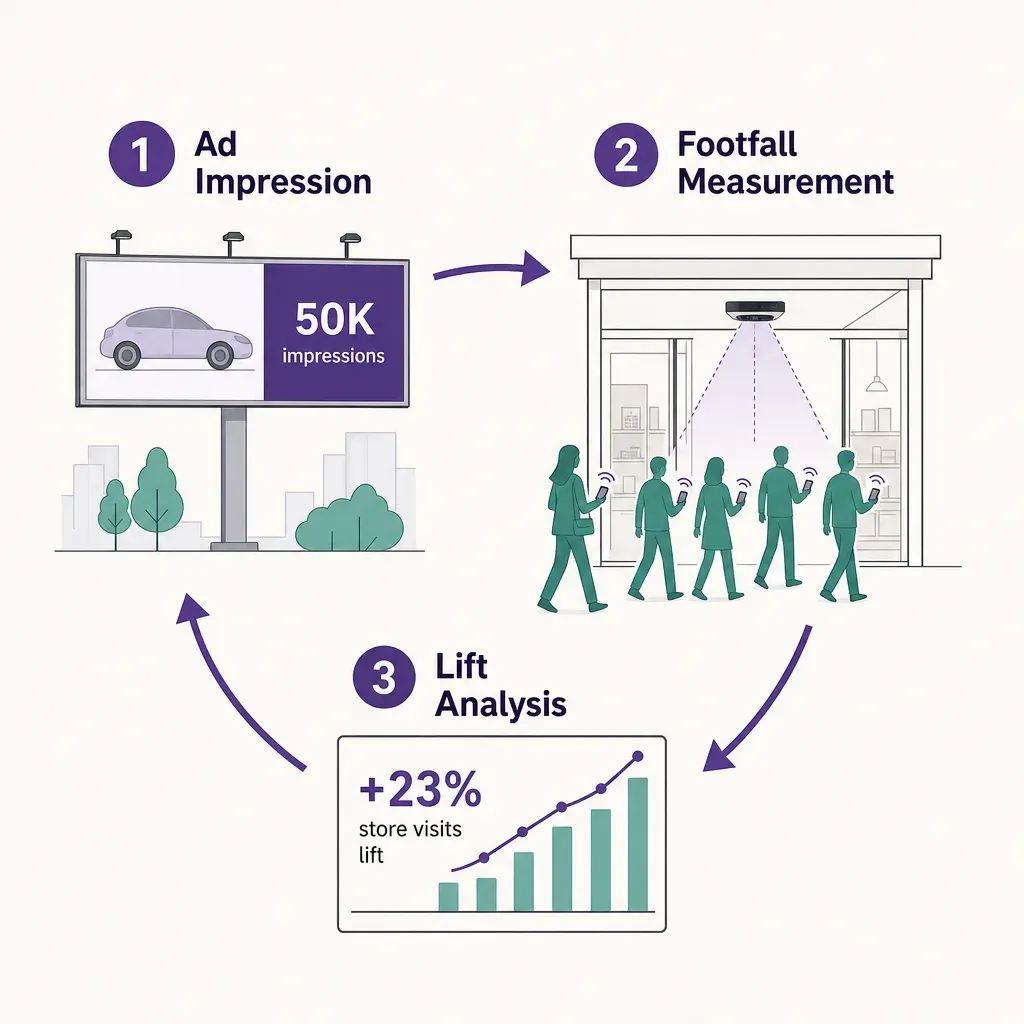
Two practical checks separate a defensible result from a flattering one. A parallel run with the exposure variable shuffled should produce a lift estimate close to zero; a model that finds large lifts under shuffled exposure is overfitting. A placebo cohort check, a similar regression run on a store category the billboard does not address, should also produce a lift estimate close to zero. When both pass and the headline lift survives, the number is worth quoting.
Illustrative ranges help calibrate expectations: a well-executed retail billboard campaign in a mature market often produces low single-digit lift in store visits over a seven-day window. Headline numbers above ten percent across a national network are common in vendor case studies and rare in audited results. The point of attribution is not to land on a flattering number, it is to land on a defensible one.
Where the failure modes live
Five patterns recur in attribution programmes that do not survive review.
- Self-selected control. Choosing as control the regions that under-performed in the prior year produces a trivially large lift that disappears under proper matching.
- Single-window reporting. Reporting only the window in which lift looks largest, without showing the parallel windows, hides a result that may not be stable.
- Counter drift. A counter whose accuracy varies with crowd density gives a lift signal driven by counting noise rather than visits.
- Audience inflation. Quoting panel-level reach as the addressable audience without weighting for catchment overlap counts impressions that could not have produced a visit.
- Vendor-controlled measurement. When the same vendor runs the media buy and the in-store counter, the experiment is structurally compromised. Independent measurement is what makes the result quotable to a CFO.
How Ariadne fits the loop
Ariadne contributes the in-store visit signal, designed so that the door-side counter is independent of the campaign and produces no personal data of its own.
Ariadne measures this with Hybrid Fusion, its patented camera-free method. Time-of-Flight depth sensing counts every visitor at the entrances, capturing geometry rather than images, while patented phone signal sensing follows movement through the interior, detecting the signals a phone emits even in airplane mode. The sensor streams both feeds to Ariadne, where Hybrid Fusion combines them into one trajectory per visit and computes counts, dwell, and paths. The streams carry no identifier: no MAC address, no device ID, no biometric data, and no camera is involved. Identifiers are stored only when a visitor explicitly opts in, which keeps the method GDPR-friendly and outside biometric territory.
For a billboard attribution programme the practical consequences line up with the three properties above. Time-of-Flight depth sensing produces door-level entries from geometry rather than images, with accuracy that holds under crowd density. Hourly entries per door are available for both test and control stores, which is the resolution the regression needs. Because the streams carry no MAC address and no device identifier by default, the counter is a measurement instrument, not a marketing one: there is no identifier to claim visits with. The sensors fit retail stores, and the data handling is set out in the privacy policy.
A buyer checklist for the attribution stack
If you are evaluating an end-to-end programme, these are the questions worth putting in writing.
- What is the control design? Confirm the cell definition, matching variables, and whether more than one design is run in parallel.
- What goes into the exposure model? Panel reach, frequency distribution, movement data, and a creative-cell split should all be named.
- Which attribution windows are reported? Same-day, seven-day, and thirty-day decayed should all be reported. A single window invites cherry-picking.
- Where does the in-store visit count come from? Confirm door-level accuracy, hourly granularity, and whether the counter is operated by an independent party.
- What covariates are in the regression? Weather, day and hour seasonality, the chain's own promotional calendar, and any competing paid media should all be named.
- Are the placebo and shuffled-exposure checks run? A lift number without the two parallel sanity checks is a number, not a measurement.
- What does the door-side counter capture? A camera-free, identifier-free door count keeps the privacy posture of the whole programme clean and avoids the vendor-controlled-measurement conflict.
FAQ
Can billboard attribution work without a mobile panel?
It can, but the result is weaker. The mobile panel links exposure probability to a specific cohort. Without it, the exposure model leans on catchment overlap with panel reach, which is acceptable for regional and national lift estimates but does not support audience-level claims.
How big should the control group be?
The control cell should be at least as large as the test cell, with matching tight enough that pre-campaign trend lines are visually indistinguishable. Match quality matters more than size; a small, well-matched control beats a large, drifting one.
Does the door-side counter need a camera?
No. Ariadne counts with Hybrid Fusion: Time-of-Flight depth sensing plus patented phone signal sensing, never cameras. Time-of-Flight captures geometry rather than images, and signal sensing captures no MAC address by default, so the measurement involves no video, no faces, and no biometric data.
What lift number should a brand expect?
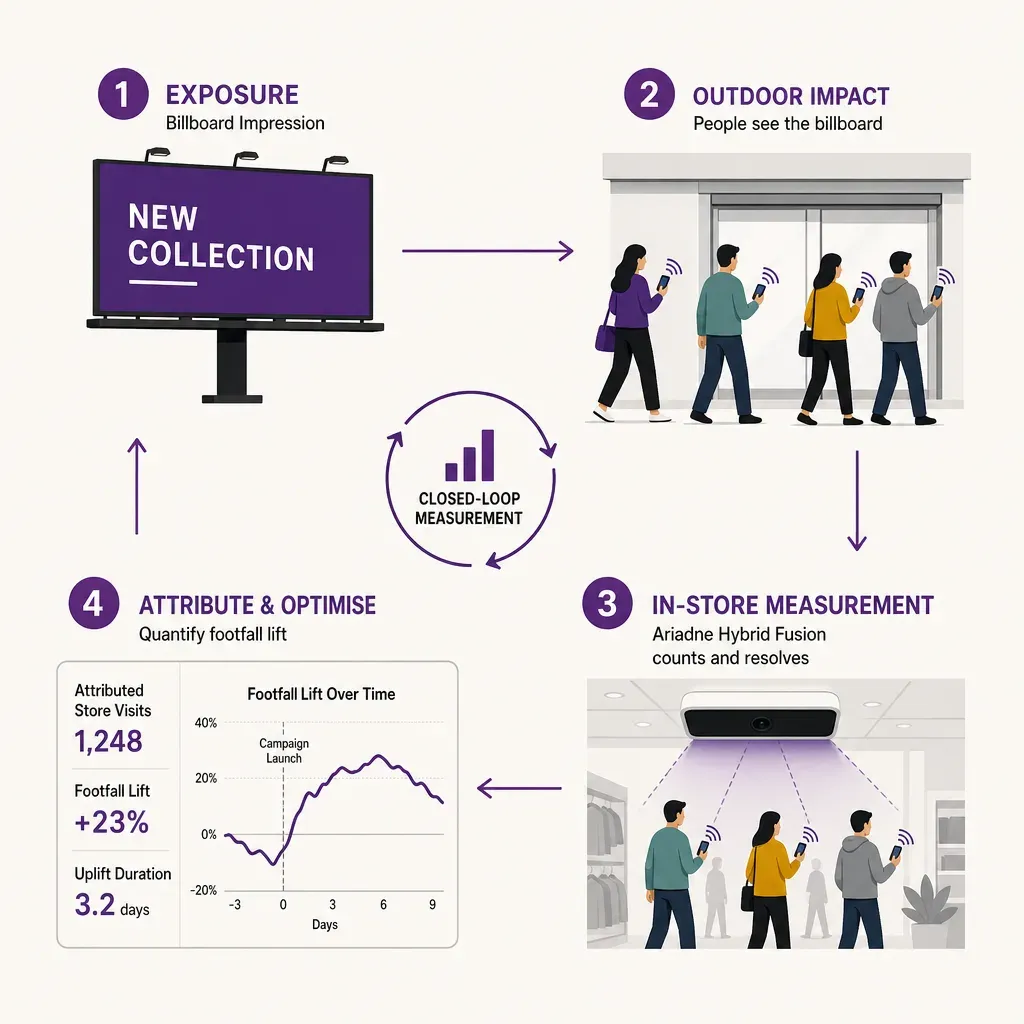
Illustrative ranges only. A well-executed retail campaign often produces low single-digit lift in store visits over a seven-day window. Audited results above ten percent across a national network are uncommon. The defensible answer is the one that survives the placebo and shuffled-exposure checks.


