
Arena flow is three problems, not one
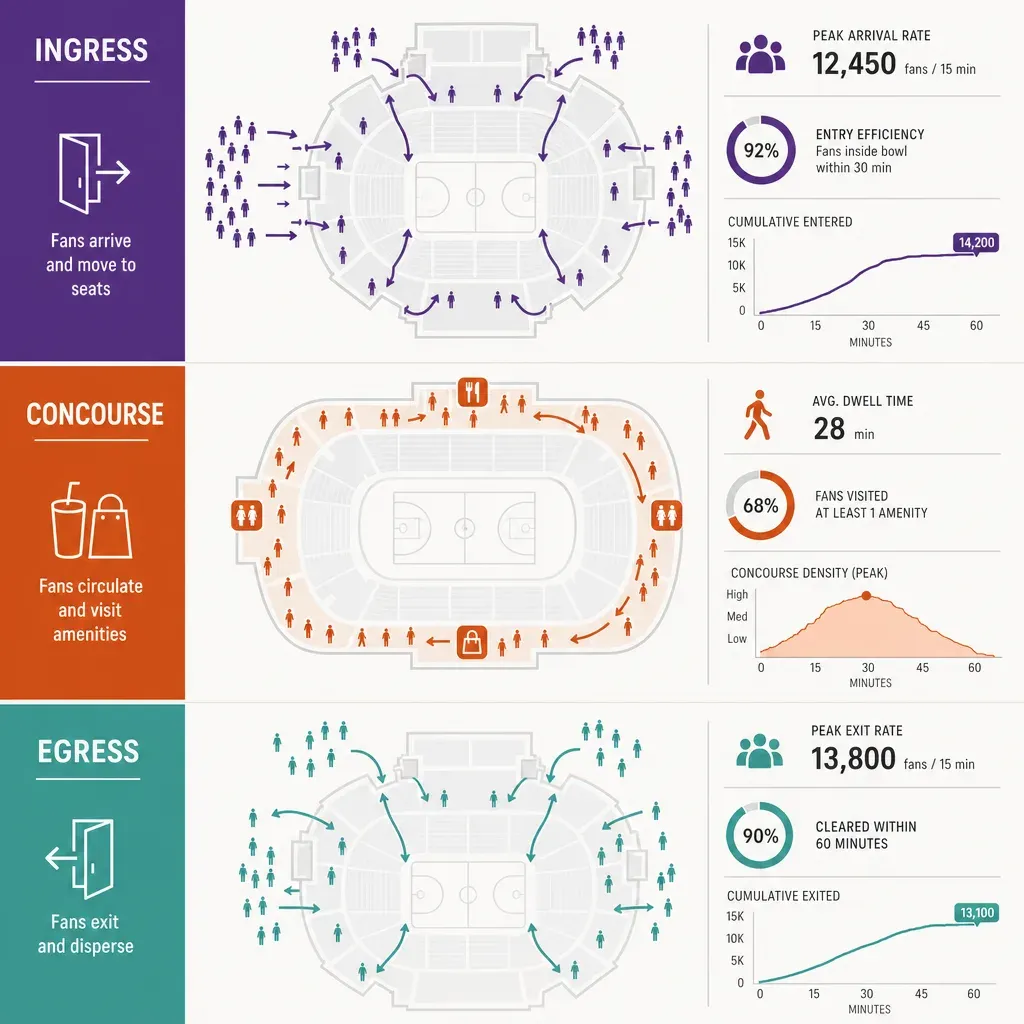
An arena does not have a single crowd. It has three, and each one behaves differently. Ingress is a one-hour surge of strangers who have never been in the building, all trying to find a seat block they read off a ticket. The concourse is a dwell-and-graze pattern around concessions, restrooms, and merchandise, broken twice by intermission peaks that look nothing like the rest of the event. Egress is a near-simultaneous evacuation that the building has to absorb in twenty to forty minutes without becoming a safety incident. Wayfinding has to handle all three, and the strategy for each is different.
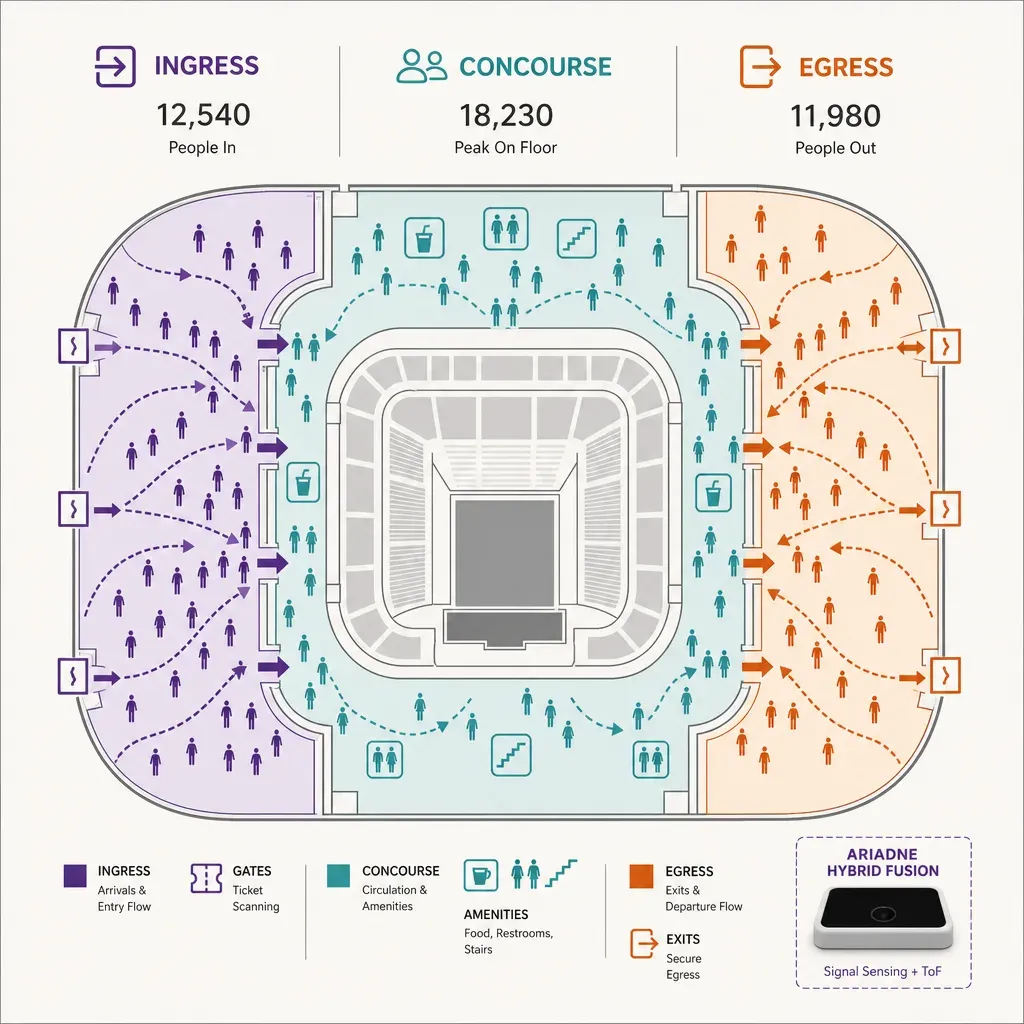
This post is about the design discipline behind that. Not the signage typography or the app screen layout, which deserve their own treatment, but the underlying flow plan: where to count, where to measure dwell, where to read zone capacity, and how those readings feed the decisions a venue operations team makes on the night. The hub for the navigation side of this work is indoor navigation; the measurement side, which is the focus here, builds on people counting placed at the right points in the building.
Ingress: turn a one-hour surge into an even flow
Doors open and a queue that has built up outside collapses into the building. In a typical mid-sized arena the bulk of the audience arrives in the last forty to sixty minutes before the event starts, with a sharp peak in the twenty minutes around the headline act or the first whistle. The wayfinding goal during this window is to keep the inbound flow moving, get fans to the correct seating block by the shortest viable route, and avoid choke points where two streams cross.
Three measurement points carry most of this work.
- Per-gate entry counts. Count every visitor at every gate, with the count broken down per turnstile or per door line. This is the floor of an ingress dataset: how many people came in, where, and at what rate per minute.
- Gate-to-seat-block load. Map each gate to the seating blocks it primarily serves. As the count climbs, you can read which blocks are filling fastest and whether the original gate-to-block plan is matching the actual queue distribution outside. If one gate is taking double its planned share, the wayfinding response is a signage and steward redirect, not waiting for the queue to spread itself out.
- Concourse load just inside the gates. Count the first concourse zone immediately behind each gate. This is the layer where a slow seat-finding crowd backs up into a fast inbound stream, and it is where most ingress congestion incidents begin. Live occupancy here is the early-warning signal for the operations centre.
The decisions that come out of this dataset are practical. Open an additional door line at a gate that is running hot. Hold a door line briefly when the concourse behind it is at capacity. Redirect fans arriving at a saturated gate to the next nearest one with shorter waits, by signage and steward instruction, before they have committed to a queue. None of this needs facial recognition or per-person tracking. It needs accurate counts, a live read of occupancy by zone, and a clear gate-to-block plan that the wayfinding signage and the staff radio script are both built around.
Concourse: design for dwell, not just throughput
Once fans are inside, the concourse stops behaving like a corridor and starts behaving like a small high street. People drift between concessions, restrooms, merchandise, and their seats, and the time they spend in each zone matters more than the number of people who walked past. The wayfinding job here is twofold: make it easy to find the nearest of each service, and keep any one of them from filling up beyond a comfortable level.
Useful measurements during the in-event window.
- Concourse zone occupancy. Treat each concourse segment as a counting zone. Live occupancy tells you which segments are crowded and which are quiet. A wayfinding screen at a busy junction can nudge fans toward a quieter parallel route to the same destination, which is the single highest-leverage move in concourse design.
- Dwell time around concessions and restrooms. Average dwell at a concession zone separates a stall doing brisk service from one with a queue that has stopped moving. Long dwell at restrooms during a non-intermission window usually flags an under-supplied facility for the crowd that gate is feeding, which is a planning input for the next event of the same scale.
- Zone capture by gate. Read which concourse segments the visitors from a given gate actually use. Many arenas discover that the planned catchment of a gate and the real catchment differ by a full segment, which has direct consequences for where to position signage, staff, and the wayfinding app's default recommended routes.
A concourse plan built on these readings is calmer to walk than one built on throughput counts alone. Throughput tells you how many people passed; dwell and occupancy tell you whether they were comfortable doing it. The first is a transit number; the second is the experience the fan remembers.
Intermission: the peak inside the peak
Intermissions and half-time are short bursts where the concourse load roughly triples in three to five minutes. The pattern is well known: fans head to restrooms and concessions in close to lockstep, queues form, and the window to serve them is typically fifteen to twenty minutes before the second half or next set begins. Wayfinding has to absorb that without crowd density tripping a safety threshold.
Three operating choices are usually on the table.
- Staggered exit cueing. If the event format allows, end-of-period cues that release blocks a minute or two apart can flatten the intermission surge meaningfully. Live block-by-block occupancy is the input that tells the operations team which blocks to release first based on which concourse segments are already light.
- Dynamic concourse signage. Wayfinding screens at concourse junctions can switch their default "nearest restroom" arrow to point at the second-nearest one when the nearest crosses a capacity threshold. The math is unflashy, but the felt experience is meaningfully better: fans get sent where there is actually space.
- Steward repositioning. Stewards do not need to be at every concourse junction all evening. They need to be at the few junctions where the data shows the worst intermission crowding for this specific event configuration. A zone occupancy heatmap from the previous event of the same format is the briefing document for tonight's deployment.
The point of all three is that intermission is not a separate event to plan in isolation; it is the moment when the rest of the concourse plan is tested at the highest load it will see. If the underlying zone-by-zone measurement is honest, intermission management becomes a series of small, defensible adjustments rather than a scramble.
Egress: design for a safe, quick clear
Egress is the part of the night with the lowest tolerance for getting wayfinding wrong. Twenty to forty thousand people leaving in twenty to forty minutes means every minute of avoidable congestion is a meaningful safety cost. The wayfinding plan needs to do two things at once: get fans to the nearest correct exit by the shortest viable route, and balance load across the available exits so that no single egress point is doing twice its share.
Measurement points that matter.
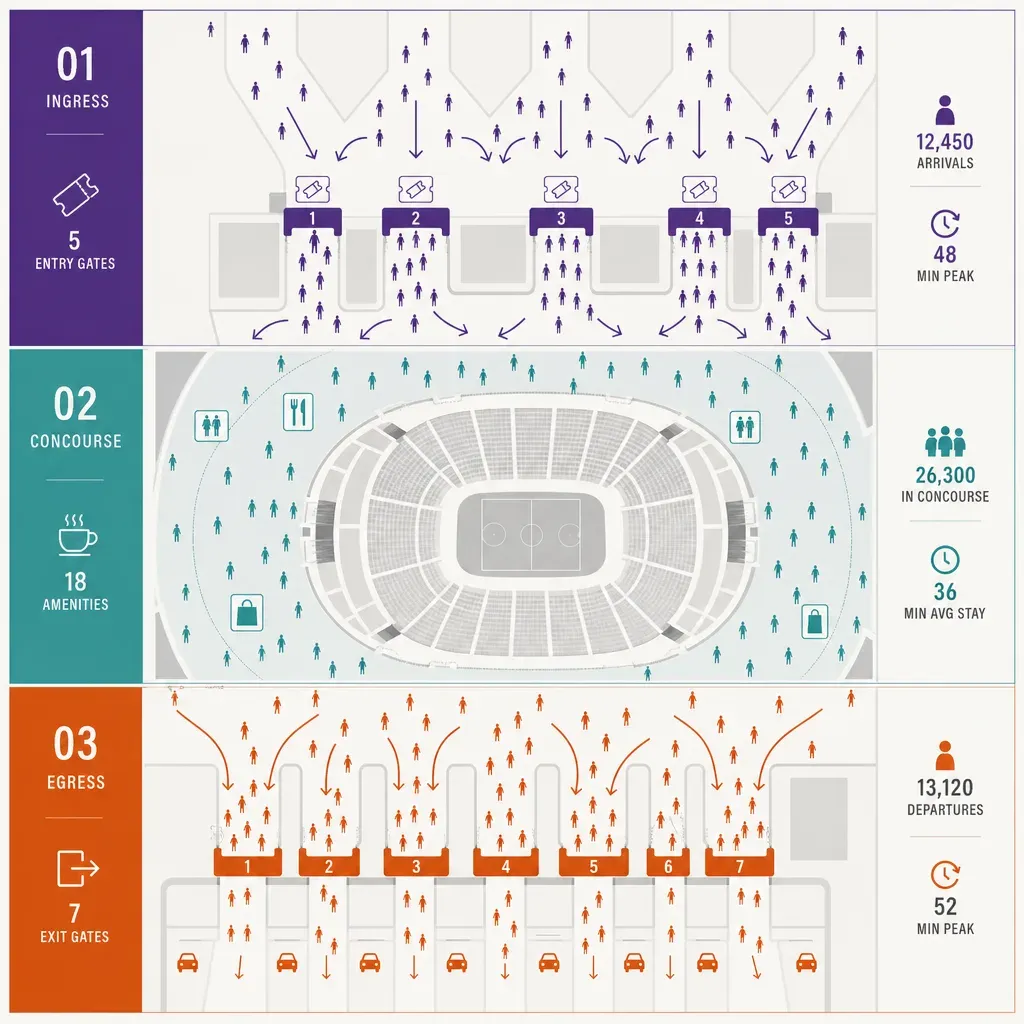
- Exit counts per gate. Count outbound at every exit, just as you did inbound, and read the per-minute outflow rate. A sustained drop in outflow at one gate without a corresponding rise elsewhere is a sign that an exit has narrowed somewhere along the path, which is worth a steward check immediately.
- Stairwell and ramp occupancy. Vertical circulation is where egress incidents historically begin. Live occupancy on the stairwell or ramp segments adjacent to each block tells the operations team where to hold a block briefly and where to release one.
- Exit-block balance. Plot the per-minute outflow share of each exit against the original block-to-exit plan. Persistent imbalance is the wayfinding input for the next event: change the signage or the default app route at the block where fans are over-choosing one exit.
Egress wayfinding decisions made on this data tend to be small and frequent rather than large and dramatic. Open a secondary exit a few minutes early at a block whose stairwell is filling. Hold the release of one block for thirty seconds while the concourse ahead clears. Switch a dynamic sign to direct fans toward the under-used exit at the far end. The aggregate effect of these small adjustments is the difference between a forty-minute clear and a twenty-five-minute one, and between a calm egress and one that the operations team writes up afterwards.
Counting, dwell, and zone capture together
The wayfinding strategy described above stands on three measurement primitives. Worth being explicit about what each one is for, because arena operations teams often inherit a system that does only one of them well.
- Counting. A count is the answer to "how many crossed this line over this window." It is the foundation of every per-gate, per-block, and per-exit number above. Without an accurate count, every later layer is built on sand.
- Dwell. Dwell time is the answer to "how long did they stay." It is the difference between a concourse segment people walked through and one they stopped in. The wayfinding meaning of a high dwell number depends on the zone: at concessions it is service throughput, at restrooms it is an under-supply signal, at merchandise it is engagement.
- Zone capture. Zone capture is the answer to "which concourse zones did visitors from a given gate or block actually use." It is the planning input that closes the loop between ingress, in-event behaviour, and egress. The first time an operations team reads a zone capture map for their building, it almost always changes a piece of signage placement.
An operational decision is only as good as the measurement underneath it. If a venue wants to defend an egress plan in front of a safety advisory group, it helps to have all three numbers, with the methodology written down, rather than throughput alone.
How Ariadne fits
Ariadne builds the counting, dwell, and zone-capture stack described above on a camera-free measurement method designed for venues that take privacy seriously, which by now is most of them.
Ariadne measures this with Hybrid Fusion, its patented camera-free method. Time-of-Flight depth sensing counts every visitor at the entrances, capturing geometry rather than images, while patented phone signal sensing follows movement through the interior, detecting the signals a phone emits even in airplane mode. The sensor streams both feeds to Ariadne, where Hybrid Fusion combines them into one trajectory per visit and computes counts, dwell, and paths. The streams carry no identifier: no MAC address, no device ID, no biometric data, and no camera is involved. Identifiers are stored only when a visitor explicitly opts in, which keeps the method GDPR-friendly and outside biometric territory.
For an arena, the practical consequences are direct. Ingress and egress counts come from Time-of-Flight sensors at the gates, capturing geometry rather than images, which means no photograph of a fan is ever stored. Concourse dwell and zone occupancy come from the patented signal sensing layer, which detects phone signals without capturing MAC addresses by default and without recognising who anyone is. Live zone occupancy is available to the operations centre during the event, and the same data, exported and segmented, is the briefing document for the next event of the same configuration. The data handling is set out in the privacy policy, and the same flow primitives carry across to other event-led venues, including event-driven digital signage environments, where the wayfinding screens are part of the operational toolkit.
A wayfinding flow checklist for arenas
If you are reviewing the wayfinding plan for an arena, or scoping a measurement upgrade, these are the questions worth working through in writing before anything is installed.
- Do you count every gate, in and out, with per-minute resolution? Hourly aggregates are not enough for ingress and egress. The minute-by-minute curve is where the operational decisions live.
- Are concourse segments treated as named zones? Each segment should have live occupancy and dwell. If the concourse is a single blob in the data, it is a single blob in the operations plan, and the response to an intermission peak is necessarily blunt.
- Does the gate-to-block plan match the real zone capture? Read which blocks the visitors from each gate actually populate, not which blocks the architectural drawing says they should. The signage and app defaults should follow the real catchment.
- Is there a live read for stairwells and ramps during egress? Vertical circulation is the egress safety pinch point. A live occupancy figure on every stairwell segment is a basic prerequisite for a defensible egress plan.
- Is anything personal captured at any point? No images, no faces, no MAC addresses by default. The cleanest answer to a board or a data protection officer is that there is nothing identifying in the count to begin with.
- Can the post-event report be produced without re-keying numbers? Counts, dwell, and occupancy should export cleanly into the same incident-and-debrief report the safety team and the venue manager already use.
Related reading
FAQ
Does the system use cameras anywhere in the arena?
No. Ariadne counts with Hybrid Fusion: Time-of-Flight depth sensing plus patented phone signal sensing, never cameras. Time-of-Flight captures geometry rather than images, and signal sensing captures no MAC address by default, so the measurement involves no video, no faces, and no biometric data.
Can it measure intermission load by concourse segment?
Yes. Each concourse segment is a counting zone with its own live occupancy and dwell time. That is the read an operations team uses to switch dynamic signage, reposition stewards, or stagger block-by-block release at the end of a period.
How accurate are the per-gate counts in a high-density surge?
Time-of-Flight depth sensing at the gates is the method most resistant to dense, fast-moving crowds, because it reads geometry rather than images and is not confused by overlap the way a camera-based method can be. Typical industry expectations are in the high-90s percent range for crossings under the sensor under arena conditions; the exact figure depends on gate geometry and sensor placement, which a survey before installation will confirm.
Does this replace stewards and steward briefings?
No, and it should not. The point of the data is to make steward deployment and signage strategy more defensible, not to remove the people who make the night work. A zone occupancy heatmap from the previous event of the same configuration is a sharper briefing document than memory or general policy, and it is what most arena operations teams settle into using once the measurement is in place.


