
Why restroom servicing is a passenger-flow problem
The cleanest signal of how an airport is run, in the eyes of the traveller, is the state of the nearest restroom. Surveys done by airport operators across the industry put restroom cleanliness in the top three drivers of overall passenger satisfaction, alongside wait times at security and the clarity of wayfinding. The figure does not move much from year to year, and it does not vary much by terminal class. The traveller does not see the airfield, the apron, or the baggage system; they see the restroom on the way from security to the gate, and they form an opinion of the whole airport from it.
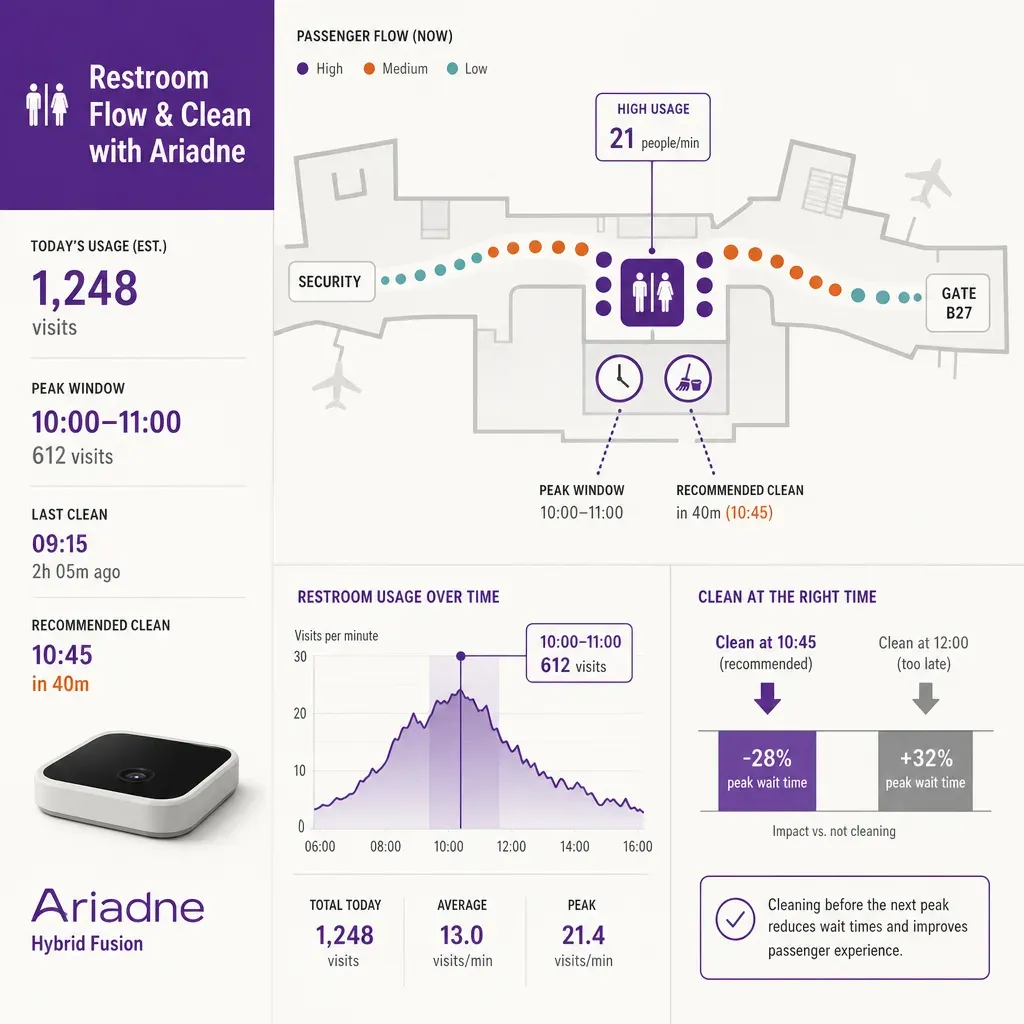
That makes restroom servicing one of the most operationally sensitive workflows an airport runs, and one of the easiest to get wrong. A common default in the industry is a fixed cadence: a cleaner walks every restroom on a 60 or 90 minute interval through the operating day, ticks the check sheet on the door, and moves on. The cadence is simple to staff and simple to audit. It is also blind to what is actually happening on the floor, which is that an airport terminal does not produce a flat load on its restrooms. The pier next to a 250 seat departure has a queue at the entrance for 40 minutes. The remote pier two gates over sits empty for the next two hours. The 90 minute cadence services both the same way. The first restroom is on its third use of the cycle when the cleaner arrives; the second is on its first. The cost of those two visits is identical; the value is not.
The case for using passenger-flow data to set the servicing schedule is not an efficiency case first. It is a quality case. The point of the data is to put the cleaner in the right restroom at the right time, so the traveller arriving five minutes after a boarding wave does not walk into a restroom that has just absorbed 180 people on a stale 90 minute interval. Cost takes care of itself once the quality target is honest.
What a fixed interval gets wrong
Fixed servicing intervals are easy to reason about because they assume the only variable is time. In an airport that assumption is almost never true. Three patterns in the underlying flow data routinely break a flat cadence.
- Boarding waves at piers. A wide-body departure pushes its passenger load into the gate area in a tight window, typically 45 to 60 minutes before push-back. Restroom traffic at the pier head spikes inside that window and then collapses. A cadence that hits the pier on the wrong side of the wave services a quiet restroom and misses the post-wave peak entirely.
- Arrival pulses at immigration. Inbound long-haul aircraft empty into the immigration hall in bursts of several hundred passengers at a time. Restrooms before and after the hall absorb most of that load in the 30 minutes after each pulse. The pulse pattern follows the inbound schedule, not the clock.
- Quiet shoulders. Between waves and pulses, sections of the terminal go very quiet. A pier between two banks of departures can run for two hours with almost no traffic. A flat cadence services those restrooms anyway, which is hours of cleaner time delivered against close to zero demand.
The combined effect is that a flat interval simultaneously over-services quiet zones and under-services busy ones. The total labour spend looks defensible on paper, because the cadence is regular and the check sheets are signed, but the traveller-facing quality outcome is unbalanced in exactly the way a satisfaction survey will pick up.
What live counts and dwell actually tell you
A flow-driven servicing model needs two figures per restroom, both produced continuously through the day. The first is a live count: how many entries the restroom has absorbed since the last service, in real time. The second is a dwell distribution: the typical time a visitor spends inside, which is the proxy for how heavily the fixtures have been used during that visit.
Entries are the headline number for a servicing trigger. A common pattern that holds up across many airports is to set a soft threshold somewhere in the range of 150 to 250 entries between services, depending on fixture count, the time of day, and the airport's quality target. A threshold of 200 means a busy pier restroom triggers a service every 35 to 45 minutes during a boarding wave, and a quiet remote-stand restroom may not trigger one for three or four hours. Those are illustrative bands; the right number for any specific restroom is a function of its capacity, its catchment, and how the operator defines acceptable condition. The point is that the cadence is now derived from the load, not from the clock.
Dwell adds a second layer. A restroom with a high entry count and a typical dwell distribution is being used the way an airport restroom usually is, and the entry threshold is a fair proxy. A restroom showing dwell well above the typical range, sustained over a window, is signalling something else: a queue forming inside, a fixture out of service, or a soft fault that has not yet been reported. The combined signal of entries plus an unusual dwell shift is what lets the operations team push an unplanned service into the rotation before a passenger complaint reaches the contact centre.
Both figures need to be produced from sensors against the architecture rather than from inside the restroom itself. The whole reason this approach is workable in a public airport is that the measurement does not require a camera or any device-side identification of the traveller. It is a count of people crossing a threshold and a measure of how long they were in the space, nothing more.
The cost, quality, and passenger-experience triangle
Operations teams that move from fixed intervals to flow-driven servicing tend to think in terms of three connected outcomes. Each one trades against the other two, and the value of having real data is that the trade becomes explicit.
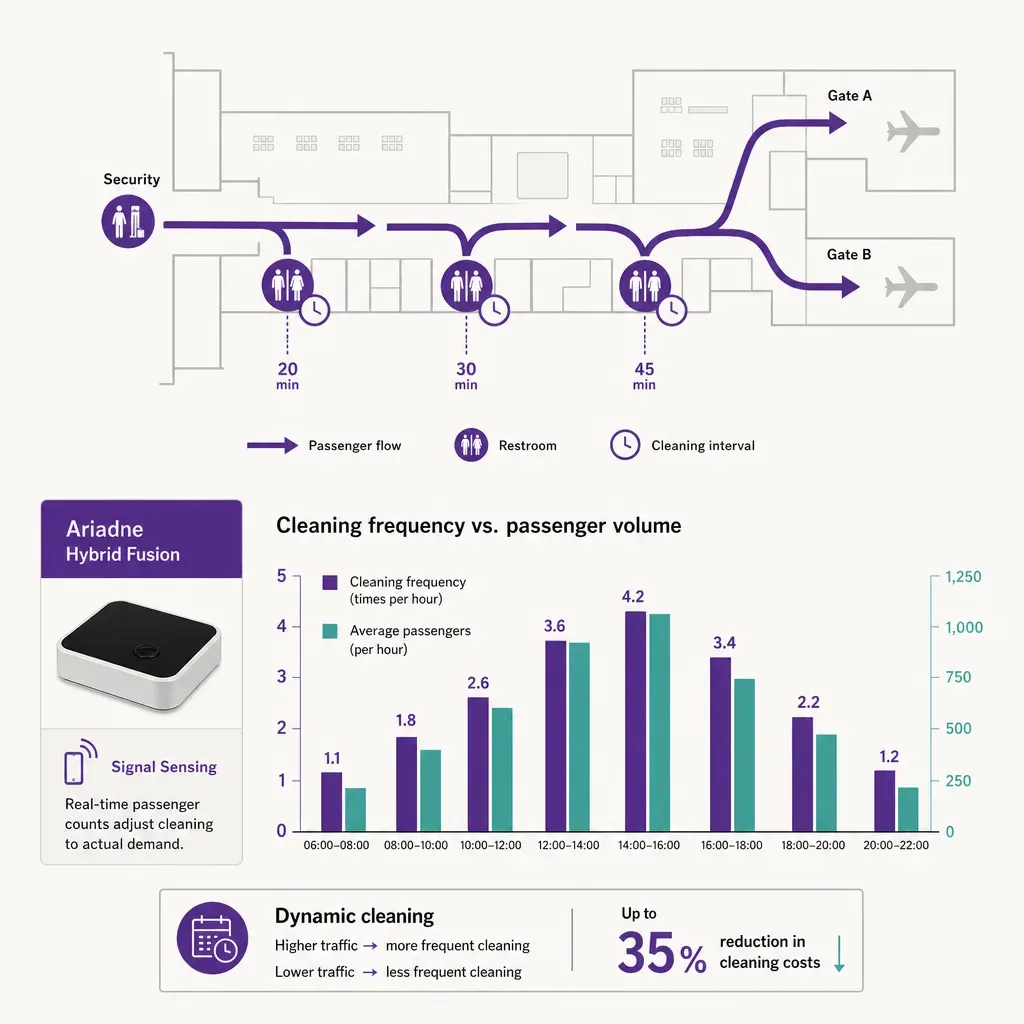
- Cost. The total cleaner hours per restroom per day. A flat cadence sets this number directly: hours equals interval count multiplied by service time. Flow-driven scheduling sets it indirectly, by responding to the actual entry curve. Operators that have moved this way commonly describe a re-allocation, not a reduction, where labour shifts from quiet zones to busy ones at roughly the same total budget. Reductions of 5 to 15 percent in total labour are plausible at the same or improved quality, but the headline benefit is usually the re-allocation rather than the cut.
- Quality. The condition of the restroom as judged by an audit or by the passenger. The most defensible quality metric is the share of restroom audits that pass on the first check, measured against a defined standard for fixtures, supplies, and soiling. Flow-driven scheduling tends to move this figure upward because the service follows the load, not the calendar.
- Passenger experience. The figure the airport's commercial and brand teams care about. Restroom cleanliness scores in passenger surveys lag operational changes by a survey cycle or two, but the link between the operational change and the score is direct. A flow-driven servicing programme is one of the few operational levers that shows up cleanly in passenger satisfaction without any change to the physical fabric of the terminal.
The triangle is helpful because it forces the question of which outcome is being optimised. An airport under a tight cost ceiling may take the labour saving and hold quality flat. An airport competing on service quality at the brand level may hold the budget flat and push the audit pass rate up. Either decision is defensible; what was not defensible was deciding by accident on a flat 90 minute cadence inherited from a previous contract.
From flow data to a servicing schedule
A flow-driven schedule is not a single algorithm. It is a small set of rules layered over a continuous count, and the rules can be set by the operations team rather than by a black-box system. A reasonable pattern that several airport teams have converged on looks like this.
- A demand-trigger threshold per restroom. Set an entry count between services that reflects the restroom's capacity and the airport's quality target. Reaching the threshold queues a service in the cleaning team's task list.
- A maximum interval. Set an upper bound regardless of count, typically in the 2 to 3 hour range, so a quiet restroom still gets a baseline service for supplies, fixtures, and visible condition.
- A pre-wave nudge. Use the flight schedule to bring forward a service in a pier restroom a known interval before a major boarding wave, so the restroom is in fresh condition when the pier fills.
- A dwell-anomaly trigger. If average dwell shifts well above the typical range and stays there, raise an unplanned service ticket. This catches queue buildups, fixture faults, and soiling events that an entry threshold alone would miss.
- A post-pulse sweep. After a major inbound or boarding event, schedule a sweep of the restrooms downstream of the event regardless of their individual triggers, because the count threshold may be crossed in a cluster faster than the rolling check can react.
All five rules sit on top of the same two inputs: a live count and a dwell distribution per restroom. The schedule is something the operations team can audit, adjust, and explain. The thresholds and intervals are theirs to choose, which is the property that makes the model usable in a regulated environment where every change has to be defended.
The privacy bar an airport restroom programme has to clear
Restrooms are the single most privacy-sensitive zone inside an airport. No camera, no video, no biometric capture, and no device-level identification can be present anywhere near them. The measurement system has to count entries and capture dwell at the corridor or doorway level without crossing into the restroom itself, and without recording anything that could identify a traveller anywhere on the journey through the terminal.
Under the GDPR, images of identifiable travellers are personal data and facial recognition produces biometric data, a special category that needs a strong legal basis and is hard to justify for an operational headcount. MAC-address capture from passing phones raises its own questions about whether a transient identifier is personal data in context. The practical bar most airport operators apply is simple: the system should report counts and dwell without capturing anything that could identify a traveller. If the honest answer to that test is yes, the conversation with the airport's data protection officer is short.
The cleanest way to clear the bar is not to soften a camera feed after the fact, but to choose a method that never captures identifying data in the first place. There is nothing to anonymise later because nothing identifying was collected to begin with.
How Ariadne fits
The two inputs a flow-driven restroom programme needs are an accurate count of entries per restroom and a dwell distribution per restroom, both continuous through the operating day, and both produced without standing up cameras in or near a privacy-sensitive zone.
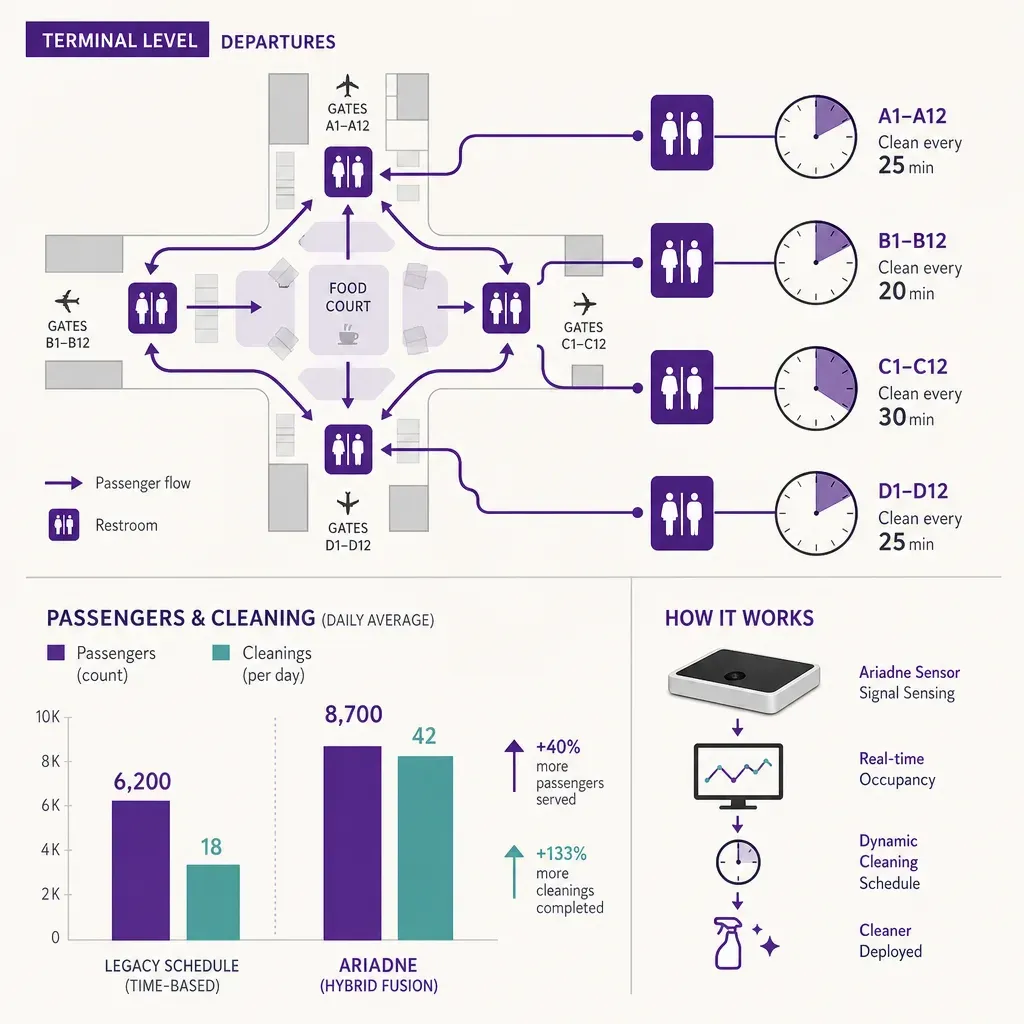
Ariadne measures this with Hybrid Fusion, its patented camera-free method. Time-of-Flight depth sensing counts every visitor at the entrances, capturing geometry rather than images, while patented phone signal sensing follows movement through the interior, detecting the signals a phone emits even in airplane mode. The sensor streams both feeds to Ariadne, where Hybrid Fusion combines them into one trajectory per visit and computes counts, dwell, and paths. The streams carry no identifier: no MAC address, no device ID, no biometric data, and no camera is involved. Identifiers are stored only when a visitor explicitly opts in, which keeps the method GDPR-friendly and outside biometric territory.
In an airport restroom context this lands in four practical ways. Entry counts at each restroom corridor come from Time-of-Flight depth sensing placed at the threshold, which counts every traveller without depending on whether they carry a phone and without forming an image of them. Group sizing is handled centrally by the patented signal sensing in the surrounding pier, so a family of four entering together counts as four uses rather than as one threshold crossing. The dwell figure inside the restroom corridor is produced from the same threshold sensors as a difference between entry and exit timestamps, which is enough for an average dwell metric without any sensor inside the restroom itself. And because the streams carry no identifier by default, the operations team can plug the count into a servicing schedule without raising any of the questions a camera-based approach would raise. Sensor hardware sits in the Ariadne sensor lineup, the wider operational view of an airport sits at airport operations, the underlying counting capability is described under people counting, and the data handling is set out in the privacy policy.
None of this replaces the cleaning team or the audit programme. What it changes is the input that feeds them. The cleaner gets a task list ordered by live demand instead of a checklist ordered by the clock, the auditor gets a continuous record of count and dwell against the service log, and the operations manager gets a defensible explanation for why a given restroom was serviced when it was.
A planning checklist for operations teams
If you are reviewing a restroom servicing contract or designing one from scratch, these are the questions worth answering before the cadence is set.
- What does the underlying load curve look like? Before agreeing to any interval, look at a week of entry counts per restroom and read the wave pattern. The curve, not the contract, should set the schedule.
- What is the quality target? Define what an acceptable restroom condition is and how it is measured. The audit pass rate against that standard is the figure the cadence is designed to hit.
- Is the trigger demand-based or time-based? A demand-trigger model with a maximum interval is more defensible than either a flat cadence or a purely on-call model. Confirm both numbers per restroom.
- How does the schedule react to schedule changes? Diversions, delays, and irregular operations move the wave. Confirm the scheduling rule reads the live count rather than the published flight plan only.
- Does the measurement capture personal data? The bar to ask for is no images, no faces, no device identifiers by default, with any identifier limited to explicit opt-in. That is the answer the airport's data protection officer will recognise.
- Is the cleaner's task list auditable end to end? The operations team should be able to trace each service back to the count and dwell trigger that raised it, and each missed trigger back to a documented reason. Without that, the model is a black box.
FAQ
Does the system put sensors inside the restroom?
No. The threshold sensors sit at the entry corridor, count travellers crossing in and out, and produce the entry and dwell figures from those timestamps. There is no sensor, camera, or microphone inside the restroom space itself. That is the property that keeps the measurement on the right side of the privacy bar a restroom area always sits behind.
How does flow-driven scheduling differ from a fixed 90 minute cadence?
A fixed cadence sets the same servicing interval for every restroom regardless of load, which simultaneously over-services quiet zones and under-services busy ones. A flow-driven schedule sets a demand-based trigger, typically an entry count between services, with a maximum interval as a backstop, a pre-wave nudge tied to the flight schedule, and a dwell-anomaly trigger for unplanned events. The total labour budget can stay flat while quality improves, because labour shifts from quiet zones to busy ones rather than being added overall.
What entry threshold should we set per service?
Common practice across airport operators puts the soft threshold somewhere in the range of 150 to 250 entries between services, but the right number depends on the restroom's fixture count, its catchment, and the airport's defined quality standard. The threshold is something the operations team should set, measure against the audit pass rate, and adjust per restroom. Treat any single industry number as a starting point, not a benchmark.
Does the measurement system use cameras at the restroom corridors?
No. Ariadne counts with Hybrid Fusion: Time-of-Flight depth sensing plus patented phone signal sensing, never cameras. Time-of-Flight captures geometry rather than images, and signal sensing captures no MAC address by default, so the measurement involves no video, no faces, and no biometric data.


