
Most counters sold today carry the word "AI" somewhere on the spec sheet. The label has stopped meaning much, because it covers a beam sensor with a smarter filter, a ceiling camera running a detection model, and a depth sensor that never takes a picture, all at once. For a buyer, that is the problem. Two systems both called "AI people counters" can disagree on the same doorway by twenty percent, and capture completely different things about the person walking through.
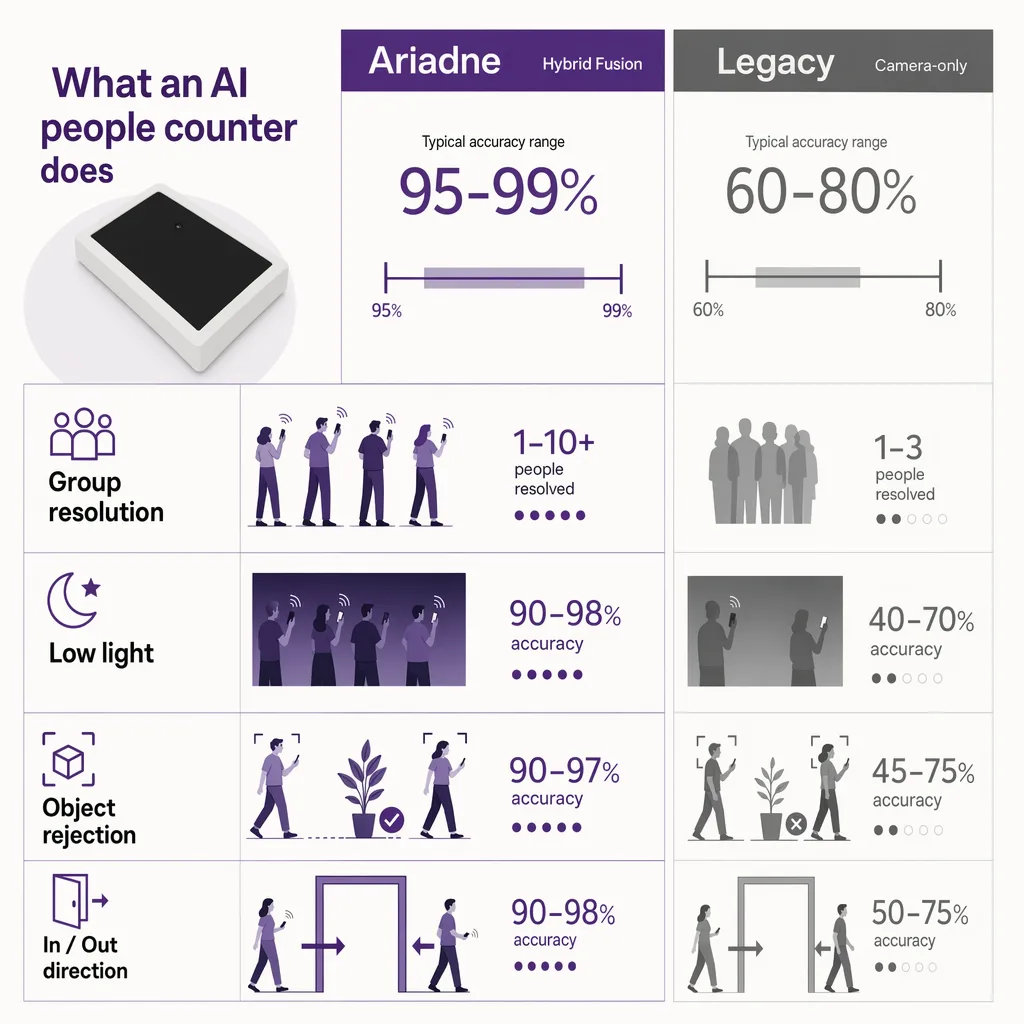
This guide separates what the AI is actually doing from what the marketing says it does. It covers the jobs a model genuinely handles in a counter, how the main sensing methods compare on accuracy and on privacy, and the four questions that tell you whether a vendor's "AI" claim holds up. If you are evaluating a people counting system for a venue, the Ariadne platform page covers deployment, accuracy by environment, and the procurement matrix; this guide covers what the AI inside a counter actually does.
What is an AI people counter?
An AI people counter is a sensor that uses machine learning to detect and count people, rather than a fixed beam or a manual tally. The AI does the hard part: telling two people apart when they walk in together, holding a count in low light, and ignoring carts, reflections, and shadows. AI describes the processing, not one sensor type. The same label covers stereo-vision cameras, depth sensors, and signal-based systems, which differ sharply on accuracy and on what they capture about a visitor.
That last point is the one buyers miss. The intelligence and the privacy posture are separate decisions. A system can be very good at counting and still record far more about a visitor than the count requires. The rest of this guide keeps the two apart on purpose.
The four jobs AI actually does in a counter
Strip away the branding and the model earns its place by solving four specific failures that simple counters cannot.
1. Group resolution
A single beam counts a break in a line. Two people walking in shoulder to shoulder break it once, so the count reads one. A model trained on real entrances learns the shape of two bodies close together and separates them. This is the single biggest source of undercounting at busy doors, and it is where a counter earns or loses its accuracy claim.
2. Counting in low light
A flat camera needs light to see. As a store dims at closing or a corridor loses daylight, a camera-based counter degrades, and the error is worst exactly when traffic is thinnest and every count matters more. Depth-based methods sidestep this because they measure distance rather than read a picture, which is covered in the methods comparison below.
3. Object rejection
Shopping carts, cleaning trolleys, reflections off polished floors, and a printed cardboard cutout near the door all look like motion to a naive sensor. A model learns what a walking person looks like and rejects the rest. Without it, a counter inflates on the things that are not people.
4. Bidirectional disambiguation
Counting entries is only half the data. A useful counter knows in from out, holds occupancy in real time, and does not double-count someone who pauses in the doorway and steps back. Telling direction apart reliably in a crowd is a tracking problem, and tracking is where the model does its quiet work.
AI counting methods, compared
Here is where the word "AI" splits into systems that behave very differently. The model is only as good as the data it runs on, and each method feeds it something different.
Stereo vision. Two lenses produce a depth map the way two eyes judge distance. Accurate and well proven, but it is still a camera: it captures images, which raises the privacy and compliance questions covered below.
Time-of-Flight (ToF) depth. A sensor fires a light pulse and times the return, building a depth map of shapes rather than a picture. It works in the dark because it brings its own light, and it captures geometry, not faces. On its own, depth at a single point struggles to resolve people across a wide or crowded space, which is why depth is often paired with a second signal.
Thermal. A thermal sensor reads heat. Good for privacy and for darkness, weaker on separating people who are physically close or standing still.
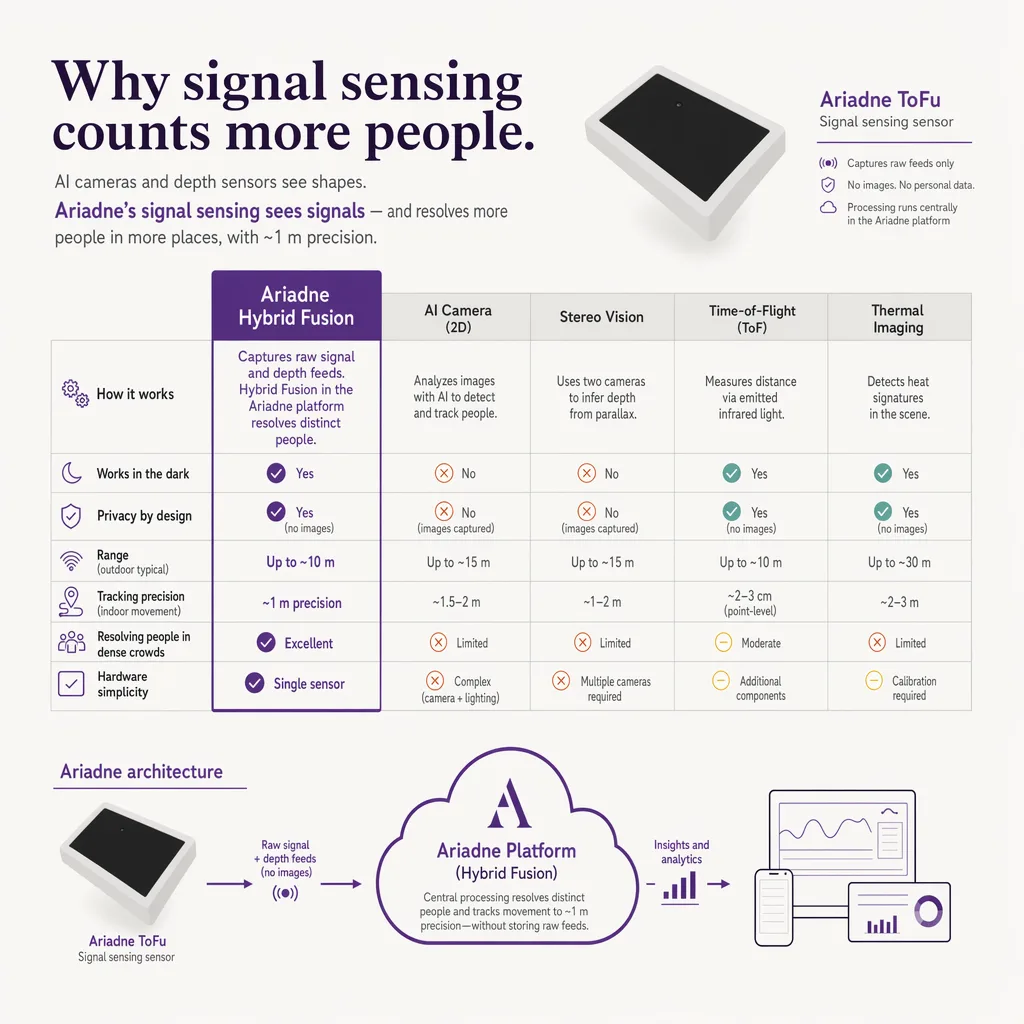
Signal-based. Instead of looking at a person, the system reads the radio signals a phone emits. It follows movement across a large interior where a single fixed sensor cannot see, and it captures no image at all.
No single method wins every row. Stereo and ToF are strong at a controlled entrance. Signal-based sensing covers the open interior. The most capable systems combine more than one, which is the approach in the next section. For a head-to-head of the sensors themselves, see stereo vs ToF vs thermal sensors. For how depth sensors resolve height and separate groups, see 3D people counting explained.
What an AI people counter should not do
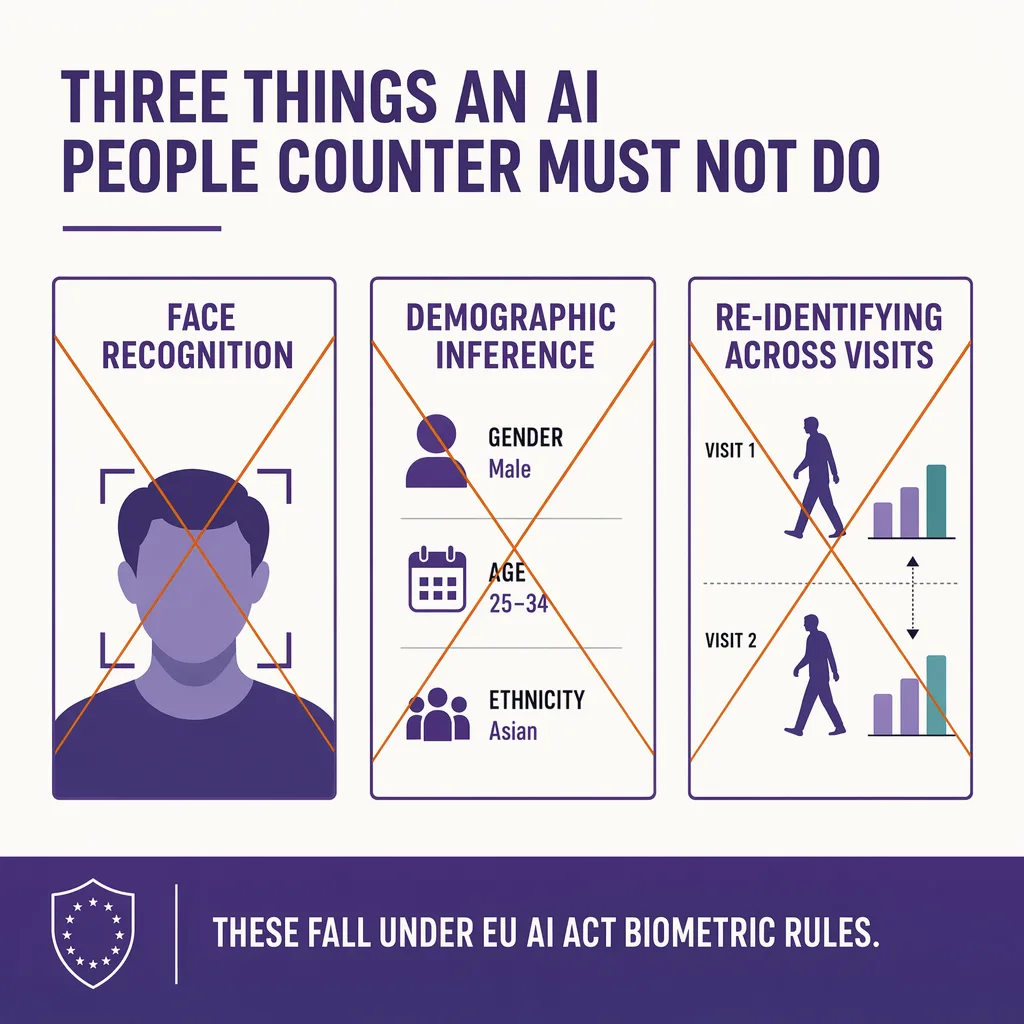
The capable methods above can, with the wrong design choices, capture far more than a count. A camera can run face recognition. A system can try to infer age or gender. A tracker can attempt to re-identify the same person across visits. None of that is required to count people, and under the EU AI Act (Regulation (EU) 2024/1689) it changes the system's legal status. Biometric identification and biometric categorisation systems are listed as high-risk under Annex III, which triggers risk-management documentation, data-governance audits, and conformity obligations, and certain biometric categorisation that infers sensitive attributes is restricted outright under Article 5. A counter that never captures a face or an identifier avoids that category entirely. See our EU AI Act analysis for people counting for the full breakdown, and biometric vs non-biometric counting for what each method records about a visitor.
The cleaner the data a counter collects, the simpler the compliance story. A counter that never captures a face or an identifier has nothing to strip out later, because it collected nothing personal in the first place. That distinction matters legally and it matters to a works council reviewing the install.
How Ariadne does it
Ariadne measures this with Hybrid Fusion, its patented camera-free method. Time-of-Flight depth sensing counts every visitor at the entrances, capturing geometry rather than images, while patented phone signal sensing follows movement through the interior, detecting the signals a phone emits even in airplane mode, and tracks that movement to about one-metre precision. The sensor streams both feeds to Ariadne, where Hybrid Fusion combines them into one trajectory per visit and computes counts, dwell, and paths. The streams carry no identifier: no MAC address, no device ID, no biometric data, and no camera is involved. Identifiers are stored only when a visitor explicitly opts in, which keeps the method GDPR-friendly and outside biometric territory.
Read against the four jobs above: depth at the door handles group resolution and low light, the fusion handles direction and tracking across the interior, and the method never crosses into the territory the previous section warned about. See the people counting hub for how the method works, AI-enabled people counters for it in practice, and the best people counting systems for how the category compares.
How to vendor-test an "AI" claim
You do not need to take the spec sheet on trust. Four questions settle most of it, and the answers belong in writing in the contract, not in a sales call.
- What does the sensor capture, exactly? Images, depth, heat, or signal. If it captures images, the privacy and compliance work is yours to manage.
- What is the accuracy on groups, measured on my site? A number from an empty test corridor is not the number you will live with. Ask for a peak-hour figure against a manual count. See a repeatable accuracy test method for how.
- Where does the processing run, and what leaves the building? "Edge" is not the same as private. What matters is what data is transmitted and stored.
- Can it infer age, gender, or identity, and can that be turned off? If the answer is anything other than "it cannot," you are buying a biometric system and the obligations that come with it.
Related reading
FAQ
Is an AI people counter the same as a camera?
No. Some AI counters use cameras, but others use depth, thermal, or signal sensing and never capture an image. The "AI" refers to the processing, not the sensor.
Does an AI people counter need the internet?
It needs a way to send counts to where you read them. Whether the model runs locally or in a platform varies by vendor, and it is a separate question from whether the system is private.
Can an AI people counter tell me age or gender?
Some can, by design. Many privacy-first systems deliberately cannot. If you do not need demographics, a system that cannot capture them is the simpler compliance choice.
How accurate is AI people counting?
Systems are typically advertised at 95 to 99 percent at a single entrance under normal conditions, but the figure that matters is the one measured on your own busiest door.
Does AI people counting comply with GDPR?
It can, and the easiest path to compliance is a system that captures no personal data to begin with rather than one that captures and then strips it.


