
Wenn Sie nach einem "3D-Personenzähler" gesucht haben, sind Sie wahrscheinlich auf eine Mischung aus Stereo-Vision-Kameras, Tiefensensoren und vielen Anbietern gestoßen, die den Begriff locker verwenden. Dieser Text erklärt, was 3D-Personenzählung tatsächlich ist, wie ein System Tiefe aufbaut, wo die zusätzliche Dimension wirklich hilft und wo sie ihre Kosten nicht rechtfertigt. Er ist geschrieben, um die Entscheidung zu informieren, nicht um Ihnen eine bestimmte Box zu verkaufen.
Was ist 3D-Personenzählung?
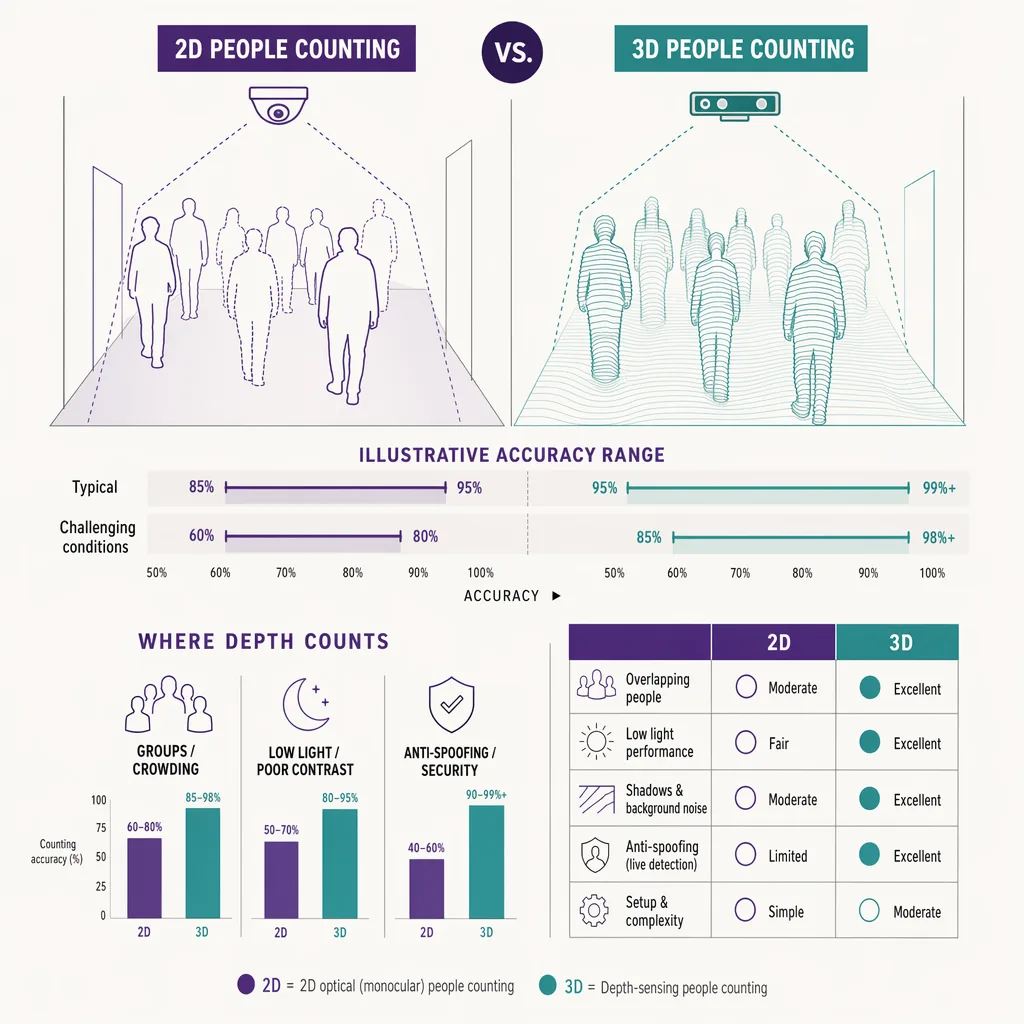
3D-Personenzählung nutzt Tiefe, nicht nur ein flaches Bild, um Personen zu zählen. Wo eine 2D-Kamera ein Bild von oben sieht und Köpfe ableitet, misst ein 3D-System die Distanz zu jedem Punkt der Szene, sodass eine Person eine Form mit Höhe und Volumen ist statt ein Pixelmuster. Diese Tiefe macht es schwerer, das System mit Schatten, Spiegelungen oder gedruckten Bildern zu täuschen, und leichter, zwei eng beieinander stehende Personen zu trennen. Die beiden gängigen Wege, Tiefe zu gewinnen, sind Stereo-Vision (zwei Linsen) und Time-of-Flight (Messung eines Lichtimpulses).
2D vs. 3D-Zählung: Was sich ändert, wenn Sie Tiefe hinzufügen
Ein 2D-Zähler arbeitet mit einem flachen Bild und einem Modell, das entscheidet, welche Flecken Köpfe sind. Er ist günstig und funktioniert unter sauberen Bedingungen. Er hat Mühe, sobald die Szene unübersichtlich wird: ein Schatten, der sich über den Boden zieht, Sonnenlicht durch eine Tür, eine hohe Auslage, die als Person gelesen wird, zwei Kunden, deren Silhouetten verschmelzen.
Tiefe hinzuzufügen ändert die Maßeinheit. Das System weiß nun, dass der Boden zweieinhalb Meter unter dem Sensor liegt und ein Kopf etwa anderthalb Meter darunter. Ein Schatten hat keine Höhe, also wird er abgewiesen. Ein Pappaufsteller ist flach, also wird er abgewiesen. Zwei Personen erzeugen zwei getrennte Volumina, selbst wenn sich ihre Umrisse von oben überlappen. Die Zählung hält genau in den Bedingungen, die eine flache Kamera scheitern lassen.
Wie 3D-Systeme Tiefe gewinnen: Stereo-Vision vs. Time-of-Flight
Es gibt zwei gängige Wege, Tiefe zu messen, und sie verhalten sich unterschiedlich.
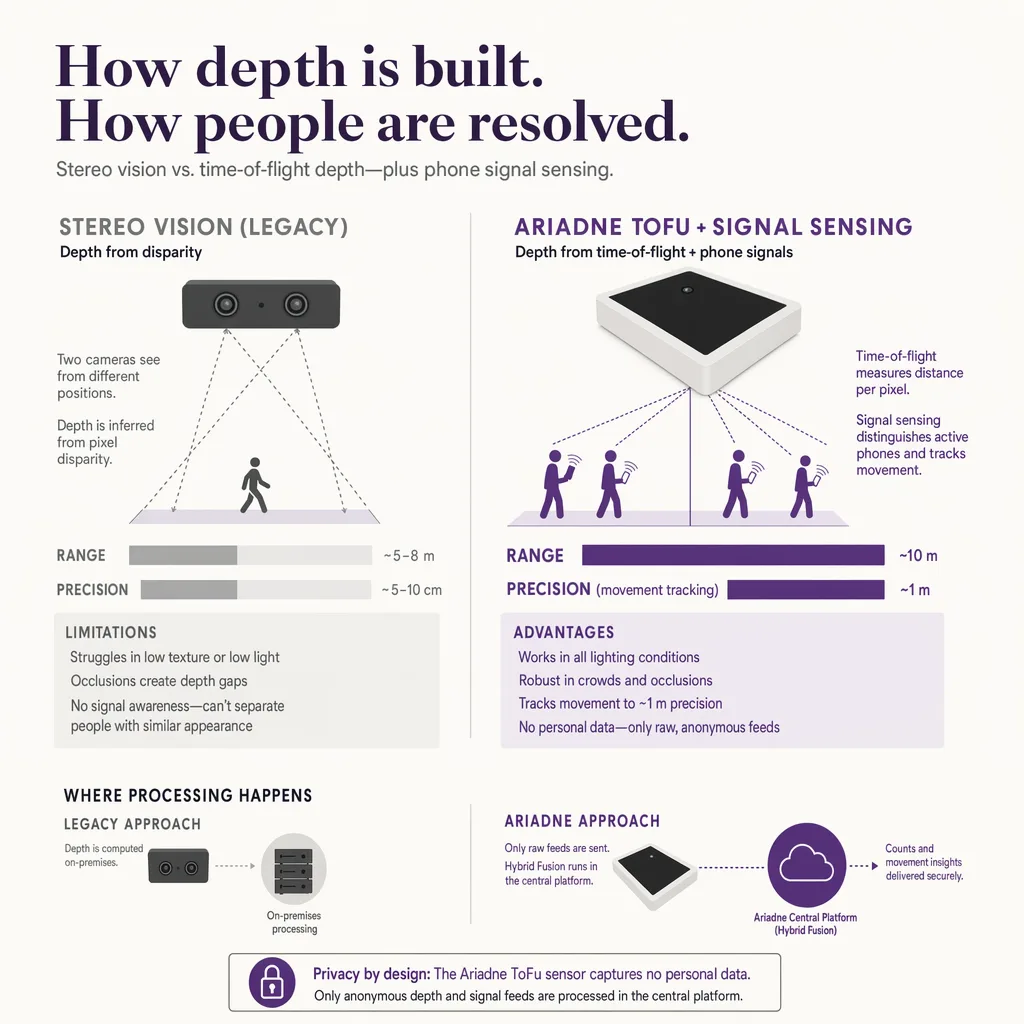
Stereo-Vision nutzt zwei Linsen in festem Abstand und vergleicht die beiden Bilder, so wie Ihre Augen Distanz einschätzen. Sie erzeugt eine detaillierte Tiefenkarte und ist im Einzelhandel gut erprobt. Der Haken ist, dass es immer noch eine Kamera ist, die Bilder erfasst, mit den daraus folgenden Datenschutz- und Compliance-Fragen.
Time-of-Flight (ToF) sendet einen Lichtimpuls aus, meist infrarot, und misst, wie lange er braucht, um von jedem Punkt der Szene zurückzukehren. Das Ergebnis ist eine Tiefenkarte von Formen, kein Foto. Weil ToF sein eigenes Licht liefert, funktioniert es im Dunkeln, und weil es Geometrie statt Bildmaterial aufzeichnet, erfasst es keine Gesichter.
Beide liefern Ihnen Tiefe. Sie unterscheiden sich darin, was sie sonst noch unterwegs erfassen, worauf der Datenschutzabschnitt zurückkommt.
Wo 3D-Zählung stark ist und wo sie Mühe hat
3D verdient sich seinen Aufpreis in bestimmten Situationen:
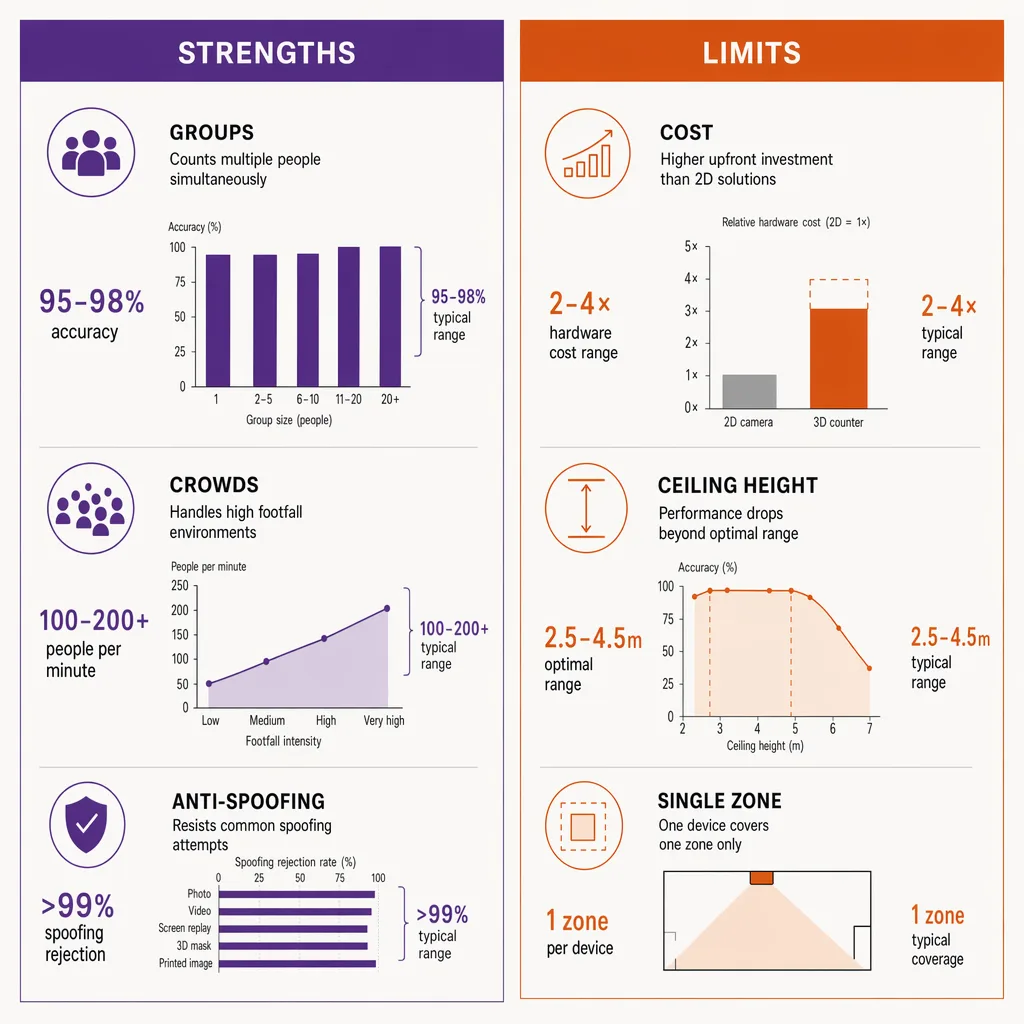
- Gruppen und Menschenmengen. Eng beieinander stehende Personen zu trennen ist der Hauptvorteil. Wenn an Ihren Türen Familien, Paare oder Schlangen vorkommen, zahlt sich Tiefe in Genauigkeit aus.
- Schwieriges Licht. Tiefenmethoden, besonders ToF, halten dort, wo eine flache Kamera versagt.
- Manipulationsschutz. Ein flaches Bild einer Person, ein Plakat oder eine Spiegelung hat keine Tiefe, also wird es abgewiesen.
Es ist nicht kostenlos, und es ist nicht immer das richtige Werkzeug:
- Kosten. Ein 3D-Sensor kostet mehr als ein Strahl oder eine einfache Kamera, und an einer ruhigen Einzelpersonen-Tür ist die zusätzliche Genauigkeit den Aufpreis vielleicht nicht wert.
- Montage und Deckenhöhe. Tiefensensoren haben einen Arbeitsbereich. Sehr hohe Decken oder ungewöhnliche Montage können den Nutzen verringern.
- Verdeckung über einen weiten Raum. Ein einzelner Tiefensensor über Kopf deckt eine definierte Zone ab. Bewegung über einen großen offenen Innenraum zu zählen ist ein anderes Problem, das Tiefe an einem Punkt allein nicht löst.
3D vs. kamerafreie Zählung: eine Datenschutznotiz
Hier ist der Unterschied, den es wert ist, in eine Kaufentscheidung mitzunehmen. "3D" sagt Ihnen, dass das System Tiefe misst. Es sagt Ihnen nicht, ob das System Bilder der gezählten Personen erfasst. Ein 3D-Zähler mit Stereo-Vision tut das. Ein Time-of-Flight-Tiefensensor tut es nicht, weil er Geometrie statt eines Bildes aufzeichnet.
Hier schlägt Ariadne einen anderen Weg ein als die Stereo-Kamera-Systeme, die sich die meisten Menschen vorstellen, wenn sie "3D-Personenzähler" hören. Ariadne verkauft keinen 3D-Personenzähler. Es zählt mit Time-of-Flight-Tiefenerfassung für Geometrie an den Eingängen und patentierter Telefon-Signalerfassung, die Bewegung durch den Innenraum auf etwa einen Meter genau verfolgt, fusioniert in der Ariadne-Plattform, ohne beteiligte Kamera und ohne standardmäßig erfassten Identifikator. Wenn Ihr Grund, sich 3D anzusehen, Genauigkeit bei Gruppen ist, ohne Kameras über Ihren Türen anzubringen, erreicht eine kamerafreie Methode aus Tiefe plus Signal dasselbe Ziel aus einer anderen Richtung. Was jede Methode über einen Besucher aufzeichnet, finden Sie unter biometrische vs. nicht-biometrische Zählung.
So bewerten Sie einen 3D-Zähler
Welche Methode Sie auch wählen, dieselben Prüfungen gelten:
- Verlangen Sie einen Genauigkeitswert, gemessen an Ihrem eigenen Standort zur Stoßzeit, gegen eine manuelle Zählung, keine Laborzahl.
- Klären Sie, was der Sensor erfasst: Bilder oder nur Tiefengeometrie. Das entscheidet Ihren Compliance-Aufwand.
- Prüfen Sie den Montagebereich gegen Ihre Deckenhöhe und Türbreite, bevor Sie sich festlegen.
- Klären Sie, welche Daten das Gebäude verlassen und wo sie gespeichert werden.
Weitere Beiträge
FAQ
Ist ein 3D-Personenzähler genauer als ein 2D-Zähler?
Meist ja unter schwierigen Bedingungen: Gruppen, Menschenmengen und schwieriges Licht. An einer ruhigen Einzelpersonen-Tür kann der Unterschied gering sein.
Nutzt ein 3D-Personenzähler eine Kamera?
Das hängt von der Methode ab. 3D-Zähler mit Stereo-Vision erfassen Bilder. Time-of-Flight-Tiefensensoren erfassen Geometrie, keine Bilder, also funktionieren sie nicht wie eine Kamera.
Funktioniert 3D-Personenzählung im Dunkeln?
Time-of-Flight tut es, weil es sein eigenes Infrarotlicht liefert. Stereo-Vision braucht wie jede Kamera ausreichend Licht.
Ist 3D-Personenzählung DSGVO-konform?
Die Methode entscheidet das nicht für sich allein. Entscheidend ist, ob das System personenbezogene Daten erfasst. Ein System, das nur Tiefe nutzt oder kamerafrei ist, erfasst keine, was die Konformität vereinfacht.
Was ist der Unterschied zwischen 3D-Zählung und Time-of-Flight?
Time-of-Flight ist ein Weg, 3D-Tiefendaten zu erzeugen. "3D" ist die übergeordnete Kategorie; ToF und Stereo-Vision sind zwei Methoden darin.
---


