
A footfall total answers one question well: how many visits did the store take in a period. It says nothing about who those visits belonged to. Ten thousand visits could be ten thousand different people who each came once, or two thousand loyal shoppers who each came five times. Those two stores look identical on a traffic chart and behave nothing alike. Visit frequency analysis is the method that tells them apart.
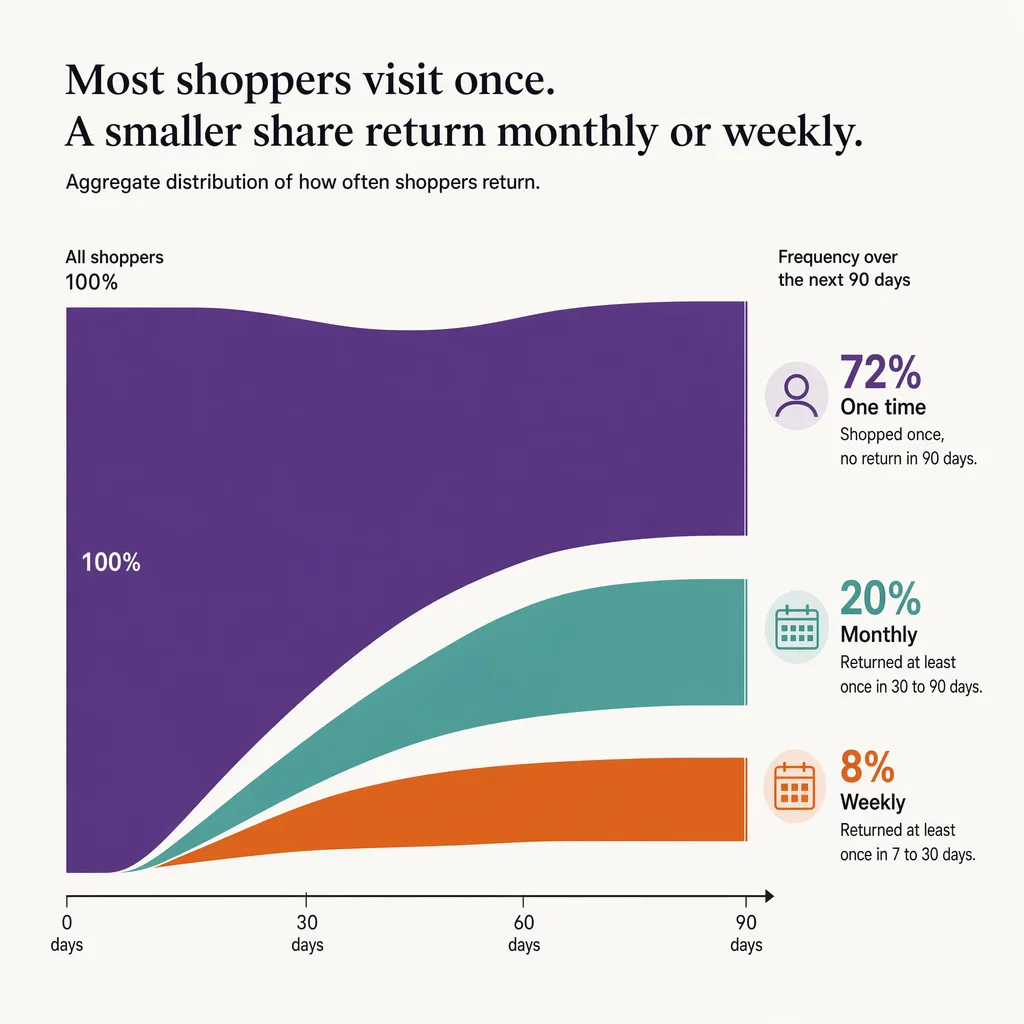
This post defines visit frequency analysis, separates it from the two metrics it gets confused with, walks the numbers it produces, and then handles the part every operator asks about: how you can tell a return visit from a first visit without collecting who the shopper is. For the deduplication step that sits just underneath frequency, see unique visitors vs footfall; this post takes distinct visitors as given and asks how often they come back.
What is visit frequency analysis in retail?
Visit frequency analysis measures how often the same shoppers come back over a period, rather than how many people came in total. Footfall counts visits; frequency analysis splits those visits into one-time visitors and returning ones and asks how many days pass between returns. It answers questions a raw entry count cannot: is traffic growing because more new people arrived or because loyal shoppers came more often, and is a loyalty push actually lifting return rate. It depends on distinguishing a repeat visit from a first visit, which requires either a loyalty or app sign-in, or a privacy-first signal that recognises a returning pattern without capturing who the person is.
The rest of the post takes that definition apart, because each phrase in it (returning shopper, days between returns, share of loyal traffic) is a separate metric with its own use and its own measurement requirement.
Frequency vs footfall vs unique visitors: three different questions
These three metrics stack on top of each other, and mixing them up is the most common error in reading traffic data.
Footfall is the count of visits. It is the base number every counting system produces, and on its own it cannot tell a busy day of newcomers from a busy day of regulars.
Unique visitors deduplicates footfall down to a headcount of distinct people. If the same shopper enters, leaves for lunch, and comes back, footfall records two visits but unique visitors records one person. This is the step that turns "how many visits" into "how many different people," and it is covered in full in unique visitors vs footfall.
Visit frequency goes one layer further again. Given a headcount of distinct people, frequency asks how often each of them returns and over what interval. Unique visitors answers "how many different people." Frequency answers "how often the same people come back." A store can hold its unique-visitor count steady while its frequency climbs, which is exactly what a working loyalty programme looks like: the same people, coming more often.
The practical point is that you cannot compute frequency without first computing unique visitors, and you cannot compute unique visitors from a raw door total alone. Each metric is a prerequisite for the next.
The metrics: return rate, days between visits, and share of repeat traffic
Visit frequency is not a single number. It resolves into a small set of measures, each answering a distinct question.
| Metric | What it answers | What it needs to compute |
|---|---|---|
| Return rate | The share of visitors who came more than once in the period | Distinct visitors, plus whether each visit is a first or a repeat |
| Average days between visits | How long a returning shopper typically waits before coming back | Repeat visits time-stamped and grouped by the same returning pattern |
| Share of visits from repeat shoppers | How much of total traffic is loyal versus new | Every visit tagged as first-time or returning |
Return rate is the headline. A high return rate says the store is building a base of people who come back on their own; a low one says the store depends on a constant supply of newcomers, which is expensive to sustain. Average days between visits adds rhythm to that: a grocery store expects a short interval measured in days, a furniture store a long one measured in months, and a shift in either direction is a signal worth reading. The share of visits from repeat shoppers is the mix number that ties frequency back to the total, showing what proportion of a busy day is loyalty rather than acquisition.
None of these can be read off a footfall chart. Each requires the store to know, for a given visit, whether the person has been seen before, which is the measurement problem the whole method turns on.
What frequency reveals that a total cannot
Consider a store whose footfall rises 15 percent month over month. On a traffic chart that is unambiguously good news. Frequency analysis can turn it into three very different stories.
If the rise came from new visitors and return rate held flat, the store is acquiring well, and the question becomes whether those newcomers come back. If the rise came from existing shoppers returning more often while new-visitor counts were flat, the store is deepening loyalty, and a recent programme or campaign is probably working. If footfall rose but return rate fell, the store pulled a wave of one-time traffic (a promotion, an event, weather) that will not repeat, and next month will likely give the gain back. The traffic total is identical in all three; only frequency separates them.
The same logic makes frequency the honest test of a loyalty programme. A loyalty push is supposed to change behaviour, and the behaviour it targets is return rate and interval, not the raw total. If the programme launched and return rate climbed while days between visits shrank, it moved the number it was built to move. If the total rose but frequency did not, the programme drew attention without changing loyalty, and the lift will fade. Frequency is also where seasonal churn shows up early: a return rate that erodes quietly under a stable total is the leading indicator of a base that is aging out before the headcount reflects it.
The measurement question: knowing a visit is a return without identifying the person
Here is the honest tension in this metric. To compute frequency you have to know whether a visit is a return, which means recognising that this visit and an earlier one belong to the same shopper. The instinctive way to do that is to identify people, and that is exactly what a privacy-first operator does not want to do.
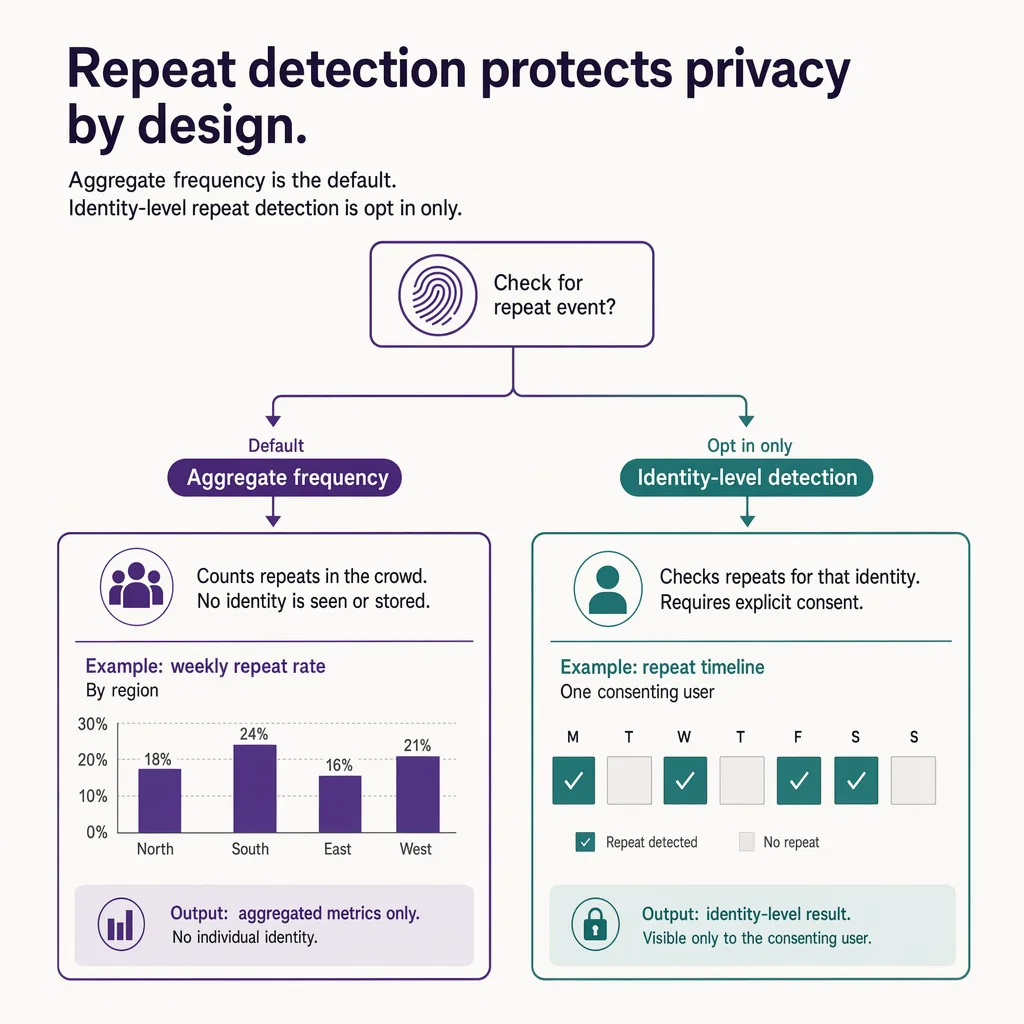
There are two legitimate paths, and they are different in kind. The first is explicit and identity-level: a loyalty card, an app login, or a guest Wi-Fi sign-in where the shopper has chosen to be recognised. That gives you named, per-person frequency, and it is entirely appropriate because the shopper opted in. The second is aggregate and privacy-first: recognising that a returning pattern is present in the traffic, and measuring return rate and interval at the population level, without ever storing who any individual is. By default, Ariadne works the second way. Return patterns are read in aggregate; identity-level repeat detection is available only when a visitor explicitly opts in, and it is never the default.
Ariadne measures this with Hybrid Fusion, its patented camera-free method. Time-of-Flight depth sensing counts every visitor at the entrances, capturing geometry rather than images, while patented phone signal sensing follows movement through the interior, detecting the signals a phone emits even in airplane mode, and tracks that movement to about one-metre precision. The sensor streams both feeds to Ariadne, where Hybrid Fusion combines them into one trajectory per visit and computes counts, dwell, and paths. The streams carry no identifier: no MAC address, no device ID, no biometric data, and no camera is involved. Identifiers are stored only when a visitor explicitly opts in, which keeps the method GDPR-friendly and outside biometric territory.
Read against the frequency question, that means the aggregate return-rate and interval figures come from the traffic itself, with no PII captured to produce them, and per-visitor frequency is unlocked only for shoppers who have chosen to be recognised through a loyalty or app sign-in. The operator gets the loyalty signal without building a surveillance record, which is the whole reason a privacy-first method matters for a metric that lives this close to identity. To see how the same counting layer supports the wider programme, see privacy-first people counting.
Frequency as a loyalty and marketing input
Frequency is not an end in itself; it is an input to two other systems. On the loyalty side, return rate and interval are the numbers a programme is designed to move, so they are the fairest scoreboard for whether it works. The mechanics of tying counted visits to a loyalty scheme are covered in entry-based loyalty, which builds directly on the recognition step this post describes.
On the marketing side, frequency is what lets you separate a campaign that bought a one-off spike from one that built a habit. A campaign that lifts the total but not return rate acquired attention; one that lifts return rate changed behaviour, which is the more valuable outcome. Reading a footfall change back to the marketing that caused it is its own discipline, covered in attributing footfall to marketing. And because frequency multiplies against spend, it pairs naturally with sales per visitor: a shopper who comes more often and spends the same each time is worth more over the year than the total alone will ever show.
FAQ
What is the difference between visit frequency and footfall?
Footfall counts visits over a period. Visit frequency measures how often the same shoppers come back within that period. Two stores with identical footfall can have very different frequency: one built on many one-time visitors, the other on a smaller base of loyal shoppers who each return several times.
How do you calculate return rate?
Return rate is the share of distinct visitors who came more than once in the period. You first deduplicate visits down to unique visitors, then tag each visit as a first-time or a repeat, and divide the repeat-visitor count by the total distinct-visitor count. It cannot be read off a raw door total, because that total does not distinguish a returning shopper from a new one.
Can you measure how often shoppers return without tracking their identity?
Yes. Return rate and average interval can be measured in aggregate, at the population level, by recognising that a returning pattern is present in the traffic without ever storing who any individual is. Identity-level, per-person repeat detection is a separate capability that requires the shopper to explicitly opt in, through a loyalty card or app sign-in, and is never the default.
Do I need cameras to measure visit frequency?
No. Ariadne counts with Hybrid Fusion: Time-of-Flight depth sensing plus patented phone signal sensing, never cameras. Time-of-Flight captures geometry rather than images, and signal sensing captures no MAC address by default, so the measurement involves no video, no faces, and no biometric data.
Why does frequency matter more than total traffic for loyalty?
A loyalty programme is built to change behaviour, and the behaviour it targets is how often people come back, not the raw headcount. A programme can lift the total by drawing one-time attention while doing nothing for return rate, in which case the gain fades. Frequency is the number that shows whether loyalty actually moved.
---


