
Mall parking data vs footfall: what the car park can and cannot tell you
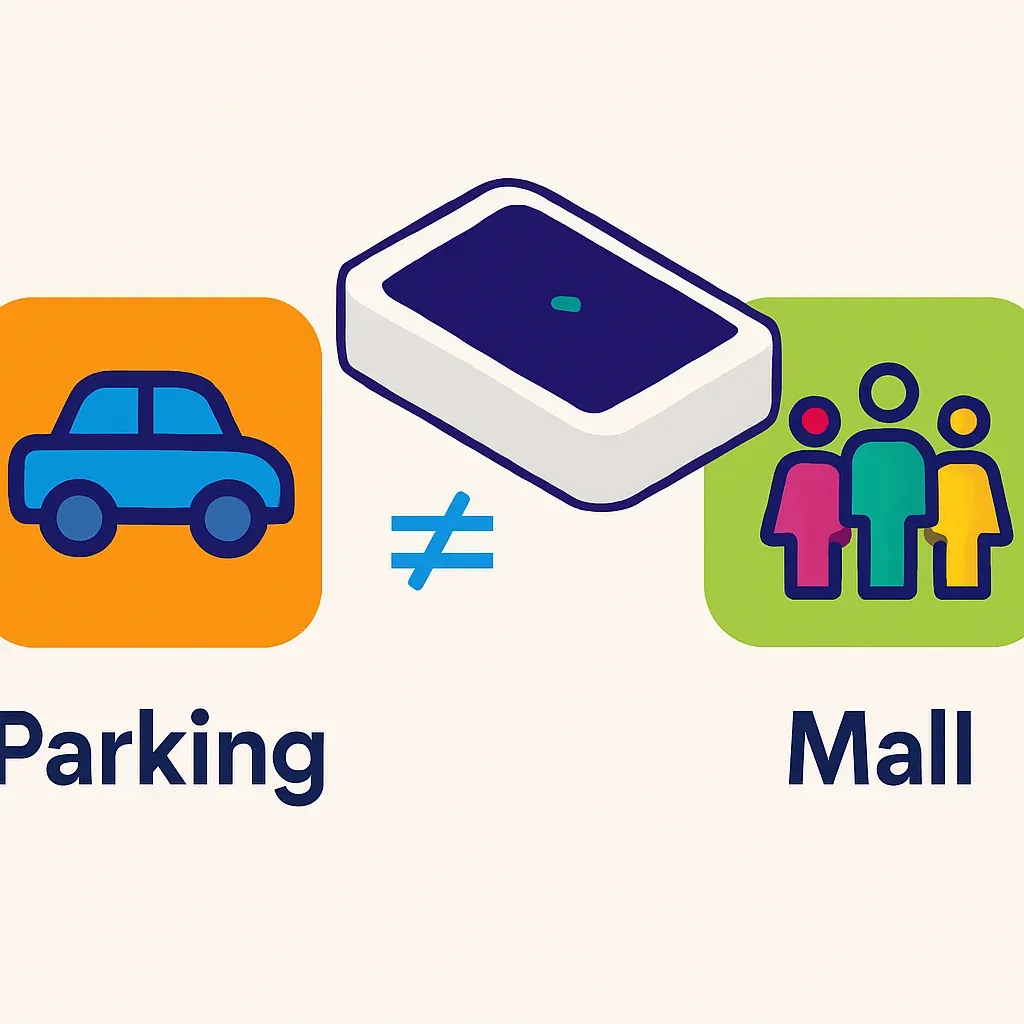
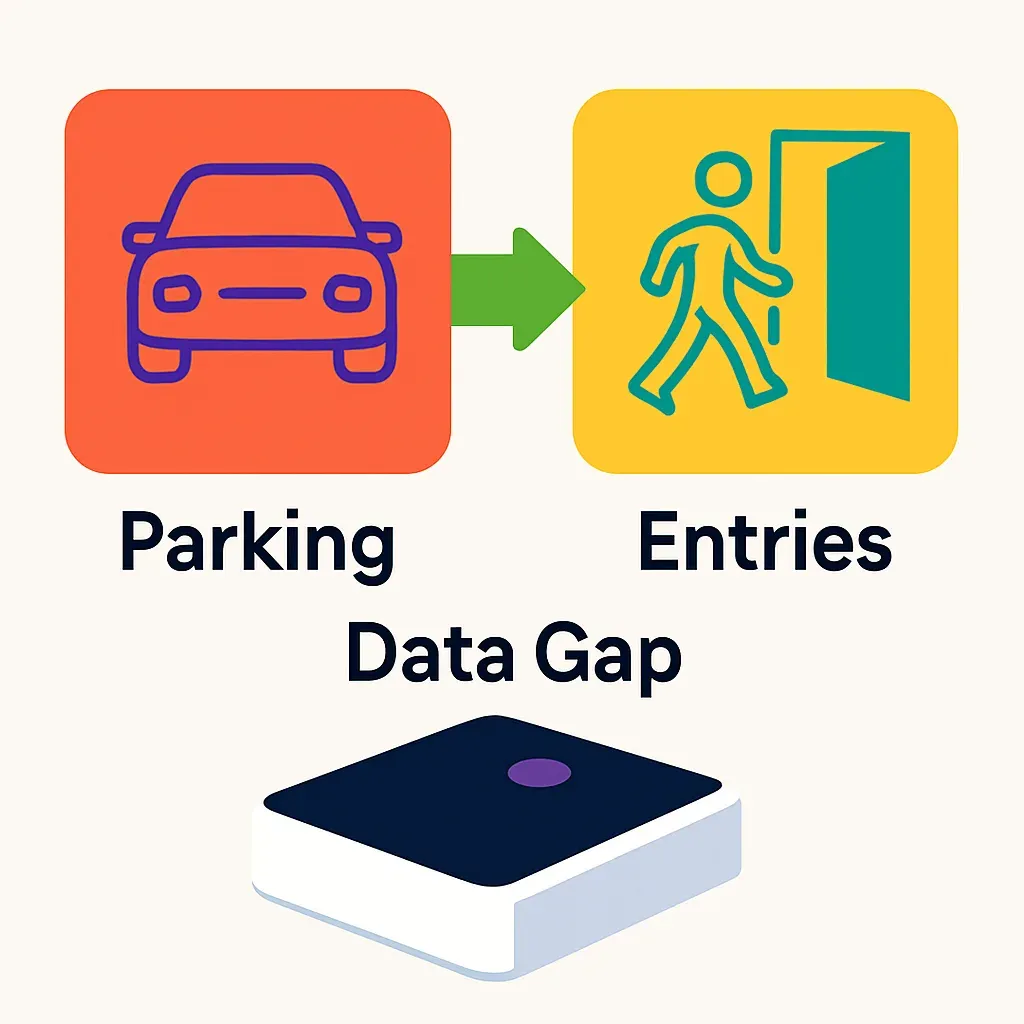
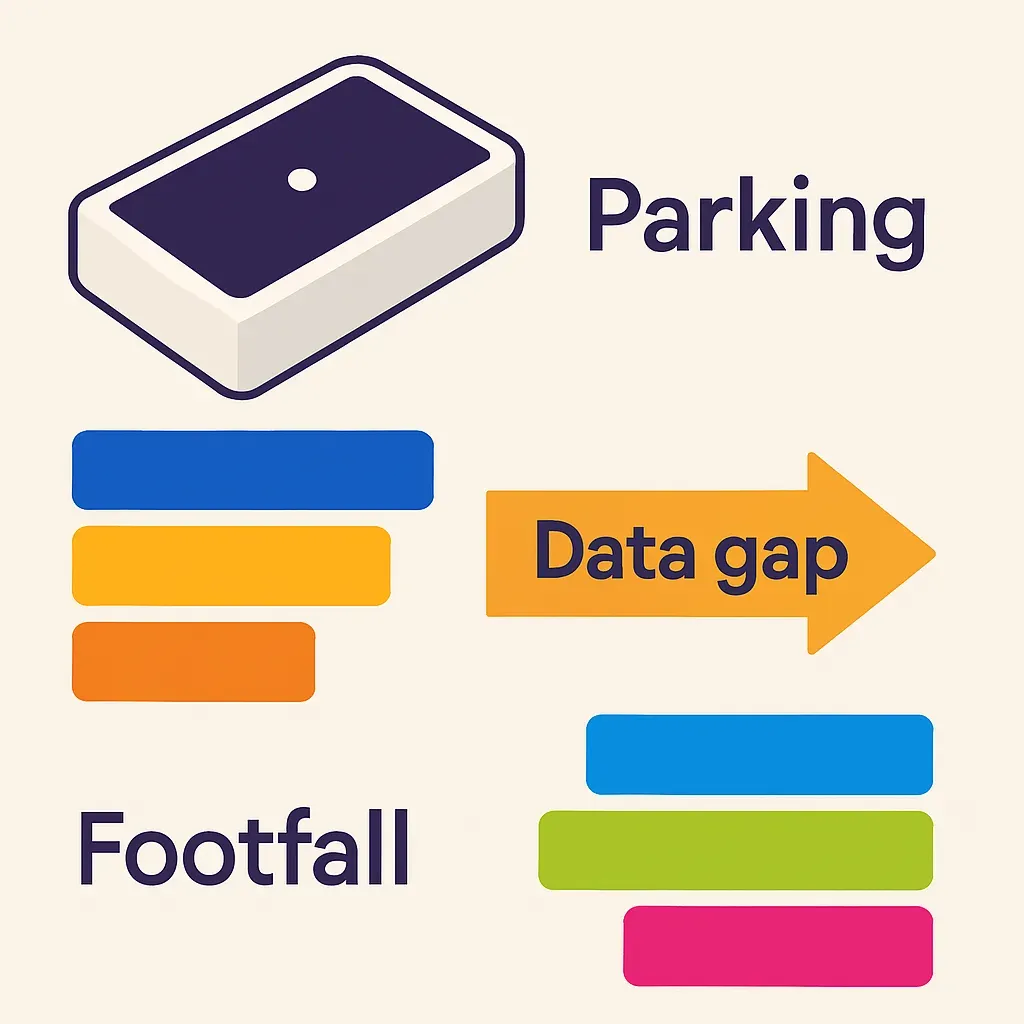
If your shopping centre has a barrier or a sensor on every parking deck, you already hold a stream of data that updates by the minute: how many cars are in, how many came and went, how full the structure is at noon on a Saturday. It is tempting to read that as a footfall number. A full car park feels like a busy centre, and an empty one feels like a quiet day. But parking occupancy and actual entries are two different measurements, and the gap between them moves with things you do not control. This guide explains where mall parking data and footfall diverge, what parking numbers are genuinely good for, and why entries at the door are the count you should run decisions on.
Why centres lean on parking data in the first place
Parking is often the cheapest data a centre already owns. The barrier or bay sensor was installed for revenue and traffic control, not analytics, so the count comes free as a side effect. It is also a real signal: cars arriving do correlate with people arriving, and over a long enough window the two move in the same general direction. For a centre with no door-level counting at all, the car park is the only quantitative read on demand, so it gets used as a footfall stand-in by default.
The problem is not that parking data is wrong. It is that it answers a different question. Parking occupancy measures vehicles and bays. Footfall measures people who walked in. The two only line up when the relationship between cars and visitors is stable, and in a real centre that relationship is anything but stable. For shopping centre footfall analytics, that distinction decides whether the number you report is defensible.
The five ways parking and footfall diverge
Each of the following pulls the cars-to-visitors ratio away from a fixed number. None of them is exotic; they all happen on an ordinary trading day, and they happen at different rates on different days, which is what makes parking a shaky proxy.
Carpooling and vehicle occupancy
One car can carry one shopper or five. Weekend family trips, group outings, and lift-sharing all raise the people-per-car figure, while a weekday lunch run is mostly solo drivers. The same 500 occupied bays can mean very different visitor counts depending on who is in the cars.
Public transit, walk-ins, and drop-offs
Visitors who arrive by bus, train, bike, on foot, or by being dropped at the entrance never touch the car park, yet they walk through the same doors as everyone else. A centre with a transit link or a dense residential catchment can take a large share of its footfall from people who leave no parking trace at all.
Staff and non-shopper parking
Retail and food-court staff, contractors, delivery drivers, and cleaning crews use the car park without ever counting as shopper footfall. Their cars sit in bays for a full shift and inflate occupancy during exactly the hours you most want a clean visitor read.
Variable dwell and bay turnover
A bay occupied for thirty minutes serves more visitors across a day than one occupied for four hours, even though both read as one occupied bay at any instant. Occupancy is a snapshot; footfall is a flow. A centre that shifts toward longer dwell can show flat or rising occupancy while the number of distinct visitors falls.
Multi-trip and pass-through parkers
Some drivers park, leave, and return the same day, or use the structure as a park-and-ride and never enter the retail floor at all. Each of these breaks the one-car-equals-one-visit assumption in a way the barrier cannot see.
A worked illustration of the gap
The numbers below are an illustration with stated assumptions, not measured results from any centre. They show how far apart parking and footfall can sit even when nothing unusual is happening.
Take a single Saturday at a mid-sized centre. Assume the car park records 4,000 vehicle entries across the day. Now apply some plausible assumptions:
- Average vehicle occupancy of 2.1 people. At 4,000 cars, that is roughly 8,400 people who arrived by car.
- Staff and non-shopper vehicles, say 8 percent of entries. Remove about 320 cars, or roughly 670 people, who are not shoppers.
- Transit, walk-in, and drop-off visitors adding 25 percent on top. If car-borne shoppers are about 7,730, that adds roughly 1,930 more arrivals the car park never saw.
- Multi-trip parkers, say 5 percent of remaining cars returning once. That double-counts some vehicles relative to distinct visits.
Under these assumptions the car park's 4,000 entries map to something closer to 9,660 shopper arrivals, and the relationship between the two is set entirely by occupancy, staff share, transit mix, and turnover, every one of which changes by day of week, season, and weather. Change vehicle occupancy from 2.1 to 1.6 on a quiet weekday and the same 4,000 cars now imply far fewer people. The point is not the specific figures, which are invented for the example. The point is that no single multiplier converts cars to visitors reliably, so a parking number cannot be trusted as a footfall number.
What parking data is genuinely good for
Saying parking is a poor footfall proxy is not the same as saying it is useless. It is a strong operational signal in its own right, as long as you ask it the questions it can actually answer:
- Capacity and overflow management. Occupancy tells you when a deck is filling and when to open overflow or redirect traffic. That is exactly what the sensors were installed for.
- Arrival-mode share over time. Compared against a real entry count, parking data reveals how much of your footfall arrives by car versus everything else, which informs transit partnerships and parking pricing.
- Revenue and tariff decisions. Dwell in the car park, peak-fill timing, and turnover drive parking revenue directly, independent of how many people those cars carried.
- Site-access planning. Vehicle flow at entrances and exits informs queuing, signage, and road layout in a way a people count cannot.
Used this way, parking data sits alongside footfall rather than standing in for it. The two together tell you more than either alone, which is also true of pairing entries with mall dwell time benchmarks to understand not just how many people came but how long they stayed.
Why entries at the door are the truth
Footfall decisions, leasing, marketing return, staffing, and the case you make to an anchor tenant, all rest on how many people actually walked the floor. That is a property of the doors, not the car park. An accurate entry count at every public entrance is the only measurement that captures every visitor regardless of how they arrived, and excludes everyone who parked but never came in.
It is also the number tenants believe. When you renew or recruit an anchor tenant, a defensible visitor count at the doors carries weight that a parking figure never will, because the tenant knows as well as you do that a full car park is not the same as a busy mall.
How Ariadne measures real entries
Ariadne measures this with Hybrid Fusion, its patented camera-free method. Time-of-Flight depth sensing counts every visitor at the entrances, capturing geometry rather than images, while patented phone signal sensing follows movement through the interior, detecting the signals a phone emits even in airplane mode. The sensor streams both feeds to Ariadne, where Hybrid Fusion combines them into one trajectory per visit and computes counts, dwell, and paths. The streams carry no identifier: no MAC address, no device ID, no biometric data, and no camera is involved. Identifiers are stored only when a visitor explicitly opts in, which keeps the method GDPR-friendly and outside biometric territory.
For a shopping centre, that means a count taken at the doors people actually walk through, not inferred from the bays their cars sit in. Time-of-Flight depth sensing gives a device-independent body count at each entrance, so a family of four arriving in one car counts as four people, and a visitor who arrived by bus counts the same as a visitor who drove. The patented signal sensing resolves distinct individuals and per-zone movement inside the centre, so you can also see where those entries go once they are in, which no parking sensor can tell you. Pair that entry count with parking occupancy and the two become complementary: parking for capacity and arrival mode, entries for the footfall number you put in front of tenants.
Related reading
FAQ
Can I just multiply parking entries by an occupancy factor to get footfall?
Not reliably. A fixed multiplier assumes vehicle occupancy, staff share, transit mix, and turnover all stay constant, and they do not; they change by day, season, and weather. The multiplier that fits a busy Saturday will overstate a quiet weekday. Measure entries directly and use parking for what it measures well, which is vehicles and bays.
Does parking data still have value if I count entries directly?
Yes. With a real entry count in hand, parking data becomes more useful, not less, because you can finally read the two against each other. That comparison tells you what share of footfall arrives by car, how arrival mode shifts over time, and where to focus parking pricing and transit partnerships.
Do you need cameras to count entries accurately?
No. Ariadne counts with Hybrid Fusion: Time-of-Flight depth sensing plus patented phone signal sensing, never cameras. Time-of-Flight captures geometry rather than images, and signal sensing captures no MAC address by default, so the measurement involves no video, no faces, and no biometric data.


