
If you are shortlisting a DILAX alternative for people counting, the useful comparison is not vendor against vendor on a feature grid. It is your site against a set of requirements: how accurately a system counts at your own doors, what it records about each visitor, how it installs, and what it costs over five years. DILAX is an established counting vendor with a long track record in public transit and retail, so the honest exercise is to work out where a different method fits your estate, not to argue that one supplier is categorically better than another.
This post sets out the four axes that decide a counting purchase, puts DILAX and Ariadne side by side on each, and then explains where Ariadne differs on its own terms: a camera-free method built on interior signal fusion, with no personal data captured at the sensor by default. Comparisons cite public documentation; no client relationship or disparagement intended.
What is a DILAX alternative for people counting?
A DILAX alternative is worth weighing on the same four axes as any counter: accuracy verified on your own site, what the system records about each visitor, the install model, and five-year cost. Ariadne counts with camera-free Hybrid Fusion, Time-of-Flight depth at entries plus patented phone-signal sensing inside, fused centrally, recording no MAC address by default and no biometric data. DILAX describes itself as a provider of automatic passenger and visitor counting for transit and retail; confirm its current product fit for your sites from its public documentation before comparing.
The rest of this post is structured so you can run that comparison yourself rather than take a claim on trust. The two systems overlap on the core job of counting people accurately, and they diverge on what happens to the data and where in the building the measurement takes place.
The four axes that decide a counting purchase
Almost every counting decision comes down to four questions, in this order.
First, accuracy on your own site. A datasheet figure is measured under controlled conditions the vendor chose. What matters is the count error at your doors, with your traffic, your door width, and your lighting. The only reliable way to know it is to run a system against a manual ground-truth count over a representative period. Any vendor, including Ariadne, should expect that test rather than resist it, and you can verify accuracy on your own site with a documented method.
Second, what the system records about each visitor. This is where methods diverge most, and it decides how much privacy documentation you have to produce. A system that captures images of visitors carries a different compliance footprint from one that records only geometry or signal data. It is worth being precise about what a counter records before you compare anything else, because it can settle the shortlist on its own.
Third, the install model. Ceiling height, mounting position, cabling, power, and whether the count runs on the sensor or in a platform all change the cost and the disruption of deployment. A store that has to close a doorway for a day to run cable is paying a cost that never shows up on the hardware quote.
Fourth, five-year cost. Hardware, install labour, the software subscription, support, and any recalibration or replacement add up very differently across suppliers. The headline price per door tells you little on its own.
DILAX vs Ariadne, at a glance
The table below compares the two at the level each vendor's public documentation supports. Cells marked "Verify on your own site" are the ones you should confirm directly rather than take from any comparison, including this one. Ariadne's cells state its canonical posture only.
| Axis | DILAX | Ariadne |
|---|---|---|
| Sensing method | Thermal and video sensing per DILAX public product documentation | Camera-free Hybrid Fusion: Time-of-Flight depth at entries plus patented phone-signal sensing inside, fused centrally in the platform |
| What it records | Verify on your own site against DILAX documentation; DILAX cites ePrivacyseal certification for its counting products | No MAC address by default, no device ID, no biometric data, no images; identifiers stored only on explicit visitor opt-in |
| Camera involved | No (thermal / video per DILAX) | No |
| Verified-on-site accuracy | Verify on your own site with a ground-truth count | Verify on your own site; do not rely on a datasheet number for either vendor |
| Typical segment fit | Public transit and retail per DILAX public materials | Retail, shopping centers, transit hubs, and mixed estates |
| Five-year cost basis | Verify on your own site (hardware, install, subscription, support) | Verify on your own site (hardware, install, subscription, support) |
Two rows are worth reading carefully. Both DILAX and Ariadne are camera-free in the sense that neither positions itself as a CCTV product, so "no camera involved" is true of both. The genuine difference is not camera versus camera-free. It is where the measurement happens and what data survives it, which the next section covers.
Where Ariadne is different on its own terms
The clearest way to describe Ariadne is by its method, not by a competitor's weakness.
Ariadne measures this with Hybrid Fusion, its patented camera-free method. Time-of-Flight depth sensing counts every visitor at the entrances, capturing geometry rather than images, while patented phone signal sensing follows movement through the interior, detecting the signals a phone emits even in airplane mode, and tracks that movement to about one-metre precision. The sensor streams both feeds to Ariadne, where Hybrid Fusion combines them into one trajectory per visit and computes counts, dwell, and paths. The streams carry no identifier: no MAC address, no device ID, no biometric data, and no camera is involved. Identifiers are stored only when a visitor explicitly opts in, which keeps the method GDPR-friendly and outside biometric territory.
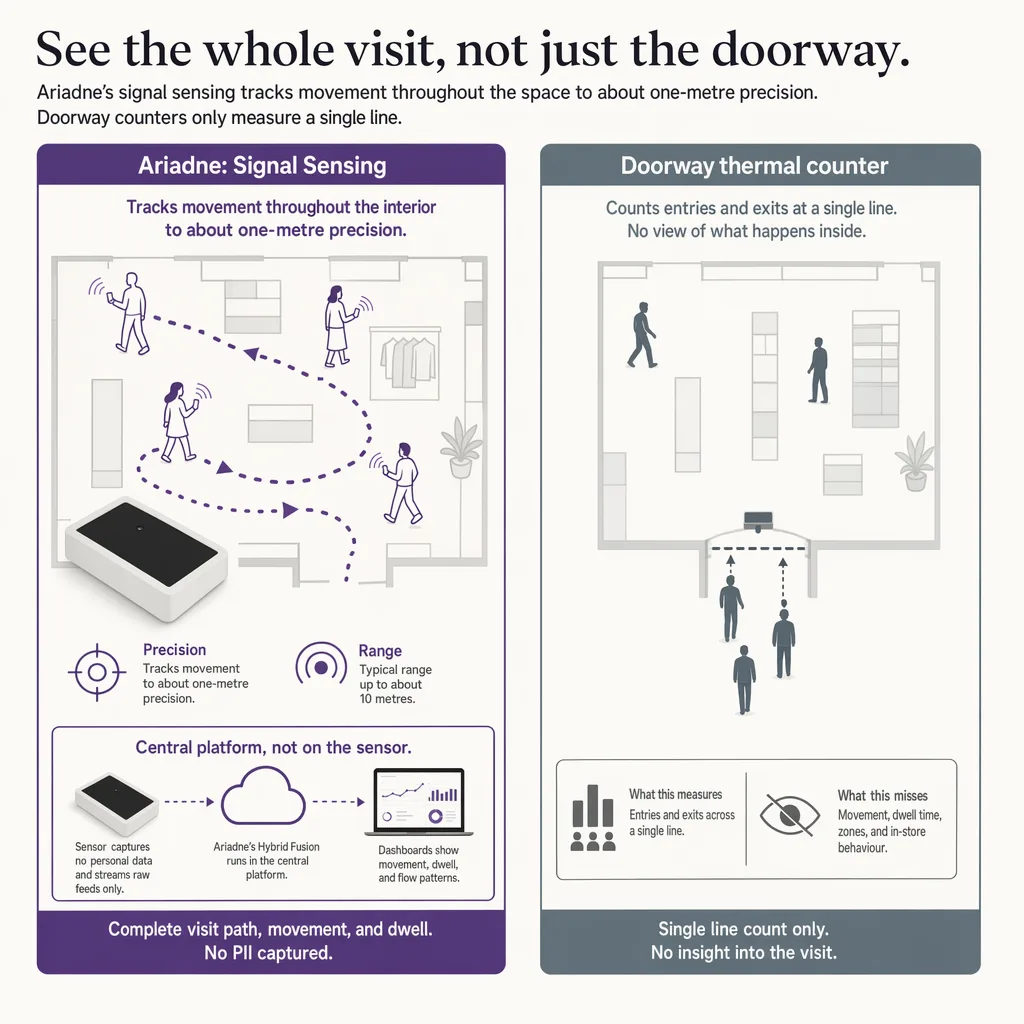
Two things follow from that method that are worth drawing out against a typical counting deployment. The first is interior coverage. Many counting systems, DILAX included per its public materials, are strong at the doorway: they count entries and exits accurately. Ariadne's phone-signal layer is designed to follow movement through the interior as well, so the output is a visit path rather than a turnstile number. For a shopping center or a transit concourse trying to understand where people actually go after they enter, that difference in what gets measured can matter more than a fractional difference in door-count accuracy.
The second is what the platform holds by default. Because the streams carry no identifier and no biometric data, and because identifiers are stored only when a visitor explicitly opts in, the measurement sits outside the EU AI Act's biometric identification and categorisation categories: there is no biometric processing to bring it inside them. That posture is not a claim about DILAX, which holds its own ePrivacyseal certification for its counting line. It is a statement of what Ariadne captures, which is the only ground a buyer should compare on. For the regulatory framing in full, see where counting sits under the EU AI Act.
Segment fit, and how to test it
DILAX has deep roots in public transit, where automatic passenger counting on vehicles is a distinct discipline, and it also serves retail. Ariadne is built for indoor visitor analytics across retail, shopping centers, and transit hubs. Depending on your estate, the segments overlap heavily or barely at all, which is exactly why segment fit belongs in the comparison rather than being assumed.
The way to resolve it is not a longer feature list. It is a pilot. Put one system on one representative entrance, run it against a manual count for a fixed period, and read what each platform actually reports back: the count error, the granularity of the data, and whether the interior journey view exists or the output stops at the door. A pilot also surfaces the install realities, the cabling, the mounting, the power, that a quote never fully captures. When you scope the pilot, the RFP questions to ask make the two systems genuinely comparable rather than each answering a slightly different question. For the wider decision framework, the people counting buyer's guide walks the full journey from business question to signed contract, and the full systems comparison covers the named market.
Whichever way the pilot lands, the point of the exercise is to buy on evidence from your own site rather than on a datasheet or a comparison table, this one included. See Ariadne's camera-free counting for how the method is deployed in practice.
FAQ
Is DILAX a camera-based people counter?
DILAX's public product documentation describes thermal and video sensing for its visitor and passenger counting line, and it cites ePrivacyseal certification for those products. It is not positioned as a CCTV or surveillance product. Confirm the exact sensing method for the specific DILAX product you are evaluating from its current documentation, and verify what it records against your own privacy requirements.
Do I need cameras to count people accurately?
No. Ariadne counts with Hybrid Fusion: Time-of-Flight depth sensing plus patented phone signal sensing, never cameras. Time-of-Flight captures geometry rather than images, and signal sensing captures no MAC address by default, so the measurement involves no video, no faces, and no biometric data.
What is the real difference between DILAX and Ariadne?
Both are camera-free in that neither is a CCTV product. The difference is where the measurement happens and what data survives it. Ariadne fuses door counts with interior phone-signal sensing to produce a visit path, not just an entry count, and it holds no identifier or biometric data by default. Compare the two on what each records and on interior coverage, not on a camera-versus-camera-free line, because that line does not separate them.
How do I compare accuracy between the two fairly?
Run a like-for-like pilot. Put each system on the same representative entrance, count manually over the same period, and compare each system's report to your ground-truth count. Do not rely on either vendor's advertised accuracy figure, since both are measured under conditions the vendor chose. A documented on-site test is the only number that transfers to your estate.
Does Ariadne fit transit as well as retail?
Ariadne is built for indoor visitor analytics across retail, shopping centers, and transit hubs. DILAX has particularly deep roots in public transit, including on-vehicle passenger counting, which is a distinct discipline. If your estate is transit-heavy, make segment fit an explicit line in your pilot rather than an assumption, and test each system on the sites that actually matter to you.
---


