
Why car showrooms fly blind on walk-ins
A car dealership measures almost everything that happens after a sale starts. Test drives are logged, finance applications are tracked, and closed deals flow into the dealer management system to the cent. The one number nobody reliably has is the one at the very top of the funnel: how many people actually walked onto the showroom floor. Unlike a supermarket or a fashion store, most showrooms have no counting hardware at the door at all. The walk-in figure, if it exists, comes from salesperson logs, and those logs are partial and biased by design.
Think about when the logging fails. A salesperson is most likely to record a visitor when they have time, which is precisely when the floor is quiet. On a busy Saturday, when three couples arrive at once and everyone is mid-conversation, the walk-ins that do not turn into an immediate test drive simply never get written down. The result is a count that under-records exactly the moments that matter most, then gets quietly treated as if it were the real traffic. A manager looking at that log cannot tell whether a flat month came from fewer people coming in or from the team converting fewer of the people who did.
The showroom funnel and the missing number
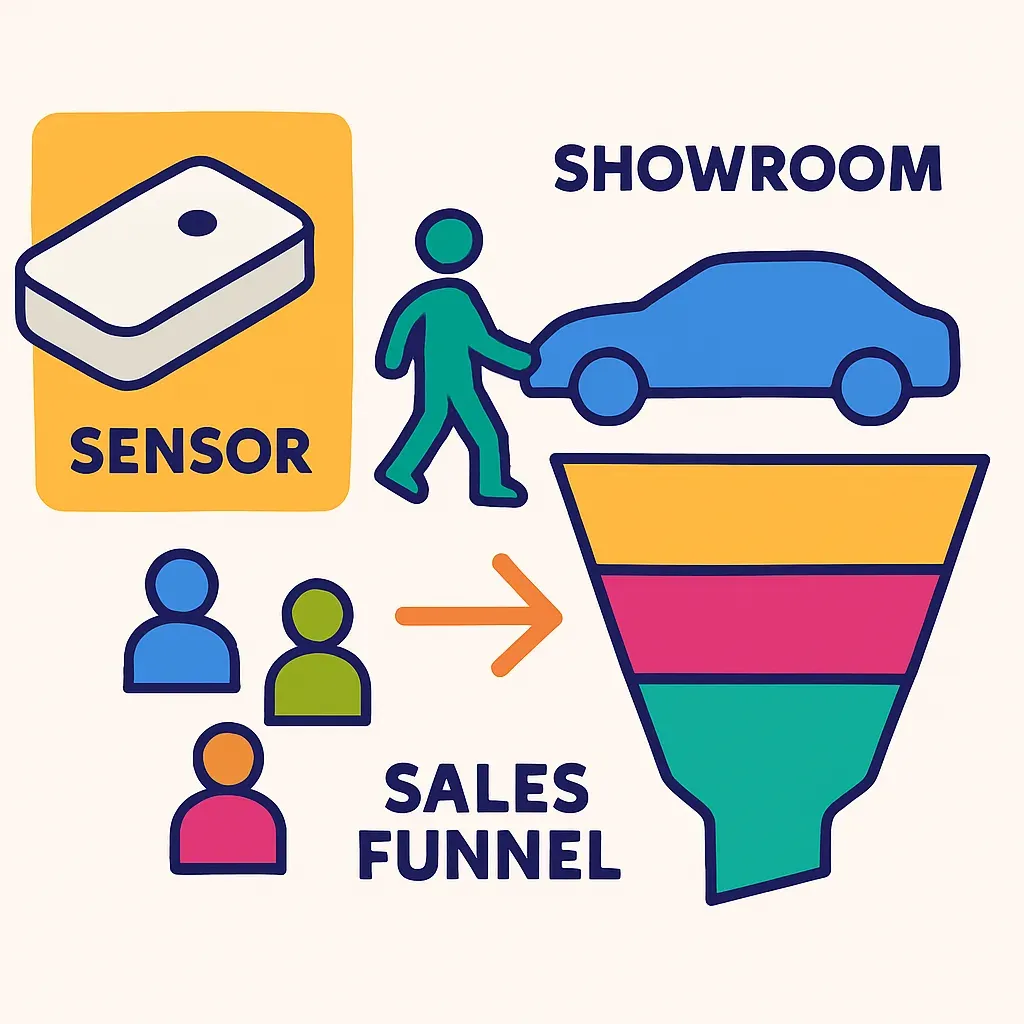
A showroom sale runs through a clear sequence: someone walks in, a salesperson engages them, the visit progresses to a test drive, and a share of those test drives close. Most dealers can see the bottom three stages. The top one, walk-ins, is the denominator that turns the rest into rates instead of raw tallies.
- Walk-ins: every person who enters the showroom floor, logged or not.
- Engaged: visitors a salesperson actually speaks with.
- Test drives: visits that progress to driving a vehicle.
- Sales: test drives that close, already tracked in the dealer system.
Without the walk-in number, a drop in sales has two completely different explanations that look identical in the data. Either fewer people came in, which is a traffic problem you fix with marketing, location, or opening hours, or the same number came in and fewer of them progressed, which is a closing problem you fix with staffing, training, or the offer. Guess wrong and you spend a marketing budget on a floor that was already busy, or you retrain a team that simply had nobody to sell to. A reliable walk-in count is what separates those two cases. For the deeper version of the same logic in general retail, the path from entry to engagement is the subject of our guide to shopper flow and in-store journeys.
What is worth measuring on a showroom floor
A walk-in count on its own is useful, but a showroom floor rewards a few more measurements that a door clicker can never give you. The four below cover most of the decisions a sales manager makes.
Walk-ins by day and hour
Knowing that a showroom sees more visitors on Saturday afternoon than Tuesday morning sounds obvious, but very few dealers have the shape of that curve in numbers. The hourly pattern tells you when demand actually peaks, which is rarely when the rota assumes it does, and it gives you a clean baseline to measure any change against.
Time on the floor
How long a visitor stays is a strong early signal of intent. A two-minute visit and a twenty-minute visit are not the same prospect, and the average dwell time on a given day tells you whether people are browsing seriously or bouncing. A sudden drop in dwell while walk-ins hold steady is an engagement problem worth investigating before the sales numbers move.
Which model zones draw interest
A showroom is laid out in zones, one model line per area. Counting which zones attract the most visitors, and where people actually linger, shows you what the floor is really pulling people toward, independent of what eventually sells. If the electric range draws a third of the floor traffic but a fraction of the sales, that gap is a concrete brief for the sales team rather than a hunch.
Returning visitors
A car is a considered purchase, and many buyers visit more than once before they commit. Knowing the share of visits that are return trips, without identifying anyone, tells you how much of your traffic is in the final consideration stage. A floor with a high return rate needs a different sales motion than one seeing mostly first-time browsers.
Turning footfall into decisions
A count only earns its keep when it changes what you do. Three decisions improve immediately once the walk-in denominator is reliable.
Staffing to footfall
Most showroom rotas are built on habit rather than measured demand. With an hourly walk-in curve you can put more salespeople on the floor when visitors actually arrive and fewer when they do not. The cost of getting this wrong is direct: an under-covered peak is walk-ins who leave without speaking to anyone, and those are the most expensive losses in the building because the marketing to bring them in is already spent.
Evaluating marketing and event spend
Dealers spend heavily on local advertising, manufacturer campaigns, and showroom events. The honest test of any of that spend is whether it lifted walk-ins, and that is exactly the number salesperson logs cannot answer. As an illustration, assume a normal Saturday averages 40 walk-ins and a launch-event Saturday records 70, with no other change. That 30-visitor lift, set against the cost of the event, is a clean before-and-after read you can defend to a finance team. The figures here are illustrative, not measured, but the method is the point: with a reliable count you measure campaigns by the traffic they create, not by the deals that happened to close that week.
Comparing branches fairly
A group running several dealerships usually ranks branches on units sold, which quietly punishes the smaller-catchment site and flatters the one on the busy ring road. Walk-in counts let you rank on conversion, the share of visitors who buy, rather than on raw volume. A branch that converts 1 in 12 walk-ins is outperforming one that converts 1 in 20, even if the second sells more cars, and that comparison points you at the practices worth copying. Those conversion rates are illustrative; the value is comparing like for like.
Privacy on the showroom floor
Counting in a car showroom carries a sensitivity that a turnstile in a stadium does not. People browsing a forty-thousand-euro purchase are relaxed, unhurried, and entirely unwilling to feel watched. A camera pointed at the floor, or anything that captures faces or tracks named individuals, would change the atmosphere of the room and is hard to square with data-protection law. The counting has to be invisible and identifier-free, measuring how many people and how they move without ever recording who they are.
That is a design constraint, not a compromise. There is nothing to anonymize when nothing identifying is captured in the first place. No images of customers, no faces, no device identifiers held by default. The floor gets the walk-in denominator and the zone interest it needs, and the customer gets a browsing experience that feels exactly as private as it should.
How Ariadne measures it
Ariadne measures this with Hybrid Fusion, its patented camera-free method. Time-of-Flight depth sensing counts every visitor at the entrances, capturing geometry rather than images, while patented phone signal sensing follows movement through the interior, detecting the signals a phone emits even in airplane mode. The sensor streams both feeds to Ariadne, where Hybrid Fusion combines them into one trajectory per visit and computes counts, dwell, and paths. The streams carry no identifier: no MAC address, no device ID, no biometric data, and no camera is involved. Identifiers are stored only when a visitor explicitly opts in, which keeps the method GDPR-friendly and outside biometric territory.
On a showroom floor those two streams map cleanly onto the funnel. The depth sensing at the entrance gives the walk-in count, the device-independent figure the salesperson logs were missing. The interior signal sensing supplies the rest: how long visitors stay, which model zones draw the most presence and dwell, and the share of visits that are returns, all without a camera and without identifying anyone. You can confirm the sensor models and mounting on the Ariadne sensor lineup, and see how the floor data feeds the wider people-counting platform.
FAQ
Do you need cameras to count showroom footfall?
No. Ariadne counts with Hybrid Fusion: Time-of-Flight depth sensing plus patented phone signal sensing, never cameras. Time-of-Flight captures geometry rather than images, and signal sensing captures no MAC address by default, so the measurement involves no video, no faces, and no biometric data.
Why not just rely on salesperson logs?
Because they undercount exactly when it matters. A salesperson logs a visitor when they have a free moment, which is during quiet periods, so busy days are systematically under-recorded. That gives you a walk-in figure that is both incomplete and biased toward slow days, which is the worst possible denominator for measuring conversion. An automatic count records every visitor the same way, peak or quiet, so the rate it produces is one you can actually trust.
Can footfall counting tell a traffic problem from a closing problem?
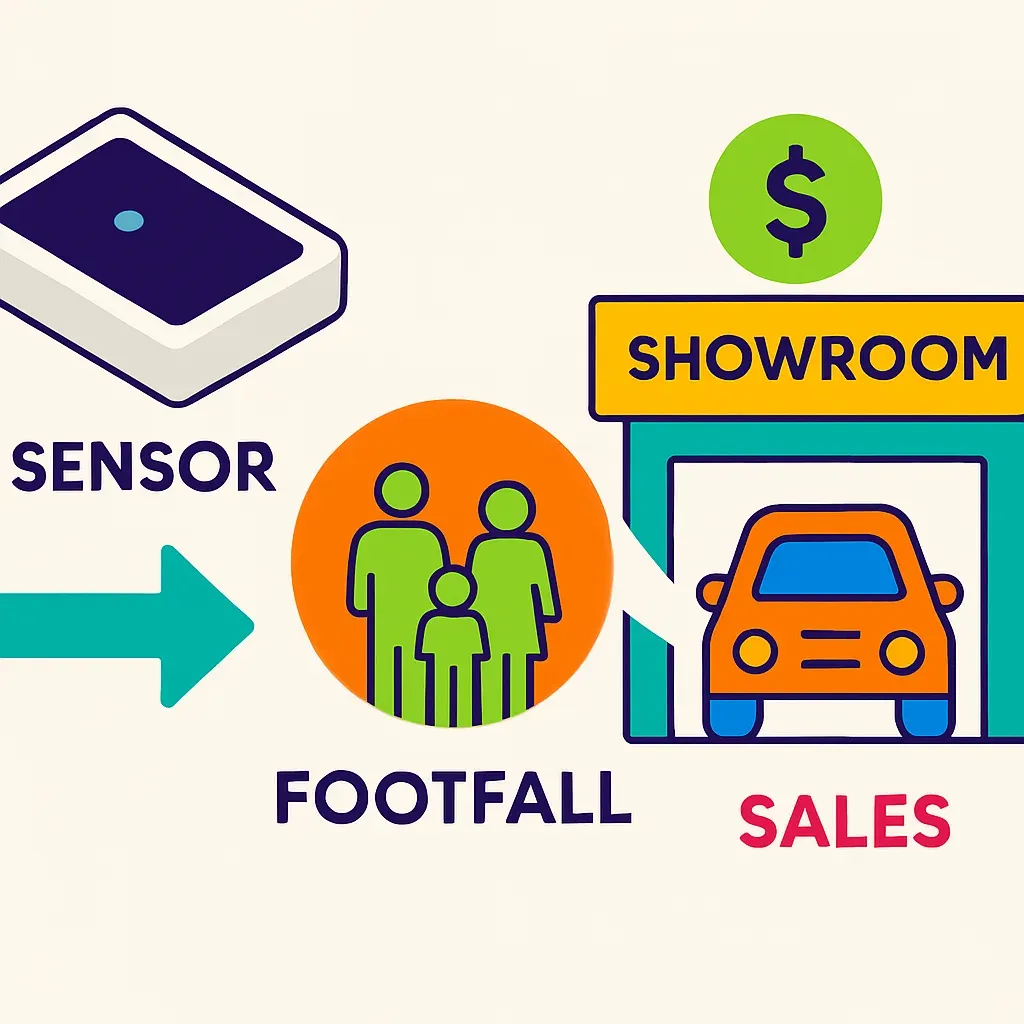
Yes, and that is its main job. A reliable walk-in count sits above your existing test-drive and sales data, so a soft month resolves into one of two answers: fewer people came in, or the same number came in and fewer progressed. The first points at marketing and reach, the second at staffing, training, or the offer. Without the walk-in denominator both look identical, which is why showrooms so often spend on the wrong fix.


