
A "Xovis alternative" search is a buyer's search. You have a counting problem, Xovis is on the shortlist, and you want to know what else fits and how to tell the options apart without taking anyone's datasheet at face value. This post gives you the four axes that decide a counting purchase, applies them to Xovis using its public documentation, and shows where Ariadne, a camera-free option, sits against them.
Xovis is a real, active, independent Swiss vendor and one of the better-known names in the counting market. Per its public product documentation, Xovis builds 3D sensors that use stereo vision. That is a mature, capable approach, and this comparison treats it as such. Where a claim would depend on your specific site, the honest position is to verify it on your own doors, not to accept a headline figure.
Comparisons cite public documentation; no client relationship or disparagement intended.
What is a good Xovis alternative?
A Xovis alternative should match what you actually need from a counter: accuracy verified on your own doors, what the sensor records about each visitor, the install and ceiling-height requirements, and five-year cost. Ariadne is a camera-free option built on Hybrid Fusion, Time-of-Flight depth sensing at entries plus patented phone-signal sensing inside, fused in the platform, recording no MAC address by default and no biometric data. Evaluate any shortlist on a like-for-like trial rather than on a datasheet number.
The point of an alternative is not to find a cheaper clone. It is to find the system whose trade-offs match your site and your obligations. A 3D stereo sensor and a camera-free fusion method can both count a door well and still leave you in very different places on installation, on what you have to document, and on what the data can tell you once the visitor is inside the space rather than just crossing the threshold.
How to compare counting vendors without trusting the datasheet
Fix the criteria before you fix on a product. These four carry the decision.
Accuracy on your own doors
Advertised accuracy is measured under the vendor's chosen conditions. Your doors have their own: width, glass, sun, group arrivals, and peak crowding. The only figure you can act on is the one you measure yourself, so plan to run each candidate against a manual ground-truth count at a real entrance. Neither Xovis's advertised number nor Ariadne's should decide this for you.
What the sensor records
Ask exactly what leaves the sensor. A count is one thing; an image, a track linked across sites, or an inferred attribute is another, and each additional thing you capture adds to what you have to justify. This is worth understanding at the level of method rather than brand, which is why it helps to read what a counter records about visitors before you compare specific products.
Install and mounting
3D and depth sensors both care about mounting height and coverage. Ask about ceiling-height requirements, coverage per unit (which drives how many you need for a wide entrance), cabling, and power. For the sensor-physics background that sits under these questions, see stereo vs ToF vs thermal sensors.
Five-year cost
Compare the five-year total for your actual door count, not the price of one unit. Sensor count, cabling, subscription, and support all feed it, and they move independently of the sticker price.
Xovis vs Ariadne, at a glance
The table compares the two on sensing, capture, install, and cost. Xovis cells reflect its public product documentation. Ariadne cells state its canonical posture. Site-dependent figures are marked to verify on your own doors, because that is the only place they are real.
| Xovis | Ariadne | |
|---|---|---|
| Sensing method | 3D sensors using stereo vision, per Xovis's public product documentation | Camera-free Hybrid Fusion: Time-of-Flight depth at entries plus patented phone-signal sensing inside |
| What it records | Counts and movement data; confirm the exact recorded fields against Xovis's public documentation for your use case | Counts, dwell, and paths with no MAC address by default, no device ID, and no biometric data |
| Camera involved | Stereo-vision based per public documentation; confirm current sensor line for your deployment | No camera |
| Verified-on-site accuracy | Verify on your own doors against a manual ground-truth count | Verify on your own doors against a manual ground-truth count |
| Mounting / ceiling requirement | Verify on your own site (3D sensors have mounting-height and coverage requirements; confirm per current spec) | Verify on your own site (Time-of-Flight at entries plus interior signal sensing; confirm per survey) |
| Five-year cost basis | Verify on your own site (units, cabling, subscription, support scoped to your doors) | Verify on your own site (hardware, install, subscription, support scoped to your doors) |
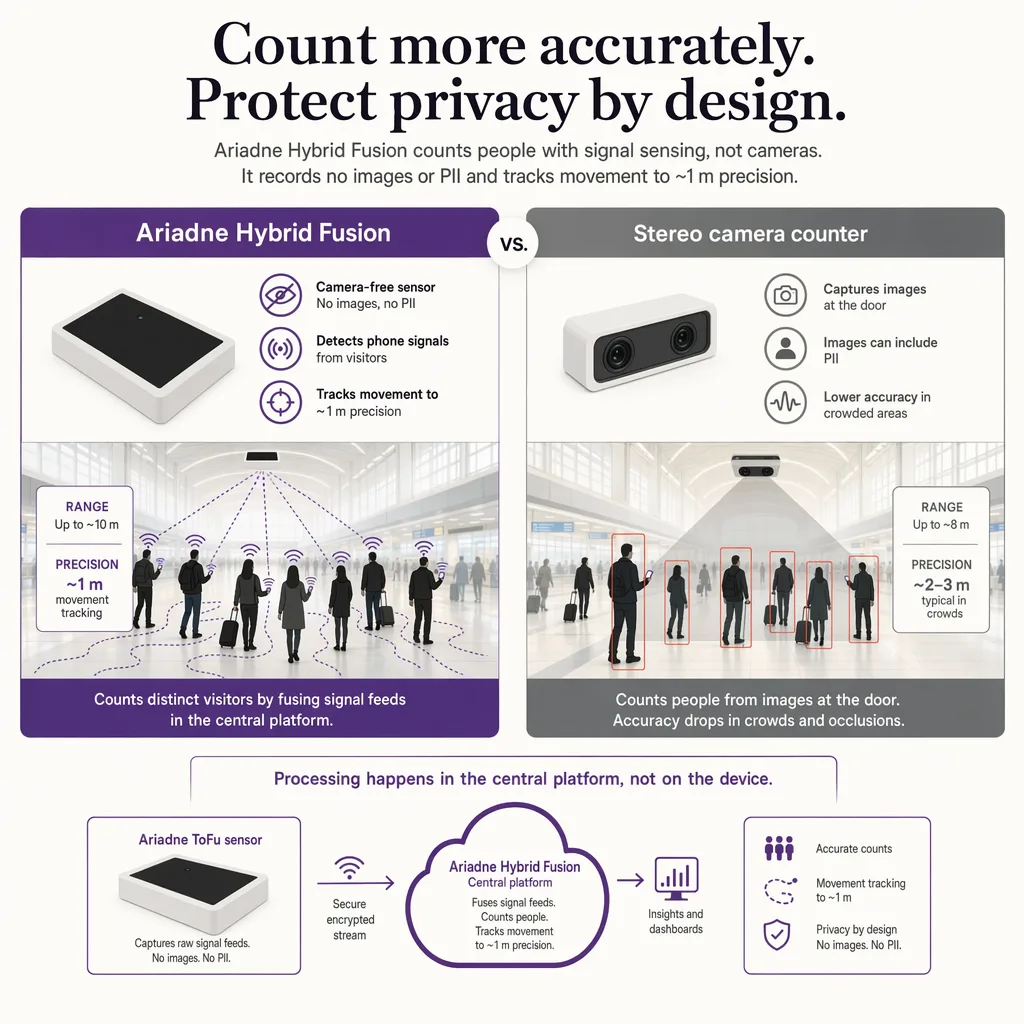
The line that most often separates a stereo-vision counter from Ariadne is not the door count itself, where both are capable, but what happens inside the space and what leaves the sensor. Ariadne fuses depth counting at the door with phone-signal sensing through the interior, so the visit is measured as a path, and it does that without a camera and without an identifier by default. For the wider field of named systems, see people counting systems compared.
Where Ariadne differs on its own terms
This contrast leans on what Ariadne does, not on a claimed Xovis shortcoming. Xovis's 3D stereo approach is a legitimate one. Ariadne's difference is that it counts without a camera and without capturing anything about the individual.
Ariadne measures this with Hybrid Fusion, its patented camera-free method. Time-of-Flight depth sensing counts every visitor at the entrances, capturing geometry rather than images, while patented phone signal sensing follows movement through the interior, detecting the signals a phone emits even in airplane mode, and tracks that movement to about one-metre precision. The sensor streams both feeds to Ariadne, where Hybrid Fusion combines them into one trajectory per visit and computes counts, dwell, and paths. The streams carry no identifier: no MAC address, no device ID, no biometric data, and no camera is involved. Identifiers are stored only when a visitor explicitly opts in, which keeps the method GDPR-friendly and outside biometric territory.
Because no images are captured and no biometric identification or categorisation takes place, there is no PII collected at the sensor to anonymise, and the method sits outside the biometric categories the EU AI Act treats as high risk. The practical effect is on your paperwork and your consultations, not just on the sensor. If the reason Xovis is being reconsidered is a preference for a method that captures nothing about the person and no image at all, that is the axis to weigh it on. Ariadne's camera-free counting sets out the approach in full.
Install and privacy questions to put in writing
Verbal assurances do not survive a procurement review. Put these in the RFP and hold every vendor to the same written answers.
- What sensor coverage does one unit give at our entrance width, and how many units does our door actually need?
- What is the required mounting height, and does it fit our ceiling and door-frame constraints?
- What exactly is recorded and transmitted per visit, and is any image, identifier, or inferred attribute captured at any point?
- What is retained, for how long, and where is it processed?
- What does a DPIA for this system have to cover, and does it involve CCTV signage or a works-council consultation?
The answers turn a marketing conversation into a comparable one. They also protect you from the two most common surprises in a counting rollout: a sensor that needs more units than the quote assumed because your entrance is wider than its coverage, and a privacy review that stalls late because nobody pinned down what the system captures until legal asked. Getting both in writing at the RFP stage, from every vendor including Xovis and Ariadne, means the comparison you sign off on is the same one you priced.
To pressure-test the whole comparison on your own site rather than on paper, run a like-for-like trial with the top two candidates at the same door. A trial does two things a datasheet cannot. It shows you the real accuracy at your busiest hour, when groups and crowding are hardest on any counter, and it forces the install questions into the open, because you find out during the pilot whether one unit covers your door or whether you need two. Run each candidate through the same window, hold both to the same manual ground-truth count, and the choice stops being a matter of which datasheet you trust.
FAQ
Is Ariadne a good alternative to Xovis?
Ariadne is a camera-free alternative that produces counts, dwell, and path data by fusing Time-of-Flight depth at the door with phone-signal sensing inside. It differs from a 3D stereo-vision sensor in method and in what it records. Whether it fits depends on your install constraints and on what you need recorded, so trial both at a representative door before deciding.
Do I need cameras to count people accurately?
No. Ariadne counts with Hybrid Fusion: Time-of-Flight depth sensing plus patented phone signal sensing, never cameras. Time-of-Flight captures geometry rather than images, and signal sensing captures no MAC address by default, so the measurement involves no video, no faces, and no biometric data.
What sensing method does Xovis use?
Per Xovis's public product documentation, Xovis builds 3D sensors that use stereo vision. Confirm the current sensor line and its exact recorded fields against its documentation for your specific deployment before drawing a final comparison.
How do I compare Xovis and Ariadne fairly?
Set one written specification, coverage, mounting height, what is recorded, retention, and five-year cost, and ask both vendors the same questions. Then install each at the same representative entrance for at least a full trading week and check both against a manual ground-truth count including peak periods.
Does a camera-free counter change my privacy paperwork versus a stereo-vision sensor?
It can. Because Ariadne captures no images and no biometric data and stores no identifier by default, there is nothing to anonymise and no footage to retain, which typically narrows what a DPIA and works-council process must cover. Confirm the exact recorded fields of any stereo-vision sensor against its documentation, then compare the two on paper with your data-protection lead.
