
A retail lease that only charged a flat rent would leave money on the table in a good year and squeeze the tenant in a bad one. Percentage rent is the mechanism that fixes both. It ties part of the landlord's income to the tenant's sales, so the rent rises when the store does well and stays modest when it does not. It is one of the oldest ideas in retail leasing, and it is also the one most directly connected to footfall, because sales do not appear from nowhere. They come from people walking in.
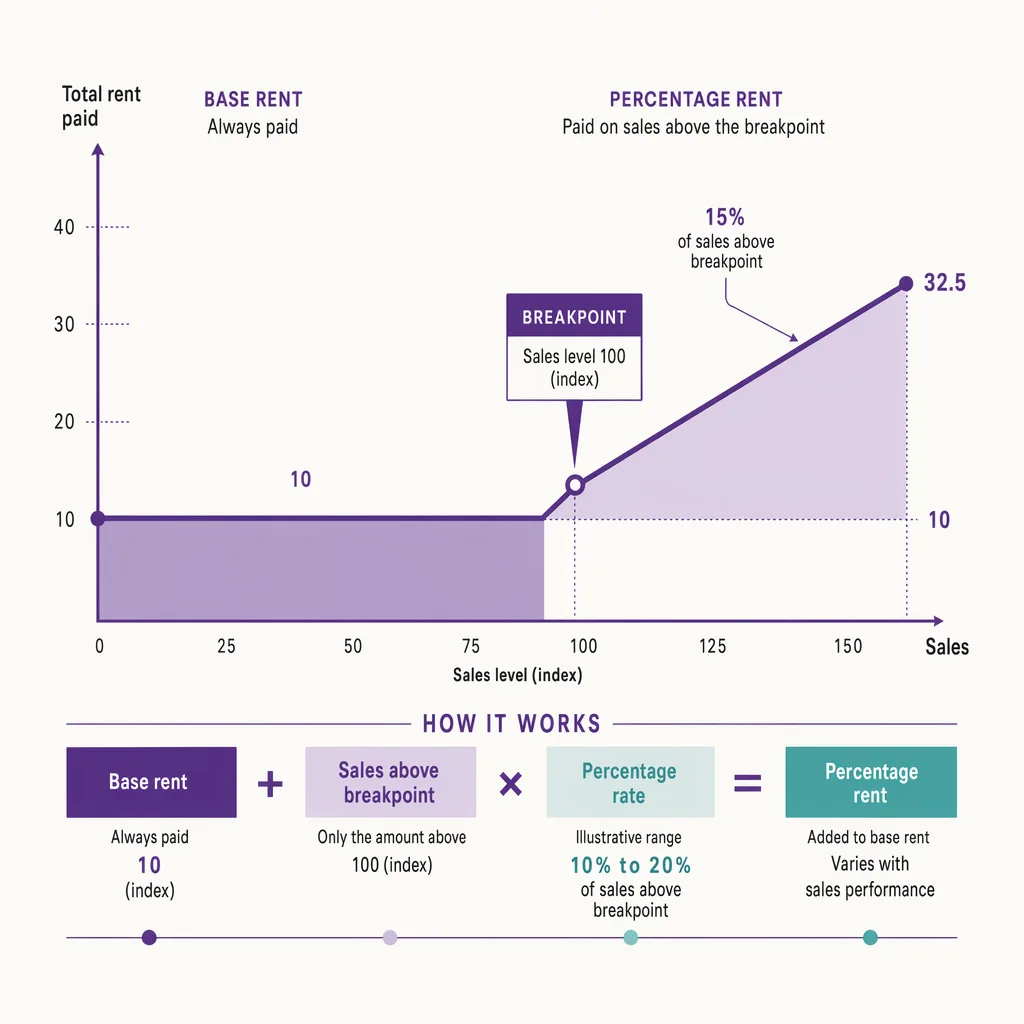
This post is about the mechanism itself: how percentage rent is calculated, what a breakpoint is, and why the traffic a center measures is the leading indicator of the overage rent a landlord will eventually collect. It sits one level down from anchor lease economics, which covers the full anchor rent picture. Here the subject is percentage rent as a standalone mechanic, and the worked example below uses round, clearly illustrative numbers so the arithmetic is easy to follow. None of the figures are a real tenant's.
What is percentage rent and how does foot traffic affect it?
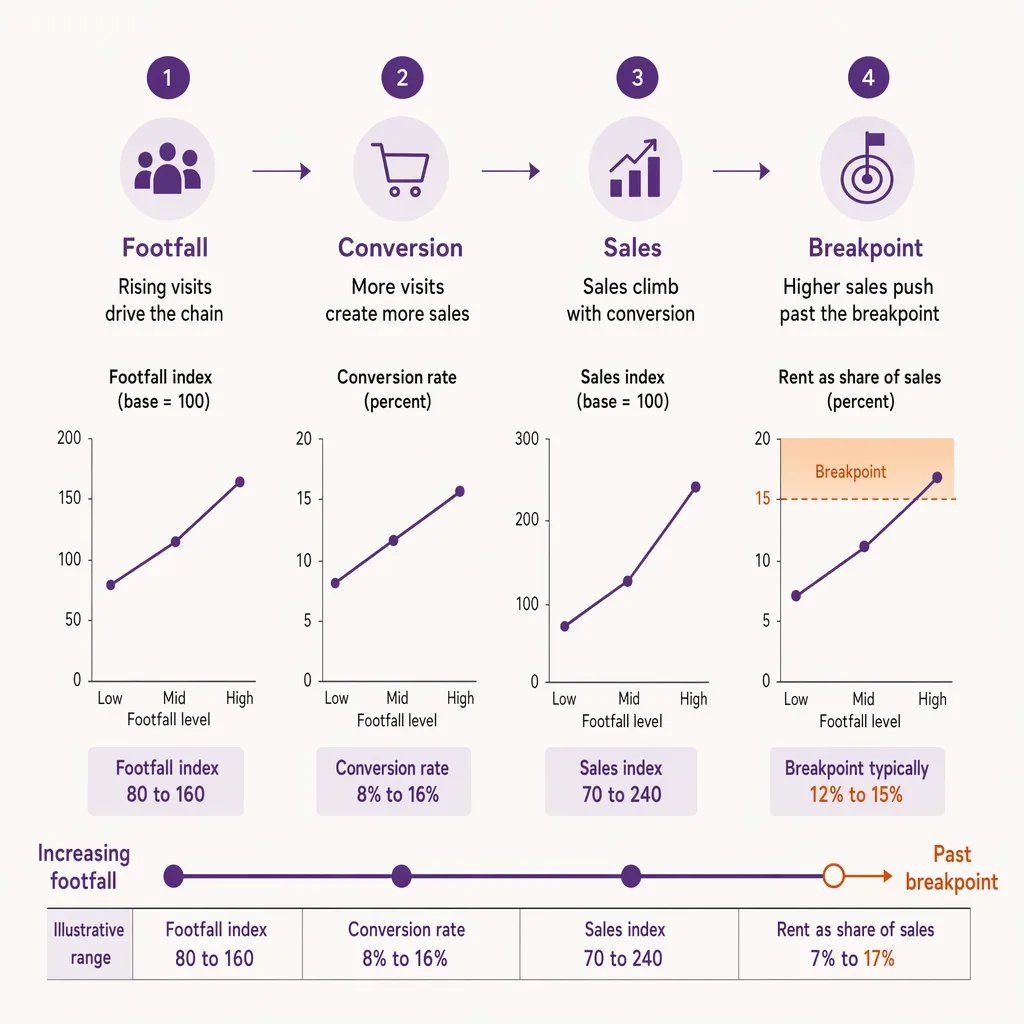
Percentage rent is additional rent a tenant pays once sales pass a set threshold called the breakpoint, on top of base rent. A common structure: base rent plus a percentage of every sales dollar above the breakpoint. Foot traffic sits one step upstream of those sales. More qualified visits, at a steady conversion rate, mean more sales, which means the tenant crosses the breakpoint sooner and the landlord earns overage rent. That is why landlords who track center footfall can forecast percentage-rent income before the sales reports arrive.
The chain is short and worth keeping in view for the rest of this post: traffic leads to sales, sales cross the breakpoint, and the amount above the breakpoint generates the overage. Footfall is the first link, and it is the one a landlord can measure directly and early. The sales reports come later, often much later, and they come from the tenant.
It helps to understand why the mechanism exists at all before working through its arithmetic. A flat rent forces one side to carry all the risk of a location's performance. Set it too high and a struggling tenant folds, leaving the landlord with a vacancy and a re-leasing cost. Set it too low and the landlord subsidizes a tenant who is thriving. Percentage rent splits the difference: a modest base rent protects the tenant in a weak year, and the overage lets the landlord share in a strong one. Both sides now have an interest in the location doing well, and both are exposed, in proportion, to how much traffic the center actually pulls. That shared exposure is what makes footfall a number both parties should care about, not just the landlord.
The mechanics: base rent, breakpoint, and the formula
Percentage rent has three moving parts.
Base rent is the fixed minimum the tenant pays regardless of sales. It covers the landlord's floor.
The breakpoint is the sales level at which percentage rent kicks in. Below it, the tenant pays only base rent. Above it, the tenant pays base rent plus a percentage of the sales above the breakpoint. That extra amount is the overage, sometimes called overage rent.
The percentage rate is the share of above-breakpoint sales the tenant owes, negotiated into the lease and varying by retail category.
There are two ways the breakpoint gets set, and the distinction is where a lot of confusion lives.
Natural versus artificial breakpoint
A natural breakpoint is derived from the base rent and the percentage rate. You divide the base rent by the percentage rate, and the result is the sales level at which the percentage of sales would exactly equal the base rent. Below that point the landlord is better off with base rent; above it, the percentage share overtakes the base. Setting the breakpoint at the natural level is the neutral, common default.
An artificial breakpoint is any breakpoint the parties negotiate to a different number, higher or lower than the natural one, usually as a lever in the wider deal. A tenant taking on a large space or a risky location might negotiate a higher breakpoint so overage starts later; a landlord with a proven high-traffic spot might push it lower. The label just means the number was set by negotiation rather than derived by formula.
A worked example (illustrative figures only)
Every number below is a round, made-up figure chosen to make the arithmetic clear. Do not read them as market rates.
Suppose a tenant signs a lease with:
- Base rent: $100,000 per year
- Percentage rate: 5 percent of sales above the breakpoint
The natural breakpoint is the base rent divided by the rate: $100,000 divided by 0.05 equals $2,000,000 in annual sales. So the tenant pays only the $100,000 base rent until sales reach $2,000,000. Every dollar of sales above that carries 5 percent overage.
Now run three sales outcomes:
- Sales of $1,800,000. Below the breakpoint. The tenant pays base rent only: $100,000. No overage.
- Sales of $2,400,000. Above the breakpoint by $400,000. Overage is 5 percent of $400,000, which is $20,000. Total rent: $120,000.
- Sales of $3,000,000. Above the breakpoint by $1,000,000. Overage is 5 percent of $1,000,000, which is $50,000. Total rent: $150,000.
The pattern is the point. Once the store clears the breakpoint, every additional dollar of sales lifts the landlord's income at the agreed rate. The landlord's upside is bolted directly to the tenant's performance, and the tenant's performance is bolted to how many people came in and bought.
Why footfall is the leading indicator of percentage-rent income
Sales are a lagging figure. A landlord usually learns a tenant's sales weeks or months after the period closes, through a reported statement. Footfall is a leading figure: it can be measured the same day, at the door, before a single sales report is filed.
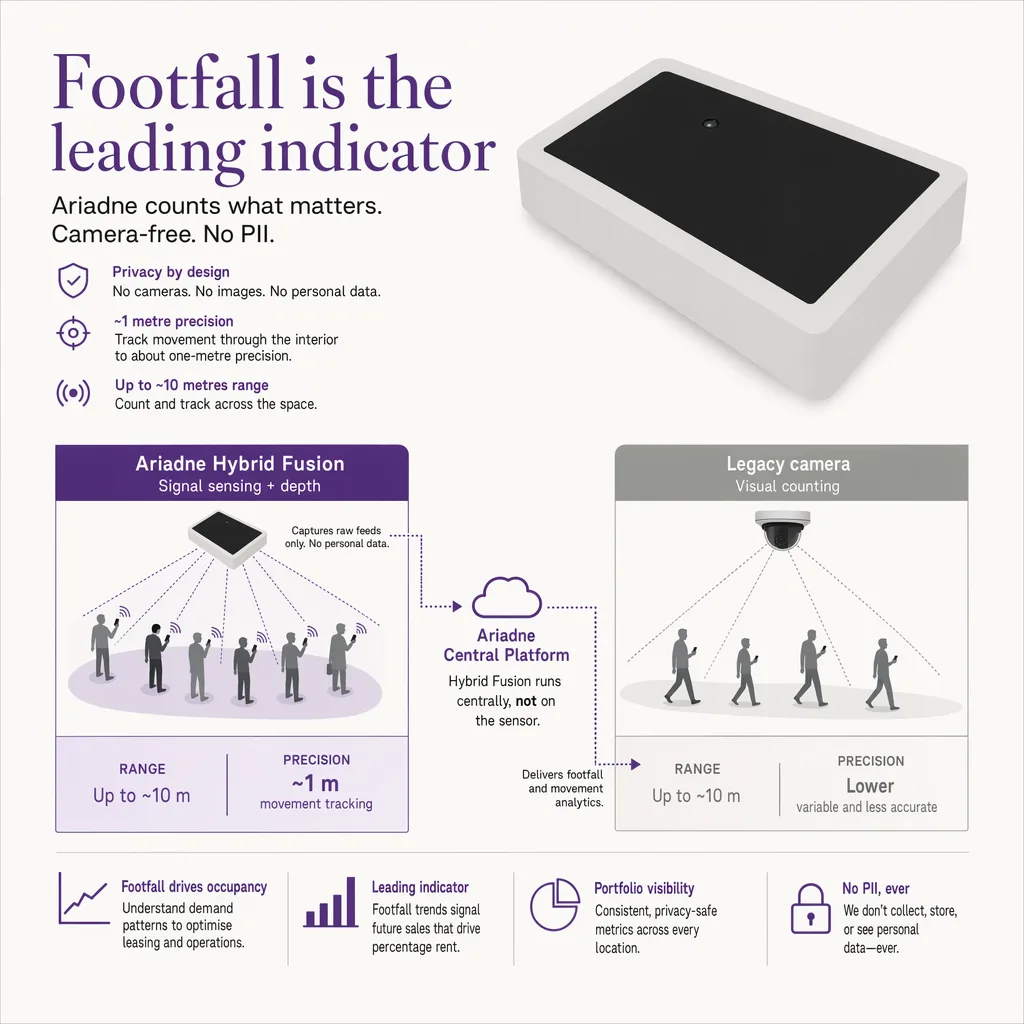
The connection runs traffic to conversion to sales to breakpoint. If footfall to a store is rising and the store's conversion rate holds steady, sales are rising too, and the tenant is moving toward or further past its breakpoint. A landlord watching center and store-level traffic can see the overage building in real time and forecast the percentage-rent line months ahead of the statements. The mechanics of that traffic-to-sales step are covered in the retail conversion rate formula; the short version is that conversion is the multiplier that turns measured visits into the sales that trigger overage.
That foresight is not a rounding-error convenience. Percentage rent can be a meaningful share of a landlord's income from a strong center, and being able to forecast it from traffic changes how the landlord budgets, when they negotiate, and how confidently they underwrite a renewal. Footfall trends also carry directly into lease negotiations, where a landlord who can show the traffic a location delivers is arguing from measured evidence rather than assertion.
What a landlord can verify with footfall versus trust in sales reports
Percentage rent creates an unusual incentive: the tenant reports the sales that determine the extra rent they owe. Most leases handle this with audit rights and certified statements, and most tenants report honestly. But the landlord is still relying on a self-reported figure for a slice of their own income, and audit rights are expensive and adversarial to exercise.
Footfall gives the landlord an independent check. It cannot replace the sales figure, and it should not try to. What it can do is flag a mismatch worth a closer look. If measured traffic to a store is climbing steadily while reported sales sit flat below the breakpoint year after year, that gap is a reasonable prompt to review, not proof of anything on its own. Conversion rates vary, a store can genuinely convert poorly, and traffic is not sales. But a landlord with no traffic data has nothing to test the report against at all. This is the same discipline that underpins tenant performance reporting: measured, independent inputs alongside the reported ones, so the numbers can be reconciled rather than simply accepted.
The honest framing is that footfall is corroborating evidence, not an audit. It narrows where a landlord looks and gives a reason to ask, which is worth a great deal when the alternative is trusting every reported figure blind.
There is a related use that has nothing to do with suspicion. Traffic data lets a landlord tell the difference between a store that is underperforming because too few people come in and one that is underperforming despite good traffic. Those two problems have opposite fixes. A store starved of footfall may be badly located within the center, poorly signed, or hurt by an anchor whose pull has faded, all of which are the landlord's problem to address. A store with healthy traffic but weak sales is converting poorly, which is the tenant's problem to fix through merchandising, staffing, or price. Without the traffic figure, a landlord looking only at flat sales cannot tell which store they are dealing with, and may push the wrong remedy. Percentage rent gives the landlord a stake in the answer, and footfall is how they find it.
Percentage rent in anchor versus inline leases
Percentage rent shows up differently depending on where in the center the tenant sits, and this is where the mechanic connects back to the anchor structure the cluster is built around.
Anchor leases often carry a high breakpoint or a low percentage rate, or sometimes no percentage rent at all, because the anchor's value to the landlord is the traffic it brings rather than the overage it pays. The landlord is effectively trading percentage-rent upside for the anchor's pull. Inline tenants are the reverse: they pay premium base rent per square foot and are far more likely to carry meaningful percentage rent, because they are the tenants monetizing the traffic the anchor delivers. The overage a landlord earns across a center is therefore concentrated in the inline units, whose sales depend on the crowd the anchor pulls in. That dependency is exactly why footfall measurement matters to the whole rent roll, not just to one lease. For the fuller picture of how those two tiers price against each other, see anchor lease economics.
How Ariadne measures center and tenant-level entries
Forecasting overage from traffic only works if the traffic number is trustworthy and clean enough to sit next to a lease. That means counting entries accurately at the center and, where the landlord wants it, at individual units, without capturing anything about the shoppers that would create a compliance problem.
Ariadne measures this with Hybrid Fusion, its patented camera-free method. Time-of-Flight depth sensing counts every visitor at the entrances, capturing geometry rather than images, while patented phone signal sensing follows movement through the interior, detecting the signals a phone emits even in airplane mode. The sensor streams both feeds to Ariadne, where Hybrid Fusion combines them into one trajectory per visit and computes counts, dwell, and paths. The streams carry no identifier: no MAC address, no device ID, no biometric data, and no camera is involved. Identifiers are stored only when a visitor explicitly opts in, which keeps the method GDPR-friendly and outside biometric territory.
For a landlord, the practical effect is that center-level and store-level entry counts arrive as the leading indicator the percentage-rent chain needs, measured directly rather than inferred from sales that show up months later. The people counting method is what produces the tenant-level entry figures a landlord would read against a rent roll.
FAQ
What is percentage rent in a retail lease?
Percentage rent is extra rent a tenant pays on top of base rent once sales pass a threshold called the breakpoint. The tenant owes an agreed percentage of every sales dollar above the breakpoint, so the landlord's income rises as the store performs. It aligns the landlord's return with the tenant's success rather than fixing it at a flat number.
What is a breakpoint in percentage rent?
The breakpoint is the sales level at which percentage rent begins. Below it, the tenant pays only base rent; above it, base rent plus a percentage of the sales above the breakpoint. A natural breakpoint is calculated by dividing base rent by the percentage rate; an artificial breakpoint is any figure the two parties negotiate instead.
How is percentage rent calculated?
Take the sales above the breakpoint and multiply by the percentage rate; that is the overage the tenant adds to base rent. In an illustrative case, a $100,000 base rent at 5 percent gives a natural breakpoint of $2,000,000. On $2,400,000 of sales, the overage is 5 percent of the $400,000 above the breakpoint, which is $20,000, for total rent of $120,000. These figures are illustrative only.
How does foot traffic affect percentage rent?
Traffic sits upstream of the sales that trigger overage. More qualified visits at a steady conversion rate mean more sales, which push the tenant past the breakpoint sooner and raise the landlord's overage. Because footfall can be measured the same day while sales reports arrive later, traffic is the leading indicator a landlord uses to forecast percentage-rent income.
Can a landlord use footfall to check a tenant's reported sales?
As corroborating evidence, yes. If measured traffic climbs while reported sales stay flat below the breakpoint, that mismatch is a reasonable prompt to review under the lease's audit rights. Footfall is not sales and cannot replace a certified statement, since conversion rates vary, but it gives a landlord an independent input to reconcile against a self-reported figure rather than trusting it blind.


