
Most explanations of shopping-center tenancy jump straight from the big anchor to the small inline shop and skip the tenant sitting between them. That middle tier has a name, and it is doing more work every year: the junior anchor. As full-line department stores close and their large boxes come back to the market, landlords increasingly refill that space not with one giant tenant but with two or three mid-size ones. Those mid-size draws are junior anchors, and they have become central to how modern centers are leased and merchandised.
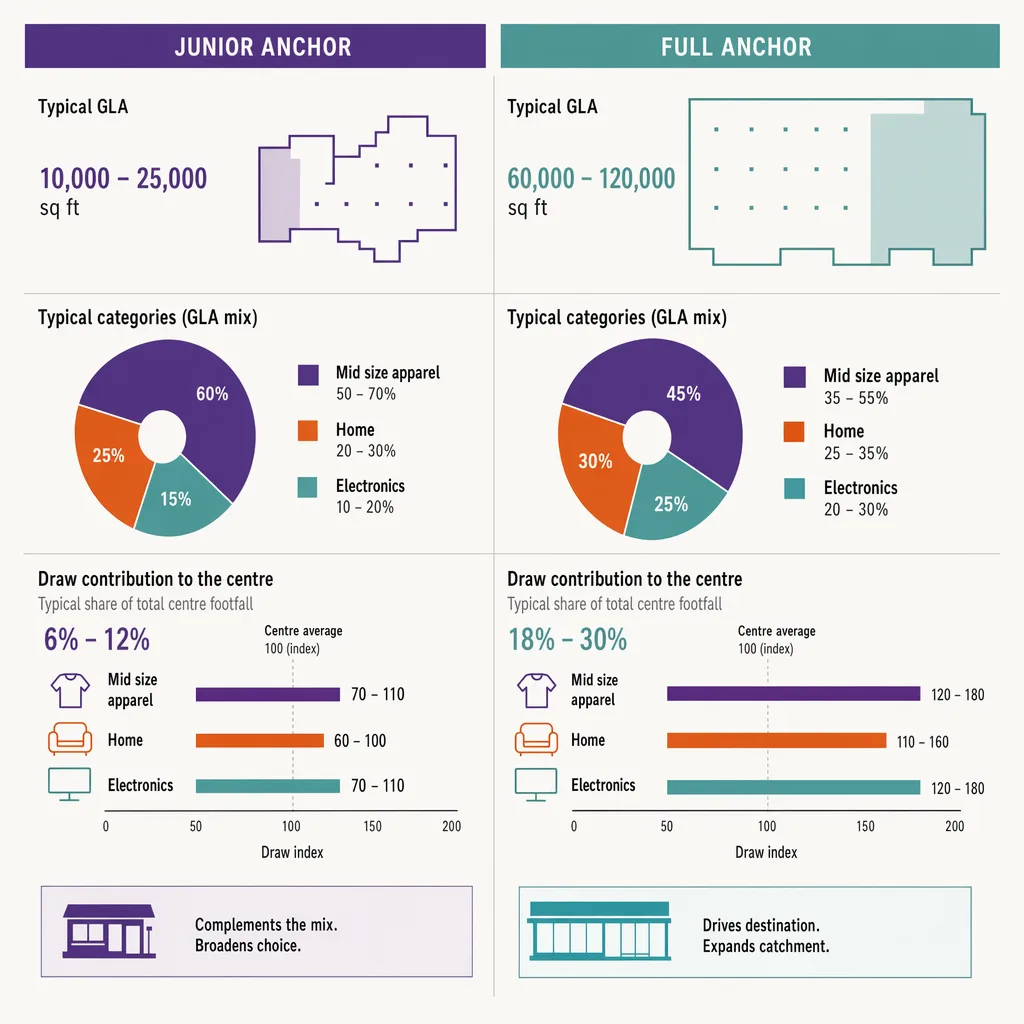
This post defines the junior anchor properly, sets out the categories that fill the role, walks the lease economics that make it attractive to a landlord, and explains why the single big anchor is giving way to a cluster of smaller ones. For the primary-anchor concept this sits beneath, see the primary anchor tenant; this post owns the tier below it.
What is a junior anchor tenant?
A junior anchor is a mid-size tenant that draws its own traffic but occupies less space than a primary anchor, typically a footprint measured in the low tens of thousands of square feet against a full-line department store's much larger box. Off-price apparel, electronics, home goods, pet, and small-format grocery commonly fill the role. Junior anchors matter more every year: as full-line department stores close, landlords carve large vacancies into two or three junior anchors that pay higher rent per square foot and pull steadier mid-market traffic.
The defining trait is self-generated draw. A junior anchor is not living on the primary anchor's crowd the way an inline shop does; it brings visitors of its own. It simply does so at a smaller scale, from a smaller box, on lease terms that sit between an anchor's and an inline tenant's. Those three facts, own draw, mid-size box, in-between lease, are the whole concept.
Junior anchor vs primary anchor vs inline: where it sits in the hierarchy
A shopping center's tenant mix runs on a hierarchy of who brings traffic and who lives on it. The primary anchor is the largest draw, occupies the most space, and often pays little or no base rent precisely because its job is to pull the crowd. At the other end, inline tenants are the small shops along the corridor: they pay the highest rent per square foot and depend heavily on the traffic the anchors bring.
The junior anchor sits deliberately in between. It brings meaningful traffic, so it is not merely riding the primary anchor's coattails, but it is not the single dominant draw either. On rent per square foot it typically pays more than a primary anchor and less than a small inline unit, reflecting that in-between draw. On space it is far larger than an inline shop and well below a full-line department store. Understanding that a center now often has several such tenants, rather than one big anchor and a row of small shops, is the key shift, and it is the reason the anchor versus inline tenant distinction alone no longer describes a modern center. (A dedicated anchor-vs-inline comparison is planned as a sibling post; until it ships, the pillar covers the two ends of the hierarchy.)
Typical junior anchor categories and size
The categories that fill the junior-anchor role share a common profile: enough brand pull to draw a dedicated visit, enough range to fill a mid-size box, and a price or format that suits value-conscious mid-market shoppers. The recurring ones:
- Off-price and discount apparel. The dominant junior-anchor category in many centers. These retailers thrive on the exact traffic a struggling full-line department store used to hold, and they actively want mid-size boxes.
- Electronics and appliances. Large-format electronics stores draw their own destination visits and fit a junior footprint well.
- Home goods and home furnishings. Homeware formats pull planned, purpose-driven trips and suit a mid-size box.
- Pet supply. A category that has grown into a reliable mid-size destination in its own right.
- Small-format and specialty grocery. Compact grocery or specialty food formats can anchor at junior scale, bringing frequent repeat traffic without a full hypermarket footprint.
What ties these categories together is a specific commercial profile. Each one has consolidated its category enough to be a recognized destination, so a shopper will make a trip specifically for it rather than discovering it in passing. Each one operates comfortably in a mid-size box, which is precisely the size problem landlords face when a department store leaves. And each one has been expanding, or at least holding steady, through a period when full-line department stores contracted. That last point is the quiet reason junior anchors exist as a category: they are the retailers with both the appetite for space and the traffic to justify it at exactly the moment the old anchors are giving space back.
On size, a junior anchor's box sits well below a full-line department store and well above an inline unit. Real-estate practitioners describe the range in broad market bands rather than a fixed figure, and the exact numbers vary by country and center type, so treat any single square-footage claim as a typical-market range rather than a hard standard. What is consistent is the ratio to its neighbors: a junior anchor is several times the size of the shops beside it and a fraction of the box a primary anchor holds. That in-between footprint is not incidental. It is the whole point of the tier, because it is the size the market can actually fill when a larger box comes back.
Lease economics: rent per square foot, term, and co-tenancy exposure
The lease is where the junior anchor's appeal to a landlord becomes clear. A primary anchor's deal is built around the traffic it brings: long term, large box, low base rent, sometimes near zero, in exchange for being the draw. A junior anchor pays more base rent per square foot than that, because it takes less space and is presumed to lean partly on the center's overall draw, yet less per square foot than a small inline shop. Term length usually sits between the two as well: longer than a fashion boutique's short lease, shorter than a department store's multi-decade commitment.
That middle position is exactly why subdividing a vacant anchor into junior anchors can improve a landlord's economics. Two or three junior anchors paying a higher blended rent per square foot can out-earn a single low-base-rent department store on the same square footage, provided they collectively pull comparable traffic. The trade-off is diversification of risk: losing one of three junior anchors hurts less than losing the single anchor the whole center was built around. For how anchor rent and percentage structures work in more depth, see anchor lease economics.
The subdivision is not free, and the economics only work if the traffic assumption holds. Carving one large box into two or three smaller ones costs capital: new entrances, demised walls, separate services, and often a period of no rent at all while the work is done. A landlord underwrites that spend against the higher blended rent the junior anchors will pay, which means the case rests on those tenants actually generating the visits they are presumed to bring. If they turn out to lean on the center's existing draw rather than adding to it, the higher rent per square foot is being charged for traffic that was already there, and the return on the conversion evaporates. That is why the traffic question, addressed at the end of this post, is not a soft metric but the load-bearing assumption under the whole strategy.
Co-tenancy is the piece that ties the junior anchor back to the rest of the center. Inline leases frequently carry co-tenancy clauses that let a tenant reduce rent or exit if a named anchor goes dark. As centers shift from one primary anchor to several junior ones, the drafting of those clauses gets more intricate: does the clause trigger on the loss of any junior anchor, a set number of them, or only the primary anchor if one remains. Getting that wording right is central to protecting the center's income, and it is a subject in itself; see co-tenancy exposure for how those clauses are structured and where they bite.
Why junior anchors are replacing the single big anchor
The rise of the junior anchor is not a fashion; it is a response to a structural problem. When a full-line department store closes, a landlord is left with a very large box and a very short list of tenants able and willing to take all of it. Another department store is rarely the answer, because the category that filled those boxes has been contracting across 2020 to 2025.
Subdividing solves several problems at once. It matches supply to demand: the retailers that are expanding, off-price apparel, home goods, specialty grocery, want mid-size boxes, not 120,000 square feet. It lifts rent per square foot, because those tenants pay more than a department store's near-zero base rent. And it spreads risk across several draws instead of betting the center on one. The mechanics of taking a stranded anchor box and refilling it, whether with one tenant or several, is its own discipline; see backfilling a vacant anchor for the full playbook.
There is a merchandising benefit alongside the financial one. A single department store offered one brand, one buying philosophy, one reason to visit. Three junior anchors offer three, and if they are chosen to complement rather than compete, off-price apparel next to home goods next to a specialty grocer, the cluster gives a shopper more reasons to come and more reasons to stay once there. The center stops depending on a single tenant's fortunes and starts behaving like a small portfolio of draws, which is more resilient by construction. When one category has a weak season, the others carry the traffic.
The result is a center that looks structurally different from the one the classic anchor model describes: multiple mid-size draws sharing the traffic-generating job that a single department store used to hold alone. That is the junior anchor's moment, and it is why the term is worth understanding rather than treating as a footnote to "anchor tenant."
Measuring whether a junior anchor earns its draw
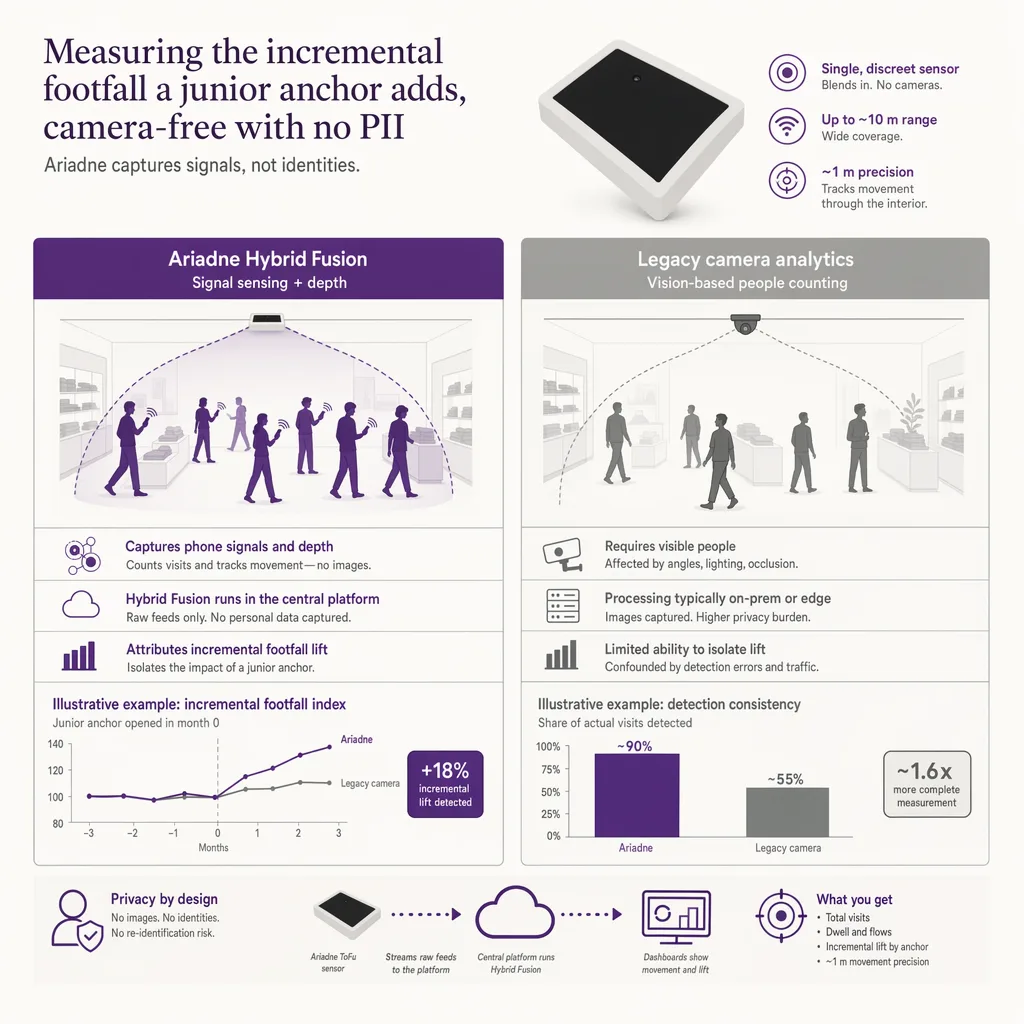
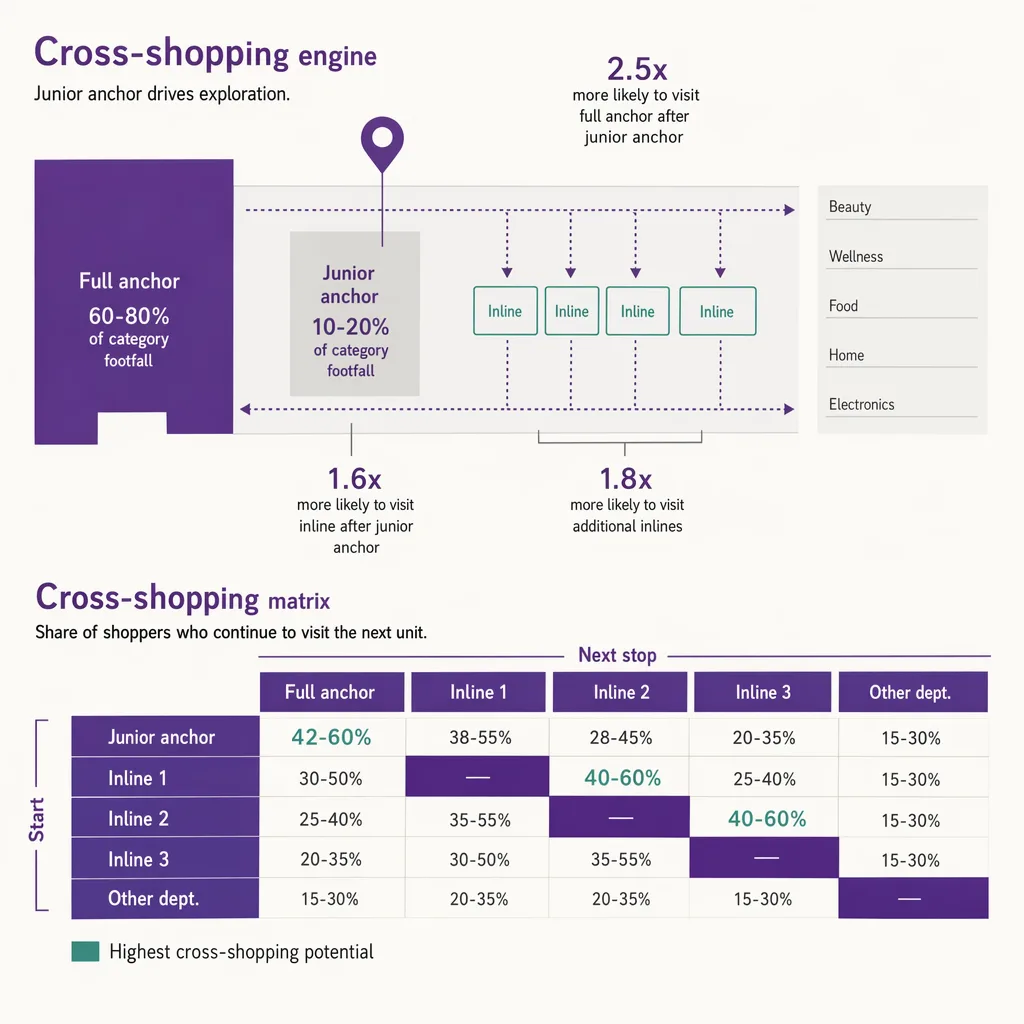
A junior anchor's whole premise is that it brings its own traffic. That premise is testable, and testing it matters more when a center relies on several junior anchors instead of one primary anchor whose pull is taken for granted. The question for each one is the same: how many visits does this tenant generate at its own door, and how much of that flow spills over to the inline shops around it.
Answering it needs consistent measurement, not impressions. A tenant that looks busy at midday on a weekend may contribute little to the center's overall draw once you compare entries across the full week and see how much traffic reaches the rest of the center. For a landlord deciding whether a subdivision into junior anchors actually improved the center, that spillover figure is the evidence that either justifies the strategy or exposes a junior anchor that is quietly living on the center rather than feeding it.
Ariadne measures this with Hybrid Fusion, its patented camera-free method. Time-of-Flight depth sensing counts every visitor at the entrances, capturing geometry rather than images, while patented phone signal sensing follows movement through the interior, detecting the signals a phone emits even in airplane mode. The sensor streams both feeds to Ariadne, where Hybrid Fusion combines them into one trajectory per visit and computes counts, dwell, and paths. The streams carry no identifier: no MAC address, no device ID, no biometric data, and no camera is involved. Identifiers are stored only when a visitor explicitly opts in, which keeps the method GDPR-friendly and outside biometric territory.
For a landlord running the multi-junior-anchor model, that produces the number the strategy stands or falls on: entries at each junior anchor and the traffic that reaches the tenants around it. See shopping center footfall analytics for how that measurement supports leasing and mix decisions across a whole center.
FAQ
What is a junior anchor tenant?
A junior anchor is a mid-size tenant that draws its own traffic but occupies less space than a primary anchor, commonly off-price apparel, electronics, home goods, pet, or small-format grocery. It sits between the primary anchor and the small inline shops in both size and rent per square foot.
What is the difference between a junior anchor and a primary anchor?
A primary anchor is the center's single largest draw, occupies the most space, and often pays little or no base rent. A junior anchor is smaller, brings meaningful but not dominant traffic, and pays more rent per square foot than a primary anchor while paying less than a small inline unit.
How big is a junior anchor tenant?
Its box sits well below a full-line department store and well above an inline shop, usually described in broad market bands rather than a fixed figure. The exact range varies by country and center type, so treat any single square-footage claim as typical-market rather than a standard.
Why are junior anchors replacing big department-store anchors?
When a full-line department store closes, landlords rarely find another to fill the large box. Subdividing it into two or three junior anchors matches the retailers that are actually expanding, lifts rent per square foot, and spreads risk across several draws instead of one.
Do junior anchors trigger co-tenancy clauses?
They can, depending on how the clause is drafted. As centers move from one primary anchor to several junior ones, co-tenancy wording gets more detailed about whether losing any junior anchor, a set number of them, or only the primary anchor lets an inline tenant cut rent or leave.


