
One trick, applied everywhere
Every Time of Flight application is the same trick wearing different clothes: measure distance fast, without contact, without capturing an image. The trick is cheap enough for a phone and reliable enough for a factory floor, which is why the application list keeps growing. Here is where the technology actually earns its keep today, and what each use case demands from the sensor.
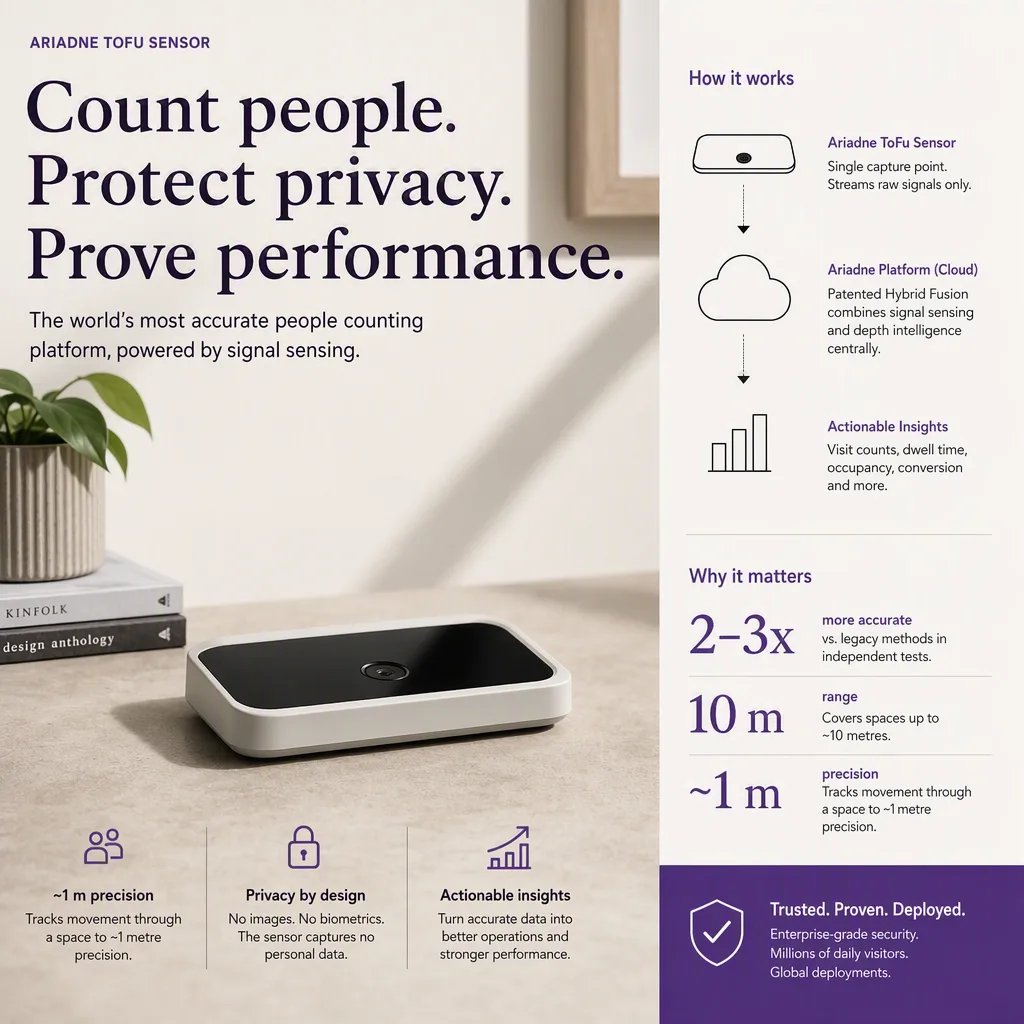
What are Time of Flight sensors used for?
In consumer devices: camera autofocus assistance, portrait depth effects, augmented reality scene mapping, and presence detection. In industry: box dimensioning, fill-level measurement, robotic obstacle avoidance, and safety zones around machinery. In buildings and public space: people counting, queue measurement, and occupancy sensing. The common thread is fast geometric measurement with no photograph involved.
Consumer devices: the volume driver
Phones adopted ToF for autofocus assist and depth-aware photography, and that volume is what pushed component prices down for every other industry. Presence detection followed: laptops that wake when you sit down and lock when you leave are running tiny single-zone ToF modules. Augmented reality leans on the same sensors to anchor virtual objects against real geometry.
Robotics and logistics: the near-field workhorse
A robot crossing a warehouse needs to know what is within a few meters, in all light, updated many times per second, and it does not need photographic detail to avoid a pallet. That is the ToF sweet spot. The same holds for dimensioning: parcel hubs measure box volumes in motion with overhead depth sensors, and warehouse systems read pallet fill the same way. Where ranges stretch to whole yards and streets, scanning systems take over; that boundary is mapped in Time of Flight vs LiDAR.
Industrial measurement and safety
Level sensing in tanks and silos, presence verification on production lines, and protective zones around moving machinery all run on ranging sensors, with ToF competing against ultrasonic and radar depending on the medium and the optics of the environment. The honest division of labor with sound-based sensing is covered in ToF vs ultrasonic.
Buildings, retail, and public space
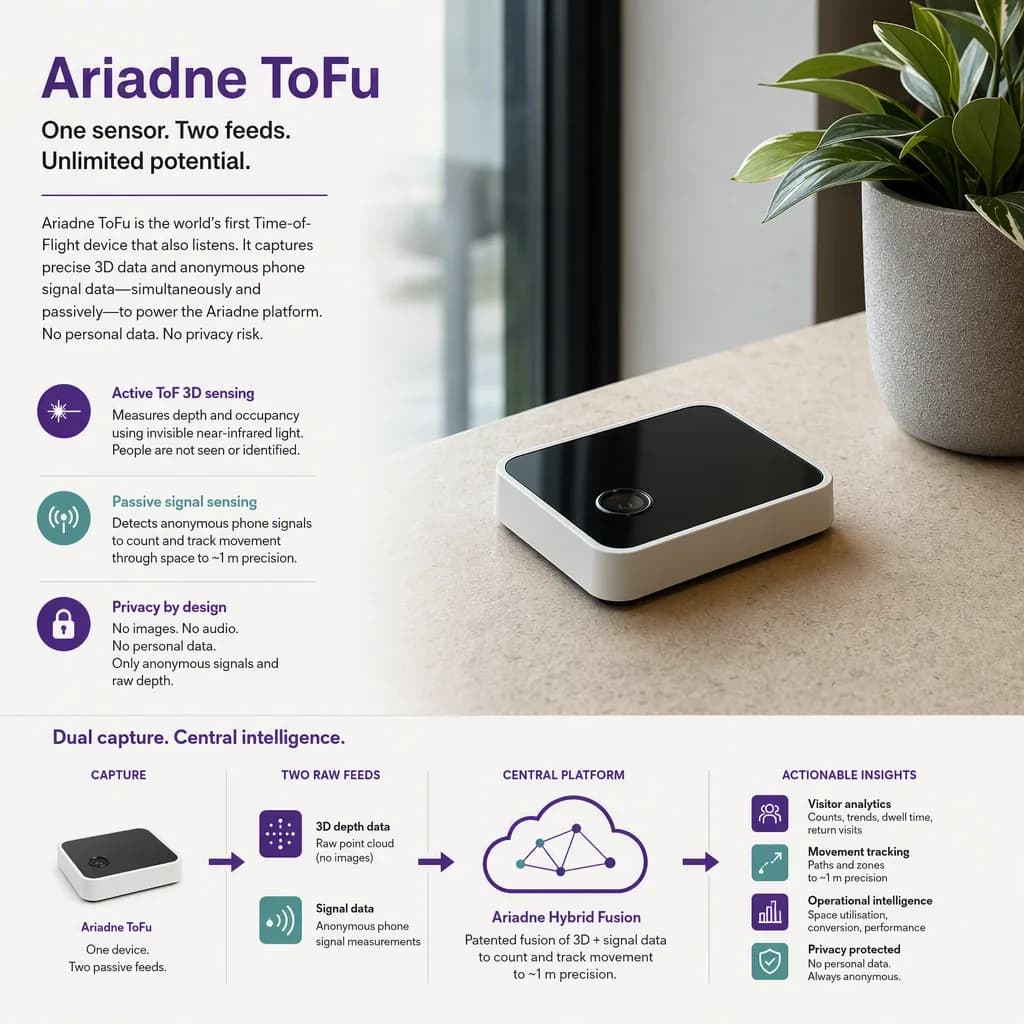
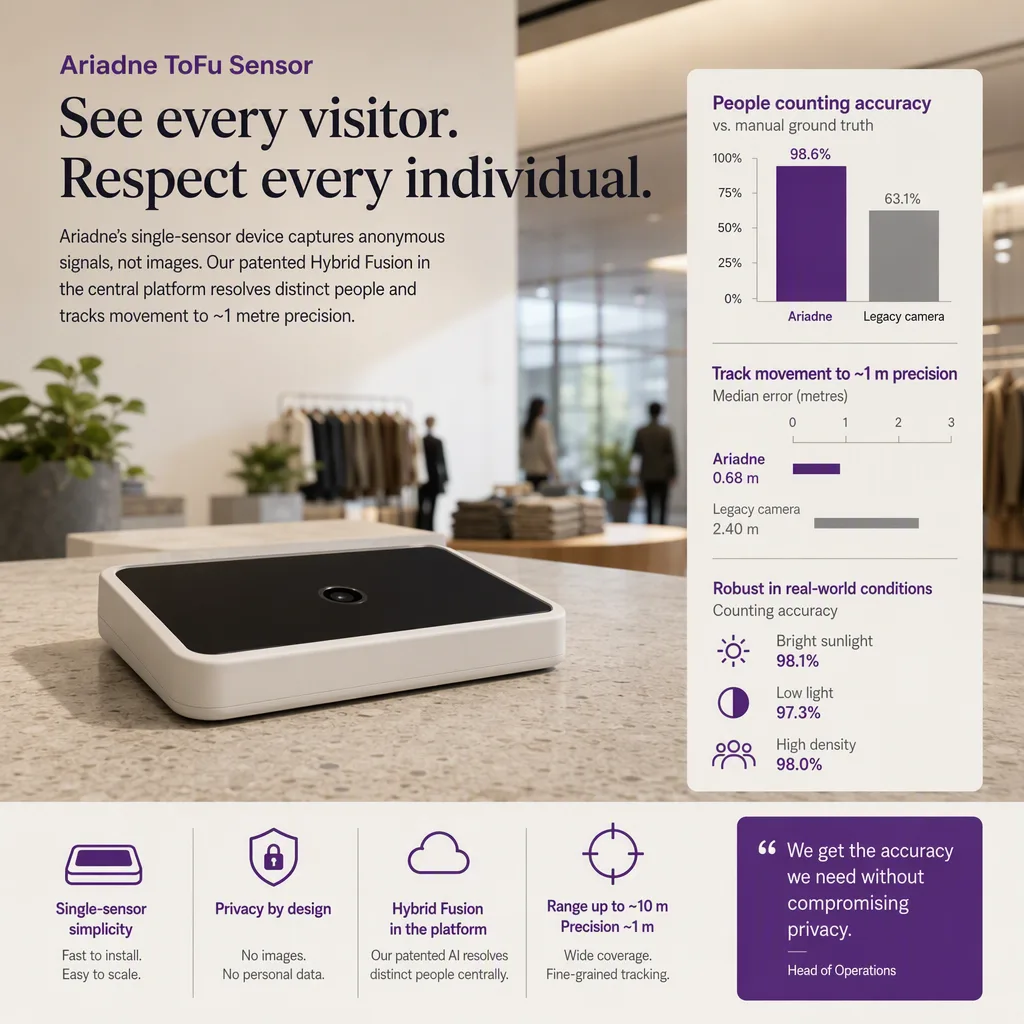
Overhead depth sensors count people at entrances, measure queues, and read room occupancy, and they do it without producing anything a privacy assessment would call an image. This is the application Ariadne lives in: ToF depth sensing at the doors as one half of a camera-free measurement method, with phone signal sensing covering the interior journey and the platform fusing both. The buyer's view of this category is the ToF people counter guide; the measurement-privacy angle is covered in people counting without cameras.
What every application shares
Reading the list back, the pattern is consistent: ToF wins wherever the question is geometric (how far, how big, how many, which way), the range is short to medium, and capturing appearance would be either useless or actively unwanted. When an application needs identity, color, or texture, it reaches for a camera and inherits everything that comes with one. When it needs geometry, ToF delivers it at sensor prices. The mechanics behind the whole family are in the pillar explainer.
---


