
Datasheet numbers meet the real world
Every Time of Flight sensor ships with two headline figures: how far it can measure and how precisely. Both are true in the conditions they were measured in. Neither transfers automatically to your doorway, your warehouse, or your robot. This post explains what moves the numbers, so you can read a datasheet as a starting point instead of a promise.
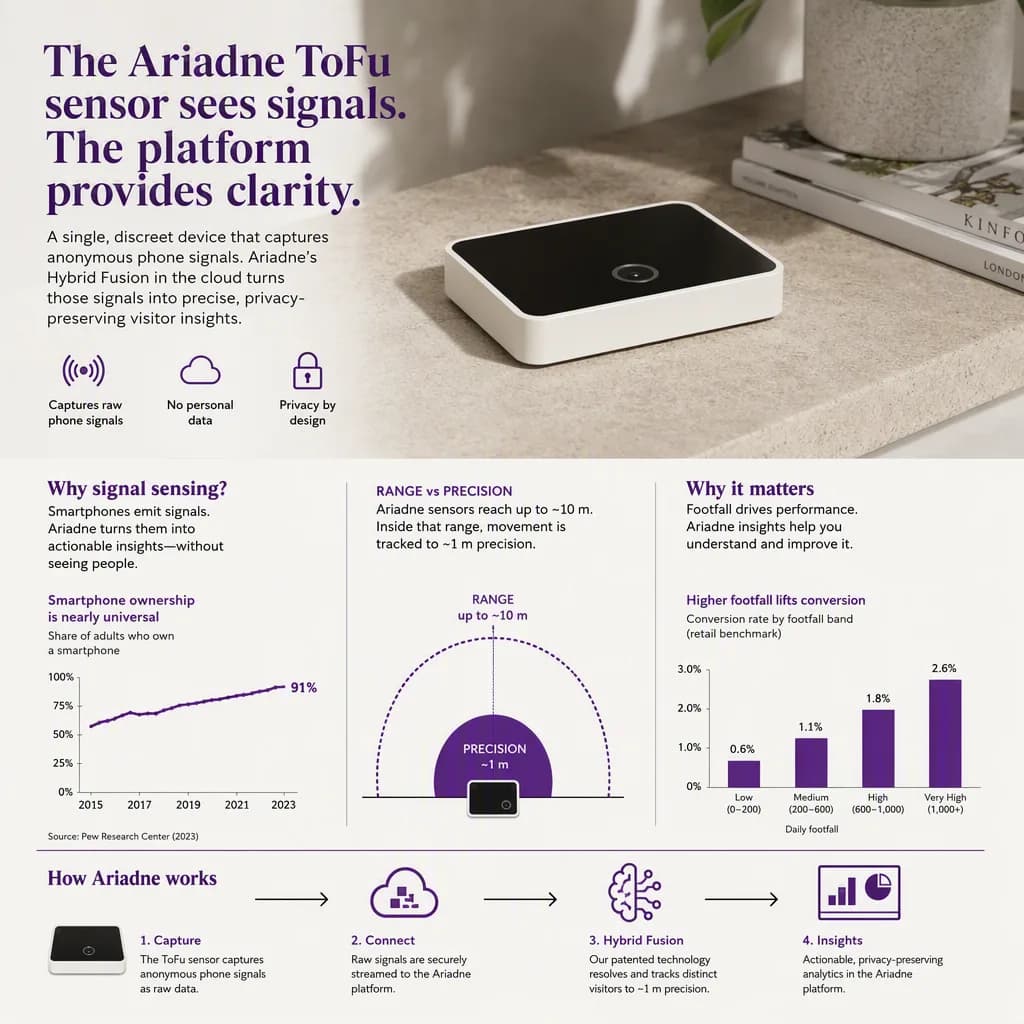
What accuracy can a ToF sensor achieve?
It depends on the measurement class. Single-point ranging modules in consumer devices typically resolve distances at millimeter-to-centimeter precision over short ranges. Depth cameras used for scene understanding and people counting typically work at centimeter scale across a few meters, which is far finer than the task needs: separating two people walking side by side requires resolving tens of centimeters, not millimeters. The honest question is never "what is the best accuracy this sensor has achieved" but "what accuracy does it hold in my geometry, my lighting, and my traffic".
The five factors that move accuracy on site
- Distance and signal strength. The farther the target, the weaker the return and the noisier each measurement. Every ToF device has a range inside which its precision holds and a tail where it degrades; the datasheet's accuracy figure applies to the former.
- Target reflectivity. Dark clothing returns less infrared light than light clothing; a matte black surface can return very little. Good sensors compensate, but reflectivity is one reason identical setups measure slightly differently.
- Ambient light. Sunlight carries infrared and raises the noise floor. Indoors this rarely matters; near glass frontage or outdoors it does. The mechanics are in ToF in sunlight.
- Multipath and geometry. Light that bounces twice before returning reports a distance that is too long. Corners, shiny floors, and cluttered scenes produce it; the indirect-ToF family is more susceptible than direct (the dToF vs iToF split).
- Temperature and calibration. Emitters and detectors drift with temperature. Factory calibration handles the normal envelope; installations next to heat sources deserve attention.
Range in practice: mounting height is the real spec
For overhead counting, the range question collapses into a simpler one: how high can the sensor mount and still resolve people cleanly below? Compact counting sensors are engineered for ceiling heights measured in single-digit meters; Ariadne's own ToF sensor, for instance, is specified for mounting heights up to 3 meters. Higher ceilings need either different optics or a different mounting plan, which is a question to settle in the site survey, not after installation.
How to verify instead of trust
Accuracy claims are checkable, and checking is cheap compared to relying on a wrong number. The method is the same regardless of vendor: run the sensor against a manual ground-truth count on your own site, across your real traffic patterns, and compare. The procedure is written up in how to test a people counter's accuracy, and the broader list of things that quietly pull accuracy down lives in people counting accuracy factors.
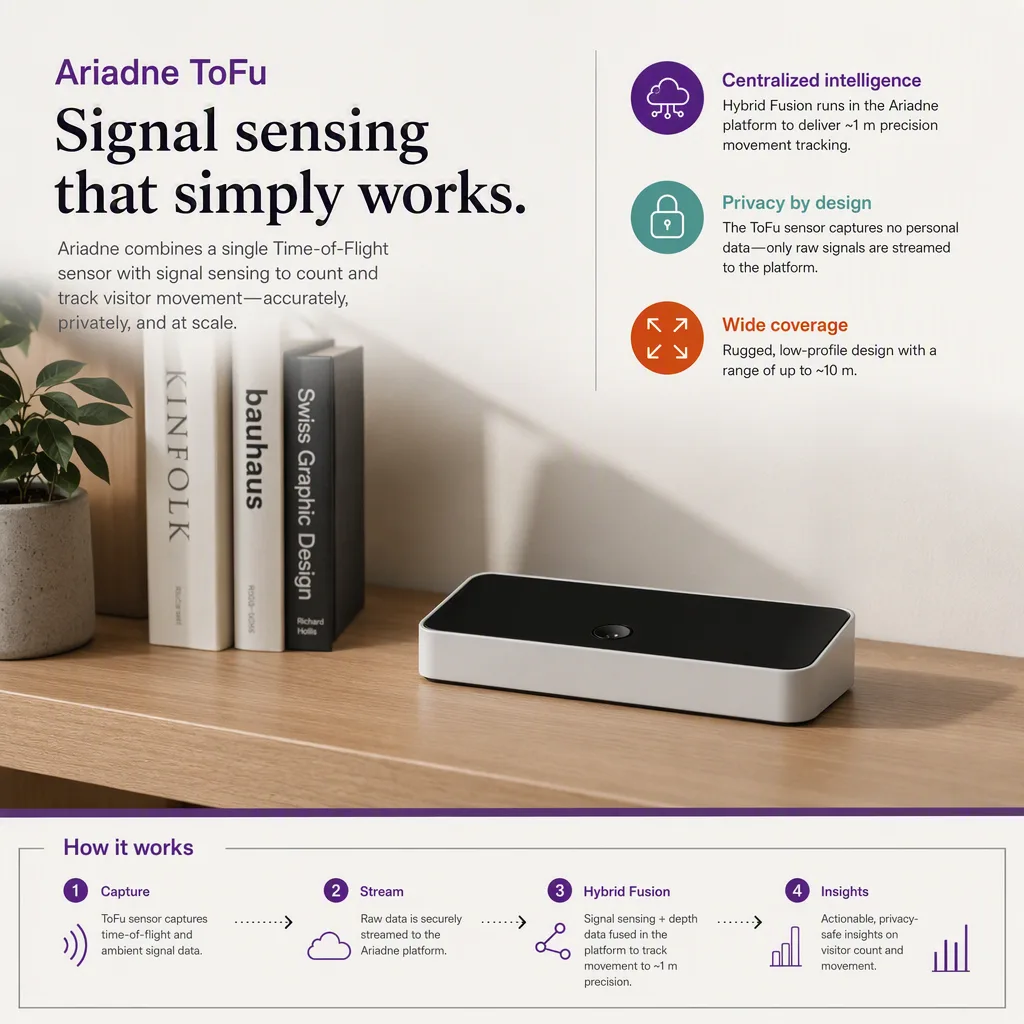
For the fundamentals behind all of this, the pillar is Time of Flight sensors, explained. And if the project behind the question is a counting deployment, Ariadne pairs ToF depth sensing at the door with phone signal sensing in the interior, fused centrally, so the entrance count is verified geometry rather than an estimate.

---


